Brazil Accepted R$598m of Pix Fraud. 16% Came Back.
In April 2026, Brazilian banks accepted that R$598.3 million of Pix payments were fraudulent. Of that money, 16.23% went back to the people who lost it. That is the best month of the five the Banco Central do Brasil currently publishes; in December 2025 the figure was 9.60%.
September 4th, 2026
Last updated: September 4
Key takeaways
- Brazil's central bank publishes monthly Pix fraud outcomes, including how much disputed money is actually returned.
- In April 2026, R$598.3 million of Pix payments were accepted as fraud and 16.23% of that value was returned.
- Banks rejected 2,677,235 of 2,960,267 fraud disputes that month, or 90.4%.
- The largest single outcome is insufficient balance: R$309.2 million, 51.7% of the accepted value.
- By value, 98.0% of precautionary blocks were released to the recipient rather than returned to the payer.
- April 2026 is the most recent month published, 127 days before this reading.
Data highlight
16.23per cent of accepted fraud value returned
Share of the value of Pix payments accepted as fraudulent that was returned to the payer
April 2026
Read by HaiPay on 4 September 2026 from the Banco Central do Brasil open data service at olinda.bcb.gov.br, function EstatisticasFraudesPix with the Database parameter set to 202512, which is the current release and contains five months from December 2025 to April 2026. For April 2026 the dataset reports 2,960,267 Pix payments disputed as fraud, of which 283,032 disputes were accepted and the remainder rejected, giving an accepted share of 9.6 per cent, and 4.236 accepted disputes per 100,000 payments. The value of the accepted disputes was 598,296,361.01 reais. The Bank's own PercentualdeDevolucao field for that month is 16.23. Of that value, 74,637,679.31 reais or 12.5 per cent was returned in full and 22,446,049.84 reais or 3.8 per cent in part, both through the special refund mechanism; 309,177,784.99 reais or 51.7 per cent was not returned because the receiving account had insufficient balance, 12,784,586.62 reais or 2.1 per cent because the account was closed, 29,277,746.60 reais or 4.9 per cent for other reasons, and 149,972,513.65 reais or 25.1 per cent is recorded as residual value not returned. Those six components sum to 100.0 per cent of the accepted value; the percentages are HaiPay's calculation from the Bank's absolute figures, while the 16.23 figure is the Bank's own. In the same month 498,417 payments worth 5,485,194,736 reais were blocked as a precaution and released, and 201,040 payments worth 111,441,791 reais were blocked and returned, so 98.0 per cent of blocked value was released. The dataset records bank-reported disputes and outcomes and is not a count of all fraud in Brazil; payments never disputed do not appear. April 2026 is the most recent month published, 127 days before this reading.
In April 2026, Brazilian banks accepted that R$598.3 million of Pix payments were fraudulent. Of that money, 16.23% went back to the people who lost it.
That is the best month of the five the Banco Central do Brasil currently publishes. In December 2025 the figure was 9.60%.
Almost nobody publishes this
Central banks publish payment volumes. Very few publish what happens after a customer says a payment was fraud, and fewer still publish the outcome broken down by why the money did not come back.
Brazil does, in an open dataset called EstatisticasFraudesPix, reachable without a key from the Bank's Olinda API. It carries, month by month, the number of Pix payments disputed as fraud, how many disputes were accepted and rejected, the value at stake, how much was returned in full and in part through the special refund mechanism known as the MED, and the reason the rest was not returned.
HaiPay pulled the current release on 4 September. It contains five months, December 2025 to April 2026. April is therefore the freshest fraud outcome data Brazil publishes, and it is 127 days old.
Nine disputes in ten are rejected
Start with the funnel, because the headline number sits at the bottom of it.
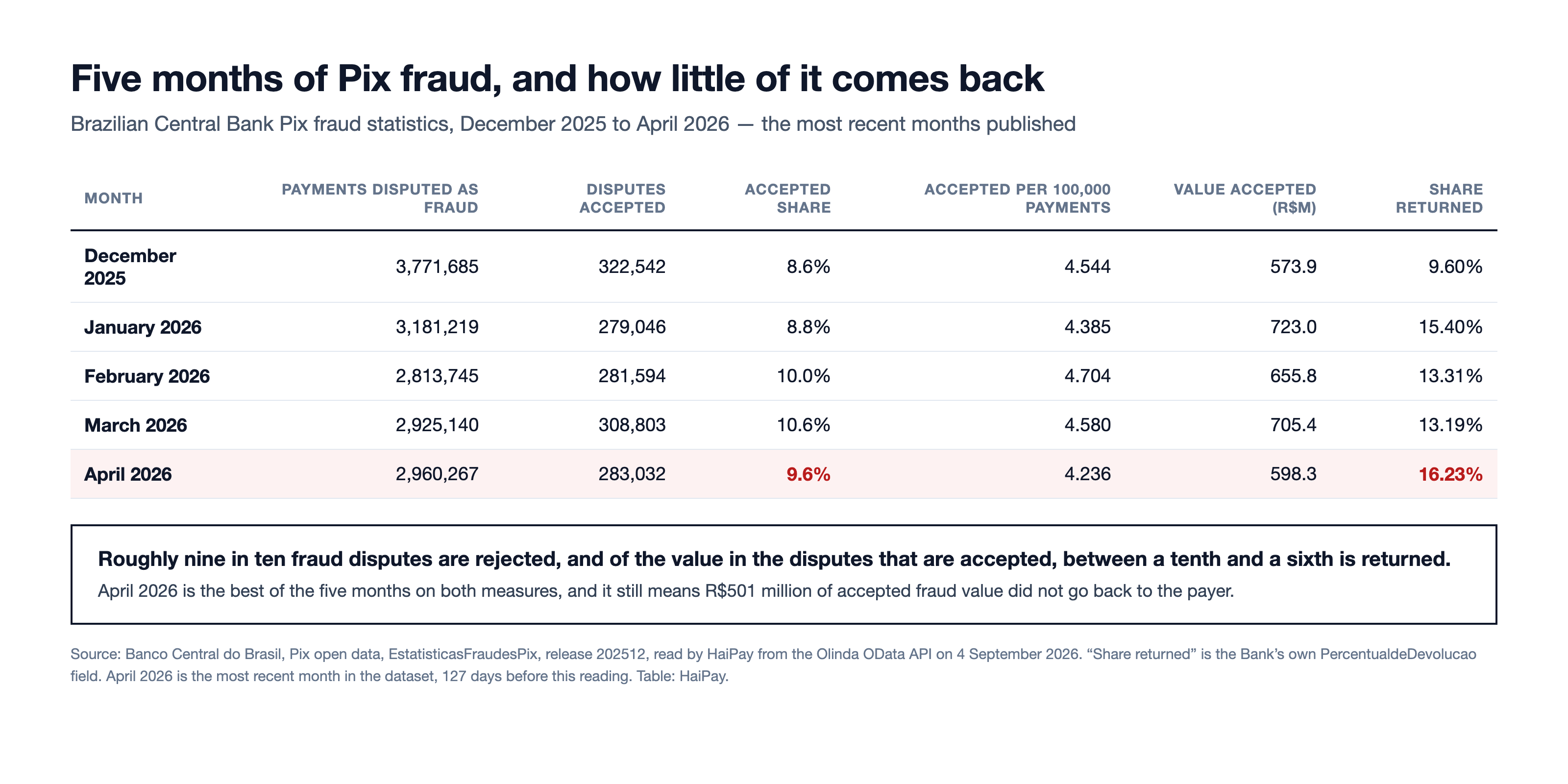
In April, 2,960,267 Pix payments were disputed as fraud. Banks accepted 283,032 of them and rejected 2,677,235 — 90.4% rejected. The accepted rate has moved between 8.6% and 10.6% across the five months without a clear direction.
The Bank also publishes accepted disputes per 100,000 payments, which controls for Pix's own growth. That figure was 4.236 in April, 4.704 in February, and 4.544 in December. On that basis the rate of accepted fraud is broadly flat, not rising.
What matters commercially is what happens to the value inside the accepted disputes, and that is where the dataset earns its keep.
More than half the money is simply gone
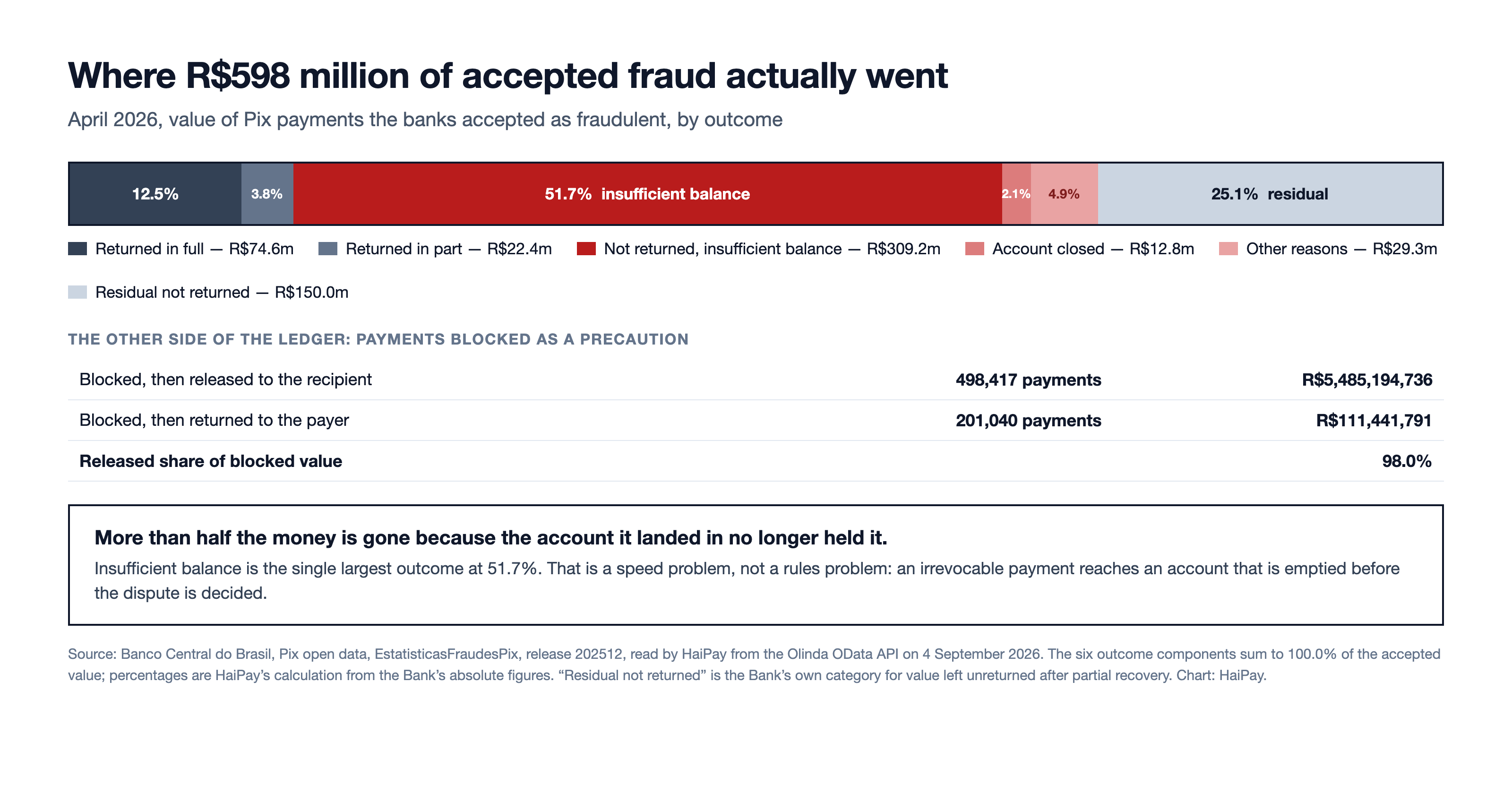
Of April's R$598.3 million of accepted fraud, R$74.6 million came back in full, 12.5%, and R$22.4 million came back in part, another 3.8%. Together that is the 16.23% the Bank reports.
The remainder breaks down by reason, and one reason dominates. R$309.2 million, 51.7% of the accepted value, was not returned because the receiving account had insufficient balance. R$12.8 million more, 2.1%, because the account had been closed. R$29.3 million, 4.9%, for other reasons. A further R$150.0 million, 25.1%, is what the Bank classes as residual value left unreturned after partial recovery.
The six components sum to 100.0% of the accepted value, which is a useful check that nothing is being netted off somewhere.
Insufficient balance being the largest single outcome is the whole design problem of instant payments stated in one number. The payment is irrevocable and settles in seconds. The dispute is decided by humans, later. By the time it is decided, the money has moved on from the account it landed in.
The block that mostly hits the wrong payments
The same dataset carries the other side of the trade-off, and it is the number most likely to be uncomfortable for anyone arguing for more aggressive blocking.
In April, 498,417 Pix payments worth R$5.49 billion were blocked as a precaution and then released to the recipient. A further 201,040 payments worth R$111.4 million were blocked and returned to the payer. By value, 98.0% of what got blocked was let through.
Read that carefully before drawing a conclusion. A released block is not proof the payment was fine; it means the block was lifted. But a mechanism that stops R$5.6 billion in a month and returns R$111 million of it is a mechanism carrying a very large friction cost per unit of fraud caught, and that ratio is the argument any bank or scheme will have internally when someone proposes tightening the rules.
The Bank also counts the people and addresses attached to fraud: 87,929 users and 94,212 Pix keys carried fraud markings in April.
What this dataset is, and what it is not
It is bank-reported outcomes, aggregated by the central bank. It is not a count of fraud in Brazil. Payments that victims never disputed do not appear, and disputes rejected by banks are recorded as rejected rather than adjudicated by anyone else.
The refund percentage is the Bank's own published field, not HaiPay's calculation. The component shares of the accepted value are HaiPay's arithmetic on the Bank's absolute figures, and they reconcile to 100.0%.
The data is also late. April 2026 is 127 days before this reading, so nothing here describes the position today, and a scheme rule change made since would not be visible.
HaiPay did not contact the Banco Central do Brasil, and did not attempt to reconcile these figures against any bank's own disclosures.
What to watch
Three things, all from the same source. Whether the refund share holds above 15% in the next release or falls back towards the 9.6% of December. Whether the insufficient-balance share moves, because that is the one component a rule change on holding periods or receiving-account limits would actually shift. And whether the 98% release rate on precautionary blocks comes down, which would suggest the blocking is getting more precise rather than merely more frequent.
This piece reads a public dataset. It is not advice on fraud strategy, and the figures describe Brazil only.
How to cite
HaiPay News, "Brazil Accepted R$598m of Pix Fraud. 16% Came Back.", https://www.haipay.net/news/pix-fraud-refunds-sixteen-per-cent, September 4th, 2026
About the author
Crystal
Digital Public Relations
A digital PR specialist with a Master's in Journalism & Communication from UNSW. Started as an intern at ABC Australia, now leads public relations at Haipay, crafting press releases and media strategies that bring brand stories to life.
Reviewed by WeiJun TangEditorial policy