Singapore's Light-Touch Payment Licence Has 13 Holders
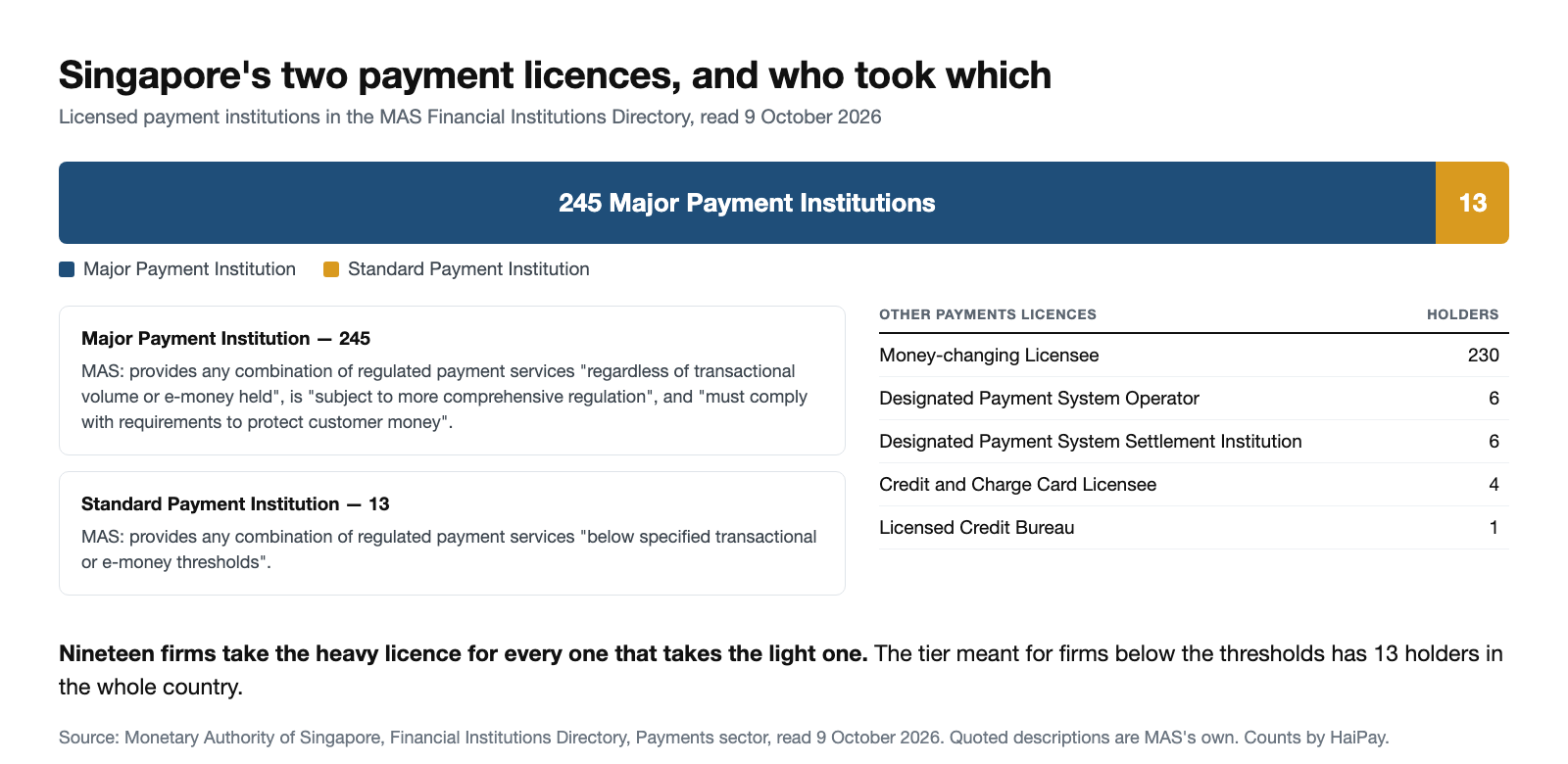
Singapore's Payment Services Act has two licences for payment firms. The heavier one, the major payment institution, carries a duty to safeguard customer money. The lighter one is for firms below the thresholds.
October 9th, 2026
Last updated: October 9
Key takeaways
- Singapore's register shows 245 major payment institutions against 13 standard ones, a ratio of nineteen to one.
- The major licence carries the duty to safeguard customer money; the standard one is for firms below the thresholds.
- 220 of the 245 major licensees hold cross-border money transfer. Singapore's payments industry is largely a remittance industry.
- Fifty-six hold exactly one service, and 42 of those hold only cross-border transfer. One holds only domestic transfer.
- No payment institution in Singapore holds all seven regulated services. Seven firms hold six, including PayPal and Revolut.
- All 38 payment institutions licensed for digital payment tokens are in the major tier. No standard institution holds one.
Data highlight
13licensees
Standard payment institutions on the Monetary Authority of Singapore's Financial Institutions Directory, against 245 major payment institutions
MAS Financial Institutions Directory as read on 9 October 2026
Compiled by HaiPay on 9 October 2026 from the Monetary Authority of Singapore's Financial Institutions Directory, the regulator's public register, at eservices.mas.gov.sg/fid. The figures cover the directory's Payments sector. The directory reports 245 major payment institutions, 13 standard payment institutions, 230 money-changing licensees, six designated payment system operators, six designated payment system settlement institutions, four credit and charge card licensees and one licensed credit bureau. The descriptions of the two payment institution licences are quoted from MAS's own tooltips and licence pages: a major payment institution "provides any combination of regulated payment services, regardless of transactional volume or e-money held", is "subject to more comprehensive regulation than standard payment institutions as the scale of their operations pose greater risks" and "must comply with requirements to protect customer money"; a standard payment institution provides "any combination of regulated payment services, below specified transactional or e-money thresholds". HaiPay did not rely on the directory's own filter counts alone. Every listing page for both tiers was retrieved, 25 pages for major payment institutions and two for standard ones, giving 262 listing rows for the major tier and 13 for the standard tier, and each institution's own detail page was then read for the list of regulated payment services it is licensed to provide. The 262 major-tier rows resolve to 245 distinct companies: 16 companies are listed twice because the directory creates a row for each trading name, shown in the entry as the company name followed by "tdg as" and the trading name. After merging those duplicates, the per-service counts computed from the detail pages reproduce the directory's own facet counts exactly, service by service: cross-border money transfer 220, domestic money transfer 146, merchant acquisition 102, account issuance 89, e-money issuance 76, digital payment token 38 and money-changing 35. For the 13 standard payment institutions the same method gives cross-border money transfer 10, domestic money transfer 7, account issuance 6, merchant acquisition 6, e-money issuance 4, money-changing 2 and digital payment token 0. The distribution of how many services each major payment institution holds, 56 firms with one, 55 with two, 55 with three, 27 with four, 45 with five, seven with six and none with seven, is HaiPay's calculation from the same pages and sums to 245. The breakdown of the 56 single-service firms, 42 holding only cross-border money transfer, 13 only digital payment tokens and one only domestic money transfer, is likewise HaiPay's. The seven firms holding six services are named as the directory names them: Digital Treasures Center Pte. Ltd., iChange Pte. Ltd., MoolahGo Pte. Ltd., PayPal Pte. Ltd., Revolut Technologies Singapore Pte. Ltd., Xfers Pte. Ltd. and XREX Pte. Ltd. A recorded permission describes what a firm is allowed to provide, not what it does; the directory publishes no transaction volumes, customer numbers or float. The count covers licensed payment institutions only and excludes banks, which hold their own licences under separate legislation, and any exempt entities. Firms may also hold licences in other sectors of the directory, and this article does not net those out. Entries carry their own last-updated dates and the pages read today carry 2026 dates; HaiPay did not audit the currency of all 258 entries. HaiPay observes that no standard payment institution holds a digital payment token licence but does not assert a reason for that, and did not contact the Monetary Authority of Singapore or any licensee.
Singapore's Payment Services Act has two licences for payment firms. The heavier one, the major payment institution, carries a duty to safeguard customer money. The lighter one is for firms below the thresholds.
As of today the register has 245 major payment institutions and 13 standard ones. Nineteen to one.
What the two licences mean
The regulator's own descriptions are short. A major payment institution "provides any combination of regulated payment services, regardless of transactional volume or e-money held", is "subject to more comprehensive regulation", and "must comply with requirements to protect customer money". A standard payment institution provides the same combination of services "below specified transactional or e-money thresholds".
The lighter tier exists so that a small firm can start without the full weight. Thirteen firms in the country are using it.
Beside those two sit the other payments licences: 230 money-changing licensees, six designated payment system operators, six settlement institutions for those systems, four credit and charge card licensees and one licensed credit bureau.
The licence is mostly a remittance licence
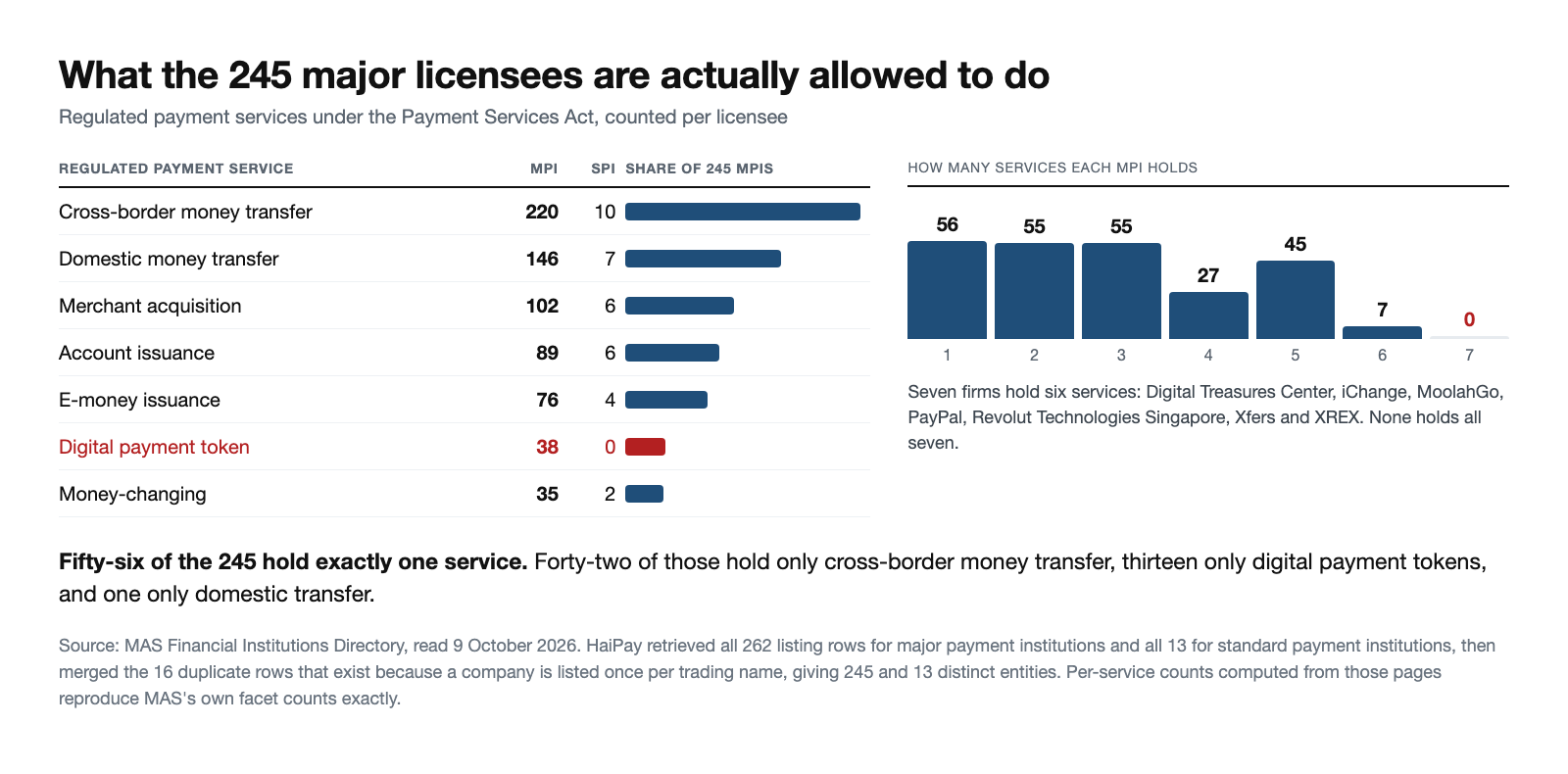
The register records which of the seven regulated payment services each firm may provide. Counted across the 245 major institutions, one service dominates: 220 of them hold cross-border money transfer. That is 90%.
Domestic money transfer follows at 146, merchant acquisition at 102, account issuance at 89 and e-money issuance at 76. Digital payment tokens, the crypto permission, sit at 38, and money-changing at 35.
Fifty-six of the 245 hold exactly one service. Forty-two of those hold only cross-border money transfer, thirteen only digital payment tokens, and one only domestic transfer.
So a large part of what Singapore calls its payments industry is a remittance industry with a wider name over the door.
Nobody holds all seven
The spread across firms is narrow at the top. Fifty-six hold one service, 55 hold two, 55 hold three, 27 hold four, 45 hold five and seven hold six.
No payment institution in Singapore holds all seven. The seven firms with six are Digital Treasures Center, iChange, MoolahGo, PayPal, Revolut Technologies Singapore, Xfers and XREX.
Among standard payment institutions the ceiling is lower still: the widest holds four services, and none holds a digital payment token licence at all. Every one of the 38 payment institutions licensed for digital payment tokens is in the major tier.
Why this matters to anyone picking a partner here
Two practical readings.
First, a Singapore payment licence does not tell you what the firm can do for you. A counterparty described as "MAS licensed" may hold one permission out of seven, and the most common single permission is remittance. The service list on the register entry is the thing to check, not the licence name.
Second, the tier itself carries the safeguarding duty. Customer money protection attaches to the major licence. With 245 holders against 13, almost every licensed payment firm in Singapore is inside that regime, which is a better position for a merchant than the headline count of licences suggests.
How these numbers were produced
MAS publishes the counts as filter facets on its directory. HaiPay did not take them on trust. Every listing page for both tiers was retrieved, 262 rows for major institutions and 13 for standard ones, and each institution's own page was read for its service list.
The 262 rows resolve to 245 companies, because 16 companies appear twice, once per trading name. After merging those, the per-service counts computed from the institution pages match the regulator's facet counts exactly, service by service.
What this is not
A permission is what a firm may do, not what it does. The register reports no volumes, no customer numbers and no float.
The count is of licensed payment institutions, not of everyone moving money in Singapore. Banks, which hold their own licences, are not in it, and neither are exempt entities.
The breadth figures depend on the directory being current. Each entry shows its own last-updated date; the directory pages read today carry dates in 2026, and HaiPay did not audit the currency of all 258 entries.
HaiPay counted only the payments sector of the directory. Firms may hold licences in other sectors as well, and this article does not net those out.
HaiPay did not contact MAS or any licensee.
What to watch
Whether the standard tier stays empty in practice. Thirteen holders is the clearest signal in this data, and it either means the thresholds are set too low to be useful or that firms would rather hold the licence that lets them grow without reapplying.
Whether the digital payment token count moves off 38, and whether any of those firms ever appears in the standard tier.
And whether anyone ever takes the seventh permission. The gap between six and seven has been empty the whole way.
How to cite
HaiPay News, "Singapore's Light-Touch Payment Licence Has 13 Holders", https://www.haipay.net/news/singapore-standard-payment-institution-13-holders, October 9th, 2026
About the author
Crystal
Digital Public Relations
A digital PR specialist with a Master's in Journalism & Communication from UNSW. Started as an intern at ABC Australia, now leads public relations at Haipay, crafting press releases and media strategies that bring brand stories to life.
Reviewed by WeiJun TangEditorial policy
4 sources
 Monetary Authority of Singapore
Financial Institutions Directory
- Monetary Authority of Singapore
Financial Institutions Directory, Major Payment Institutions
- Monetary Authority of Singapore
Financial Institutions Directory, Standard Payment Institutions
- Monetary Authority of Singapore
Financial Institutions Directory, institution entry showing the regulated payment services held (example: Airwallex Singapore)