The First GENIUS Rule in Force Is a Form No One Can File
The American law governing dollar stablecoins applies in 101 days. One rule implementing it is now in force. It is a form, and nobody can file it yet.
October 9th, 2026
Last updated: October 9
Key takeaways
- The GENIUS Act applies in 101 days. Exactly one rule implementing it has taken effect, published on 30 September.
- That rule is an interim final rule: binding on publication, with comments running until 30 November and revisions expected.
- It prescribes the form a state regulator uses to certify its stablecoin regime, and asks 39 numbered questions about itself.
- Certifications are not being accepted yet. The rule says they wait on Paperwork Reduction Act approval of the collection.
- The test the form attests to is still a proposal: Treasury's substantial similarity principles date from 3 April and are not final.
- HaiPay's September count was 19 proposals and no final rules. It is now 22 proposals, 17 closed comment periods and one rule.
Data highlight
1rule
Rules implementing the GENIUS Act in force 101 days before the statute applies, against 22 proposed rules using the statutory term payment stablecoin
Federal Register documents from 18 July 2025, counted 9 October 2026
Compiled by HaiPay on 9 October 2026, 101 days before the GENIUS Act applies on 18 January 2027. The counts repeat the method used in HaiPay's article of 24 September 2026: a Federal Register API search for the statutory term "payment stablecoin" with a publication date from 18 July 2025, the date the Act was enacted. On 9 October that search returns 38 documents, comprising 22 proposed rules, 13 notices and 3 final rules. Of the 22 proposed rules, 17 had comment periods closing on or before 9 October 2026 and five remain open: Treasury's GENIUS Act Regulations on Payment Stablecoin Issuance, Offer, and Sale, closing 19 October 2026; the FDIC's Merger Transactions proposal, closing 23 November 2026; the Federal Reserve's Implementing the Federal Reserve Board's Responsibilities Under the GENIUS Act, 104 pages, and its Application Procedures for Board-Supervised Insured Depository Institutions proposal, 16 pages, both published 29 September 2026 and closing 30 November 2026; and the Securities and Exchange Commission's Adviser and Regulated Fund Custody Rules; Crypto Custody Rules, 234 pages, published 6 October 2026 and closing 7 December 2026. The comparison with the September figures is exact: that article counted 19 proposed rules with 16 comment periods closed and three open, and the three then-open periods were the OCC information availability proposal closing 5 October 2026, the Treasury issuance proposal closing 19 October 2026 and the FDIC merger proposal closing 23 November 2026. Of the three final rules in the search, only one implements the Act: Forms and Procedures for Review of State Certifications by the Stablecoin Certification Review Committee, an interim final rule with request for comments issued by the Department of the Treasury on behalf of the Committee, published 30 September 2026 at 91 FR 61688, document number 2026-19966, RIN 1505-AC97, 16 pages, effective 30 September 2026, with comments due by 30 November 2026, adding a new part 1522 to title 31 of the Code of Federal Regulations. The other two final rules are a Commodity Futures Trading Commission rule on the application of the federal securities laws to certain types of crypto assets, 91 FR 13714 of 23 March 2026, and an Internal Revenue Service rule on occupations that customarily and regularly received tips, 91 FR 19026 of 13 April 2026; neither implements the GENIUS Act. Widening the search to every final rule since enactment that mentions stablecoin in any form returns five documents, adding a FinCEN special measure regarding Huione Group of 16 October 2025 and an OCC rule on unsafe or unsound practices of 1 September 2026, neither of which implements the Act either. The count of 39 numbered questions is HaiPay's, from the occurrences of the form "Question N:" in the interim final rule's text. The statements that the rule is effective on publication and that certifications will not be accepted until after Paperwork Reduction Act approval of the information collection, with a notice to follow on Treasury's website, are quoted from the rule's DATES section. The composition of the Committee, being the Secretary of the Treasury as chair, the Chair of the Federal Reserve Board or the Vice Chair for Supervision if delegated, and the Chairman of the FDIC, is taken from the rule's description of section 2(27) of the Act. The $10 billion ceiling for the state route, the requirement that a state regulator submit an initial certification not later than one year after the Act's effective date, the Committee's position that any form of certification filed by 18 January 2028 satisfies that deadline even if conditional or incomplete, the optional check box for a conditional filing, the annual recertification requirement, the suspension of approval for a late recertification and the two-year cure period are all taken from the rule's preamble and its description of the new sections 1522.1 to 1522.10. The letter from seven United States senators to the Secretary of the Treasury of 16 June 2026, including the argument that the certification timeline should not operate as a one-time window and the observation that some state legislatures operate on biennial cycles, is quoted by the rule and cited there to a document published on Senator Lummis's website; HaiPay quotes it as the rule reproduces it and did not separately retrieve the letter. Treasury's broad-based principles for determining whether a state-level regulatory regime is substantially similar to the federal framework were published as a proposal on 3 April 2026 at 91 FR 16844, and the statement that changes to those principles will inherently affect the certifications states submit is the Committee's own, from footnote 5 of the interim final rule. HaiPay found no statutory deadline in the Act requiring final rules by any given date; the 18-month clock in section 20 sets when the law applies. The source links in this article are the canonical html_url values returned by the Federal Register API for each document; federalregister.gov applies bot protection to automated clients, so HaiPay read every document through the API and the full-text endpoints rather than through those pages. HaiPay did not contact the Department of the Treasury, the Federal Reserve, the FDIC, the SEC or any state payment stablecoin regulator.
The American law governing dollar stablecoins applies in 101 days. One rule implementing it is now in force. It is a form, and nobody can file it yet.
Treasury published the rule on 30 September on behalf of the Stablecoin Certification Review Committee. Sixteen pages, a new part 1522 of title 31, effective the day it appeared, comments open until 30 November. It asks 39 numbered questions about itself.
Updating a count
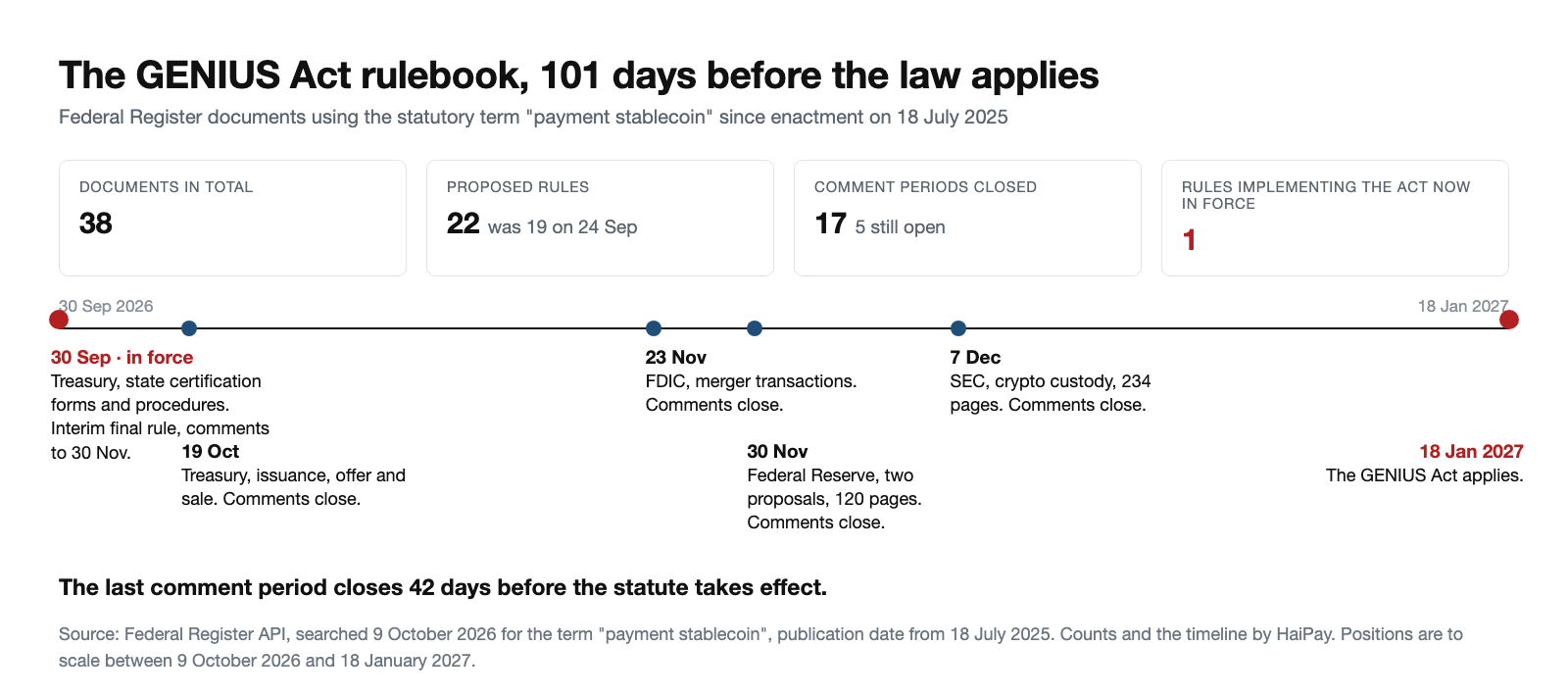
On 24 September HaiPay counted 19 proposed rules using the statutory term "payment stablecoin" since the GENIUS Act was enacted, and no final rules implementing it, with 116 days to go.
Recounted on 9 October, the same search returns 38 documents in all: 22 proposed rules, of which 17 comment periods have closed and five are still open, and one rule implementing the Act in force.
The three new proposals are the Federal Reserve's 104-page implementation proposal and its 16-page companion on application procedures, both published 29 September, and the Securities and Exchange Commission's 234-page crypto custody proposal of 6 October. Every one of them closes after Thanksgiving. The last closes 42 days before the statute takes effect.
The September article also said what to watch for: interim final rules, which take effect without a further comment round, as the date closed in. That is exactly what arrived.
The form comes before the test
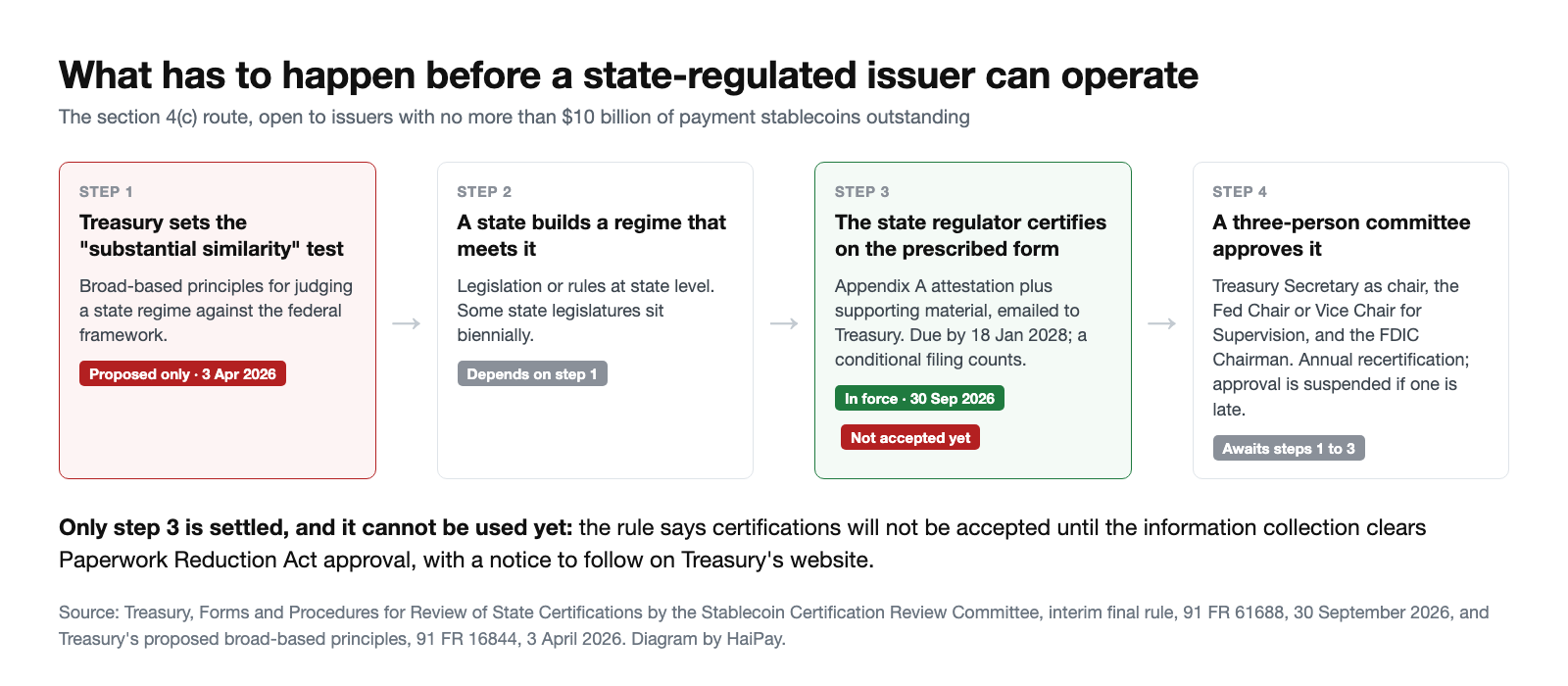
The rule prescribes how a state regulator certifies that its own stablecoin regime is substantially similar to the federal one. Under section 4(c) of the Act, that certification is what lets an issuer with no more than $10 billion outstanding opt for state regulation instead of federal.
The test the form attests to does not exist in final form. Treasury proposed its broad-based principles for judging substantial similarity on 3 April, and they are still a proposal. The Committee says so in a footnote of its own: changes to those principles will inherently affect the certifications states submit, which is why it has kept the procedures high-level enough to survive whatever the principles turn out to say.
So the sequence is form first, standard afterwards.
And the form cannot be used
The rule's own dates section settles that. It is effective 30 September, but certifications will not be accepted until the information collection clears approval under the Paperwork Reduction Act. Treasury will post a notice on its website when they are.
A rule in force that cannot yet be complied with is not unusual in American administrative practice. It is worth noticing anyway, because this is the single piece of the GENIUS framework that has made it all the way to binding text.
Three people and two dates
The Committee is small. The Secretary of the Treasury chairs it, the Chair of the Federal Reserve sits on it or delegates to the Vice Chair for Supervision, and the Chairman of the FDIC is the third member.
The statute requires a state regulator to submit its initial certification not later than one year after the Act's effective date, which is 18 January 2028. Seven senators, several of them cosponsors of the Act, wrote to the Treasury Secretary in June arguing that the deadline should not operate as a one-time window that bars future certifications, and pointing out that some state legislatures sit only every other year.
The Committee's answer is a split. Any form of certification filed by 18 January 2028 satisfies the statutory deadline, even if it is conditional or incomplete, and the form carries an optional check box saying so. Substantive review does not begin until the filing is amended into a complete one. After approval, a state must recertify every year, and approval is suspended if a recertification is late.
What an issuer should take from this
If the plan was to be state-regulated on the day the law applies, the chain is not finished. The standard is proposed, the state regimes depend on it, the form is in force but closed, and the committee that approves anything has not started.
The federal route is not in better shape. The rule that decides most of what an issuer must do, Treasury's proposal on issuance, offer and sale, has a comment period that closes on 19 October, and no final text.
What has changed since September is not the volume of work. It is the first confirmation of how the gap will be bridged: by rules that take effect first and get revised later.
What this is not
This is a count of documents, not of pages or importance, and it uses the same method as the September article: the Federal Register API, the term "payment stablecoin", publication date from 18 July 2025 onward.
One rule in force means one rule implementing the Act that has taken effect. Three final rules in that window use the statutory term; the other two are a CFTC rule on the securities laws and crypto assets and an IRS rule on tipped occupations. Widening the search to any final rule mentioning stablecoin at all adds two more, and neither implements the Act.
An interim final rule is binding now, but the Committee states it intends to revise the forms and procedures after considering comments, so the text quoted here may not be the text that governs in January.
HaiPay found no statutory deadline requiring final rules by any date; the 18-month clock sets when the law applies, not when regulators must finish. HaiPay did not contact Treasury, the Federal Reserve, the FDIC or any state regulator.
What to watch
Whether Paperwork Reduction Act approval and Treasury's notice arrive before 18 January, so that the one usable piece of the framework is actually usable.
Whether the substantial similarity principles are finalised before the statute applies, after it, or not at all in that window.
And whether more interim final rules follow. One has now done precisely what September's article said to look for, with 101 days left on the clock.
How to cite
HaiPay News, "The First GENIUS Rule in Force Is a Form No One Can File", https://www.haipay.net/news/genius-act-first-rule-in-force-state-certification, October 9th, 2026
About the author
Crystal
Digital Public Relations
A digital PR specialist with a Master's in Journalism & Communication from UNSW. Started as an intern at ABC Australia, now leads public relations at Haipay, crafting press releases and media strategies that bring brand stories to life.
Reviewed by WeiJun TangEditorial policy
5 sources
- Department of the Treasury
Forms and Procedures for Review of State Certifications by the Stablecoin Certification Review Committee, interim final rule, 91 FR 61688
- Department of the Treasury
GENIUS Act Broad-Based Principles for Determining Whether a State-Level Regulatory Regime is Substantially Similar, proposed rule, 91 FR 16844
- Department of the Treasury
GENIUS Act Regulations on Payment Stablecoin Issuance, Offer, and Sale, proposed rule, 91 FR 53368
- Office of the Federal Register
Federal Register API, full-text search