NewsRegulation
A $5bn Cap Became $30bn. The $25bn Bank Gains Least.
Since 11 July, a US bank has been able to treat up to six times as much reciprocal deposit money as non-brokered as it could before — or 1.72 times as much, depending entirely on how large it is. The FDIC wrote the arithmetic down on 1 September, in a rule that took effect the day it published and takes comments for a month afterwards.
Key takeaways 6
- The FDIC's interim final rule raises the reciprocal deposit general cap from $5 billion to a tiered maximum of $30 billion.
- The new cap is 50% of liabilities to $1bn, 40% of the $1-10bn slice and 30% of the $10-96.33bn slice.
- A bank with exactly $25 billion in liabilities gains least: 1.72 times its old cap, against 6 times at $96.33 billion.
- As a share of its own balance sheet the smallest bank gains most, at 50% of liabilities against 3% at $1 trillion.
- Banks with a CAMELS composite rating of 3 are now eligible for the exception if they are also well capitalised.
- The FDIC estimates 33 institutions could pay less, cutting assessment revenue by $45.8 million a year.
Since 11 July, a US bank has been able to treat up to six times as much reciprocal deposit money as non-brokered as it could before — or 1.72 times as much, depending entirely on how large it is.
The FDIC published the rule conforming its own regulations to that statute on 1 September. It is an interim final rule, effective the day it published, with comments due 1 October. The FDIC's own framing is worth keeping in view: because section 902 of the 21st Century ROAD to Housing Act was effective on enactment, the agency says that "relative to a post-statutory baseline these amendments will have no substantive effect". The statute made the change. The rule writes it down.
From one ceiling to three tiers
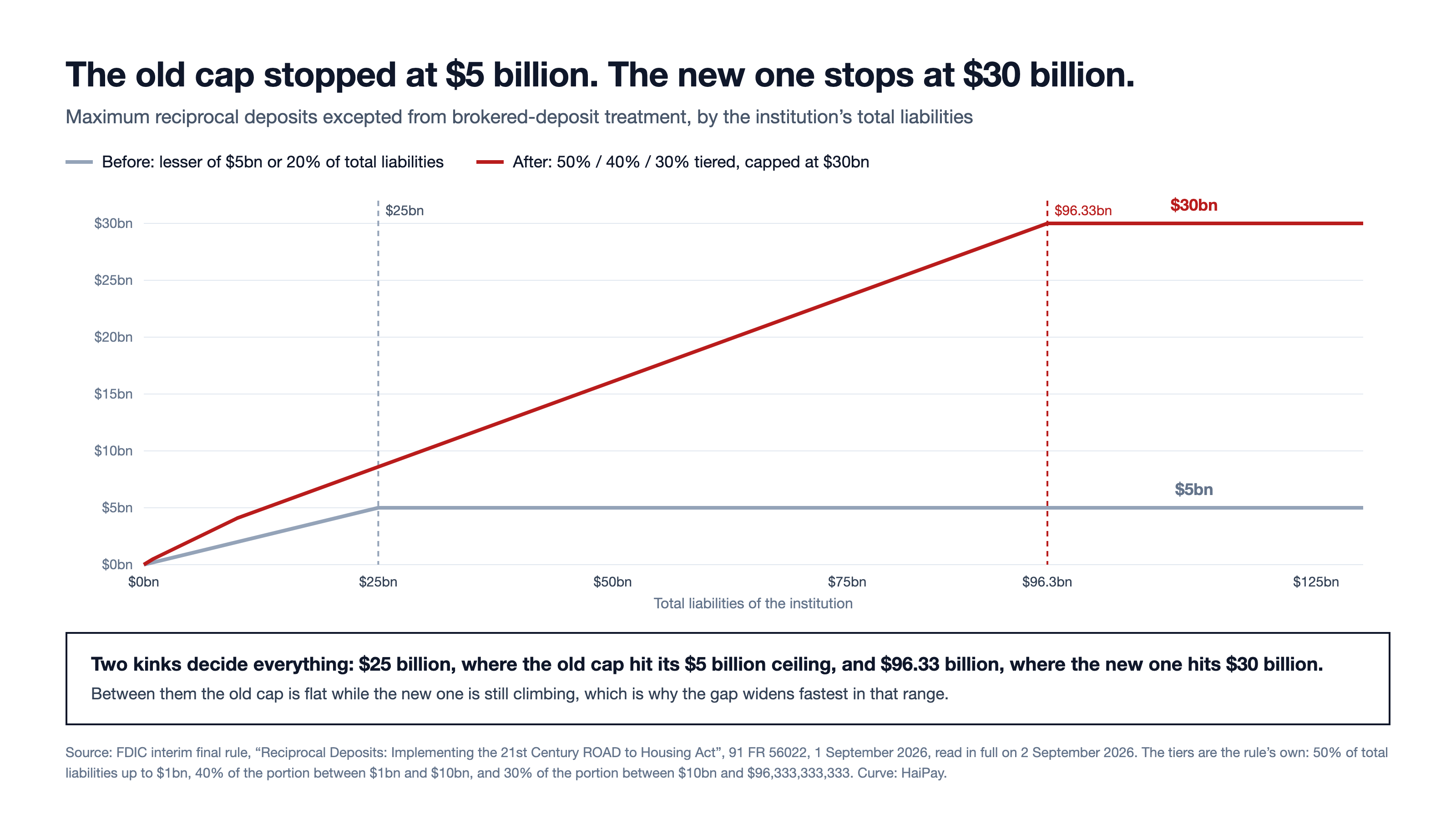
Since 2018, a qualifying bank could exclude reciprocal deposits from brokered-deposit treatment up to a general cap of "the lesser of $5 billion or 20 percent of the total liabilities" of the institution. One number, one percentage, and a hard stop.
The statute replaced that with a tiered calculation, which the FDIC has now written into 12 CFR 337.6(e)(1). The general cap is the sum of 50% of total liabilities up to $1 billion, 40% of the portion between $1 billion and $10 billion, and 30% of the portion between $10 billion and $96,333,333,333.
That last figure is not arbitrary. It is the exact point at which the third tier reaches $30 billion, which the rule states is the maximum general cap available to any institution. Work backwards from $30 billion through the tiers and $96,333,333,333 is what falls out.
The institution that gains least has $25 billion in liabilities
Because the old cap was the lesser of two things, it behaved differently at different sizes. Below $25 billion in total liabilities, 20% was the binding constraint. At exactly $25 billion, 20% equalled $5 billion, and from there upward the $5 billion ceiling bound instead — flat forever, however large the bank.
The new cap keeps climbing to $96.33 billion. Put the two together and the increase is not monotonic.
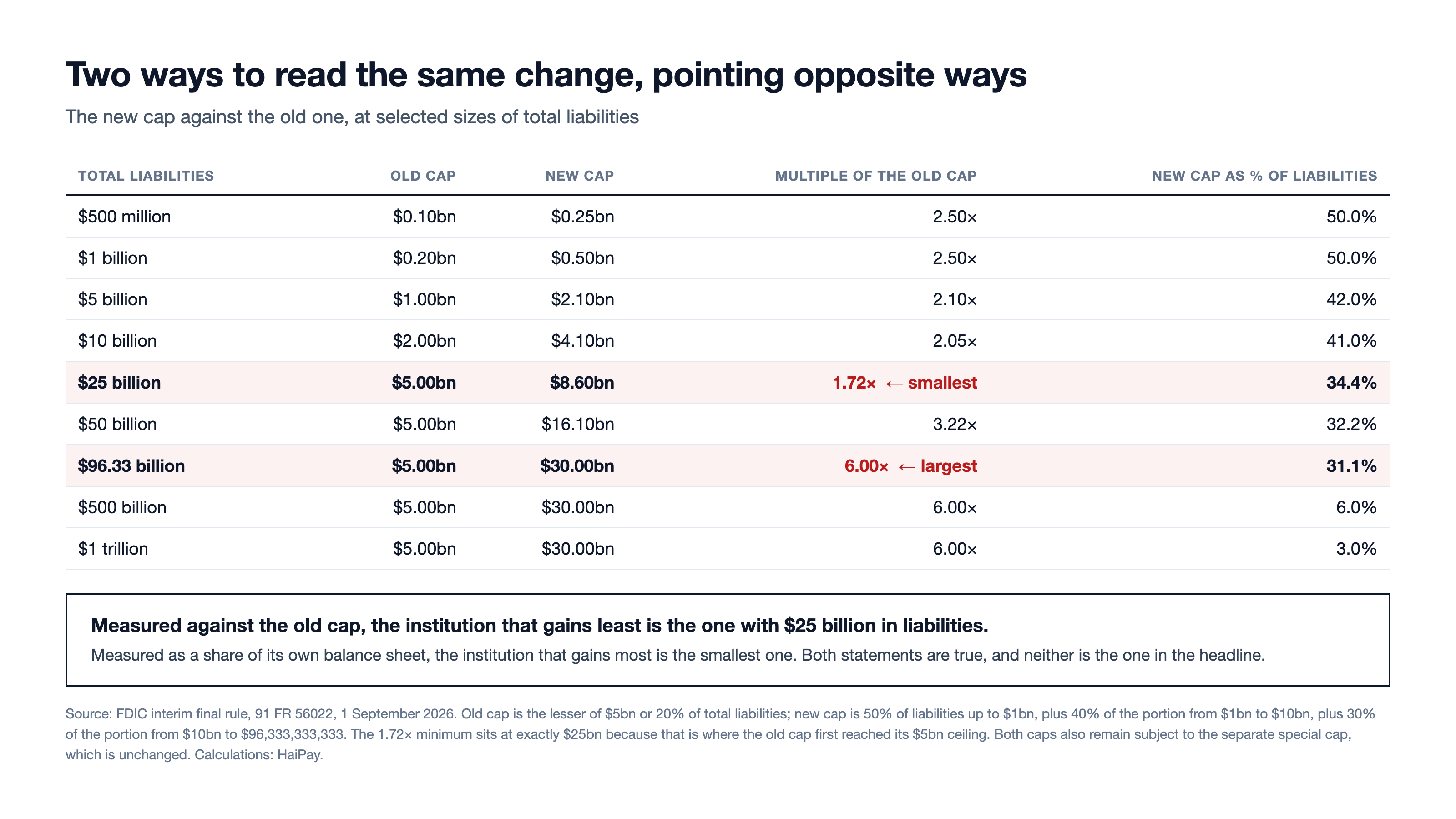
A bank with $500 million in liabilities goes from $100 million to $250 million: 2.5 times. A bank with $10 billion goes from $2 billion to $4.1 billion: 2.05 times. A bank with exactly $25 billion goes from $5 billion to $8.6 billion: 1.72 times, the smallest increase anywhere on the curve. A bank with $96.33 billion or more goes from $5 billion to $30 billion: 6 times, and that multiple holds for every institution above that size.
The $25 billion bank does worst because it was the one size that had already extracted the full value of both halves of the old formula.
Read it the other way and the answer reverses
Measured as a share of its own balance sheet, the smallest institutions gain most. The new cap is 50% of liabilities for a bank under $1 billion, 41% at $10 billion, 34.4% at $25 billion, 31.1% at $96.33 billion, and then falls away — 6% at $500 billion, 3% at $1 trillion, because the $30 billion ceiling stops moving while the balance sheet does not.
So there is no single answer to who benefits. Against the old rule, the largest eligible institutions gain most. Against their own size, the smallest do. Neither reading is stated in the rule; both come from the same four numbers in it.
How much money this is actually about
The rule contains its own measurement, taken from 31 March 2026 call report data, the last before the statute took effect.
There were 4,278 FDIC-insured institutions. Of those, 2,089 — 48.8% — reported holding reciprocal deposits at all, totalling $462.8 billion. But only 331 institutions, 7.7% of the industry, reported brokered reciprocal deposits, and those totalled $91.9 billion. That $91.9 billion is the pool the change actually acts on: 19.9% of all reciprocal deposits, and 7.6% of the $1.204 trillion of brokered deposits reported across 1,971 institutions.
The FDIC then counts the institutions whose deposit insurance assessments could fall: 16 established small institutions, 14 large or highly complex institutions, and three more through the brokered deposit adjustment. Thirty-three institutions, or 10% of the 331. The estimated effect on the insurance fund is a reduction in aggregate assessment revenue of $45.8 million a year.
Set that against the $91.9 billion of brokered reciprocal deposits and the relief is worth about five basis points on the affected balances. It is a real number and a small one, and the FDIC adds that against a post-statutory baseline even this is nil, because the statute had already done it.
A rating category was added, and the statute did not finish the job
The second change is smaller in the text and larger in effect. To use the exception at all, a bank must be an "agent institution", and before the Housing Act the first prong of that definition required a composite condition of "outstanding or good", which the FDIC has interpreted as a CAMELS composite rating of 1 or 2.
The statute replaced that with an explicit requirement of a CAMELS composite rating of "1", "2", or "3". The FDIC's own summary of the effect is that this expands "the agent institution definition to include institutions assigned a CAMELS composite rating of '3'", provided they are also well capitalised.
The agency then flags something the statute left behind. Section 902 amended the "outstanding or good" language in the agent institution definition but not the same phrase where it appears in the special cap provision. Read together, the FDIC says, an institution that becomes subject to the special cap may not have that cap calculated on the preceding four quarters at all, but on quarters that are years older. It works through a bank downgraded from 2 to 3 in 2026 and to 4 in 2030, whose special cap would rest on its 2025-2026 holdings, and concludes that the special cap "no longer approximates the status quo" at the moment eligibility is lost.
Effective before comment
The rule took effect on publication. The FDIC invoked the good cause exception at 5 U.S.C. 553(b)(B) to waive both prior notice and comment and the customary 30-day delayed effective date, reasoning that leaving its regulations inconsistent with the amended statute would cause "uncertainty for industry participants". Because no proposed rule was published, the agency also concluded that the Regulatory Flexibility Act's analysis requirements do not apply, while inviting feedback on burden anyway.
The statute took effect on 11 July. The conforming rule took effect 52 days later. The comment period closes 30 days after that, on a rule that already binds.
What to watch
Reciprocal deposits are how a bank places a large customer deposit across a network of other banks so the whole balance stays within insurance limits, and takes matching deposits back. The classification matters because brokered deposits feed into assessment rates and into supervisory views on funding.
The FDIC says the change "may result in increased holdings of reciprocal deposits by IDIs, including by institutions that previously did not utilize reciprocal deposits", and that it cannot estimate how many institutions or how much volume. That is the agency saying it expects new entrants to this funding channel and does not know the size.
Three things to watch. Whether the comment file objects to the CAMELS 3 admission, which is the substantive change rather than the arithmetic one. Whether the unamended "outstanding or good" language in the special cap provision gets fixed. And whether call report data over coming quarters shows reciprocal deposit balances rising fastest in the $25 billion to $96 billion band, where the gap between the old cap and the new one is widest.
This piece reads a rule. It is not legal or compliance advice, and any institution's actual cap depends on its own call report data and supervisory ratings.
Data highlight
1.72 multiple of the previous cap
Smallest increase in the reciprocal deposit general cap available at any institution size, which occurs at exactly USD 25 billion of total liabilities
Comparison of the cap before and after section 902 of the 21st Century ROAD to Housing Act, effective 11 July 2026
Read the methodology and limitations
Methodology and limitations
Calculated by HaiPay from the two cap formulas set out in the FDIC interim final rule at 91 FR 56022, published and effective 1 September 2026 and read in full on 2 September 2026. The previous general cap was the lesser of USD 5 billion or 20 per cent of the institution's total liabilities.
The general cap as amended, which the rule writes into 12 CFR 337.6(e)(1), is the sum of 50 per cent of total liabilities up to USD 1 billion, 40 per cent of the portion between USD 1 billion and USD 10 billion, and 30 per cent of the portion between USD 10 billion and USD 96,333,333,333, giving a stated maximum of USD 30 billion.
Evaluating both formulas across institution sizes gives a ratio of the new cap to the old one that is 2.50 at USD 1 billion of total liabilities or below, falls to a minimum of 1.72 at exactly USD 25 billion, and rises to 6.00 at USD 96,333,333,333 and above. The minimum sits at USD 25 billion because that is the size at which 20 per cent of total liabilities first equalled the old USD 5 billion ceiling, so the old cap stops rising there while the new one continues.
The figures assume the general cap binds and take no account of the separate special cap, which section 902 did not amend, or of whether a given institution qualifies as an agent institution. Institution-level caps are calculated by the FDIC from Call Report data.
Term definition
- Reciprocal deposit
- An arrangement in which a bank places a large customer deposit across a network of other banks, so that the whole balance stays within deposit insurance limits at each of them, and receives an equal amount of deposits back from that network. The customer keeps one relationship; the insurance coverage is spread. Whether those returned deposits count as brokered deposits is what the cap in this rule decides.
- Brokered deposit
- A deposit received by a bank through a third party that places or facilitates the placement of other people's money. US law restricts which banks may accept them, and the classification feeds into deposit insurance assessment rates and into how supervisors read a bank's funding profile. The reciprocal deposit exception exists to keep a defined volume of reciprocal deposits outside that classification.
- Interim final rule
- A rule an agency issues in final, binding form without first publishing a proposal, while still taking comment afterwards. It requires a good cause finding under the Administrative Procedure Act that prior notice and comment would be impracticable, unnecessary or contrary to the public interest. The rule is in force during the comment period, and the agency may amend it when it adopts a permanent version.
2 sources
- Office of the Federal Register
- Office of the Federal Register
How to cite
HaiPay News, "A $5bn Cap Became $30bn. The $25bn Bank Gains Least.", https://www.haipay.net/news/fdic-reciprocal-deposit-cap-five-to-thirty-billion, 3 September 2026