Who Owns a Swipe-Fee Claim? Not the Facilitator.
The money in the Visa and Mastercard interchange settlement was agreed years ago. Who owns the claims to it is still being decided, one company at a time, in a federal court in Brooklyn.
September 23rd, 2026
Last updated: September 23
Key takeaways
- A Brooklyn federal court has opened 28 separate cases over who owns claims in the Visa and Mastercard interchange settlement.
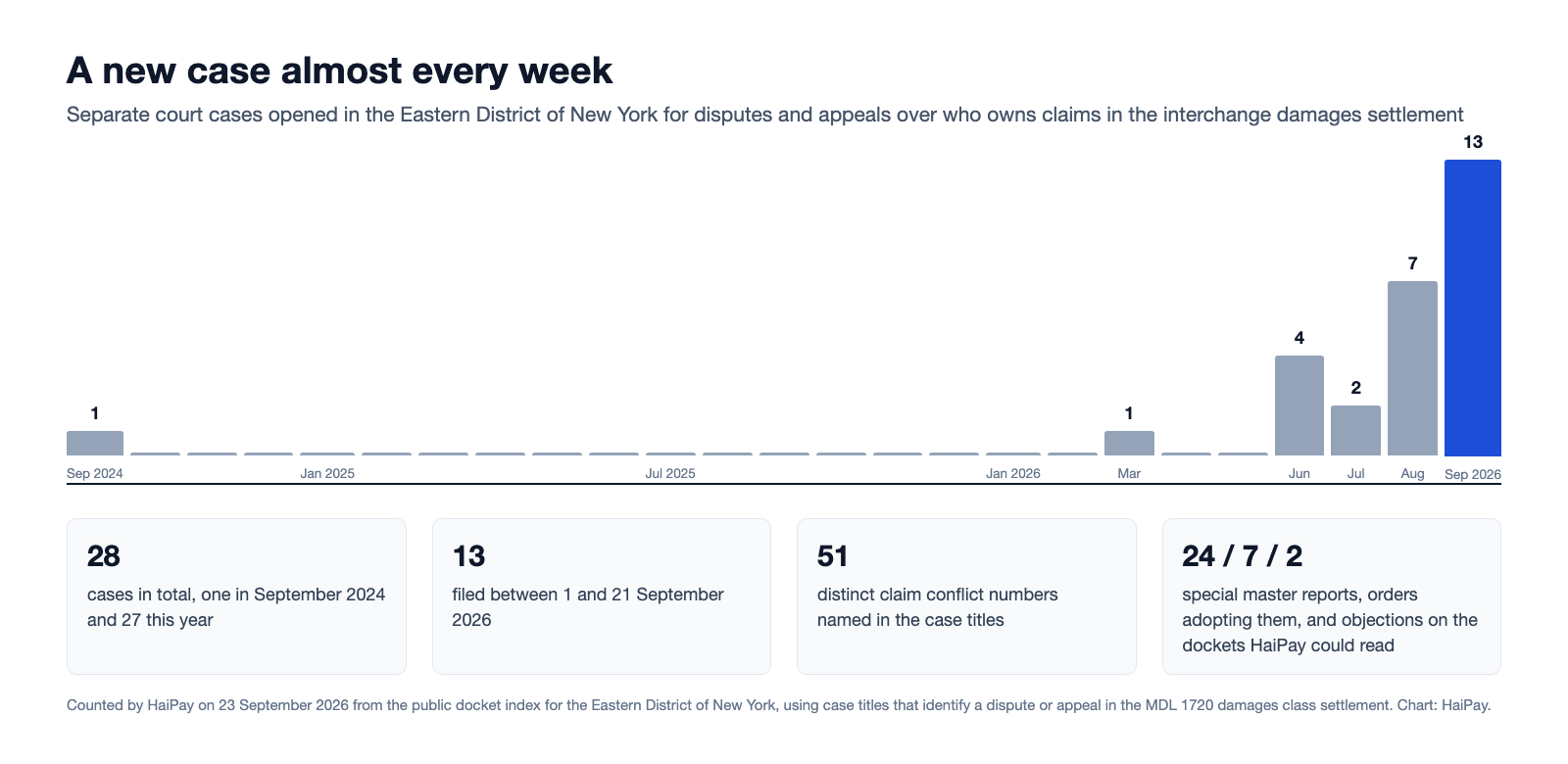
- One was filed in September 2024; the other 27 came this year, including 13 between 1 and 21 September.
- The court holds that only one entity in a payment chain can be a class member, and it is the merchant, not the payment facilitator.
- On 16 June it applied that to Teleflora, refusing it claims over the transactions of 35,909 member florists.
- Case titles name 51 distinct claim conflict numbers; most open with a report from the special master.
- A separate order sanctioned a claims-filing firm that told class members Square transactions could not be counted.
Data highlight
28cases
Separate cases opened in the Eastern District of New York over who owns claims in the interchange damages settlement
4 September 2024 to 21 September 2026
Counted by HaiPay on 23 September 2026 from the public docket index for the United States District Court for the Eastern District of New York, searched through CourtListener for dockets matching "MDL 1720". HaiPay kept the dockets whose case titles identify them as disputes or appeals in the MDL 1720 damages class settlement, which gives 28 cases: one filed on 4 September 2024 and 27 filed in 2026, comprising one in March, four in June, two in July, seven in August and 13 between 1 and 21 September. Their titles name 51 distinct claim conflict numbers, and five name a company: Yoox, CWI, Rodan & Fields, 3124 Enterprises and Aley Restaurant Management. Twenty-three of the 28 list Judge Brian Cogan as the assigned judge and five list none. Of the 35 docket records returned with filings attached, 24 include a report and recommendation from the special master, seven include an order adopting such a report and two include objections. Substantive holdings are taken from two orders of the same court obtained from govinfo: the order of 16 June 2026 finding that Teleflora is not a member of the damages class with respect to the transactions of 35,909 member florists for which it acted as payment facilitator, while remaining a class member for its own sales, and the memorandum decision of 7 May 2026 adopting a magistrate judge's recommended sanctions against Betz & Baril PPLC and ClickFunds LLC, which included the finding that the firm files claims for about 9,000 class members for a share of recovery, that it told class members transactions involving Square could not be counted, and that for at least one class member $2.3 million of sales volume was omitted from a claim. The class definition, all persons and businesses that accepted Visa or Mastercard cards in the United States from 1 January 2004 to 24 January 2010, and the underlying holdings on payment facilitators are quoted in the 16 June 2026 order, citing In re Payment Card Interchange Fee & Merchant Discount Antitrust Litigation, 735 F. Supp. 3d 249 (E.D.N.Y. 2024), reconsideration denied, 2025 WL 2490442 (E.D.N.Y. 29 August 2025), affirmed 2026 WL 1210154 (2d Cir. 4 May 2026), and Old Jericho Enterprises, Inc. v. Visa, Inc., 175 F.4th 172 (2d Cir. 2026). Dockets filed under other titles would not be captured by this count, and the docket database can lag the court's own records. The dockets do not state amounts in dispute and HaiPay makes no estimate. Allegations in filings are allegations. HaiPay did not contact any company, law firm or court named.
The money in the Visa and Mastercard interchange settlement was agreed years ago. Who owns the claims to it is still being decided, one company at a time, in a federal court in Brooklyn.
HaiPay counted the separate cases the court has opened for these disputes. There are 28. One was filed in September 2024. The other 27 were filed this year, and 13 of those in the first three weeks of September.
The rule: one claimant per payment chain
The damages class covers every business that "accepted" a Visa or Mastercard card in the United States between 1 January 2004 and 24 January 2010. The settlement agreement never defined "accepted", and that one word is what the fights are about.
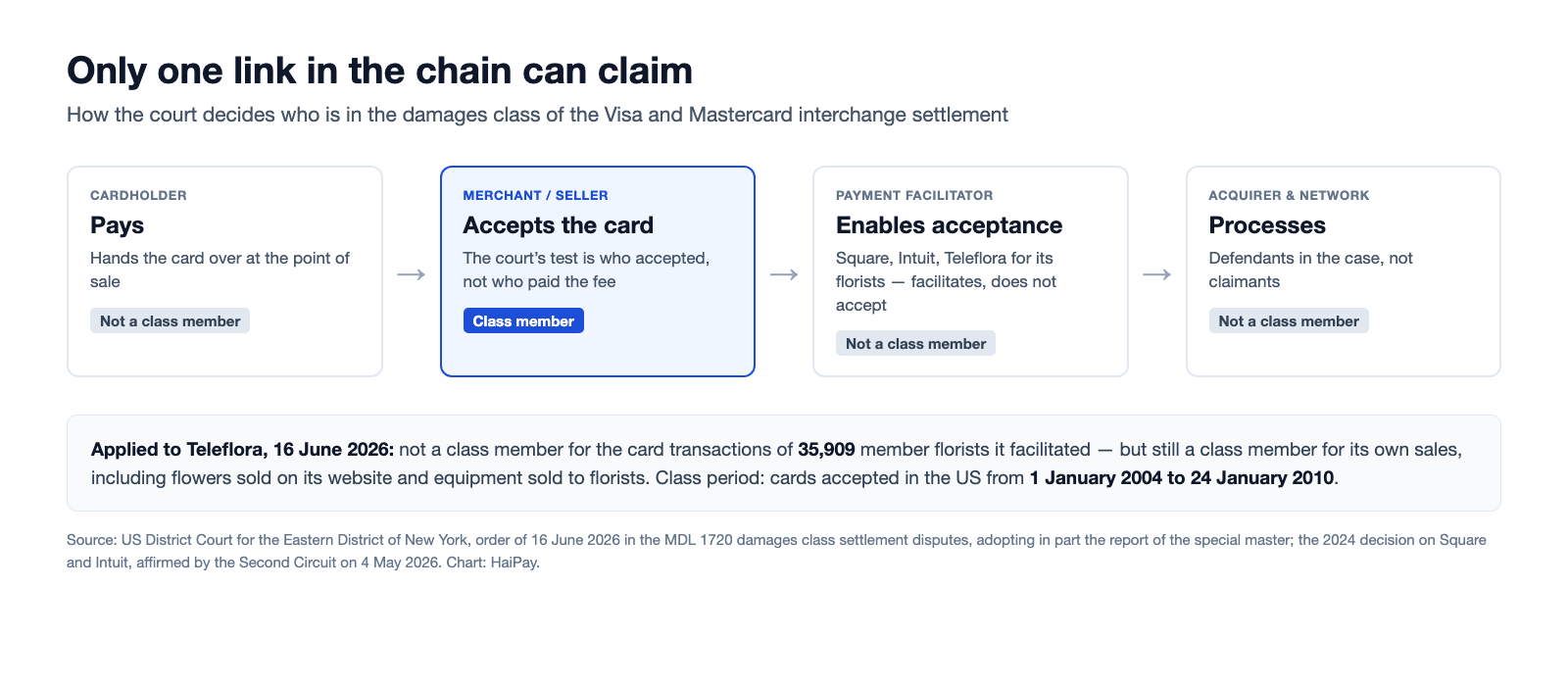
In 2024 the court decided it in a case brought by Square, now Block, and Intuit. Both had filed claims based on transactions they processed for their own merchant customers as payment facilitators. The court held that only one entity in a payment chain can be treated as having accepted a card, and that the entity is the merchant, not the facilitator that enables it. The Second Circuit affirmed on 4 May 2026, and in a separate ruling this year rejected the argument that class membership turns simply on who paid the interchange fee.
The court's reasoning was practical. Visa's rules distinguish a payment facilitator from a merchant and do not let one entity be both in the same transaction. Mastercard's rules say sellers accept cards while facilitators facilitate. And, as the court put it, the cardholder hands the card to the seller.
What it looks like in practice
On 16 June, the same court applied that rule to Teleflora, the flower-delivery network.
Teleflora sells flowers on its own website, and it also acts as a clearing house and payment facilitator for member florists. It had asked to file claims covering the card transactions of 35,909 of those florists.
The judge said no. It does not matter, he wrote, how Teleflora's business differs from Square's or Intuit's, because they are alike in the one respect that counts: they do not accept payment cards. Teleflora stays in the class for its own sales, including the flowers it sells online and the terminals and services it sells to florists. The florists' transactions belong to the florists.
The order also turned Teleflora's fairness argument around. Teleflora said it had believed for years that it was a class member. The judge asked what would happen to the thousands of merchants whose payout it was trying to claim.
The disputes are accelerating
Each dispute gets its own miscellaneous case number, and most are titled by a claim conflict number rather than a company name. HaiPay counted 51 distinct conflict numbers across the 28 cases. Five name the company: Yoox, CWI, Rodan & Fields, 3124 Enterprises and Aley Restaurant Management.
All of them sit before the same judge, Brian Cogan. Most open the same way, with a report and recommendation from the special master appointed to sort the claims out, the retired judge James Orenstein. Of the cases where the docket record shows filings, HaiPay found a special master report in 24, an order adopting the recommendation in seven, and formal objections in two.
A second fight, about the people filing the claims
On 7 May the court sanctioned a law firm, Betz & Baril, and a lead generator, ClickFunds, over information they gave class members. The firm files claims for about 9,000 class members in exchange for a share of their recovery.
This time the problem was not marketing. The firm had told class members that sales volume from transactions involving Square could not be counted in their claims. For at least one class member, the court noted, that meant $2.3 million of sales volume left out of a claim.
Class counsel asked for a punitive sanction that would have barred the respondents from any share of any class member's settlement money. The court chose a remedial one: notify the affected clients, let them cancel their contracts, reopen the claims period for anyone who does, and shift the costs to the respondents.
It was not the first round. Similar orders followed misleading statements in 2019 and again in 2024, when about 1,700 and then about 9,000 clients had to be notified.
What this count is not
HaiPay counted cases in one federal district whose titles identify them as disputes or appeals in this settlement. Related matters filed under other names would not be caught, and the public docket database HaiPay used can lag the court's own records.
The dockets do not say how much money each dispute is worth, and HaiPay makes no estimate. HaiPay did not contact any company, law firm or court named.
What to watch
Whether September's pace, 13 cases in three weeks, continues into the fourth quarter.
Whether any facilitator-side claimant wins after this year's appellate rulings, which would reopen a question the court treats as settled.
And the reopened claims window for clients who leave Betz & Baril, which creates a fresh set of filings for a claims process already producing a case a week.
How to cite
HaiPay News, "Who Owns a Swipe-Fee Claim? Not the Facilitator.", https://www.haipay.net/news/interchange-settlement-claim-ownership, September 23rd, 2026
About the author
Crystal
Digital Public Relations
A digital PR specialist with a Master's in Journalism & Communication from UNSW. Started as an intern at ABC Australia, now leads public relations at Haipay, crafting press releases and media strategies that bring brand stories to life.
Reviewed by WeiJun TangEditorial policy
4 sources
- United States Government Publishing Office
Order adopting in part the special master's report on Teleflora, 16 June 2026
- United States Government Publishing Office
Memorandum decision and order on sanctions, 7 May 2026
- United States Government Publishing Office
United States Courts opinions for In re Payment Card Interchange Fee and Merchant Discount Antitrust Litigation
- Free Law Project
Docket index for the Eastern District of New York, cases matching MDL 1720