The SEC's Onchain Stock Limits: 75 Symbols, 0.25% of Volume
On 17 September the SEC issued what it calls the "Innovation Exemption": an order letting a new kind of venue trade tokenised versions of US-listed shares through automated market makers and liquidity pools, without registering as an exchange. The order has numbers in it that the announcement did not. A venue can trade at most 75 tokenised Tier 1 stocks, and in each of them no more than 0.25% of the underlying stock's average daily share volume.
September 21st, 2026
Last updated: September 21
Key takeaways
- The SEC's Innovation Exemption lets venues trade tokenised US stocks without registering as an exchange.
- Each venue is capped at 75 Tier 1 symbols and 0.25% of each stock's average daily share volume.
- Tier 2 stocks are capped at 250 symbols and 2.5%, ten times the Tier 1 volume share.
- Every leg of a trade must be onchain, and the venue chooses which crypto asset is the cash leg.
- No venue can operate under the exemption before 17 October 2026, after a 30-day public notice.
- The order had not appeared in the Federal Register by 21 September, so no comment deadline is set.
Data highlight
75Tier 1 symbols per venue, each capped at 0.25% of volume
Limits on Tier 1 tokenised NMS stock traded on a Tokenized Securities Venue under the SEC's Innovation Exemption
21 September 2026
Read by HaiPay on 21 September 2026 from the SEC's Order Granting Temporary Conditional Exemptive Relief, Release No. 34-106402, File No. 4-927, dated 17 September 2026, 60 pages, and its fact sheet. The order exempts Tokenized Securities Venues that trade tokenised NMS stock through permissioned automated market maker liquidity pools from the definition of exchange, and certain liquidity providers from the definition of dealer, for five years after publication. Tier 1 tokenised NMS stock traded on a venue cannot exceed 75 symbols and 0.25 per cent of the average daily share volume during the prior month in the relevant NMS stock; Tier 2 cannot exceed 250 symbols and 2.5 per cent. The volume share is the venue's average daily share volume in the token divided by the underlying stock's average daily share volume as reported by an effective transaction reporting plan. Tiers follow the Limit Up-Limit Down Plan: Tier 1 is S&P 500 and Russell 1000 stocks and exchange-traded products with over 2 million dollars of notional consolidated average daily volume; Tier 2 is other NMS stock excluding rights and warrants. Conditions include verifying that each token carries the same rights as the underlying share class; written notice to the issuer, and no trading until at least 30 calendar days after receipt, for tokens made by an unaffiliated third party, with the issuer able to object; auditable public smart contracts on a public permissionless distributed ledger; halting when the primary listing exchange halts; and a public notice at least 30 calendar days before operating. Every leg of a trading pair must be a tokenised NMS stock, a non-security crypto asset or a tokenised money market fund, the order does not limit the type of non-security crypto asset, and its example is a payment stablecoin issued by a permitted payment stablecoin issuer as defined in the GENIUS Act. The order contains ten numbered requests for comment. It had not appeared in the Federal Register as of 21 September 2026, and no final GENIUS Act regulations had appeared there either, so on the current record the Act takes effect on 18 January 2027, 119 days after this reading; the earliest a venue could operate under the exemption is 17 October 2026. HaiPay did not contact the SEC or any venue and expresses no legal view on whether any product qualifies.
“The Innovation Exemption, while temporary, would allow TSVs to trade tokenized NMS stock in a permissioned environment today while the Commission considers the need for additional action to facilitate onchain trading.”
On 17 September the SEC issued what it calls the "Innovation Exemption": an order letting a new kind of venue trade tokenised versions of US-listed shares through automated market makers and liquidity pools, without registering as an exchange.
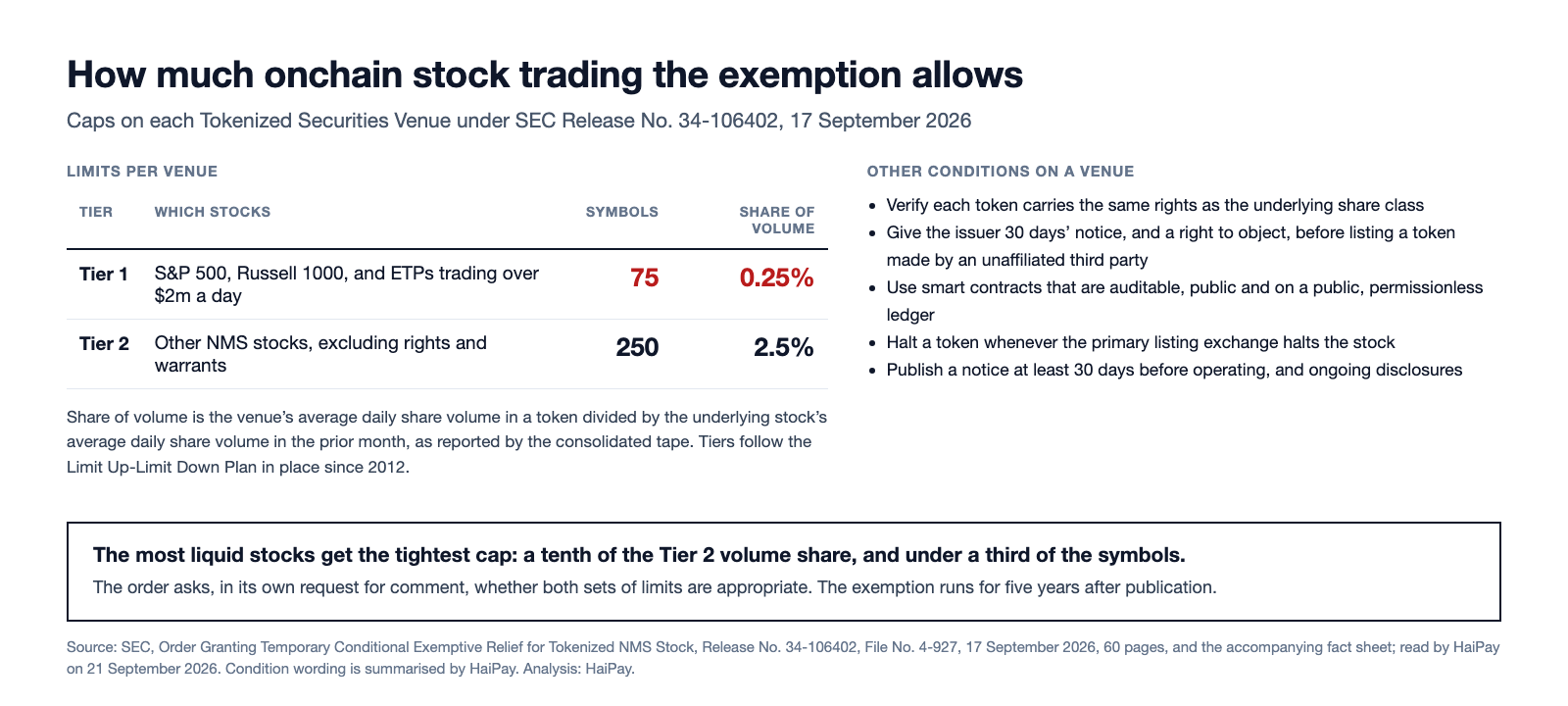
The order has numbers in it that the announcement did not. A venue can trade at most 75 tokenised Tier 1 stocks, and in each of them no more than 0.25% of the underlying stock's average daily share volume. For Tier 2 stocks the limits are 250 symbols and 2.5%.
What the order allows
The order, Release No. 34-106402, creates a category called a Tokenized Securities Venue. A venue brings together buyers and sellers of tokenised NMS stock by running one or more automated market maker liquidity pools for permissioned participants, and by setting the standards for who may access them.
It grants two temporary exemptions. The venue is exempted from the definition of "exchange" in the Securities Exchange Act. Liquidity providers who supply tokenised stock from their own capital, and who may quote prices or commit capital, are exempted from the definition of "dealer." Both run for five years after publication.
Participants can include retail investors. The order says so, and asks each venue to disclose who is eligible.
The limits, in numbers
The two tiers are borrowed from the Limit Up-Limit Down Plan, which has sorted US equities since 2012. Tier 1 is the S&P 500, the Russell 1000, and exchange-traded products trading over $2 million a day. Tier 2 is everything else, less rights and warrants.
The volume share is calculated per stock: a venue's average daily share volume in a token, divided by the underlying stock's average daily share volume in the prior month as reported by the consolidated tape.
The shape of that is worth noticing. The largest and most liquid names get the tightest limit, a tenth of the Tier 2 volume share and fewer than a third of the symbols. The order does not explain the design in those terms. The arithmetic is simple, though: a venue may take up to ten times the share of trading in a smaller stock that it may take in a large one.
The SEC is not certain it has these right. Among the ten numbered questions in its request for comment, it asks directly whether 75 symbols and 0.25%, and 250 symbols and 2.5%, are appropriate.
The conditions
A venue must verify that each token gives holders the same rights and privileges as the underlying share class. If an unaffiliated third party made the token, the venue must give the issuer written notice, and trading cannot begin until 30 calendar days after the issuer receives it; an issuer may object within that window.
Smart contracts must be auditable, public, and deployed on a public, permissionless distributed ledger. Trading in a token must halt whenever the primary listing exchange halts the stock. And a venue must publish a notice on its website at least 30 calendar days before it operates, with further disclosures after that.
Tokenised stock, for these purposes, does not include a crypto asset that a third party issues as its own security to give synthetic exposure to a share, such as a tokenised linked security. The order does not name any product, and HaiPay offers no legal view on where any particular product falls.
The cash leg
This is the part that matters for payments, and it is in a footnote.
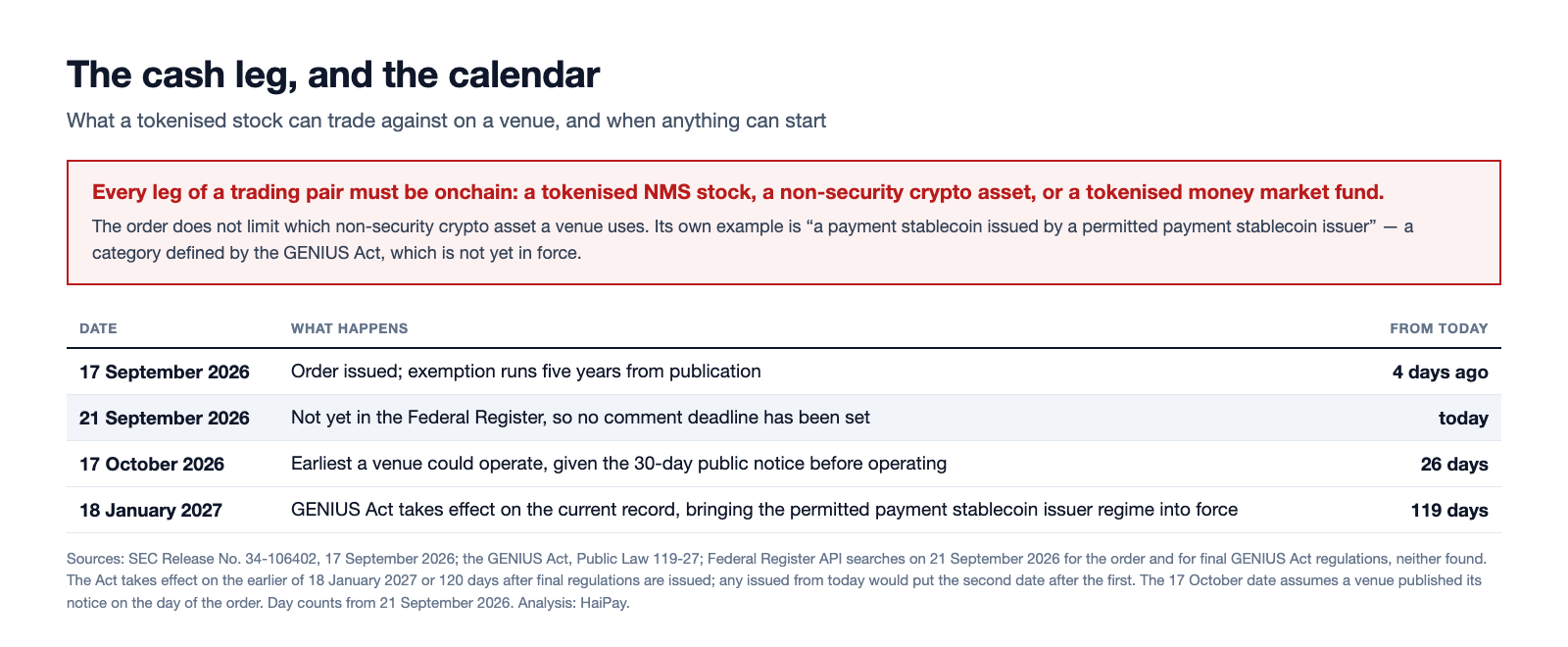
Every leg of a trading pair on a venue must be a tokenised NMS stock, a non-security crypto asset, or a tokenised money market fund. Everything that trades is onchain. The order states that it "does not limit the type of non-security crypto asset" a venue can pair with a tokenised stock, and leaves that choice to the venue.
Its own example of the money side is "a payment stablecoin issued by a permitted payment stablecoin issuer." That is a category created by the GENIUS Act, which is not yet in force. The order notes that such stablecoins will categorically not be securities only after the Act's effective date.
That date is the earlier of 18 January 2027 or 120 days after final implementing regulations. HaiPay found no final regulations in the Federal Register as of 21 September, and any issued from today would put the 120-day date after 18 January. On the current record, the legal category behind the SEC's model settlement asset takes effect in 119 days.
In the meantime, the choice of what a tokenised share trades against belongs to whoever runs the venue.
The calendar
No venue can use the exemption before 17 October, because of the 30-day public notice, and only then if its notice went up on the day of the order.
The order had not appeared in the Federal Register by 21 September, four days after it was issued. Its comment period is tied to that publication, so no deadline has yet been set. Comments go to file number 4-927.
What HaiPay could not establish
How many venues intend to operate under the exemption, or whether any has published its 30-day notice. Those notices go on each venue's own website and there is no central list.
What 0.25% of volume means in shares or dollars for any given stock. That depends on each stock's prior-month volume, which changes monthly, and HaiPay did not compute it.
When the five-year clock starts. The order says five years after publication without, in the text HaiPay read, defining publication as the Federal Register date or the date on the SEC's website.
HaiPay did not contact the SEC or any prospective venue.
What to watch
The first 30-day notices. They are public by design, and the first one to appear will show which stablecoin, if any, is chosen as the cash leg.
Federal Register publication, which starts the comment period.
And 18 January 2027, when the regime behind the stablecoin in the SEC's own example takes effect.
This piece reads an SEC order and its fact sheet. It is not legal or investment advice.
How to cite
HaiPay News, "The SEC's Onchain Stock Limits: 75 Symbols, 0.25% of Volume", https://www.haipay.net/news/sec-innovation-exemption-tokenized-stock-limits, September 21st, 2026
About the author
Crystal
Digital Public Relations
A digital PR specialist with a Master's in Journalism & Communication from UNSW. Started as an intern at ABC Australia, now leads public relations at Haipay, crafting press releases and media strategies that bring brand stories to life.
Reviewed by WeiJun TangEditorial policy
4 sources
- U.S. Securities and Exchange Commission
Order Granting Temporary Conditional Exemptive Relief for Tokenized NMS Stock on Tokenized Securities Venues, Release No. 34-106402, File No. 4-927
- U.S. Securities and Exchange Commission
Fact Sheet: Order Granting Temporary Conditional Exemptive Relief for Trading of Tokenized NMS Stock on Tokenized Securities Venues
- U.S. Securities and Exchange Commission
SEC Issues Innovation Exemption to Facilitate the Trading of Tokenized NMS Stock and Requests Comment, press release 2026-90
- United States Congress
GENIUS Act, Public Law 119-27