Hong Kong E-Wallet Value Fell 7.4%. Spending Rose 12.8%.
The Hong Kong Monetary Authority published its quarterly e-wallet statistics on 18 September. The headline figure it gave was that the value of transactions through stored value facilities fell 7.4% year on year, to HK$264.7 billion in the second quarter. That number is accurate, and it points the wrong way. Spending through those same wallets rose 12.8%.
September 21st, 2026
Last updated: September 21
Key takeaways
- HKMA data show e-wallet transaction value fell 7.4% year on year in Q2 2026, to HK$264.7 billion.
- Spending payments through those wallets rose 12.8%; point-of-sale spending rose 9.8% and online 17.3%.
- The fall came from top-ups, withdrawals and transfers, which together dropped HK$30.4 billion.
- Spending rose from 25.3% to 30.8% of all value moving through Hong Kong e-wallets.
- Credit cards in circulation rose 36.1% to 31.03 million, while value per card fell 21.5%.
- Overseas credit card purchases rose 19% by number but were flat by value, so each got smaller.
Data highlight
12.8per cent rise in e-wallet spending value, year on year
Year-on-year change in the value of spending payments through Hong Kong stored value facilities
Q2 2026
Read by HaiPay on 21 September 2026 from the Hong Kong Monetary Authority's Statistics of SVF Schemes Issued by SVF Licensees for the second quarter of 2026 and its annex, published 18 September 2026. Total value of SVF transactions was HK$264,736 million in Q2 2026 against HK$285,821 million in Q2 2025, a fall of 7.4 per cent. Of that, spending payments were HK$81,477 million against HK$72,211 million, a rise of 12.8 per cent, comprising point-of-sale spending of HK$47,698 million, up 9.8 per cent, and online spending of HK$33,779 million, up 17.3 per cent. Adding value fell 11.2 per cent to HK$107,166 million, withdrawal fell 18.2 per cent to HK$59,645 million and person-to-person transfers fell 17.9 per cent to HK$16,448 million; together those three fell by HK$30,350 million, or 14.2 per cent. Spending payments rose from 25.3 to 30.8 per cent of total value. Average values, calculated by HaiPay from the HKMA's value and count figures, were HK$40.7 rising to HK$44.4 for spending payments and HK$1,087 falling to HK$788 for withdrawals. SVF accounts in use were 90.382 million at the end of Q2 2026, up 9.2 per cent year on year, and SVF deposit and float was HK$21,846 million, up 7.3 per cent. Both quarters use the classification the HKMA applies from Q1 2025. From the HKMA's payment card statistics for the same quarter, published the same day, credit cards in circulation were 31.03 million against 22.80 million a year earlier, up 36.1 per cent, and credit card transaction value per card fell from HK$11,769 to HK$9,233 in the quarter, down 21.5 per cent; overseas retail transactions rose 19.0 per cent by number and fell 0.1 per cent by value, so the average overseas transaction fell from HK$931 to HK$781. The HKMA does not explain the rise in cards in circulation or break overseas spending down by destination. HaiPay did not contact the HKMA or any SVF licensee.
The Hong Kong Monetary Authority published its quarterly e-wallet statistics on 18 September. The headline figure it gave was that the value of transactions through stored value facilities fell 7.4% year on year, to HK$264.7 billion in the second quarter.
That number is accurate, and it points the wrong way. Spending through those same wallets rose 12.8%.
What the headline contains
Stored value facilities are Hong Kong's licensed e-wallets and prepaid products: the category that covers transport cards, mobile wallets and prepaid accounts. The HKMA's total value figure adds together four different things: spending payments, money added to wallets, money withdrawn from them, and transfers between people.
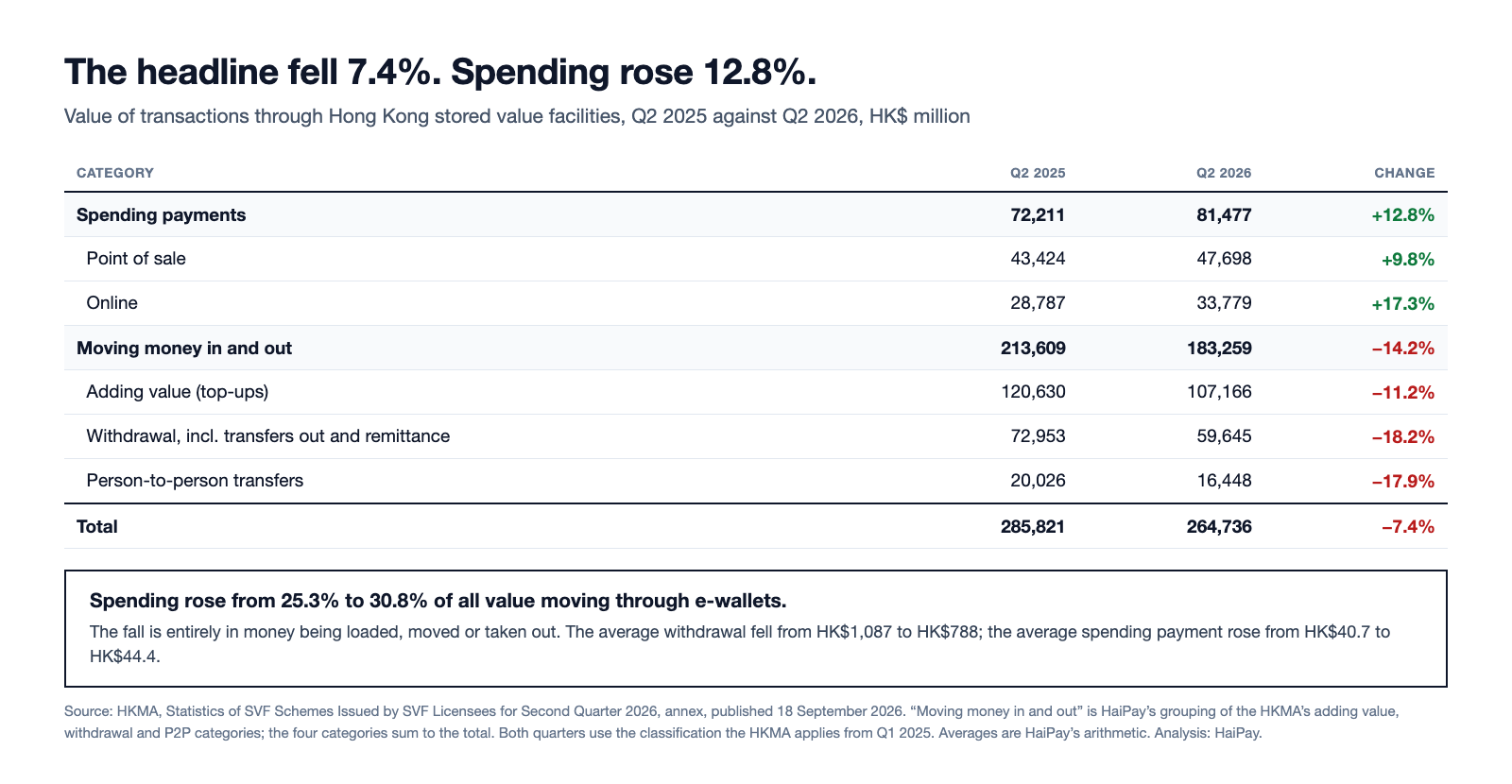
Split out, the second quarter of 2026 against the same quarter of 2025 looks like this. Spending payments rose from HK$72.2 billion to HK$81.5 billion, up 12.8%. Within that, point-of-sale spending rose 9.8% and online spending rose 17.3%.
Everything that fell was money moving in and out. Adding value fell 11.2%. Withdrawals, which the HKMA defines to include ATM cash, transfers to other financial institutions and outward remittance, fell 18.2%. Person-to-person transfers fell 17.9%. Together those three dropped by HK$30.4 billion, more than enough to turn a HK$9.3 billion rise in spending into a HK$21.1 billion fall overall.
As a result, spending went from 25.3% of all value moving through e-wallets to 30.8%.
The averages tell the same story from the other side. The average spending payment rose from HK$40.7 to HK$44.4. The average withdrawal fell from HK$1,087 to HK$788, the average top-up from HK$513 to HK$448, and the average person-to-person transfer from HK$400 to HK$306. The big-ticket movements shrank; the everyday payments grew.
The comparison is like for like. The HKMA reclassified some transactions into its withdrawal category from the first quarter of 2025, and both quarters compared here use that classification.
The number of wallets keeps rising
Accounts in use reached 90.38 million at the end of June, up 9.2% in a year. The float held in them, the money sitting in wallets, rose 7.3% to HK$21.8 billion. Transaction numbers rose 3.6%, with online spending payments up 12.8% by count.
So more wallets, more money parked in them, more purchases made with them, and less money being shuttled through them. That is a picture of wallets being used more as a way to pay and less as a place to route money.
The card side
The HKMA published its payment card statistics the same day, and they contain a number that needs explaining and does not get one.
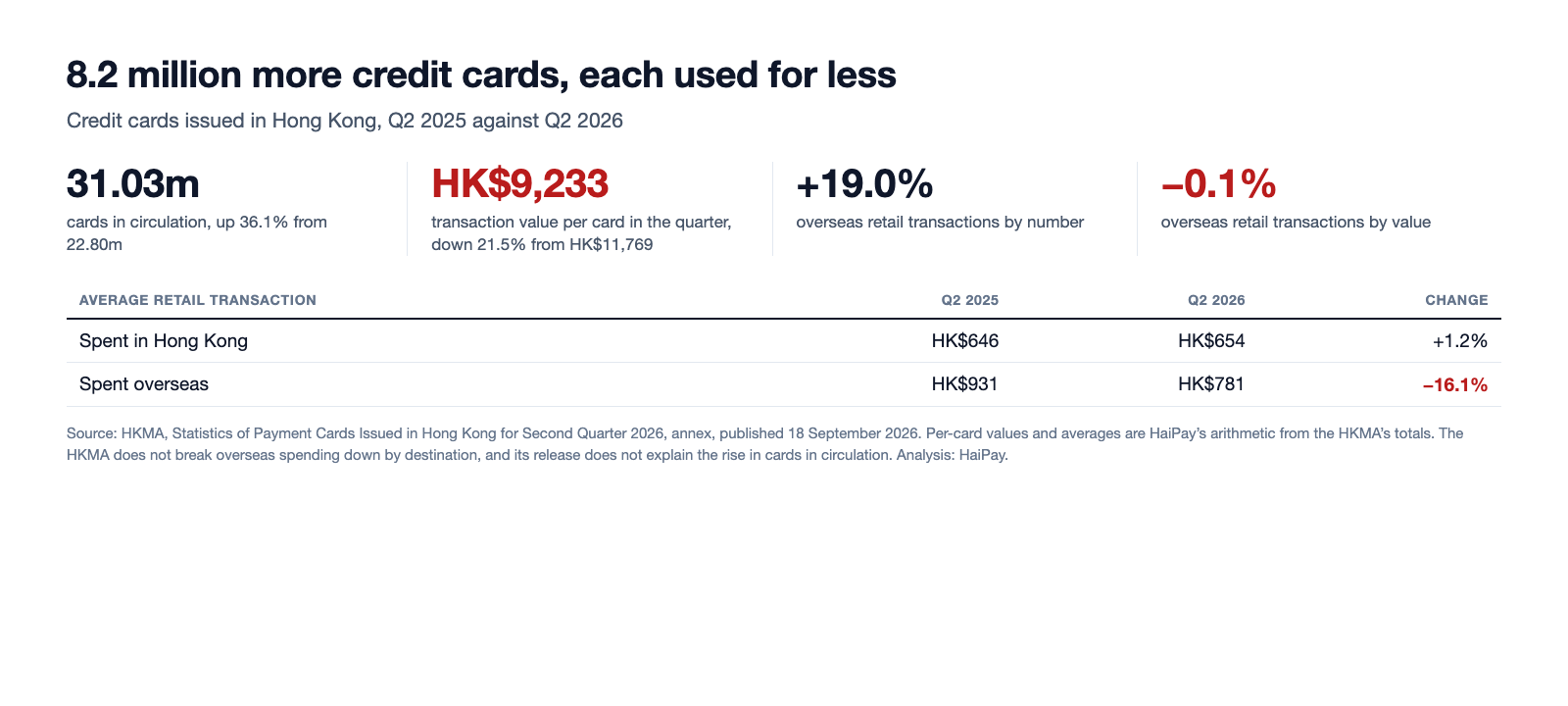
Credit cards in circulation reached 31.03 million at the end of June, up from 22.80 million a year earlier. That is 8.2 million more cards, an increase of 36.1%, and 6.3% in the latest quarter alone.
Card use did not keep pace. Total credit card transaction value rose 6.8%, so value per card fell from HK$11,769 in the quarter to HK$9,233, down 21.5%. Transactions per card fell from 15.8 to 13.0.
Overseas spending moved in two directions at once. The number of overseas retail transactions on Hong Kong-issued credit cards rose 19.0% year on year; their value was flat, down 0.1%. The average overseas transaction fell from HK$931 to HK$781, while the average transaction in Hong Kong edged up from HK$646 to HK$654. More purchases abroad, each one smaller.
The HKMA's release does not say why the card count jumped, and it does not break overseas spending down by destination. HaiPay is not attributing either pattern to a cause.
What HaiPay could not establish
Why credit cards in circulation rose by 36.1%. The release gives no explanation, and the figure could reflect new issuance, a change in how cards are counted, or both.
Where the overseas spending went. The statistics distinguish only Hong Kong from overseas.
How individual wallets performed. The HKMA publishes industry totals only, and names no scheme.
HaiPay did not contact the HKMA or any SVF licensee.
What to watch
The third-quarter release, which on the HKMA's usual quarterly timing would be expected around December, and which will show whether spending keeps rising as a share of wallet value or whether the second quarter was an outlier.
Whether the HKMA explains the card count. A 36.1% annual rise in a mature card market is either a real shift or a statistical one, and the answer changes how every per-card figure should be read.
And the overseas average. A falling average ticket alongside rising transaction counts is the pattern a reader would expect from more frequent, smaller cross-border purchases, but the data as published cannot confirm it.
This piece reads published HKMA statistics. It is not investment advice.
How to cite
HaiPay News, "Hong Kong E-Wallet Value Fell 7.4%. Spending Rose 12.8%.", https://www.haipay.net/news/hong-kong-e-wallet-spending-q2-2026, September 21st, 2026
About the author
Crystal
Digital Public Relations
A digital PR specialist with a Master's in Journalism & Communication from UNSW. Started as an intern at ABC Australia, now leads public relations at Haipay, crafting press releases and media strategies that bring brand stories to life.
Reviewed by WeiJun TangEditorial policy
4 sources
- Hong Kong Monetary Authority
Statistics of Stored Value Facilities (SVF) Schemes Issued by SVF Licensees
- Hong Kong Monetary Authority
Statistics of SVF Schemes Issued by SVF Licensees for Second Quarter 2026, annex
- Hong Kong Monetary Authority
Statistics of Payment Cards Issued in Hong Kong for Second Quarter 2026
- Hong Kong Monetary Authority
Statistics of Payment Cards Issued in Hong Kong for Second Quarter 2026, annex