Four MoMo Markets Migrated. Nigeria Is Not One of Them.
Ericsson and MTN Group Fintech said on Friday they had completed a migration of MTN's MoMo mobile money platform to a cloud-native architecture in four African markets. MoMo carried 13.0 billion transactions worth 330.5 billion dollars in the first half of 2026. The announcement about modernising it contains no figure of that kind at all.
August 25th, 2026
Last updated: August 25
Key takeaways
- Ericsson and MTN completed a MoMo platform migration in Eswatini, Ghana, Rwanda and Uganda on 21 August.
- The announcement gives only infrastructure figures: CPU and database load down up to 86%, APIs 80% faster.
- No baseline is given for any of those figures, and no user or transaction number appears at all.
- Nigeria, MTN's largest fintech market, is not listed as complete, in progress or under discussion.
- Eswatini is one of the four completed markets and is not mentioned once in MTN's interim results.
- MTN reported 70.8m MoMo monthly active users and US$330.5bn of transaction value in H1 2026, group-wide.
Data highlight
0figures
User-facing figures disclosed in the MoMo migration announcement
2026-08-21
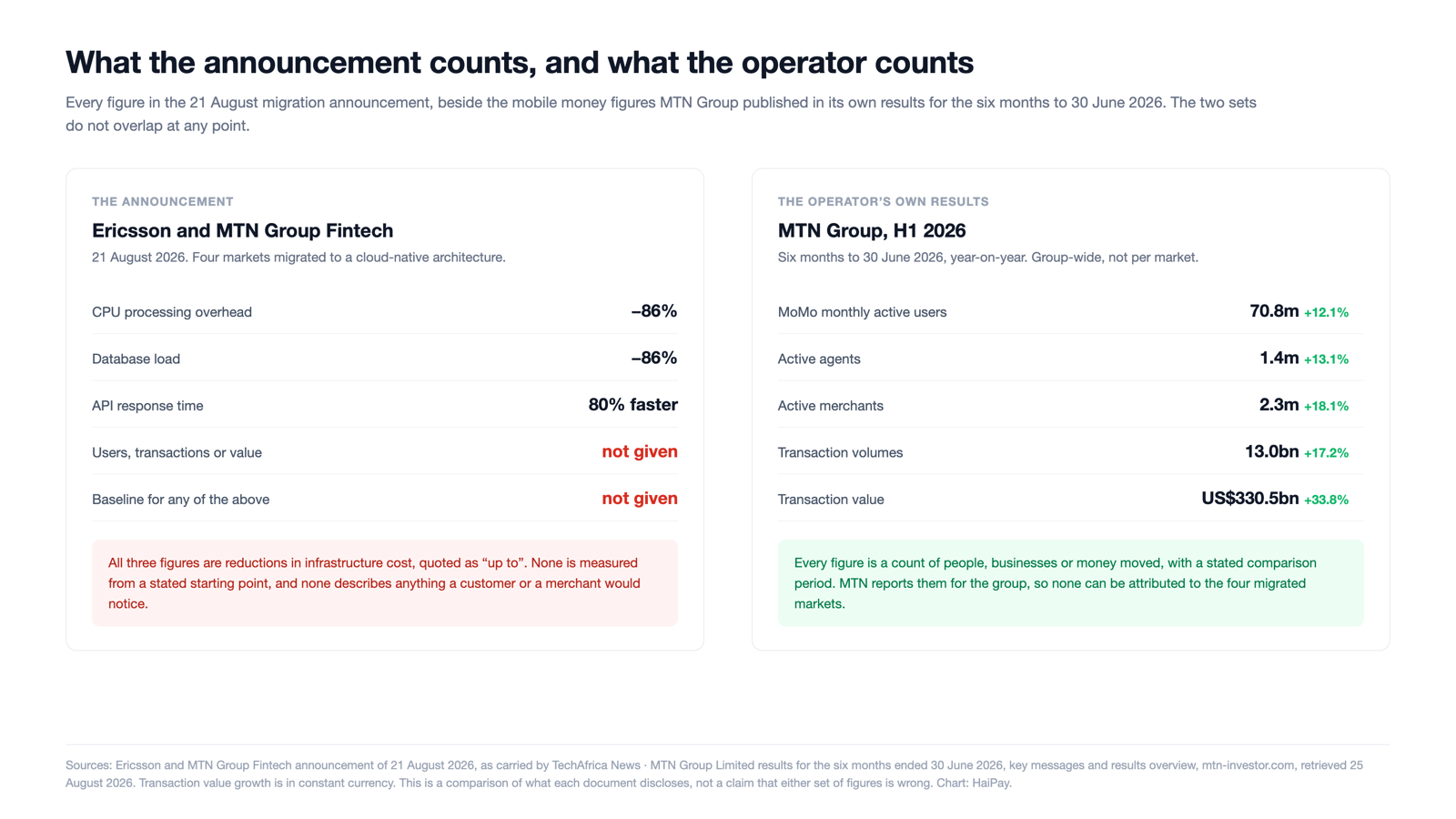
Enumeration of every quantitative claim in the Ericsson and MTN Group Fintech announcement of 21 August 2026, classified as infrastructure metrics or as counts of users, transactions, value, availability or downtime. The announcement contains three quantitative claims, all describing the cost of running the platform: CPU processing overhead and database load reduced by up to 86 per cent, and API response times 80 per cent faster. None carries a stated baseline. No figure is given for users, transactions, transaction value, availability or downtime, in the four completed markets or in aggregate. Over the same period MTN Group's results for the six months ended 30 June 2026 report 70.8 million MoMo monthly active users, 1.4 million active agents, 2.3 million active merchants, 13.0 billion transactions and 330.5 billion dollars of transaction value, all reported group-wide and therefore not attributable to the four markets.
“The MoMo Evolved Migration advances our vision of building Africa's leading digital financial platform”
Ericsson and MTN Group Fintech said on Friday they had completed a migration of MTN's MoMo mobile money platform to a cloud-native architecture in four African markets: Eswatini, Ghana, Rwanda and Uganda.
MoMo is the largest mobile money business on the continent. In the six months to 30 June 2026 it carried 13.0 billion transactions worth 330.5 billion dollars for 70.8 million monthly active users. The announcement about modernising the platform that carries them contains no figure of that kind at all.
What the announcement measures
Three numbers appear in it. CPU processing overhead and database load fell by up to 86 per cent. API response times are 80 per cent faster. Each is quoted as an improvement without a starting point, and all three describe the cost of running the system rather than anything a customer or an agent would experience.
That is normal for a vendor infrastructure announcement and it is not a criticism of the work. Reducing database load by a large fraction on a platform of this size is a substantial engineering result. It is worth being clear, though, about what has and has not been disclosed: no user, transaction, value, availability or downtime figure is given for the four markets, before or after.
Artemij Demidczyk, acting chief technology and information officer at MTN Group Fintech, is quoted saying the migration "advances our vision of building Africa's leading digital financial platform". Hossam Kandeel, head of mobile money and business development for Ericsson in West and Southern Africa, is quoted on the importance of modernising mobile financial services infrastructure. Neither quotation carries a metric.
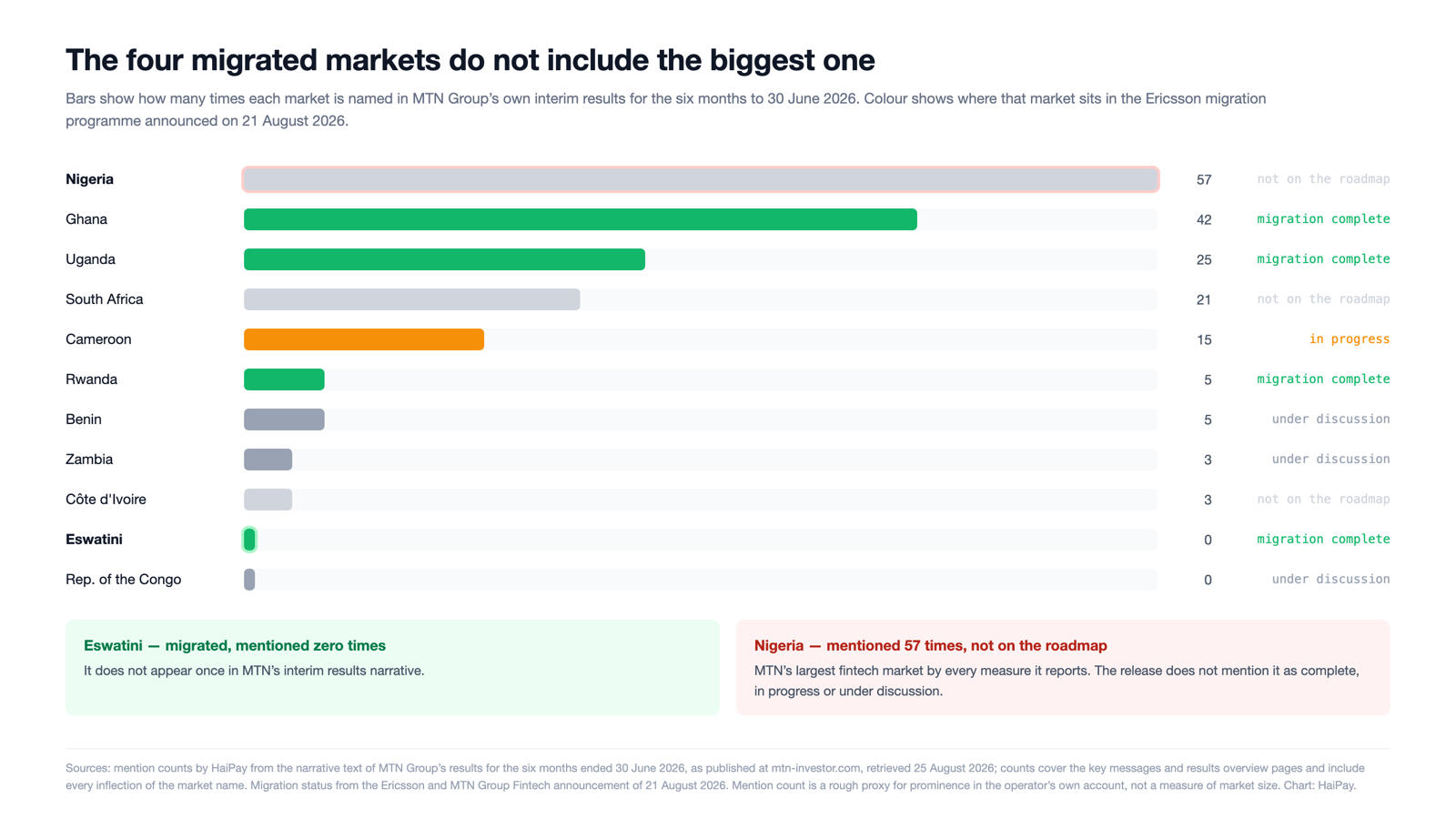
The four markets, and the one that is missing
The release names Cameroon as an ongoing project and Benin, the Republic of the Congo and Zambia as markets in discussion. Nigeria does not appear anywhere in it — not as complete, not in progress, not under discussion.
Nigeria is MTN's largest fintech market. It is named 57 times in MTN Group's own results narrative for the first half of 2026, more than any other country. MoMo MAU growth in the period was described as driven "particularly in Nigeria". The structural separation of the Nigerian fintech business is still working through regulatory approvals, and the Ant International super-app partnership is due to launch there first.
At the other end of the same list is Eswatini, which is one of the four completed migrations and which MTN's interim results narrative does not mention once.
None of this makes the sequencing wrong. Migrating a smaller market first is exactly how a team de-risks a platform change, and Ghana and Uganda are not small. It does mean that a headline describing completion "in African markets" covers four of a footprint that MTN's own results discuss across at least eight, and excludes the biggest.
What MTN reported in the same period
MTN published its results for the six months to 30 June 2026 earlier this month. Across the group, MoMo monthly active users rose 12.1 per cent to 70.8 million. Active agents grew 13.1 per cent to 1.4 million and active merchants 18.1 per cent to 2.3 million. Transaction volumes rose 17.2 per cent to 13.0 billion and transaction value 33.8 per cent in constant currency to 330.5 billion dollars.
Fintech revenue grew 13.3 per cent in constant currency, and 1.4 per cent as reported, to 14.9 billion rand. Advanced services — lending, remittances, payments and insurance rather than cash-in and cash-out — reached 37.4 per cent of fintech revenue excluding airtime advance, up four percentage points.
These are group figures. MTN does not break MoMo user or transaction numbers out by market in the interim results, so none of them can be attributed to the four migrated markets, and no before-and-after comparison for those markets is possible from public data.
One market appears in both documents, for opposite reasons
Uganda is on the completed migration list. It is also one of two markets MTN singles out for fintech trouble in the same half.
MTN attributes that trouble specifically. Fintech revenue growth, it says, was held back by the suspension of airtime advance in Nigeria and by "operational disruptions within the Uganda agent network". The agent network is the human distribution layer of cash-in and cash-out points, not the platform. MTN does not connect the disruption to any technology migration, and neither do we; we note the overlap because both documents cover the same market in the same period and a reader comparing them will see it.
Why the modernisation is happening now
The context MTN gives is a shift in what MoMo earns from. Growth in cash-out, person-to-person transfers and withdrawals was described as more muted in Ghana, Uganda, Côte d'Ivoire and Cameroon, reflecting competitive and regulatory pricing pressure and what MTN calls the industry-wide maturation of basic mobile money.
The growth is in advanced services instead. Lending facilitated 2.7 billion dollars of loan value in the half, up 78.3 per cent. Virtual cards issued with Mastercard reached about 954,000 year to date across seven markets. Remittance transaction values rose 11.5 per cent.
Those products need more from a platform than a transfer rail does: more integrations, more real-time decisions, more third parties calling in. An API response time is not a customer metric, but it is a reasonable thing to care about if the plan is to sell services that other systems have to call.
What is established and what is not
Established: Ericsson and MTN Group Fintech announced on 21 August 2026 that the MoMo migration is complete in Eswatini, Ghana, Rwanda and Uganda, ongoing in Cameroon, and under discussion for Benin, the Republic of the Congo and Zambia. The announcement gives reductions of up to 86 per cent in CPU processing overhead and database load and 80 per cent faster API response times, with no baseline, and no user or transaction figures. MTN Group's results for the six months to 30 June 2026 report 70.8 million MoMo monthly active users, 1.4 million agents, 2.3 million merchants, 13.0 billion transactions and 330.5 billion dollars of transaction value, all group-wide. MTN attributes fintech revenue pressure to airtime advance suspension in Nigeria and agent network disruption in Uganda.
Not established: what the 86 per cent and 80 per cent figures are measured against; whether service quality changed for users in the four markets; how many markets MoMo operates in, which MTN does not state in the interim results; whether Nigeria is planned for migration at all; and whether the Uganda agent network disruption has any relationship to the platform work, which neither company suggests and which we have not tested.
The narrow reading is that the platform carrying 330 billion dollars a half has been modernised in four of its markets, and that the only numbers published about it describe how much less processor time it now uses.
How to cite
HaiPay News, "Four MoMo Markets Migrated. Nigeria Is Not One of Them.", https://www.haipay.net/news/mtn-momo-migration-four-markets-cpu-metrics, August 25th, 2026
About the author
Crystal
Digital Public Relations
A digital PR specialist with a Master's in Journalism & Communication from UNSW. Started as an intern at ABC Australia, now leads public relations at Haipay, crafting press releases and media strategies that bring brand stories to life.
Reviewed by WeiJun TangEditorial policy