NewsLocal Payments
MAS Raised Fintech Funding 47%. It Is Still Below FSTI 2.0.
Against the round now ending, S$220 million is an increase of 46.7 per cent. Against the round before it, it is a reduction of 12 per cent. Both readings are true and MAS has published the data for either.
Key takeaways 6
- MAS committed S$220 million over three years to FSTI 4.0, the fourth iteration of the scheme since 2015.
- That is 46.7 per cent above FSTI 3.0's S$150 million and 12 per cent below FSTI 2.0's S$250 million.
- Per year it is S$73.3 million, against S$83.3 million a year in the 2020 to 2023 round.
- The release names six tracks but does not say how the S$220 million divides between them.
- MAS puts Singapore's sector at 1,800+ fintech firms, close to 10,000 staff, and S$2.9 billion of investment in 2025.
- Across four iterations the scheme has committed S$845 million in total.
The Monetary Authority of Singapore announced on 31 August that it will commit S$220 million over three years to the renewed Financial Sector Technology and Innovation Scheme, FSTI 4.0. The money runs through six tracks covering institutional innovation, AI adoption, infrastructure and talent, and MAS says it will support at least 1,000 FinTech internship opportunities over the period.
MAS published an annex alongside the release setting out every previous iteration of the scheme. Read against it, the S$220 million is both a substantial increase and a figure that has been beaten before.
Four rounds since 2015
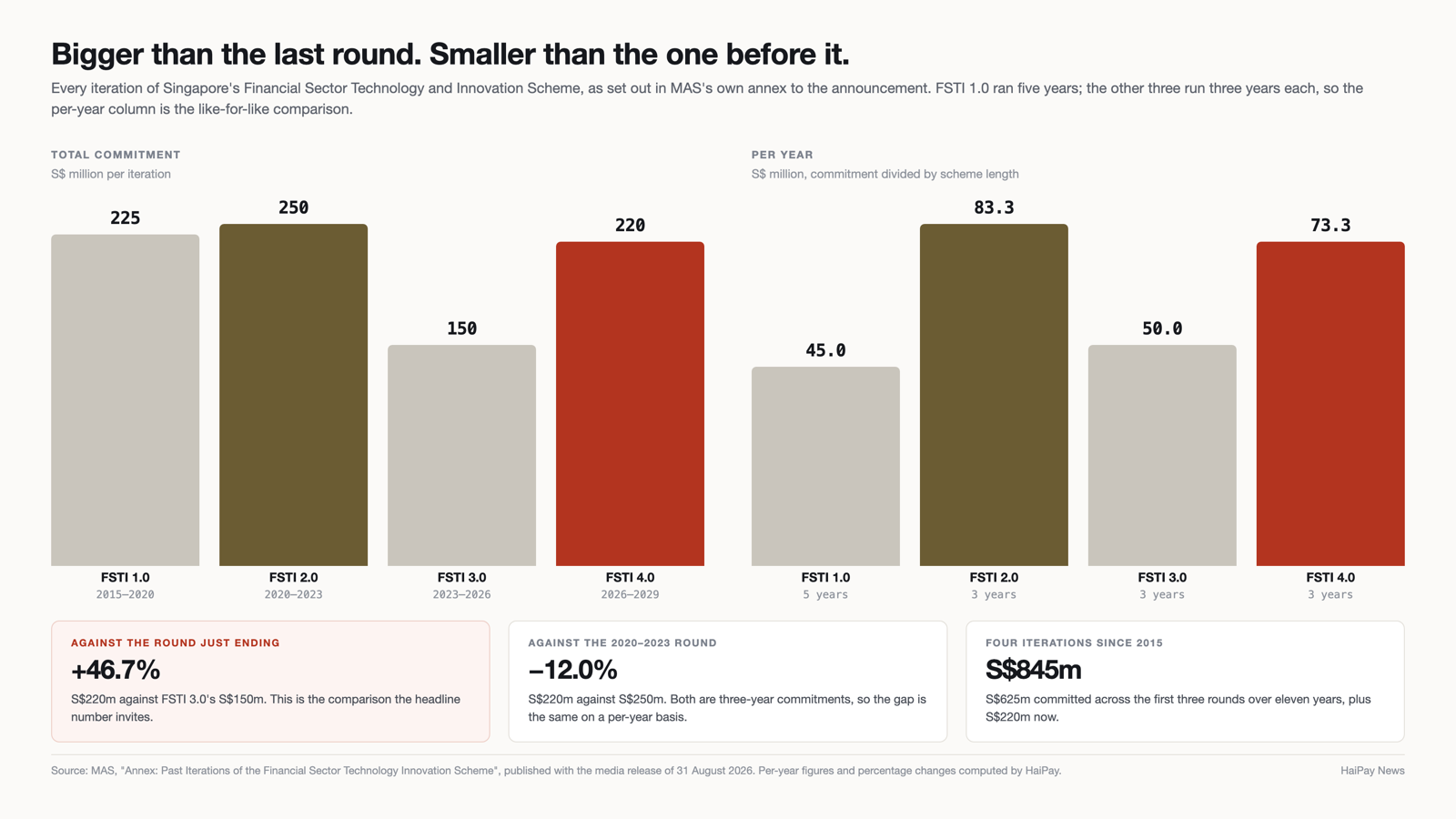
FSTI 1.0 ran from 2015 to 2020 with S$225 million over five years. FSTI 2.0 followed with S$250 million over three. FSTI 3.0, which the new round replaces, was S$150 million over three years. FSTI 4.0 is S$220 million over three.
Against the round now ending, that is an increase of 46.7 per cent. Against the round before it, it is a reduction of 12 per cent. Because 2.0, 3.0 and 4.0 are all three-year commitments, the per-year picture is the same: S$73.3 million a year now, against S$83.3 million a year between 2020 and 2023.
Both readings are true and MAS has published the data for either. Which one travels depends on where the comparison starts. The headline figure is a recovery from the smallest round the scheme has had, not a new high, and the annual run rate remains below the level of six years ago.
Across all four iterations the scheme has now committed S$845 million, of which S$625 million covered the eleven years from 2015 to 2026.
Six tracks, no published split
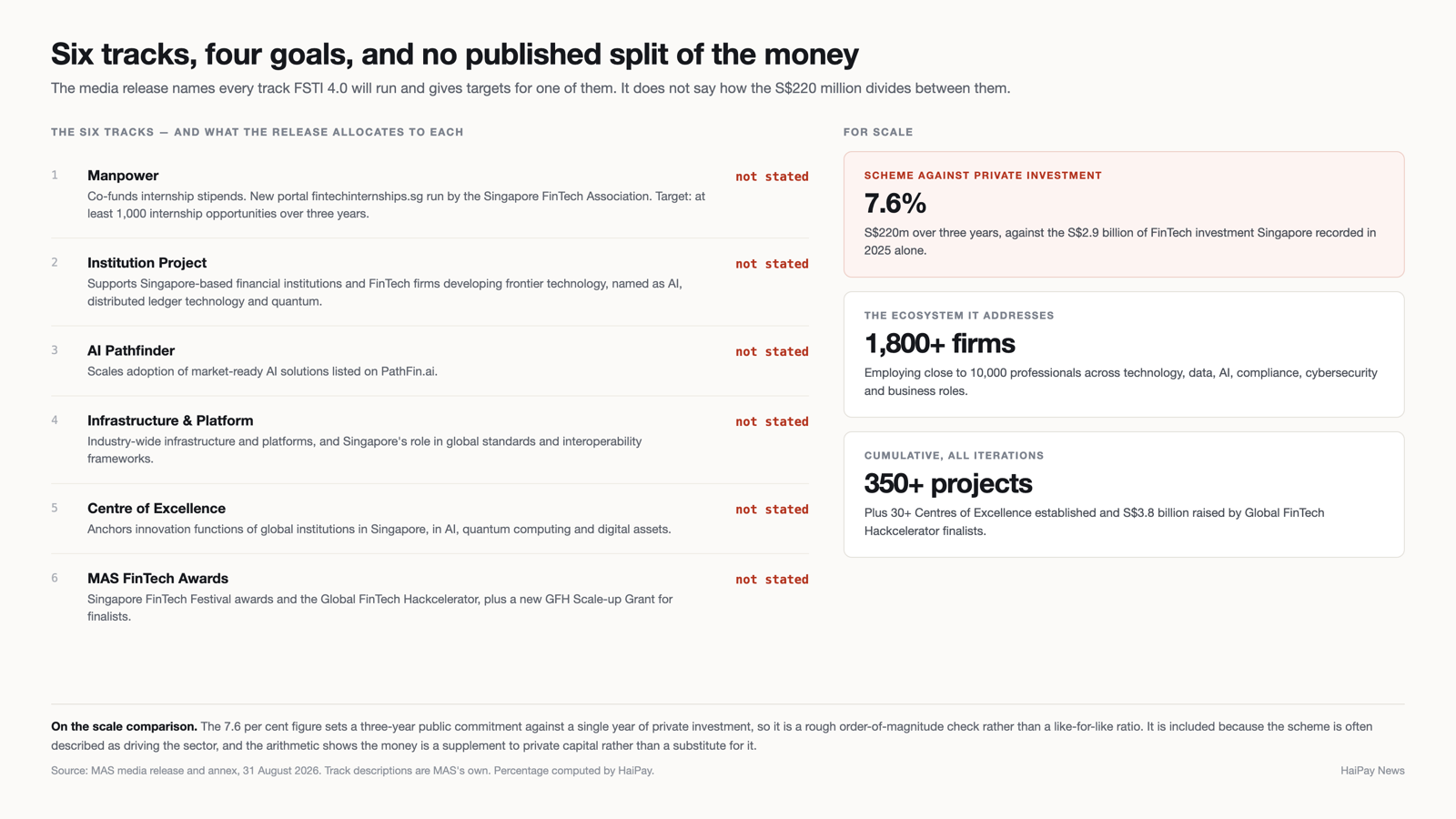
The release names all six tracks and describes what each is for. It gives a target for one of them, the 1,000 internships. It does not say how the S$220 million divides between them, so there is no way to tell from the announcement whether the weight sits with the Institution Project track, the Centres of Excellence, or the infrastructure work.
That matters for anyone deciding whether to apply. The tracks address very different constituencies: a financial institution building on distributed ledger technology, a firm listing an AI product on PathFin.ai, and a startup entering the Global FinTech Hackcelerator are three separate propositions with three separate economics, and the release gives no basis for estimating what is available to any of them.
The size of the thing being supported
MAS puts Singapore's fintech sector at more than 1,800 firms employing close to 10,000 people, and says fintech investment in Singapore reached S$2.9 billion in 2025.
Set the new commitment against that last figure and S$220 million over three years is about 7.6 per cent of one year of private investment. That comparison is deliberately rough, because it puts a three-year public commitment beside a single year of private capital, but it is the right order of magnitude to have in mind. The scheme is a supplement to private funding and to the ecosystem's own scale, not the thing that funds it.
The cumulative claims MAS makes for the scheme across all iterations are 350 or more projects supported, more than 30 Centres of Excellence established, and S$3.8 billion raised by Global FinTech Hackcelerator finalists. That last figure is money raised by companies that reached the finals, not money attributable to the scheme.
What we could not verify
Everything above comes from the MAS release of 31 August and the annex published with it. We did not independently verify the ecosystem figures, the S$2.9 billion investment total for 2025, or the cumulative impact claims, and MAS does not source them in the annex.
We did not obtain the detailed scheme conditions. The release points to a scheme page on mas.gov.sg for further details, which we did not review, so eligibility criteria, co-funding ratios and per-project caps are outside what this piece can say. Those are the numbers that determine what the scheme is actually worth to an applicant.
We also could not establish whether the FSTI 3.0 commitment was fully drawn. A commitment is an allocation, not a disbursement, and none of the four figures in the annex is described as spent rather than committed. Comparing commitments across rounds is comparing intentions.
What to watch
The scheme conditions, because the co-funding ratio and caps decide whether S$220 million reaches many firms in small amounts or a few in large ones. The Singapore FinTech Festival on 18 to 20 November, where the awards track and the new Global FinTech Hackcelerator Scale-up Grant will be visible and where allocation detail usually surfaces. And whether MAS reports drawdown against FSTI 3.0, which would turn the comparison in Figure 1 from one of intentions into one of outcomes.
Data highlight
46.7 percent
Increase in total FSTI funding commitment from the third to the fourth iteration
FSTI 3.0 (2023–2026) to FSTI 4.0 (2026–2029)
Read the methodology and limitations
Methodology and limitations
Computed from the funding commitments MAS published in "Annex: Past Iterations of the Financial Sector Technology Innovation Scheme", issued with its media release of 31 August 2026. The annex gives FSTI 1.0 at S$225 million over five years (2015-2020), FSTI 2.0 at S$250 million over three years (2020-2023) and FSTI 3.0 at S$150 million over three years (2023-2026). The media release gives FSTI 4.0 at S$220 million over three years. The increase from FSTI 3.0 is 220 divided by 150, or 46.7 per cent.
The change from FSTI 2.0 is 220 divided by 250, a reduction of 12.0 per cent. Per-year figures divide each commitment by its stated length, giving S$45.0m, S$83.3m, S$50.0m and S$73.3m respectively; because 2.0, 3.0 and 4.0 are all three-year schemes, the per-year comparison between them is identical to the total comparison. The four-iteration total of S$845 million is the sum of the four commitments. All figures are commitments as published; MAS does not state amounts drawn or disbursed, so these compare allocations rather than spending.
Term definition
- FSTI Scheme
- The Financial Sector Technology and Innovation Scheme, run by the Monetary Authority of Singapore since 2015 to co-fund technology projects in the financial sector. FSTI 4.0 is its fourth iteration and runs from 2026 to 2029.
- Funding commitment
- An amount an authority allocates to a scheme over a stated period. It is not the same as money disbursed: a commitment can go undrawn, so comparing commitments across scheme rounds compares intentions rather than spending.
- Centre of Excellence
- Under the FSTI scheme, an innovation function that a global financial institution or technology firm anchors in Singapore. MAS says more than 30 have been established across all iterations of the scheme.
2 sources
How to cite
HaiPay News, "MAS Raised Fintech Funding 47%. It Is Still Below FSTI 2.0.", https://www.haipay.net/news/mas-fsti-4-220-million, 1 September 2026