NewsLocal Payments
Argentina Made 7 Billion Fast Payments. Five Years Ago, 327m
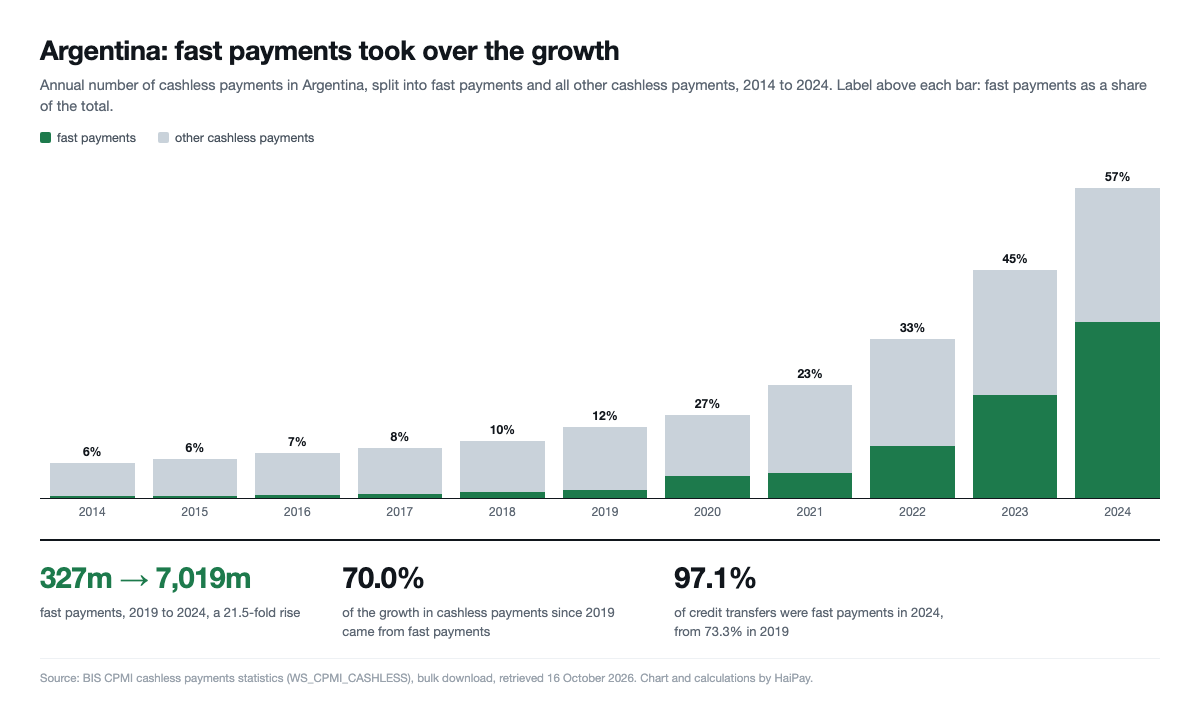
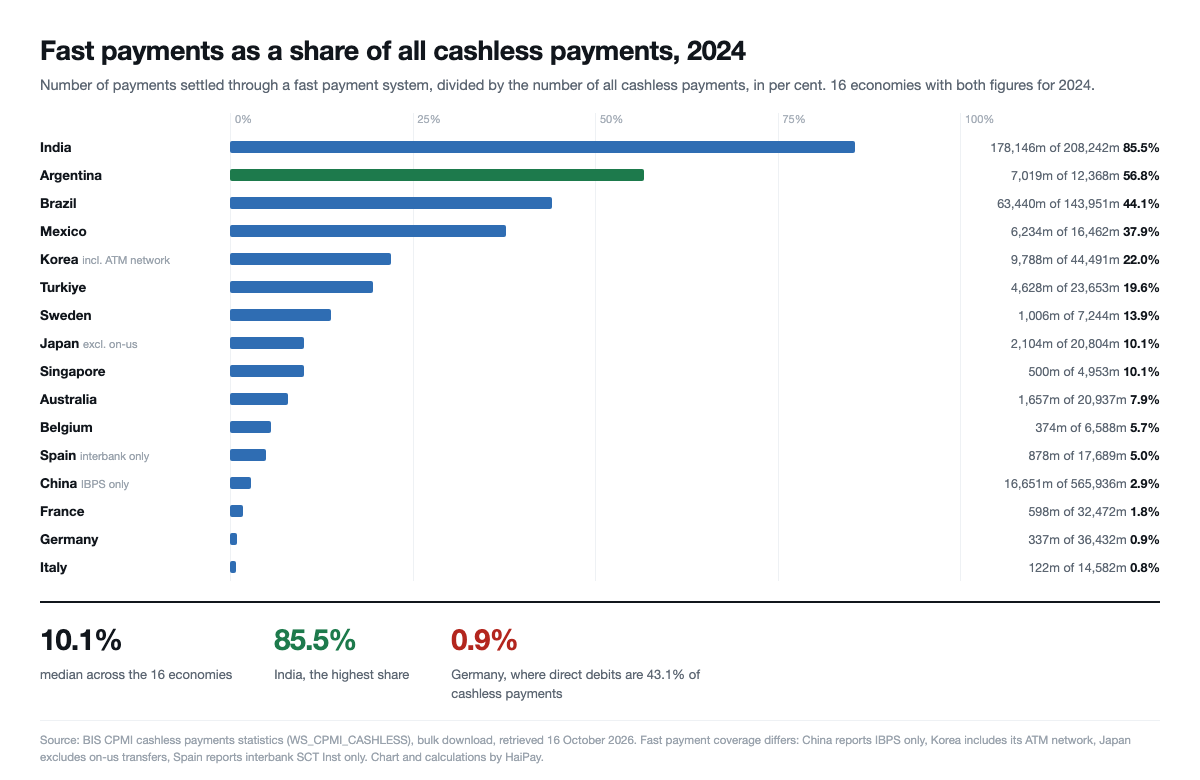
Argentines made 7.02 billion fast payments in 2024, a 21.5-fold rise from 327 million in 2019, according to BIS payment statistics. Fast payments now make up 56.8% of the country’s cashless payments, second only to India among 16 economies.

Key takeaways 6
- Argentina’s fast payments rose from 327 million in 2019 to 7.02 billion in 2024, a 21.5-fold increase, BIS data show.
- Fast payments are 56.8% of Argentina’s cashless payments, second among 16 economies after India at 85.5%.
- Fast payments made up 70.0% of the growth in Argentina’s cashless payments between 2019 and 2024.
- At 149 fast payments per person, Argentina ranks third of 17, behind Brazil at 298 and Korea at 189.
- In Germany fast payments are 0.9% of cashless payments and in Italy 0.8%, against a median of 10.1%.
- National definitions differ and the data do not show which services drove Argentina’s growth.
Argentines made 7.02 billion fast payments in 2024, according to payment statistics published through the Bank for International Settlements. In 2019 they made 327 million.
That is a 21.5-fold rise in five years. Fast payments, the transfers that move between accounts within seconds, now make up 56.8% of all cashless payments in Argentina. Among the 16 economies with comparable data, only India’s share is higher.
From one in nine to more than half
In 2019, fast payments were 11.6% of Argentina’s cashless payments. By 2022 they were 32.9%. In 2024 they passed half.
The overall number of cashless payments grew too, from 2.81 billion to 12.37 billion. Fast payments accounted for 70.0% of that increase.
They have also taken over Argentina’s credit transfers. In 2019, 73.3% of credit transfers were fast payments. In 2024 the figure was 97.1%.
Between 2022 and 2024 the number of fast payments in Argentina grew 3.40-fold, the fastest growth of the 18 economies that report them. France was second at 3.02-fold and Brazil third at 2.64.
Where Argentina sits
India leads on share, with fast payments at 85.5% of all cashless payments. After Argentina come Brazil at 44.1% and Mexico at 37.9%. The median across the 16 economies is 10.1%.
At the other end are three of the euro area’s largest economies. Fast payments are 1.8% of cashless payments in France, 0.9% in Germany and 0.8% in Italy. In Germany, direct debits alone make up 43.1%.
Measured per person, Argentina made 149 fast payments in 2024. That is third among 17 economies, behind Brazil at 298 and Korea at 189, and ahead of India at 127.
In absolute terms, India and Brazil dominate. Together they made 82.0% of the 294.8 billion fast payments recorded across the 18 economies in 2024.
Why this matters
Argentina is now one of a handful of economies, with India, Brazil and Mexico, where an instant account-to-account transfer is a mainstream way to pay rather than a niche one. For a payment provider entering the market, that changes the default: checkout and payouts that do not support fast transfers miss the method behind more than half of cashless payments.
The contrast with Germany, France and Italy is just as useful. Instant payment rails exist across the euro area, but in those three economies people still pay overwhelmingly by card and direct debit.
What this is not
National definitions differ. China reports only its interbank system, Korea includes transfers through its ATM network, Japan excludes transfers within the same bank, and Spain counts interbank instant transfers only. Treat cross-country comparisons as indicating scale, not exact rank.
The data do not say how Argentines make these payments. They do not separate QR code payments, wallet transfers, bank apps or business payments, so nothing here shows which service drove the growth.
Several large economies, including the United States, the United Kingdom and Canada, do not report a fast payment series in this dataset. Their absence is a gap in the data, not evidence that they lack fast payments.
These are counts, not values. HaiPay did not contact the BIS or the Central Bank of Argentina.
What to watch
Whether Argentina’s share keeps climbing toward India’s or levels off. The 2021 dip, from 26.9% to 22.6%, shows the path has not been a straight line.
Whether France’s 3.02-fold growth since 2022 continues. It is the fastest in the euro area from a low base.
And whether the economies missing from the fast payment series start reporting one, which would make this comparison far more complete.
Data highlight
56.8 %
Share of Argentina’s cashless payments by number that went through fast payment systems in 2024, up from 11.6 per cent in 2019 and second among 16 economies in the BIS CPMI statistics after India
2019 to 2024
Read the methodology and limitations
Methodology and limitations
Compiled by HaiPay on 16 October 2026 from the statistics on payments and financial market infrastructures that the Committee on Payments and Market Infrastructures publishes through the Bank for International Settlements, downloaded as the bulk files WS_CPMI_CASHLESS and WS_CPMI_MACRO from data.bis.org. Fast payments are the annual number of cashless payments reported with the payment speed attribute for fast payments, for all instruments where available and otherwise for credit transfers; all cashless payments are the annual number of cashless payments of all types, including card and e-money payments, credit transfers, direct debits, cheques and other instruments. Payments per person divide the number of fast payments by population from the macro file. 18 economies report a fast payment series for 2024; the United States, the United Kingdom, Canada, Switzerland, Saudi Arabia, Indonesia and South Africa do not report one in this dataset, which does not mean they have no fast payment system. 16 economies have both a fast payment figure and an all-cashless figure for 2024; Hong Kong SAR and the Netherlands lack the latter. Coverage of the fast payment series differs: China reports only transactions processed in its Internet Banking Payment System, Korea includes its Electronic Banking System and CD/ATM system, Japan excludes credit transfers between accounts at the same bank, and Spain reports interbank SCT Inst payments only. In Argentina, fast payments numbered 326.7 million in 2019 and 7,019.4 million in 2024, a 21.5-fold rise, against 81.7 million in 2014. All cashless payments rose from 2,805.8 million to 12,367.6 million, or 4.41-fold, so fast payments accounted for 70.0 per cent of the increase. Fast payments were 5.9 per cent of Argentina’s cashless payments in 2014, 11.6 per cent in 2019, 26.9 per cent in 2020, 22.6 per cent in 2021, 32.9 per cent in 2022, 45.2 per cent in 2023 and 56.8 per cent in 2024, and were 73.3 per cent of credit transfers in 2019 and 97.1 per cent in 2024. Across the 16 economies in 2024 the share of fast payments in all cashless payments was 85.5 per cent in India, 56.8 in Argentina, 44.1 in Brazil, 37.9 in Mexico, 22.0 in Korea, 19.6 in Turkiye, 13.9 in Sweden, 10.1 in Japan and in Singapore, 7.9 in Australia, 5.7 in Belgium, 5.0 in Spain, 2.9 in China, 1.8 in France, 0.9 in Germany and 0.8 in Italy, with a median of 10.1 per cent; in Germany direct debits were 43.1 per cent of cashless payments. Fast payments per person in 2024 were 298.4 in Brazil, 189.1 in Korea, 149.1 in Argentina, 126.5 in India, 95.5 in Hong Kong SAR, 95.2 in Sweden and 82.8 in Singapore, and 4.0 in Germany, the lowest of the 17 economies with population data. Among the 18 economies with values for 2022 and 2024, the number of fast payments grew 3.40-fold in Argentina, the most, followed by France at 3.02 and Brazil at 2.64. The 18 economies made 294.8 billion fast payments in 2024, of which India and Brazil together made 82.0 per cent. Every share, ratio, multiple and median is HaiPay’s arithmetic on the published values. Three limits apply. The definition of a fast payment and the coverage of each national series differ, as described above, so cross-economy comparisons indicate scale rather than exact rank. The statistics do not break Argentina’s fast payments down by service, channel or user, so they cannot show whether the growth came from QR code payments, wallets, bank apps or businesses. And these are counts of payments, not values, which in Argentina’s case also avoids distortion from high inflation over the period but says nothing about the amounts moved. HaiPay did not contact the BIS or the Central Bank of Argentina.
Data note
HaiPay calculation from the BIS CPMI bulk files WS_CPMI_CASHLESS and WS_CPMI_MACRO, downloaded from data.bis.org on 16 October 2026. Fast payments are the annual number of payments reported with the fast payment speed attribute, for all instruments where available and otherwise for credit transfers. All cashless payments include card and e-money payments, credit transfers, direct debits, cheques and other instruments.
In Argentina, fast payments rose from 326.7 million in 2019 to 7,019.4 million in 2024, and all cashless payments from 2,805.8 million to 12,367.6 million, so the fast payment share rose from 11.6 to 56.8 per cent. 16 economies have both figures for 2024; India’s share is the highest at 85.5 per cent and the median is 10.1 per cent.
National coverage differs: China reports its Internet Banking Payment System only, Korea includes its CD/ATM system, Japan excludes transfers within the same bank and Spain reports interbank SCT Inst only, so cross-country comparisons show scale rather than exact rank. The data do not break Argentina’s fast payments down by service or channel. Counts, not values, are used throughout.
Data and research materials
- Fast payments by economy, 2022 and 2024 (BIS CPMI, HaiPay calculations) ↓CSV · 2 KB
- Argentina fast payments and all cashless payments, 2014-2024 ↓CSV · 1 KB
HaiPay’s charts and the two CSV tables on this page may be reused with attribution to HaiPay and a link to this article. The underlying statistics are published by the Bank for International Settlements; reuse of the source data is governed by the BIS terms of use, not by HaiPay.
Term definition
- Fast payment
- Under the CPMI definition, a payment in which the transfer of the message and the availability of funds to the payee happen in real time or near real time, as close as possible to 24 hours a day, seven days a week. In Argentina they were 56.8 per cent of cashless payments in 2024.
- Cashless payment
- Any payment made without banknotes or coins, including card and e-money payments, credit transfers, direct debits and cheques. Argentina recorded 12.37 billion in 2024.
- Credit transfer
- A payment initiated by the payer, who instructs their bank or provider to move funds to the payee’s account. In Argentina, 97.1 per cent of credit transfers were fast payments in 2024.
4 sources
- Bank for International Settlements
Index page listing the BIS bulk files, including the two used here.
Accessed 16 October 2026 · UTC
- Bank for International Settlements
CPMI cashless payments statistics (WS_CPMI_CASHLESS), bulk download
Annual counts of fast payments and of all cashless payments for each economy, 2014 to 2024. Source of every share, multiple and growth figure in this article.
Accessed 16 October 2026 · UTC
- Bank for International Settlements
CPMI macro statistics (WS_CPMI_MACRO), bulk download
Population for each economy, used only to calculate fast payments per person.
Accessed 16 October 2026 · UTC
- Bank for International Settlements
The BIS presentation of the same CPMI statistics, for readers who want to browse the tables rather than download the files.
Accessed 16 October 2026 · UTC
How to cite
HaiPay News, "Argentina Made 7 Billion Fast Payments. Five Years Ago, 327m", https://www.haipay.net/news/argentina-fast-payments-share-of-cashless, 16 October 2026