NewsLocal Payments
Western Union Ships 33 Apps. Most Live in One Store Each.
Western Union publishes 33 separate apps on Apple's App Store. Twenty-four of them appear in exactly one country's storefront.
Key takeaways 6
- Western Union publishes 33 apps on the App Store; 24 of them appear in exactly one storefront each.
- A lookup of its US listing alone returns 1 of 50 storefronts — accurate, and almost completely misleading.
- Six of 25 payment apps are in all 50 storefronts: Wise, Payoneer, Stripe Dashboard, Monzo, GCash and Grab.
- Monzo banks only in the UK and GCash only in the Philippines, yet both are downloadable in all 50 storefronts.
- Four apps had two current versions live at once; Klarna was seven days behind in Germany and the United States.
- China's storefront carries 11 of the 25 apps and India's 15, the two thinnest catalogues of the fifty tested.
Western Union publishes 33 separate apps on Apple's App Store. Twenty-four of them appear in exactly one country's storefront.
The app on its US listing is in one storefront too. Which is how HaiPay's first pass through the data recorded the world's best-known money-transfer brand as available in 1 of 50 countries — a number that is accurate, and almost completely misleading.
What the sweep found
HaiPay looked up 25 payment, wallet, banking and remittance apps in 50 Apple storefronts: 1,250 queries, 966 of which returned a listing. All 966 are free.
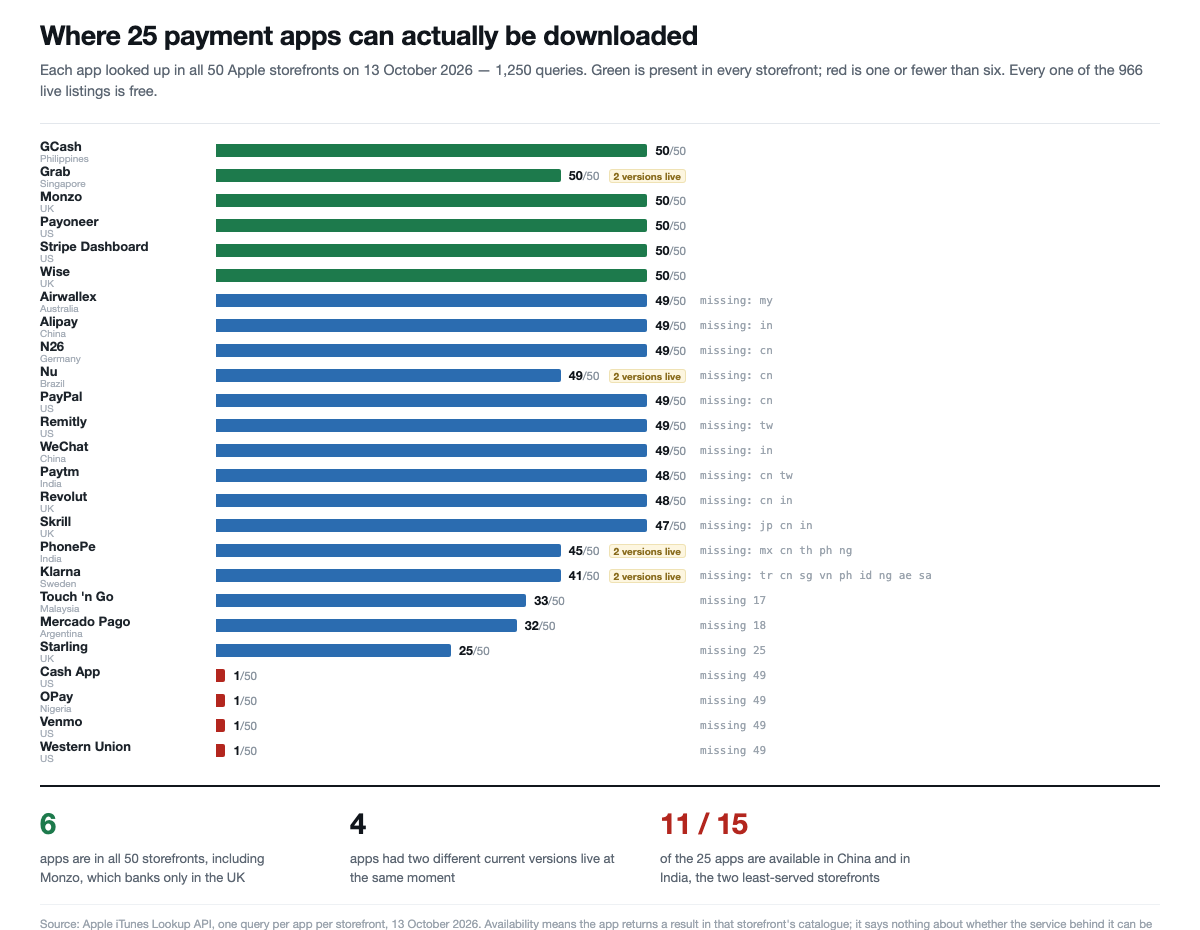
Six apps are in all fifty: Wise, Payoneer, Stripe Dashboard, Monzo, GCash and Grab.
That list is the first thing worth pausing on. Monzo is a British bank that serves British residents. GCash is a Philippine wallet. Both are downloadable in Saudi Arabia, Chile, Norway and forty-seven other places. Being in a storefront says where you can press Get. It says nothing about whether the account behind it will open.
At the other end, four apps are in exactly one storefront each, and three of those are deliberate: Cash App and Venmo are American products with no pretence otherwise, and OPay is Nigerian. The fourth is Western Union, and that one is an artefact.
Thirty-three binaries
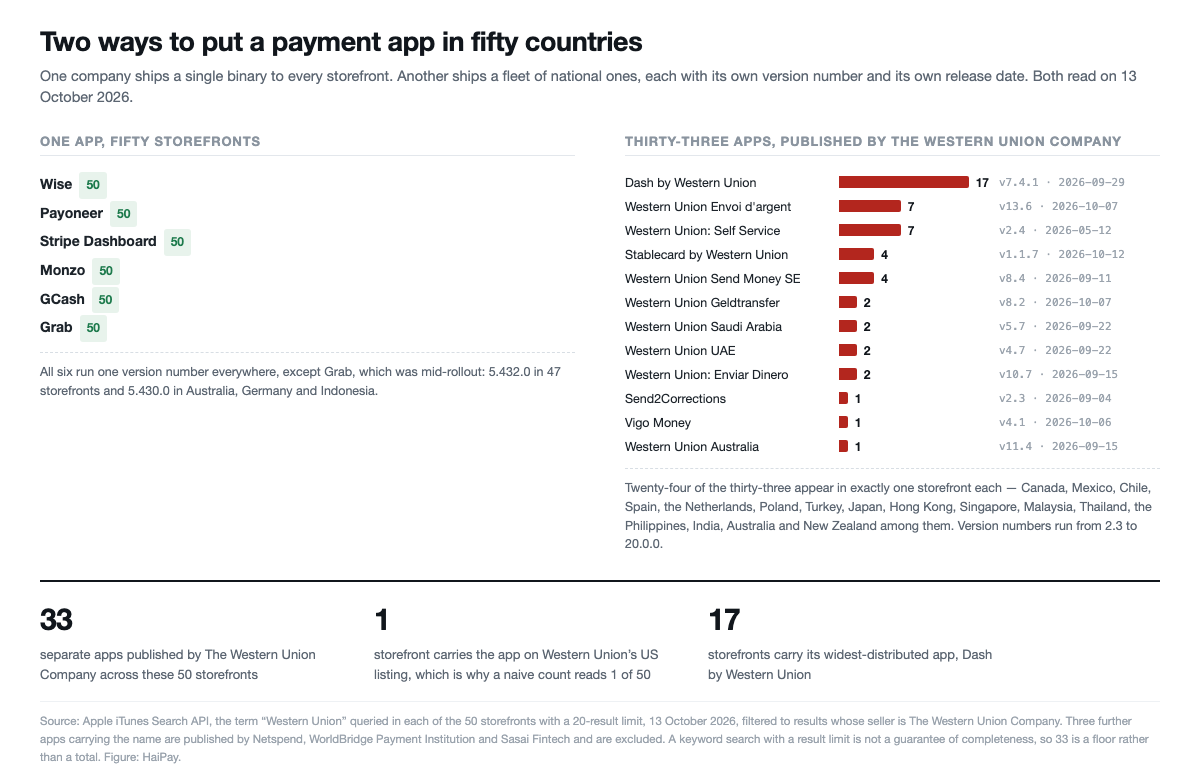
Search each storefront for the company name rather than looking up one identifier and a different structure appears. Thirty-three apps published by The Western Union Company, most of them national: Western Union Canada, México, Chile, España, Nederland, Poland, Japan, Hong Kong, Singapore, Malaysia, Thailand, the Philippines, India, Australia, New Zealand, and more.
Each carries its own version number. They run from 2.3 to 20.0.0. Each has its own release date.
The widest-distributed is not the US app at all. It is Dash by Western Union, in 17 storefronts. A money transfer app shared across seven European storefronts comes next, alongside Western Union: Self Service, also in seven.
Two strategies, then. One binary shipped to every catalogue, which is what Wise, Payoneer and Stripe do. Or a fleet of national ones, each maintained and released separately, which is what Western Union does. Neither is wrong. They produce very different numbers when anyone counts, and the counting is what people quote.
Four apps, two versions, same moment
The sweep caught four apps running two different current versions simultaneously.
Klarna was on 26.41.293 in 39 storefronts, released 12 October, and on 26.40.314 in Germany and the United States, released 5 October. Nu was on 8.0.14 everywhere except Brazil. PhonePe was on its newest build in 42 storefronts but on a 7 October build in Australia, Canada and India. Grab was mid-rollout as the sweep ran: 5.432.0 in 47 storefronts dated that same day, 5.430.0 in Australia, Germany and Indonesia dated ten days earlier.
In two of the four cases — Nu and PhonePe — the storefront on the older build is the company's home market. That is an observation from four cases, not a rule, and this sample cannot establish one.
What it does establish is that "the current version" of a payment app is a question with more than one answer at any given moment, and that the answer depends on where the person asking is standing.
The two least-served catalogues
The United States carries 24 of the 25. China carries 11 and India 15.
The Chinese storefront is missing PayPal, Revolut, N26, Nu, Klarna, Skrill, Paytm, PhonePe, Mercado Pago, Starling, Cash App, Venmo, OPay and Western Union's US app. The Indian one is missing Alipay, WeChat, Revolut, Skrill, Starling, Mercado Pago and four others.
These are the two largest smartphone markets on earth, and on this basket they are the thinnest catalogues of the fifty. The reasons are regulatory, commercial and political in different mixtures for each app, and this article does not attempt to separate them.
Why this matters
Anyone writing "available in 50 countries" on a payments page is making a claim that can now be checked in an afternoon, for free, by anyone with a laptop. The same is true of competitors' claims.
But the check cuts both ways, and the Western Union result is the useful lesson in this dataset. One identifier, looked up fifty times, produced a number that was technically correct and practically wrong. The company's actual App Store footprint is one of the largest in this sample, and finding it required asking a different question.
The honest version of the metric is not "where is the app". It is "where can a person in this country download something from this company, and is it the same build as everyone else's". On this evidence those are three separate questions.
What this is not
Availability is not usability. An app returning a result in a storefront says nothing about whether the service behind it can be used from that country, whether an account can be opened, or whether payments will clear. Monzo and GCash prove the point from one direction; Western Union proves it from the other.
This is Apple only. It says nothing about Google Play, which matters most in precisely the markets where iOS share is lowest.
The 33 Western Union apps come from a keyword search with a result limit, so that figure is a floor rather than a total. Three further apps carrying the name belong to Netspend, WorldBridge Payment Institution and Sasai Fintech and are excluded.
The 25-app list is HaiPay's, chosen for international marketing or scale, and is not exhaustive. Catalogues change daily; this is one reading on one day, and one release was visibly still propagating as it was taken.
HaiPay did not contact Apple or any publisher named here.
What to watch
Whether the fleet model shrinks. Thirty-three national binaries is thirty-three release trains, thirty-three review queues and thirty-three sets of screenshots. The industry's direction of travel is one codebase and many locales.
Whether version divergence closes. Four of 25 apps were split on a single Tuesday. Run the same sweep weekly and that share is a free, public measure of how staged a company's releases actually are.
And whether China and India move. They are 11 and 15 of 25 today. Both numbers are set by decisions outside the publishers' control, which makes them a reasonable proxy for how open each market is to foreign payment software.
Data highlight
33 apps
Distinct apps published by The Western Union Company across 50 Apple storefronts, of which 24 appear in exactly one storefront each
Storefronts read 13 October 2026
Read the methodology and limitations
Methodology and limitations
Compiled by HaiPay on 13 October 2026 from Apple's public iTunes APIs. HaiPay selected 25 payment, wallet, banking and remittance apps on the basis of international marketing or scale — the list is HaiPay's and is not exhaustive — and looked each one up in 50 Apple storefronts using itunes.apple.com/lookup with an app's numeric track identifier and a country code, giving 1,250 queries.
The storefronts were us, ca, mx, br, ar, cl, co, pe, gb, ie, de, fr, it, es, nl, be, pt, at, ch, se, no, dk, fi, pl, cz, hu, ro, gr, tr, jp, kr, cn, hk, tw, sg, my, th, vn, ph, id, in, au, nz, za, ng, ke, eg, ae, sa and il. An app counts as available in a storefront when the lookup returns a result there; 966 of the 1,250 queries did, and every one of those 966 listings is priced at zero.
Six apps returned a result in all 50: Wise, Payoneer, Stripe Dashboard, Monzo, GCash and Grab. Four returned a result in exactly one: Western Union's US listing (track 424716908, in us), Cash App (us), Venmo (us) and OPay (ng). Counts for the rest are Airwallex 49, Alipay 49, N26 49, Nu 49, PayPal 49, Remitly 49, WeChat 49, Paytm 48, Revolut 48, Skrill 47, PhonePe 45, Klarna 41, Touch 'n Go 33, Mercado Pago 32 and Starling 25.
Counting the other way, the storefront carrying the most of these 25 apps is the United States with 24; China carries 11 and India 15, the two lowest.
Four apps returned more than one current version across storefronts at the same moment: Klarna 26.41.293 in 39 storefronts (released 12 October) against 26.40.314 in Germany and the United States (5 October); Nu 8.0.14 in 48 (12 October) against 8.0.13 in Brazil (5 October); PhonePe 26.0925.00 in 42 (12 October) against 26.0911.08 in Australia, Canada and India (7 October); and Grab 5.432.0 in 47 (13 October) against 5.430.0 in Australia, Germany and Indonesia (3 October).
In two of those four cases the lagging storefront includes the company's home market, which is HaiPay's observation and not a pattern this sample can establish. The Western Union figure required a correction to method and is reported here as such. A naive reading of the matrix gives Western Union 1 of 50, because the company's US consumer listing is published only in the US storefront.
HaiPay therefore ran a second pass, querying itunes.apple.com/search for the term "Western Union" in each of the 50 storefronts with a 20-result limit and filtering to results whose seller field reads The Western Union Company. That returned 33 distinct apps, of which 24 appear in exactly one storefront each, with version numbers ranging from 2.3 to 20.0.0 and independent release dates. The widest-distributed is Dash by Western Union, version 7.4.1, in 17 storefronts; next are a money transfer app (track 1045347175) and Western Union: Self Service, each in 7.
Three further apps carrying the Western Union name are published by Netspend Corporation, WorldBridge Payment Institution SA and Sasai Fintech Limited and are excluded from the 33. A keyword search with a result limit does not guarantee completeness, so 33 is a floor and not a total. Every count, share and comparison above is HaiPay's arithmetic on the API responses; Apple publishes none of them. Three limits apply.
Storefront availability records where an app can be downloaded, not where the service behind it can be used: Monzo banks only in the United Kingdom and GCash is a Philippine wallet, and both return a result in all 50 storefronts. The sweep covers Apple only and says nothing about Google Play, which matters most in exactly the markets where iOS share is lowest. And catalogues change daily, so this is one reading, taken on one day; the Grab release dated 13 October was still propagating as the sweep ran.
HaiPay did not contact Apple or any app publisher named here.
Term definition
- Storefront
- A country-specific App Store catalogue. An app is published to each one separately, so the same identifier can be present in some and absent in others; availability in a storefront is not evidence the service behind the app works in that country.
- Fleet model
- Publishing a separate national app per market rather than one binary everywhere. Western Union runs 33 on the App Store, each with its own version number and release date.
- Version divergence
- The same app showing different current versions in different storefronts at the same moment, normally a staged rollout. Four of the 25 apps measured were divergent on 13 October 2026.
5 sources
How to cite
HaiPay News, "Western Union Ships 33 Apps. Most Live in One Store Each.", https://www.haipay.net/news/payment-app-store-availability, 13 October 2026