NewsLocal Payments
Inside the Euro Area, 93% of Banks Do Instant. Outside, 22%
Six hundred and eighty-seven banks and payment firms are members of the SEPA credit transfer scheme but not of the instant one. Four hundred and ninety-six of them — 72% — are outside the euro area.

Key takeaways 6
- 687 SEPA credit transfer participants are not in the instant scheme; 496 of them, or 72%, sit outside the euro area.
- Euro-area coverage is 93.3% (2,674 of 2,865). Outside the euro area it is 22.4% (143 of 639).
- Switzerland has 4 instant participants against 185 in credit transfer; Norway has 1 against 82; Montenegro has none of 12.
- Joining clusters on single days: 159 share a readiness date of 2 Dec 2024, 122 share 6 Jan 2025, 83 share 9 Jan 2025.
- Across five registers and 11,000-plus rows, the Scheme Leaving Date field is filled in twenty-three times in total.
- The one-leg-out instant scheme has 98 participants, 92 of them Spanish, and 77 are registered only to receive.
Six hundred and eighty-seven banks and payment firms are members of the SEPA credit transfer scheme but not of the instant one. Four hundred and ninety-six of them — 72% — are outside the euro area.
Switzerland has 185 participants in SEPA credit transfer. Four are in SEPA Instant. Norway has 82 and one.
Five registers, published as spreadsheets
The European Payments Council runs the SEPA schemes and publishes the full membership of each as a downloadable file. There are five: credit transfer, instant credit transfer, direct debit core, direct debit business-to-business, and a one-leg-out instant scheme for payments with one end outside Europe.
Counting the rows that are active today: 3,504 participants in credit transfer across 44 countries, 2,817 in instant across 40, 2,733 and 2,296 in the two direct debit schemes, and 98 in one-leg-out.
Every row carries a country, a BIC, a readiness date and a leaving date. That is enough to ask three questions the council does not answer itself: who is missing, when did everyone join, and has anyone left.
The gap follows the currency
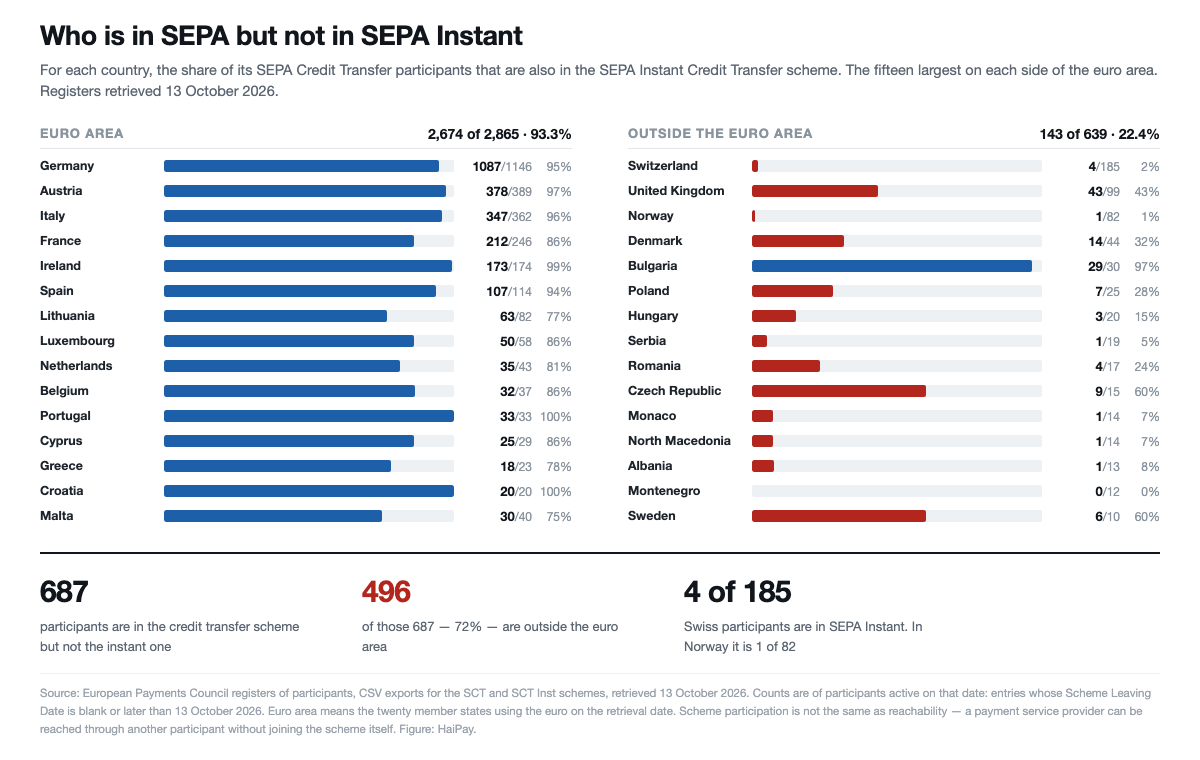
Inside the twenty euro-area countries, 2,674 of 2,865 credit transfer participants are also in the instant scheme. That is 93.3%. Ireland is at 99%, Austria 97%, Italy 96%, Germany 95%. Portugal and Croatia are at 100%.
Everywhere else: 143 of 639. That is 22.4%.
The extremes are stark. Switzerland is at 2%, Norway at 1%, Serbia at 5%, Monaco and North Macedonia at 7%. Montenegro has twelve credit transfer participants and no instant ones; so do Iceland with six, Moldova with nine and Vatican City with one. The United Kingdom, with 43 of 99, is at 43%. Denmark is at 32%, Poland 28%, Hungary 15%.
One country outside the euro area breaks the pattern completely: Bulgaria, at 29 of 30. The register does not say why, and this article does not guess.
Nobody joined for five years, then everybody did
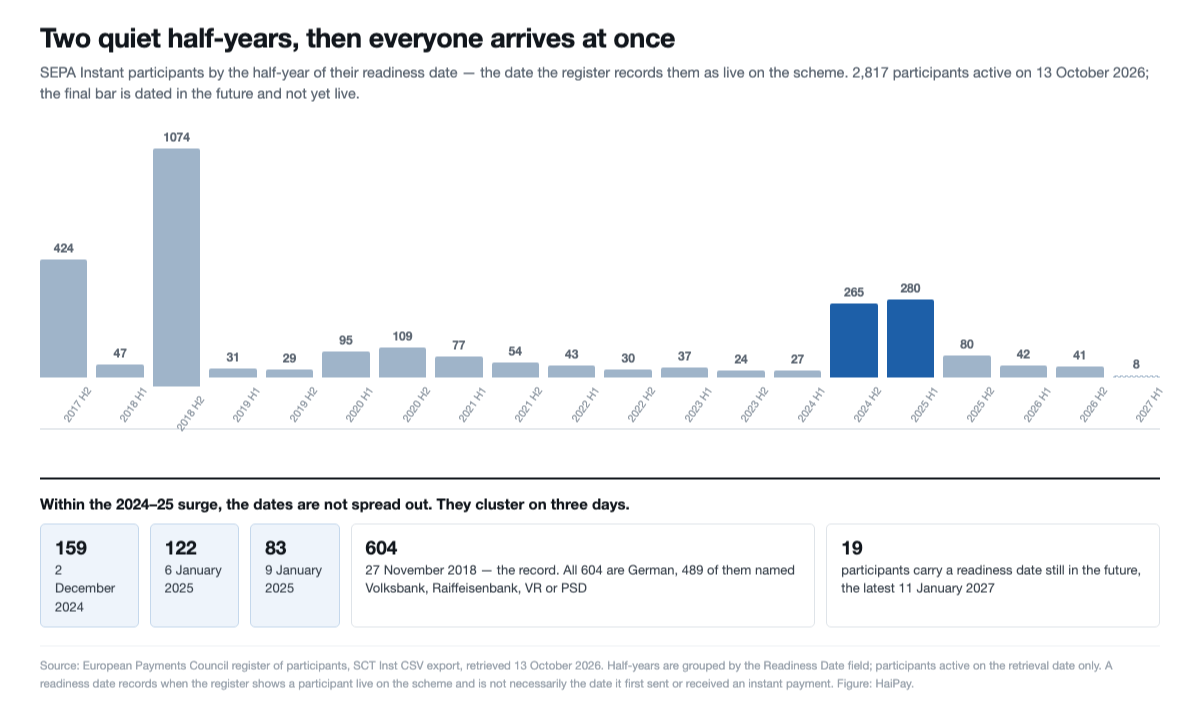
The instant scheme opened in November 2017. Four hundred and twenty-four participants carry a readiness date in that half-year, 422 of them on 21 November alone. A year later 1,074 more arrived, 983 of them German. Then it went quiet: eleven consecutive half-years, from the start of 2019 to the middle of 2024, with fewer than 110 joiners each and several with fewer than 40.
In the second half of 2024, 265 joined. In the first half of 2025, 280.
And within that surge the dates are not spread out at all. One hundred and fifty-nine participants share a readiness date of 2 December 2024. One hundred and twenty-two share 6 January 2025. Eighty-three share 9 January 2025.
Dates that sharp are not independent decisions. They are a coordinated onboarding, and the register records the coordination without explaining it.
The all-time record for a single date is still 27 November 2018, when 604 participants went live at once. All 604 are German; 489 of them have Volksbank, Raiffeisenbank, VR or PSD in the name.
The column nobody reads
Each register has a Scheme Leaving Date. Across all five schemes and 11,459 rows, it is filled in twenty-three times.
Nine in credit transfer, five in instant, five in direct debit core, four in business-to-business. Several of those are dated in the future: TSB Bank plc is recorded as leaving both credit transfer and direct debit core on 22 March 2027.
Membership of a European payment scheme is, on this evidence, close to permanent. Firms join and then stay, and the register's exit column is nearly empty.
The same field read forwards is more interesting. Nineteen participants carry a readiness date later than today — they are registered but not yet live. Six of them are Danish savings banks, all dated 11 January 2027.
The scheme with 98 members
One-leg-out instant, the newest of the five, is for instant payments where one party is outside the SEPA area. It has 98 participants.
Ninety-two of them are in Spain. The other six are three in Andorra and one each in Cyprus, Luxembourg and the United Kingdom. Seventy-seven of the 98 hold only the payee's role, meaning they can receive under the scheme but are not registered to send.
The register's earliest readiness dates for this scheme are in 2024: 36 that year, 59 in 2025, 3 so far in 2026. Two years in, SEPA's cross-border instant extension is effectively one country with a receiving function.
Why this matters
Anyone building euro payouts has to know which counterparties can actually be paid instantly, and the honest answer is geographic. Inside the euro area, instant is close to universal and can be treated as the default. One step outside it — Switzerland, Norway, most of the Western Balkans — and the same assumption fails almost completely.
That matters for product copy as much as for routing. "Instant SEPA transfers" is true for a German or Irish counterparty and misleading for a Swiss one, and the register is the free, public way to check which you are dealing with before promising a settlement time.
What this is not
Scheme participation is not reachability. A bank can be reachable for instant payments through another participant without appearing in the register under its own name. These are counts of scheme members, not of institutions that can receive an instant payment, and the real reachable share is higher than 22.4% outside the euro area by an amount this data cannot measure.
A readiness date records when the register shows a participant live. It is not necessarily the day that firm first sent or received an instant payment.
HaiPay tried to retrieve the text of Regulation (EU) 2024/886, the instrument the industry calls the Instant Payments Regulation, to establish what it requires and when. Every automated request to EUR-Lex — by CELEX number, by Official Journal reference and by ELI identifier — was redirected to the current day's Official Journal index, and the European Commission's own instant payments page now returns 404. This article therefore makes no claim about that regulation's requirements or deadlines. The clustering of readiness dates is reported as what the register shows.
The registers are amended continuously. These are the figures in the files retrieved on 13 October 2026.
HaiPay did not contact the European Payments Council.
What to watch
Whether the non-euro share moves. It is 22.4% today, and 181 of the 496 missing participants are Swiss and 81 Norwegian. A single decision at group level in either country would move this number more than a year of individual signups everywhere else.
Whether the 2027 readiness dates hold. Nineteen participants are already registered for dates that have not arrived, which makes the register a short-range forecast as well as a record.
And whether one-leg-out spreads beyond Spain. Ninety-two of 98 participants in one country, two years in, is either a very early scheme or a scheme that one market has adopted and the rest have read about.
Data highlight
687 participants
SEPA Credit Transfer participants that are not in the SEPA Instant Credit Transfer scheme, of which 496 are outside the euro area
Registers retrieved 13 October 2026
Read the methodology and limitations
Methodology and limitations
Compiled by HaiPay on 13 October 2026 from the European Payments Council's registers of participants, retrieved in full as CSV exports from europeanpaymentscouncil.eu for all five SEPA schemes: SEPA Credit Transfer, SEPA Instant Credit Transfer, SEPA Direct Debit Core, SEPA Direct Debit Business-to-Business and One-Leg Out Instant Credit Transfer. The council's web register returns 403 to automated clients; the CSV export paths return 200 and were used instead.
Each row carries a country, participant name, address, BIC, Readiness Date and Scheme Leaving Date, and the One-Leg Out export carries a Role column as well. HaiPay counted a participant as active when its Scheme Leaving Date is blank or later than 13 October 2026, which gives 3,504 participants in SEPA Credit Transfer across 44 countries, 2,817 in SEPA Instant across 40, 2,733 in Direct Debit Core, 2,296 in Direct Debit B2B and 98 in One-Leg Out.
The gap of 687 between the credit transfer and instant registers, every country split, every share and every date grouping below are HaiPay's arithmetic; the council publishes none of them. Euro area means the twenty member states using the euro on the retrieval date: Austria, Belgium, Croatia, Cyprus, Estonia, Finland, France, Germany, Greece, Ireland, Italy, Latvia, Lithuania, Luxembourg, Malta, the Netherlands, Portugal, Slovakia, Slovenia and Spain.
On that basis the euro area has 2,865 credit transfer participants and 2,674 instant ones, or 93.3 per cent, and everywhere else has 639 and 143, or 22.4 per cent; 496 of the 687-participant gap, which is 72 per cent, falls outside the euro area. The largest single shortfalls are Switzerland with 4 instant participants against 185 in credit transfer, Norway with 1 against 82, the United Kingdom with 43 against 99, Germany with 1,087 against 1,146, Denmark with 14 against 44 and France with 212 against 246.
Montenegro (12 credit transfer participants), Iceland (6), Moldova (9) and Vatican City State (1) have none in the instant scheme. Bulgaria, at 29 of 30, is the only country outside the euro area above 90 per cent; the register does not say why and HaiPay offers no explanation.
As a cross-check HaiPay also matched on BIC rather than headcount and found 700 credit transfer participants whose BIC does not appear in the instant register, against the headcount difference of 687; the 13-participant discrepancy is instant participants absent from the credit transfer register, and the country ranking is unchanged either way.
Grouping the instant register by Readiness Date gives 424 participants in the second half of 2017, 1,074 in the second half of 2018, then nine consecutive half-years below 110, then 265 in the second half of 2024 and 280 in the first half of 2025, 80 in the second half of 2025, 42 and 41 in the two halves of 2026 and 8 dated in the first half of 2027.
Within that 2024-25 surge the dates are heavily clustered: 159 participants share a readiness date of 2 December 2024, 122 share 6 January 2025 and 83 share 9 January 2025. The record for a single date is 27 November 2018 with 604 participants, all of them German, 489 of which carry Volksbank, Raiffeisenbank, VR or PSD in their names. Nineteen participants carry a readiness date later than the retrieval date and are therefore registered but not yet live, the latest being 11 January 2027.
Scheme Leaving Date is populated on 9 credit transfer rows, 5 instant rows, 5 Direct Debit Core rows and 4 Direct Debit B2B rows, and several of those dates are themselves in the future, including TSB Bank plc leaving both credit transfer and Direct Debit Core on 22 March 2027.
In the One-Leg Out register, 92 of the 98 participants are in Spain, with 3 in Andorra and one each in Cyprus, Luxembourg and the United Kingdom; 77 hold only the payee's role, and readiness dates are 36 in 2024, 59 in 2025 and 3 in 2026. Two limits apply throughout.
First, scheme participation is not the same as reachability: a payment service provider can be reachable for instant payments through another participant without appearing in the register under its own name, so these counts are of scheme members and not of institutions that can receive an instant payment. Second, a readiness date records when the register shows a participant live on the scheme and is not necessarily the date it first sent or received a payment.
HaiPay attempted to retrieve the text of Regulation (EU) 2024/886, the instrument the industry calls the Instant Payments Regulation, from EUR-Lex; every automated request for it, by CELEX number, by Official Journal reference and by ELI identifier, was redirected to the current day's Official Journal index, and the European Commission's instant payments page returns 404.
HaiPay therefore makes no statement in this article about what that regulation requires or by when, and the clustering of readiness dates is reported as what the register shows rather than as compliance with any deadline. The registers are amended continuously and these figures are a single snapshot. HaiPay did not contact the European Payments Council.
Term definition
- Readiness date
- The date the EPC register records a participant as live on a SEPA scheme. It is not necessarily the day that firm first sent or received a payment, and nineteen participants currently carry one in the future.
- Scheme participation
- Membership of a SEPA scheme in a participant's own name. It is narrower than reachability: a bank can be reached through another participant without being listed, so these counts understate who can be paid.
- One-leg-out instant
- The newest of the five SEPA schemes, for instant euro payments where one party is outside the SEPA area. It has 98 participants, 92 of them in Spain.
5 sources
- European Payments Council
- European Payments Council
Register of participants, SEPA Instant Credit Transfer scheme
- European Payments Council
- European Payments Council
- European Payments Council
Register of participants, One-Leg Out Instant Credit Transfer scheme
How to cite
HaiPay News, "Inside the Euro Area, 93% of Banks Do Instant. Outside, 22%", https://www.haipay.net/news/sepa-instant-euro-area-gap, 13 October 2026