Seven UK Banks, Three Transactions, One Tokenised Pound
Seven British banks have moved real customer money as tokenised sterling deposits. The transactions announced on 24 September were three: two remortgage completions and one purchase from a private seller.
September 28th, 2026
Last updated: September 28
Key takeaways
- UK Finance says seven British banks completed the first live customer transactions using tokenised sterling deposits.
- The count is three: two remortgage completions and one consumer purchase from a private seller on a marketplace.
- Funds were locked and released automatically on completion, with the customer earning interest until the money moved.
- No value, no volume, no bank pairing and no general-availability date were disclosed. This is a pilot result, not a service.
- Tokenised deposits stay a claim on the bank and keep deposit protections, which is what separates them from a stablecoin.
- Next pilots target digital debt instruments settled against tokenised money, the model called delivery versus payment versus reserves.
Data highlight
3transactions
Live customer transactions completed with tokenised sterling deposits under the Great British Tokenised Deposit initiative
announced 24 September 2026
Compiled by HaiPay on 28 September 2026 from the UK Finance press release "UK banks complete first live customer transactions using tokenised sterling deposits", published 24 September 2026, and the statements it contains. The release states that the transactions were delivered through the Great British Tokenised Deposit initiative convened by UK Finance, that the participants are Barclays, HSBC UK, Lloyds Banking Group, Monzo, Nationwide, NatWest and Santander, and that the platform was developed by Quant as shared UK industry infrastructure. The first set of live retail transactions comprised two remortgage completions, in which deposit funds were locked and then automatically released at completion, with the customer able to continue earning interest on funds held until completion and a digital connection to HM Land Registry explored, and one consumer marketplace transaction, in which funds were locked in the buyer's account and released when the goods were exchanged, giving three transactions in total. The release does not state the value or volume of the transactions, does not identify which participating banks were involved in each transaction, and gives no date for general availability. It says further pilots are expected over the coming months to demonstrate digital-asset settlement, with participating banks issuing digital debt instruments that can be traded and settled and coupons paid in tokenised deposits, described as delivery versus payment versus reserves. Quotations attributed in this article to UK Finance, the Economic Secretary to the Treasury, Quant and EY are taken from that release, including EY's description of the pilots as the culmination of five years of collaboration across market participants, central banks, regulators and supervisors. Comparisons are to HaiPay's own earlier reporting from primary sources: the Eurosystem launched Pontes on 21 September 2026 with 13 financial institutions and four market DLT operators to settle tokenised assets in central bank money, and Swift named 17 banks for the controlled go-live of its shared ledger for tokenised deposits in cross-border payments. HaiPay did not contact UK Finance, Quant, EY, HM Treasury or any participating bank, and did not independently verify that the transactions took place as described; the account rests on the announcement.
Seven British banks have moved real customer money as tokenised sterling deposits. The transactions announced on 24 September were three: two remortgage completions and one purchase from a private seller.
That is the whole of it so far, and it is still the most concrete thing any UK bank has done with programmable commercial bank money.
What actually happened
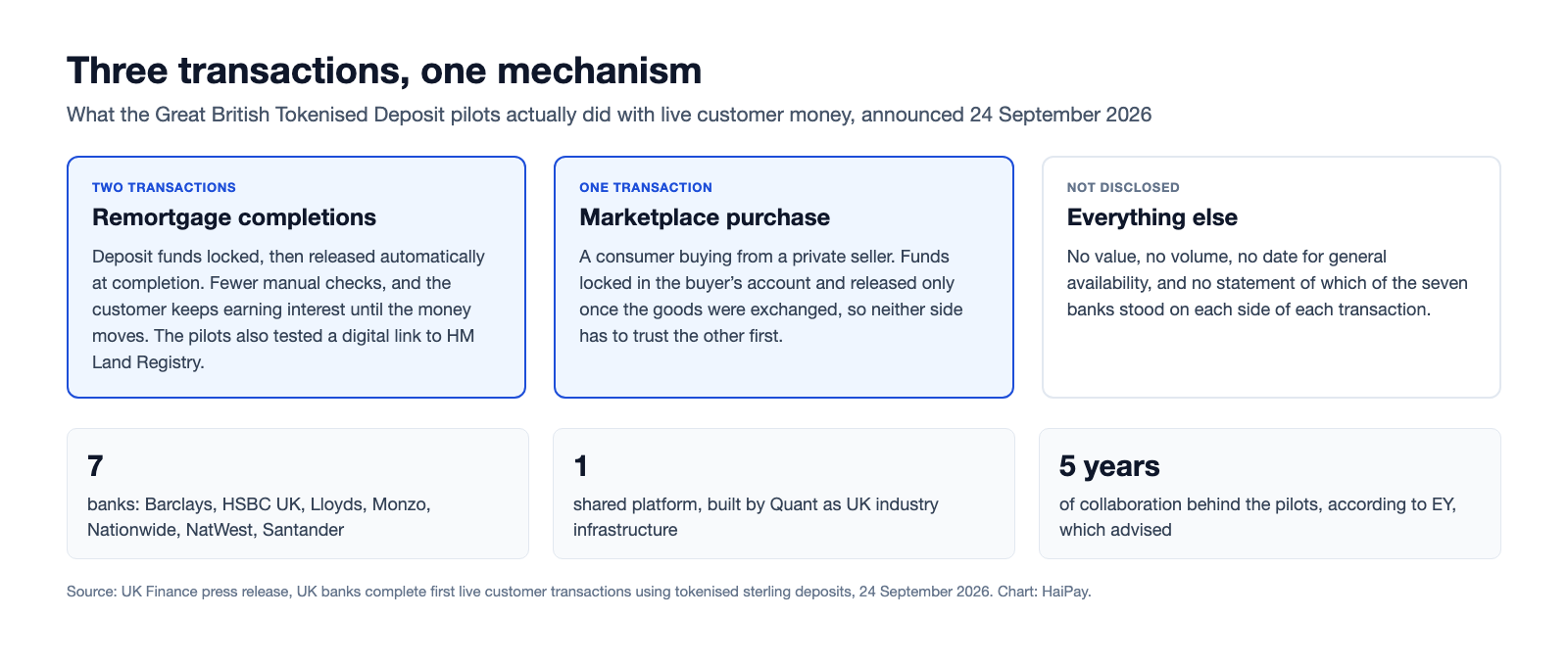
The work sits inside the Great British Tokenised Deposit initiative, convened by UK Finance, with Barclays, HSBC UK, Lloyds Banking Group, Monzo, Nationwide, NatWest and Santander taking part. The platform was built by Quant as shared industry infrastructure.
In the two remortgages, the deposit funds were locked and then released automatically at completion. UK Finance says this cuts manual checks and settlement delays, and that the customer can keep earning interest on the money until the moment it moves. The pilots also tested a digital connection to HM Land Registry.
In the marketplace transaction, a consumer bought an item from a private seller. The money sat locked in the buyer's account and was released only when the goods changed hands.
Both cases are the same mechanism: money that will not move until a condition is met, held at a bank rather than at an escrow agent or a marketplace.
Why a payments team should care
Tokenised deposits are commercial bank money in a form that can carry instructions. The deposit keeps the regulatory protections a normal bank balance has, which is the difference between this and a stablecoin.
Conditional release is the part with immediate commercial value. Two of the most expensive failure modes in UK payments are a property completion collapsing on the day and an authorised push payment sent to the wrong hands. Both are cases where the money left before the condition was satisfied.
Quant's chief executive was blunt about the framing: real money on UK infrastructure, not an experiment, aimed at failed completions and push payment fraud.
What the announcement does not say
It does not give a value, a volume or a timetable for general availability. Three transactions is a pilot result, not a service.
It does not say which of the seven banks were on each side of each transaction, so nobody outside can tell how much of the network was exercised.
And it does not claim regulatory change. The release positions the work as complementary to what the Bank of England, the Treasury, the Financial Conduct Authority and the Payment Systems Regulator are doing on the future of retail payments, which is a careful way of saying the rules have not moved.
What comes next, per the participants
More pilots are expected over the coming months, aimed at settling digital assets against tokenised money. Banks in the project plan to issue digital debt instruments that can be traded and settled, with coupons paid in tokenised deposits.
The industry shorthand for that is delivery versus payment versus reserves: the asset, the commercial bank money and the central bank leg lining up in one movement.
EY, which advised, describes the pilots as the culmination of five years of collaboration across banks, central banks, regulators and supervisors. That is the honest measure of pace in this field, and it is worth holding next to the announcement.
How it compares
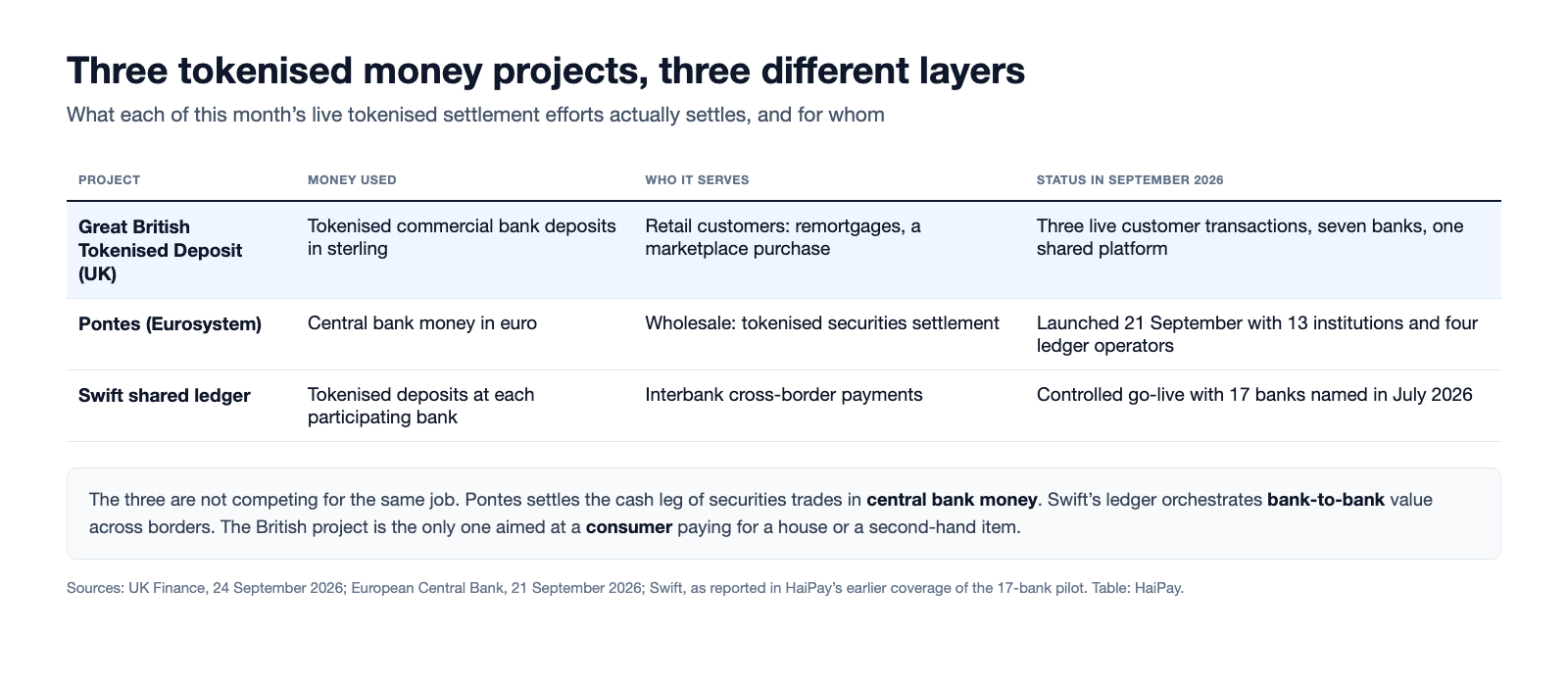
Europe's equivalent moved in a different order. The Eurosystem launched Pontes on 21 September to settle tokenised assets in central bank money, starting with 13 institutions and four ledger operators.
Swift's shared ledger, which 17 banks are piloting for tokenised deposits in cross-border payments, is aimed at interbank flows rather than a consumer buying a second-hand item.
The British project is the retail-facing one, and that is both its distinction and its risk: retail volume is where programmable money either proves useful or quietly does not.
What to watch
Whether the next pilots report values and counts. Without them, the only measurable fact will stay at three transactions.
Whether any participant commits a date for customers to use this outside a pilot.
And whether the conditional-release model shows up in the fraud statistics. The claim on the table is that money held until a condition is met is money a push payment scam cannot take. That is testable, once there is enough of it to test.
HaiPay's account of this is based on the UK Finance announcement and the statements it contains. HaiPay did not contact any of the banks, UK Finance or Quant, and did not independently verify that the transactions occurred as described.
How to cite
HaiPay News, "Seven UK Banks, Three Transactions, One Tokenised Pound", https://www.haipay.net/news/uk-tokenised-deposits-first-live-transactions, September 28th, 2026
About the author
Crystal
Digital Public Relations
A digital PR specialist with a Master's in Journalism & Communication from UNSW. Started as an intern at ABC Australia, now leads public relations at Haipay, crafting press releases and media strategies that bring brand stories to life.
Reviewed by WeiJun TangEditorial policy