Australia Kills $1.8bn of Card Surcharges From 1 October
On Thursday, card surcharges disappear from Australian checkouts. Six networks have agreed to ban them, three because the Reserve Bank stopped protecting the right to charge and three by choice.
September 28th, 2026
Last updated: September 28
Key takeaways
- From 1 October, eftpos, Mastercard, Visa, American Express, PayPal and UnionPay all bar surcharging in Australia.
- The RBA estimates $1.8 billion of surcharges a year on designated networks, $1.6 billion of it paid by consumers.
- Domestic consumer credit interchange is capped at 0.3% from 0.8%, and debit at 8 cents from 10 cents.
- Foreign-issued cards get a 1.0% interchange cap, but only from 1 April 2027.
- Interchange cuts are worth about $910 million a year, less than the surcharges removed.
- From 30 January 2027 large acquirers must publish how much of the interchange cut reached merchants.
Data highlight
1.8billion Australian dollars a year
Card surcharges levied each year on the designated Australian card networks, removed from 1 October 2026
1 October 2026 to 1 April 2027
Compiled by HaiPay on 28 September 2026 from the Reserve Bank of Australia's Review of Merchant Card Payment Costs and Surcharging, Conclusions Paper published 31 March 2026 and updated 19 June 2026, and from the RBA's page of frequently asked questions on the removal of card payment surcharges from 1 October 2026. The RBA states that it has removed its prohibition on no-surcharge rules with effect from 1 October 2026, which allows the designated card networks to ban surcharging, and that the RBA does not directly regulate merchants. The designated networks are eftpos, Mastercard and Visa; the RBA records that all three will introduce no-surcharge rules from that date covering credit, debit and prepaid cards, and that American Express, PayPal and UnionPay, which the RBA does not currently regulate, have also decided to remove surcharging from the same date. The RBA states that the changes do not apply to weekend surcharges, public holiday surcharges, booking fees or service fees, nor to payment service provider charges such as terminal rental or transaction processing; that taxi surcharging remains a matter for state and territory regulators; that a card payment made on or after 1 October may not be surcharged even where the invoice was issued earlier; that discounts for particular payment methods remain permitted; and that any exemptions are a decision for each card network rather than the RBA. Financial figures are the RBA's own estimates: consumers pay about $1.6 billion of a total $1.8 billion in card surcharges each year on designated networks; the interchange changes lower merchants' wholesale card costs by about $910 million a year; and the industry cost of removing surcharging is about $25 million, against about $45 million for a debit-only removal. Interchange decisions from Chapter 3 of the Conclusions Paper: the cap on domestic-issued consumer credit interchange falls to 0.3 per cent of transaction value and the credit benchmark is abolished; the domestic debit and prepaid cap falls to 8 cents, or 0.16 per cent on an ad-valorem basis, with the 8 cent benchmark retained; the domestic commercial credit cap stays at 0.8 per cent with its benchmark abolished; and a cap of 1.0 per cent is introduced on foreign-issued card transactions acquired in Australia. Previous caps were 0.8 per cent for credit and 10 cents or 0.2 per cent for debit and prepaid. The implementation dates are those the RBA lists: 1 October 2026 for the end of the no-surcharge prohibition and lower domestic interchange caps, 30 October 2026 for publication of specified card fee information by designated networks and large acquirers, 30 January 2027 for publication by large acquirers of interchange pass-through to merchant service fees, and 1 April 2027 for interchange caps on foreign-issued card transactions and more detailed merchant statements. HaiPay has not verified that each network has implemented what it announced, notes the RBA's caveat that network rules may change, and did not contact the RBA, any card network or any acquirer.
On Thursday, card surcharges disappear from Australian checkouts. Six networks have agreed to ban them, three because the Reserve Bank stopped protecting the right to charge and three by choice.
The RBA estimates Australians were paying $1.6 billion of the $1.8 billion in card surcharges levied each year on the regulated networks. From 1 October, that line comes off the bill.
What actually changes
The RBA does not regulate merchants. What it did was remove its own prohibition on "no-surcharge" rules, which had stopped card networks from banning surcharges. With the prohibition gone, the networks moved.
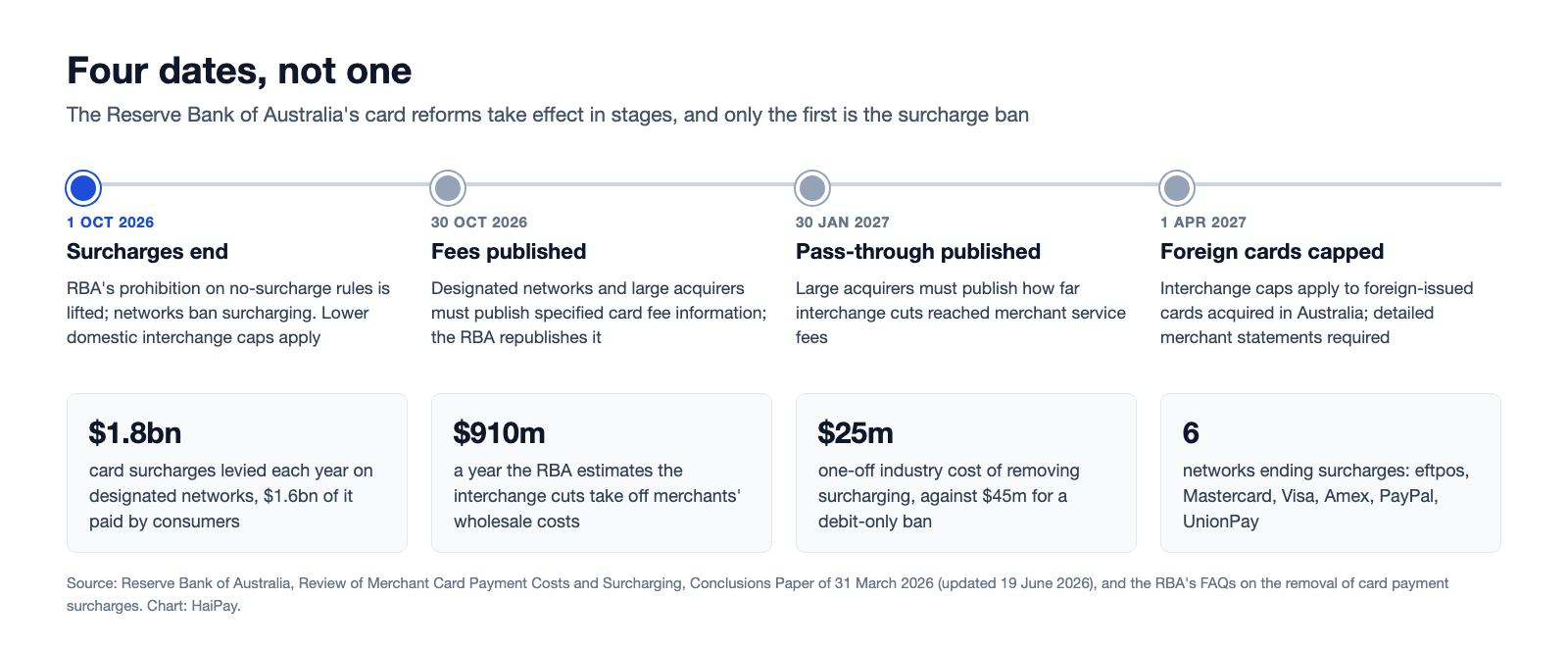
eftpos, Mastercard and Visa, the three networks the RBA designates, have each said they will bar surcharging on credit, debit and prepaid cards from 1 October. American Express, PayPal and UnionPay, none of which the RBA currently regulates, have said they will do the same.
For most merchants the change will be physical. The RBA says large payment service providers intend to remove the surcharging function from their terminals around 1 October.
What is not covered
Surcharges that exist for other reasons survive. The RBA's guidance is explicit that the change does not touch weekend surcharges, public holiday surcharges, booking fees or service fees.
Nor does it touch what providers charge merchants. Terminal rental, transaction processing and other acquiring fees are payments for services, not surcharges, and they continue.
Taxi fares stay with state and territory regulators. And a merchant that issued an invoice before 1 October cannot surcharge a card payment made after it.
Merchants can still steer customers, but only with a carrot: discounts for particular payment methods remain allowed.
The part merchants should read twice
Removing the surcharge does not remove the cost. It moves it onto the merchant, who can put it into shelf prices but cannot itemise it.
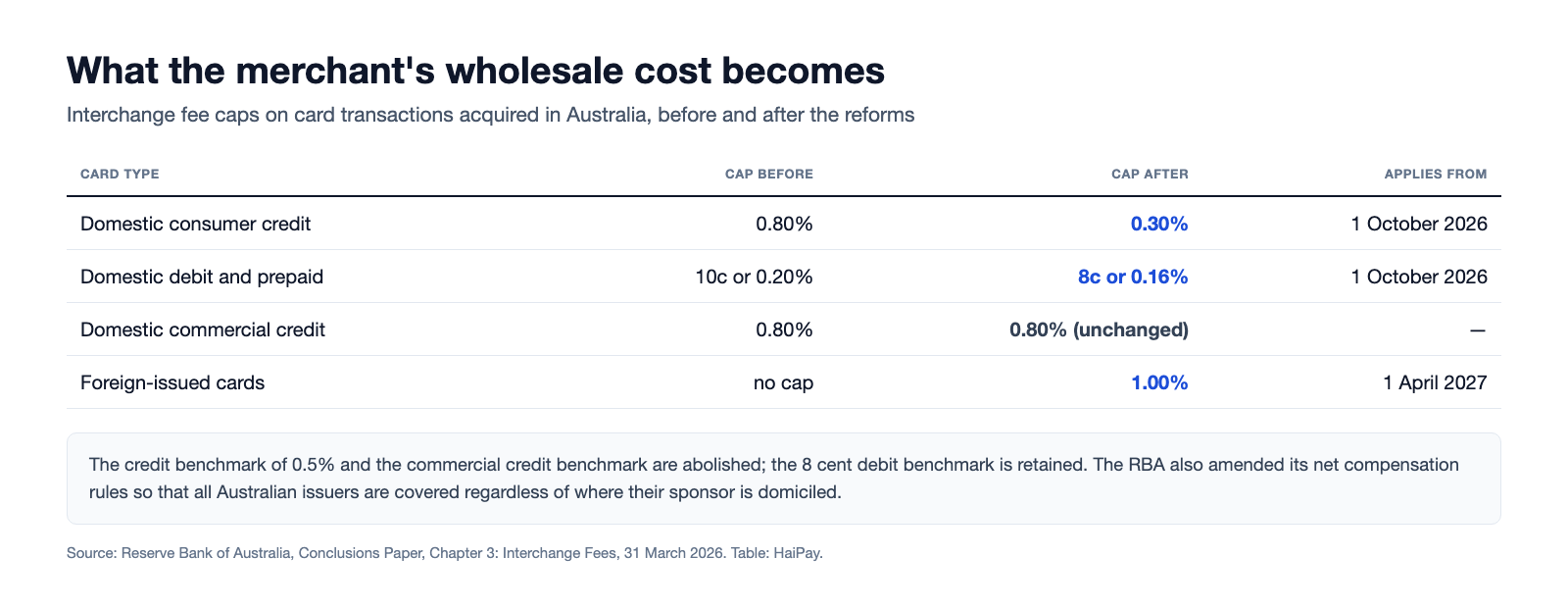
The RBA's answer is to cut the wholesale cost at the same time. From 1 October, interchange caps on domestic transactions fall: the cap on consumer credit drops to 0.3% of transaction value from 0.8%, and the debit and prepaid cap drops to 8 cents, or 0.16% on an ad valorem basis, from 10 cents or 0.2%. The commercial credit cap stays at 0.8%.
Foreign-issued cards, until now outside the regime, get a cap of 1.0% from 1 April 2027.
The RBA puts the total saving at about $910 million a year in lower wholesale costs, against $1.8 billion of surcharges removed. The two numbers do not match, and the gap is the merchant's to manage.
Whether the saving arrives is a separate question
The reform assumes acquirers pass the interchange cuts through. The RBA is not relying on trust.
From 30 October, the designated networks and large acquirers must publish specified card fee information on their websites, and the RBA will republish it. From 30 January 2027, large acquirers must publish how much of the interchange reduction reached merchant service fees. From 1 April 2027, all acquirers must give merchants more detailed statements.
That sequence is the useful part of this reform for anyone outside Australia: a regulator cutting a wholesale price and then publishing, firm by firm, who passed it on.
What this is not
HaiPay has not verified that every network has implemented what it announced, and the RBA's own page notes that network rules may change.
The $1.6 billion and $1.8 billion figures are RBA estimates of surcharges paid, not measured totals, and the $910 million is the RBA's estimate of the interchange effect. Whether consumers end up better off depends on how much of the surcharge is rebuilt into prices, which nobody can measure yet.
Exemptions are for the networks to grant, not the RBA, so pockets of surcharging may survive on terms HaiPay cannot see today. HaiPay did not contact the RBA, any network or any acquirer.
What to watch
The October and January publications. They will show, by name, which acquirers passed the interchange cut through and which did not.
Shelf prices in categories that surcharged heavily, such as hospitality and taxis, where the cost has to go somewhere.
And the further review the RBA said it would run on the parts of the payments system it does not regulate, which is where buy-now-pay-later and the non-designated networks sit, including whether American Express should be brought in.
How to cite
HaiPay News, "Australia Kills $1.8bn of Card Surcharges From 1 October", https://www.haipay.net/news/australia-card-surcharge-ban-1-october, September 28th, 2026
About the author
Crystal
Digital Public Relations
A digital PR specialist with a Master's in Journalism & Communication from UNSW. Started as an intern at ABC Australia, now leads public relations at Haipay, crafting press releases and media strategies that bring brand stories to life.
Reviewed by WeiJun TangEditorial policy
5 sources
- Reserve Bank of Australia
Frequently Asked Questions: Removal of Card Payment Surcharges From 1 October 2026
- Reserve Bank of Australia
Review of Merchant Card Payment Costs and Surcharging, Conclusions Paper, Executive Summary
- Reserve Bank of Australia
Conclusions Paper, Chapter 3: Interchange Fees
- Reserve Bank of Australia
Conclusions Paper, Chapter 8: Impact and Implementation