Payment Firms Passport Into 29 Countries, or None
The European Banking Authority publishes the full register of licensed payment firms as a downloadable file, updated at least once a day. HaiPay downloaded today's copy, checked it against the checksum the EBA publishes beside it, and counted.
September 23rd, 2026
Last updated: September 23
Key takeaways
- Of 1,455 authorised EU payment and e-money institutions, 581 are listed in no country other than their own.
- Of the 874 that passport, 476 are listed in all 29 other EEA countries and only 142 in one to five.
- Among e-money institutions, more than half of all 429 are listed in every other EEA country.
- Every one of the 30 EEA countries has more firms passported in than licensed at home.
- Germany has 95 home-licensed firms against 705 passported in; Slovenia has five against 653.
- Being listed in a country is a notification by a regulator, not evidence of customers or volume there.
Data highlight
39.9per cent
Authorised EEA payment and e-money institutions listed in no country other than their own
23 September 2026
Counted by HaiPay on 23 September 2026 from the European Banking Authority's PSD2 register, using the official bulk download published at euclid.eba.europa.eu (file download-PSDMD-202609230000.json, snapshot timestamped 23 September 2026 00:00 UTC, 330,543 records). The ZIP was verified against the SHA-256 hash the EBA publishes with it, 8e3de6aca47b89fd73a23c8c988739cc5682d406a2394e29a343bc64d8579031, and the JSON against its own accompanying checksum. HaiPay counted the 1,026 entities of type PSD_PI (authorised payment institutions) and 429 of type PSD_EMI (authorised electronic money institutions), 1,455 in total. A firm's home country is its ENT_COU_RES property; the countries in which it is listed are the country keys of its Services property. Host countries were restricted to the 30 EEA codes in the EBA's own code list published in its data specification. On that basis 581 firms, 39.9 per cent, have no host country; 874 have at least one; 476 are listed in all 29 other EEA countries; 599 in 26 or more; and 142 in one to five. Among payment institutions, 476 of 1,026 have no host country; among e-money institutions, 105 of 429, with 236 listed in all 29 others. For each country HaiPay counted home-licensed firms against firms from elsewhere listed there; every EEA country has more of the latter. Passport rates by home country were calculated only where the country has at least 20 licensed firms. Authorisation cohorts use the earliest ENT_AUT date; 319 entities carry more than one. Seventeen entries use a country code, EU, that is not in the EBA's EEA code list, and 12 of those list no other country; they are counted as having no host country. Excluded from the count: 2,759 exempt payment institutions, 129 registered account information service providers, 336 institutions entitled under national law, 248 branches, 88 exempt e-money institutions, 1,661 exclusions and 323,867 agents. Being listed in a country is a notification by a national authority, not evidence of activity, customers or volume there, and the register contains no volume data. National competent authorities supply and correct the data and update it at least once a day. HaiPay did not contact any firm or authority named.
The European Banking Authority publishes the full register of licensed payment firms as a downloadable file, updated at least once a day. HaiPay downloaded today's copy, checked it against the checksum the EBA publishes beside it, and counted.
Of the 1,455 payment institutions and e-money institutions authorised across the European Economic Area, 581, or 39.9%, are listed in no country other than their own. They have a licence that works in 30 countries and use it in one.
That matches the four-in-ten figure circulating this week. The more striking number is at the other end.
What the passport is
A payment firm licensed in one EEA country can serve customers in the other 29 without applying again. It tells its home regulator where it intends to operate, the home regulator notifies the host, and the entry appears in the register the EBA maintains under Article 15 of the second Payment Services Directive. National authorities own the data and update it at least daily; the EBA publishes the whole file, and a checksum, for anyone to download.
That single filing is the legal basis of most cross-border payment businesses in Europe. It is also, for most licence holders, unused.
Almost everyone who leaves home goes everywhere
Of the 874 firms listed outside their home country, 476 are listed in all 29 of the others. Another 123 are listed in 26 to 28. Only 142 are listed in between one and five.
The register, in other words, has almost no middle. A firm either stays home or files for the entire single market. The median passporting firm covers 29 countries.
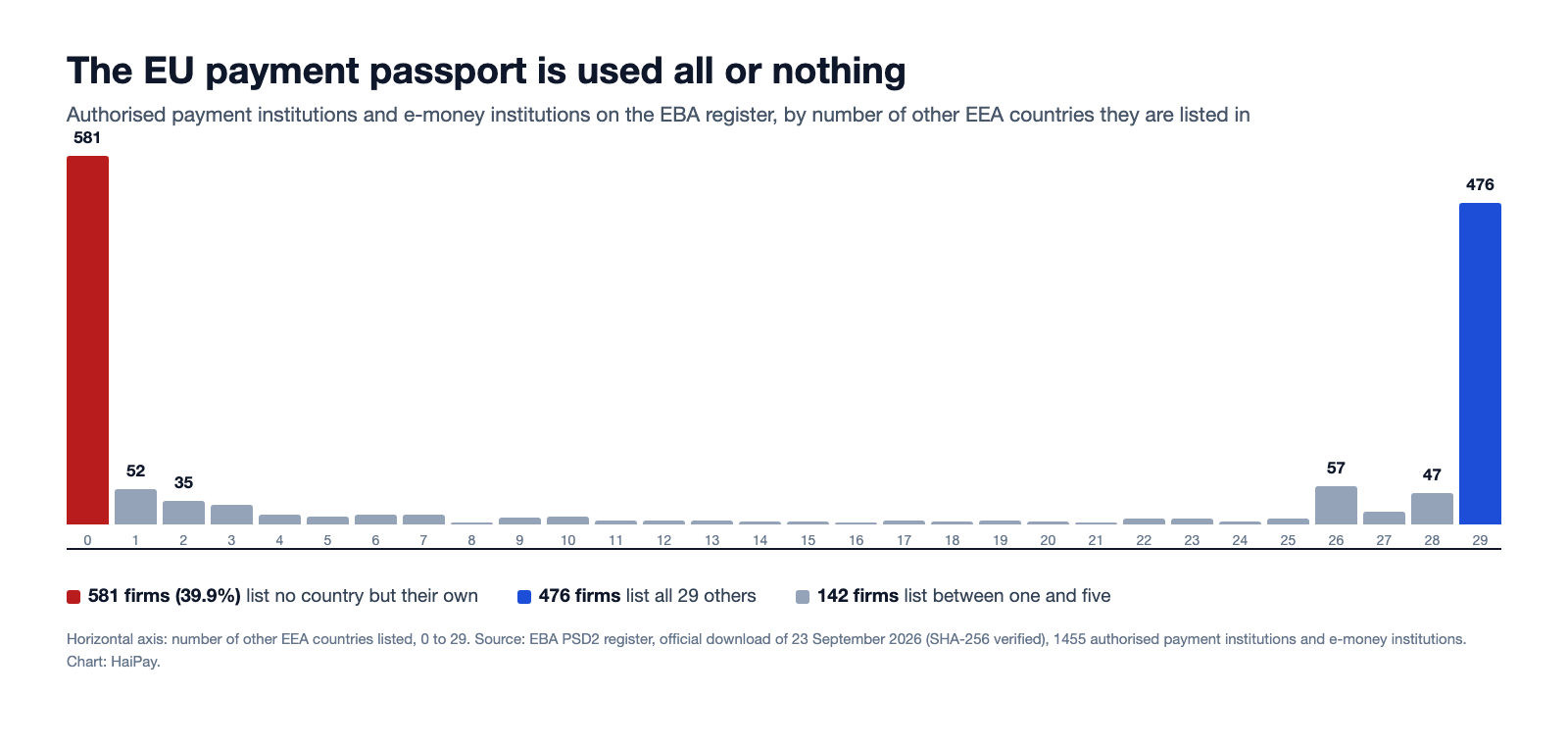
The pattern is strongest among e-money institutions, the licence most used by prepaid, wallet and card programme businesses. There are 429 of them. Only 105 stay home, and 236, more than half of all of them, are listed in every other EEA country.
Payment institutions, the broader licence covering acquiring, money remittance and payment initiation, are more domestic: 476 of 1,026 are listed nowhere else.
In every market, most licensed providers are foreign
Turn the data around and count, for each country, the firms licensed there against the firms from elsewhere listed as providing services there.
Every one of the 30 countries has more of the second than the first. Germany has 95 home-licensed firms and 705 passported in. Slovenia has five and 653. Austria has ten and 699. Even Lithuania, which has more home-licensed payment and e-money firms than any other EEA country at 151, has 563 listed in from elsewhere.
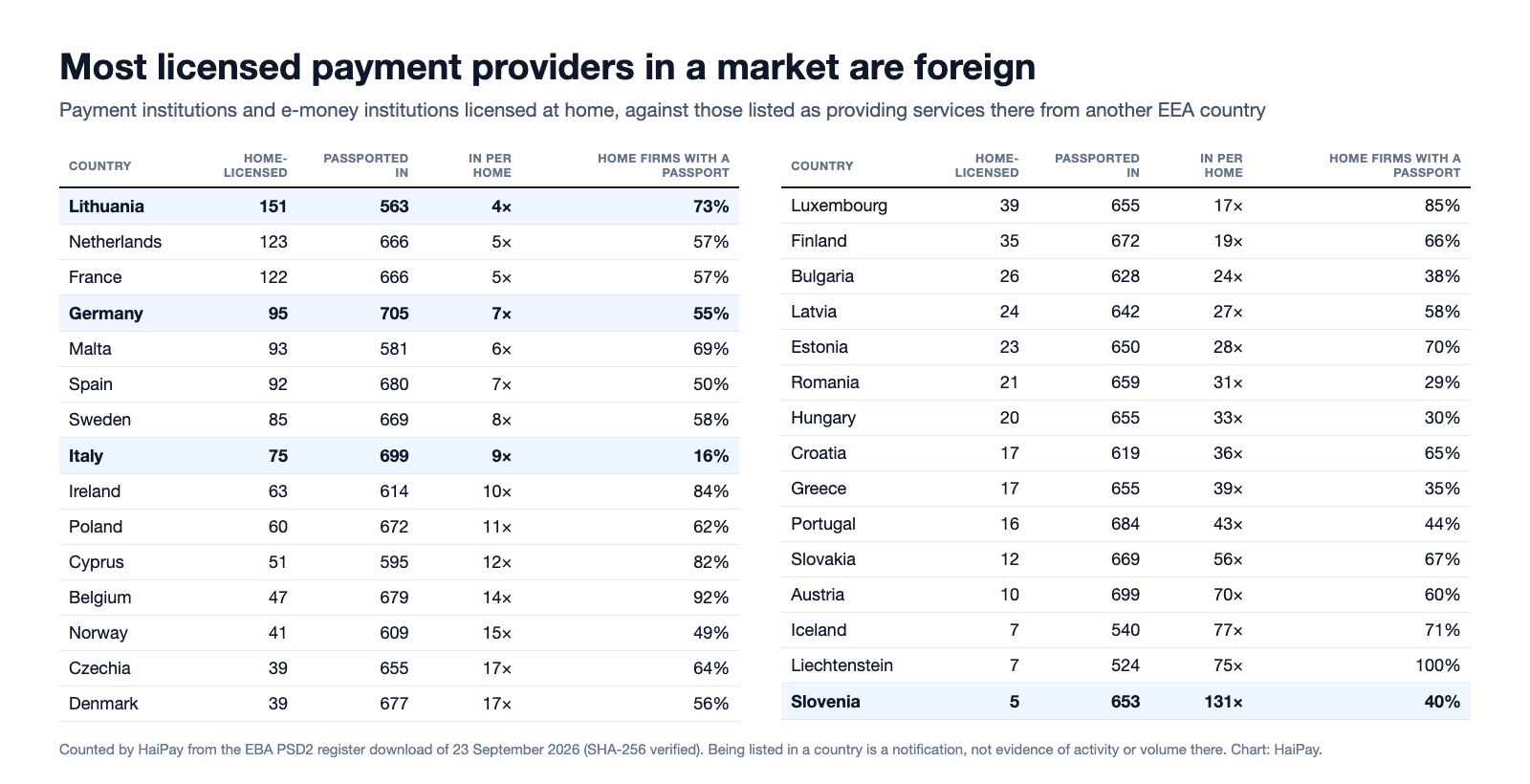
This is what a single market looks like on paper. Whether those firms serve anyone in those countries is a different question, and the register does not answer it.
Where the licence is used, and where it is not
Home countries differ sharply in how much their firms travel.
Ninety-two per cent of Belgium's 47 firms are listed abroad, 85% of Luxembourg's 39 and 84% of Ireland's 63. Lithuania, the largest home base, sits at 73%.
Italy is the outlier at the other end. Of 75 Italian payment and e-money institutions, 12 are listed in another EEA country. Romania is at 29% and Hungary at 30%.
Age does not explain much. Firms authorised in 2019 or earlier passport at 58%, those authorised from 2020 to 2023 at 65%, and those authorised since 2024 at 58%. New entrants are not noticeably more European than old ones.
What this data is not
Being listed in a country is a notification, not evidence of business. A firm can be listed in 29 countries and have customers in two. The register carries no volumes, no revenue and no customer counts, and HaiPay makes no claim about any firm's activity.
The register covers payment institutions and e-money institutions. It does not cover banks, which passport under separate banking rules, and it is not a count of everyone who can process a payment in Europe.
HaiPay's count excludes three other categories in the same file: 2,759 exempt small payment institutions, none of which lists a host country; 129 registered account information service providers; and 323,867 agents, the distribution networks that firms register under their own licences.
National authorities supply and correct the data, and the file shows the seams. Seventeen entries use a country code, "EU", that does not appear in the EBA's own list of EEA country codes; 12 of those have no other country recorded. And 319 entities carry more than one authorisation date. HaiPay used the earliest.
What to watch
Whether the all-or-nothing shape holds when the register is counted again next quarter. It is the kind of pattern that a change in how authorities file notifications could flatten, without anything changing in the market.
Whether Italy's rate moves. Among the countries with more than 20 licensed firms, its 16% is the lowest in the EEA.
And the agent numbers. There are 223 registered agents for every authorised payment or e-money institution in the file, and that is where the actual distribution of payments in Europe sits. It deserves its own count.
How to cite
HaiPay News, "Payment Firms Passport Into 29 Countries, or None", https://www.haipay.net/news/eu-payment-passport-all-or-nothing, September 23rd, 2026
About the author
Crystal
Digital Public Relations
A digital PR specialist with a Master's in Journalism & Communication from UNSW. Started as an intern at ABC Australia, now leads public relations at Haipay, crafting press releases and media strategies that bring brand stories to life.
Reviewed by WeiJun TangEditorial policy
5 sources
- European Banking Authority
EBA PSD2 register, bulk download
- European Banking Authority
Register of payment and electronic money institutions under PSD2
- European Banking Authority
EBA register file metadata, including path and SHA-256 hash
- European Banking Authority
Specification of the data properties of the JSON file with the content of the EBA PSD2 Register