Tariff Refunds Reach $100 Billion. Tracing Them to Shoppers Is the Hard Part
US Customs and Border Protection has now repaid $100 billion of the tariffs the Supreme Court struck down in February. The money is moving. Whether any of it reaches the shoppers who paid it is a separate question, and it turns on whether a merchant can still connect an import charge to a specific order.
August 11th, 2026
Last updated: August 11
Key takeaways
- The Supreme Court voided IEEPA tariffs on 20 February 2026, putting about $166 billion of collected duties up for repayment.
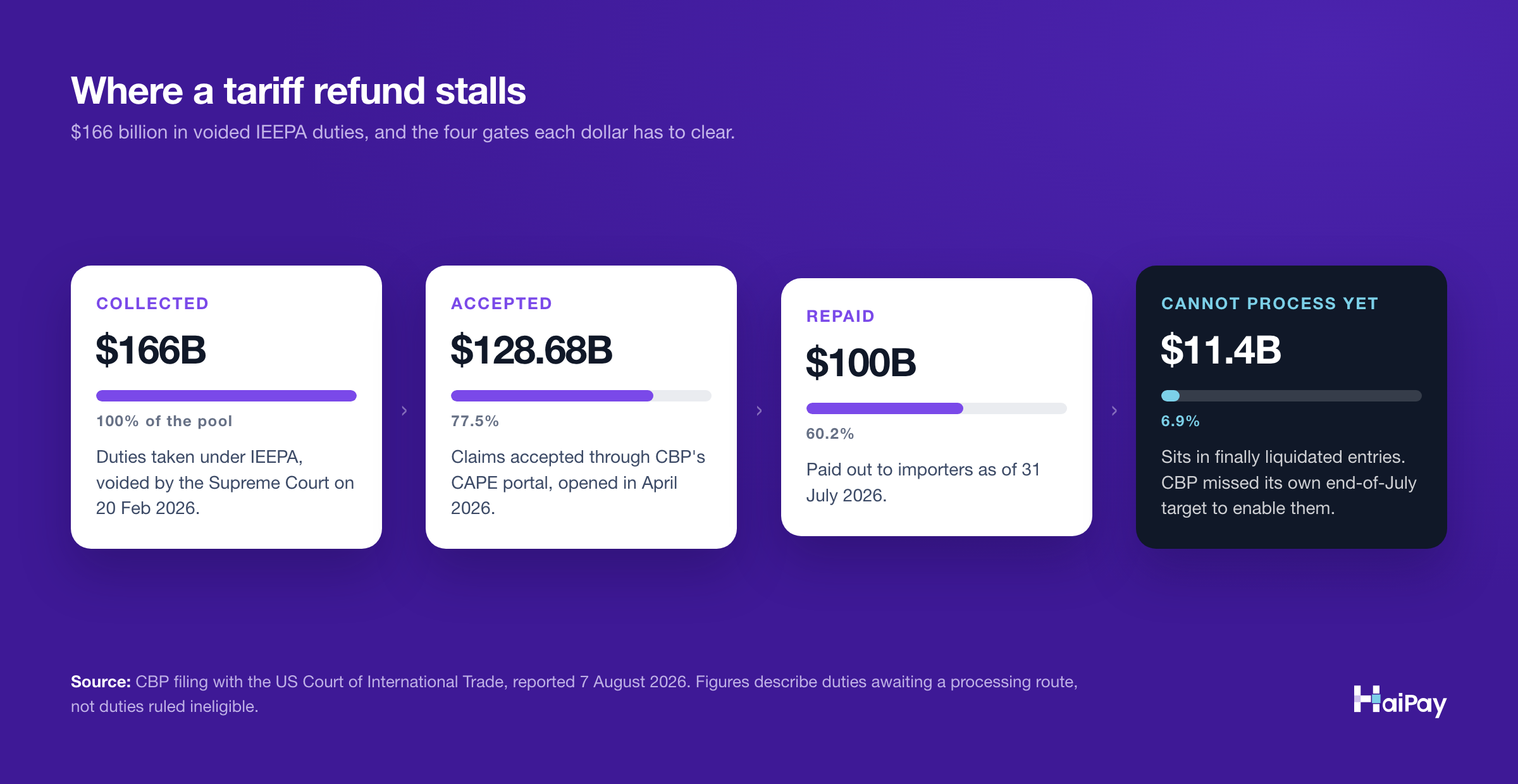
- US Customs had repaid $100 billion of it as of 31 July 2026, and accepted $128.68 billion in claims through its portal.
- About $11.4 billion sits in entries that have finally liquidated, which the refund portal still cannot process.
- Amazon received about $600 million in Q2 2026 and will refund shoppers only where it can trace the import charge to an order.
- Amazon is not the importer for the large majority of goods in its store, so most of those duties were never its to reclaim.
- Trade lawyer Joseph Spraragen expects 10-15% of collected duties will never be refunded.
Data highlight
11.4 billionUSD
IEEPA duties held in finally liquidated entries that CBP's refund portal cannot yet process
As of 31 July 2026
Figure disclosed by US Customs and Border Protection in a filing with the US Court of International Trade, reported by Supply Chain Dive on 7 August 2026. It represents 6.9% of duties collected under the International Emergency Economic Powers Act and covers entries that have finally liquidated, for which the agency's Consolidated Administration and Processing of Entries portal had not enabled refund processing as of the filing; CBP had missed a stated end-of-July target for that capability. The figure describes duties awaiting a processing route, not duties determined to be ineligible for refund.
“I would anticipate that 10-15 percent of the duties collected will not be refunded.”
Customs and Border Protection had paid out $100 billion in refunds of tariffs collected under the International Emergency Economic Powers Act as of 31 July, agency official Brandon Lord said in a filing with the US Court of International Trade. The agency has accepted $128.68 billion in claims through the portal it opened in April, out of roughly $166 billion subject to repayment after the Supreme Court's decision in Learning Resources, Inc. v. Trump, decided 6-3 on 20 February 2026.
Not Every Entry Can Be Reopened
The remaining balance is not simply a queue.
About $11.4 billion of the duties, or 6.9% of the IEEPA total, sits in entries that have finally liquidated. Customs and Border Protection's refund portal cannot yet process those, and the agency missed its own end-of-July target for switching that capability on. Since a feature expansion on 29 June, 2.2 million submissions have been filed through the system.
That is the first place a refund can stall, and it happens before any merchant has to decide what to do with the money.
The Condition Amazon Attached
Amazon received approximately $600 million in tariff refunds in the second quarter. Chief Financial Officer Brian Olsavsky told analysts the company would return money to shoppers under one condition only.
"We've identified a limited set of circumstances where we can trace that we've passed specific import charges onto customers, and when we receive those refunds, we will proactively contact affected customers and automatically issue refunds to them," he said. Otherwise, Amazon would use the refunds to keep investing in lower prices.
The operative word is trace.
Why Amazon's Share Is Smaller Than It Looks
Traceability is the second constraint. The first is standing.
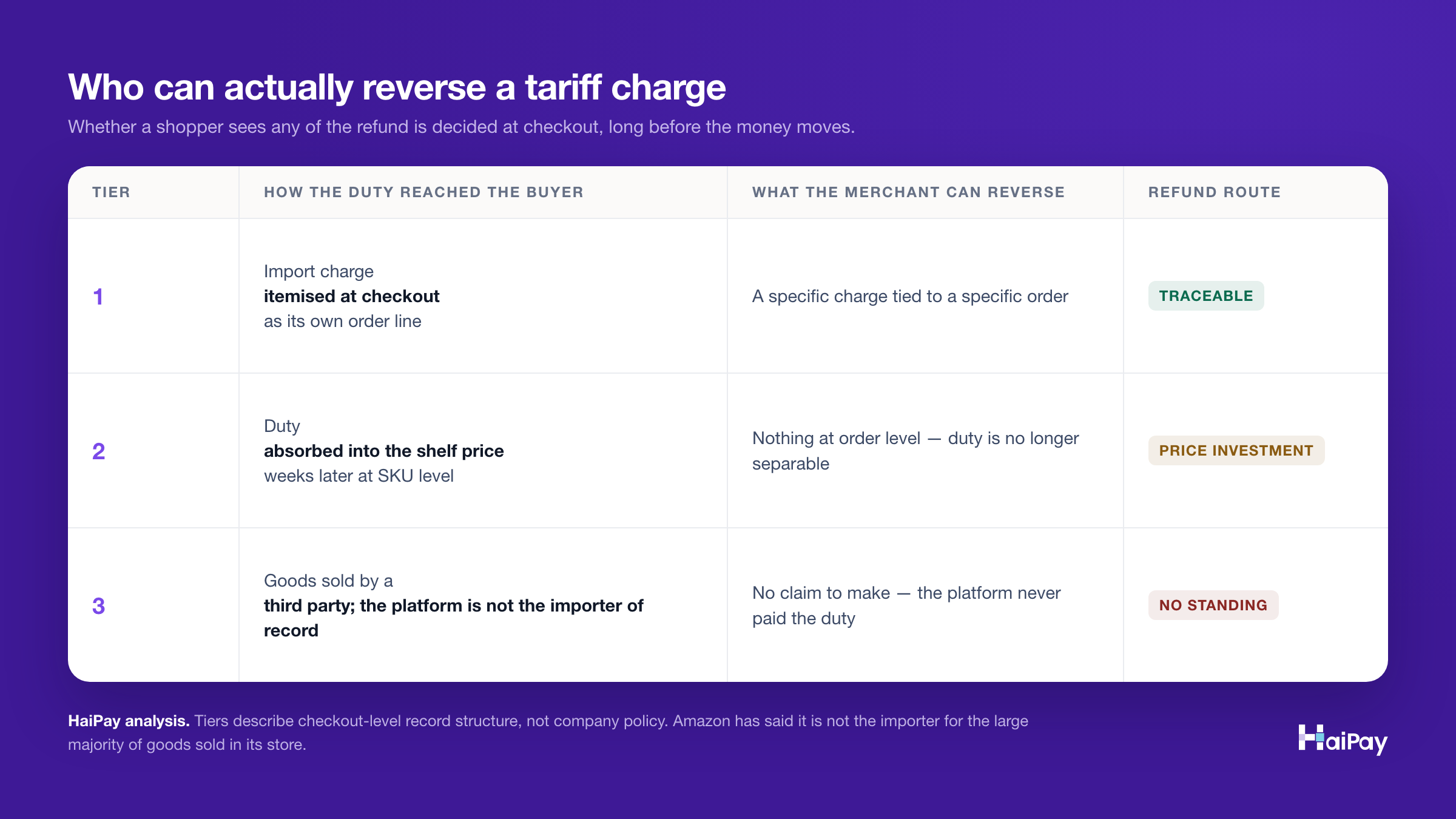
Olsavsky also told analysts that Amazon is not the importer for the large majority of goods sold through its store. Third-party sellers import those goods themselves and pay the duties on them. Where Amazon never paid the duty, there is no refund for it to receive and nothing for it to pass on.
The $600 million therefore covers a narrow slice: goods Amazon imported itself, on which it can also show the charge reached a specific order. The two conditions cut the number down independently, which is why a company of Amazon's size collected a figure this small.
Where Retailers Have Landed
Amazon, Walmart, Costco, FedEx and UPS have said they will pass refunds on. Apple, Nintendo, Ford, General Motors and Nike have made no such commitment.
The sums involved are not small. Apple recorded up to $2.2 billion in tariff-related recoveries and is directing its refund toward US investment projects. Ford expects about $1.3 billion, General Motors about $500 million, and Nike close to $1 billion. Nintendo has argued that consumers agreed to tariff-related price increases at the point of purchase and are not entitled to a share of the rebate. Costco chief executive Ron Vachris said the company's commitment would be "to find the best way to return this value to our members."
Why This Is a Payments Problem, Not Just Policy
Reversing a charge is straightforward when it exists as a discrete, referenceable line item. It is much harder when the cost was absorbed into a price.
Retailers promising pass-through generally itemized import charges at checkout, where the fee appears as its own line on the order. Those that absorbed duty into shelf prices have no order-level record to reverse, whatever their intent. A tariff attaches to a shipment; a price is set weeks later at the SKU level, blending duty, freight, currency and margin. By the time a customer pays, the duty is no longer a separable component of what they paid.
Full repayment is not assumed. Kathleen Claussen, a professor at Georgetown Law School, told Newsweek that repaying the entire $166 billion was "reasonably unlikely but possible," citing importers that never apply, the absence of an automatic mechanism, and businesses that have since closed. Joseph Spraragen, a partner at trade law firm GDLSK, put a figure on it: "I would anticipate that 10-15 percent of the duties collected will not be refunded."
Correction
Correction, 11 August 2026: An earlier version of this article said about $83 billion had been returned and attributed that figure to filings with the US Court of International Trade. The figure came from secondary coverage published on 3 August. A filing by US Customs and Border Protection with the Court of International Trade put the amount paid at $100 billion as of 31 July 2026. The figure and its attribution have been corrected, and the article has been updated with the agency's filing as the source.
How to cite
HaiPay News, "Tariff Refunds Reach $100 Billion. Tracing Them to Shoppers Is the Hard Part", https://www.haipay.net/news/tariff-refunds-traceability-merchant-systems, August 11th, 2026
About the author
Crystal
Digital Public Relations
A digital PR specialist with a Master's in Journalism & Communication from UNSW. Started as an intern at ABC Australia, now leads public relations at Haipay, crafting press releases and media strategies that bring brand stories to life.
Reviewed by Wesley WangEditorial policy