PayPal Users Can Now Pay Weixin Pay Merchants in China
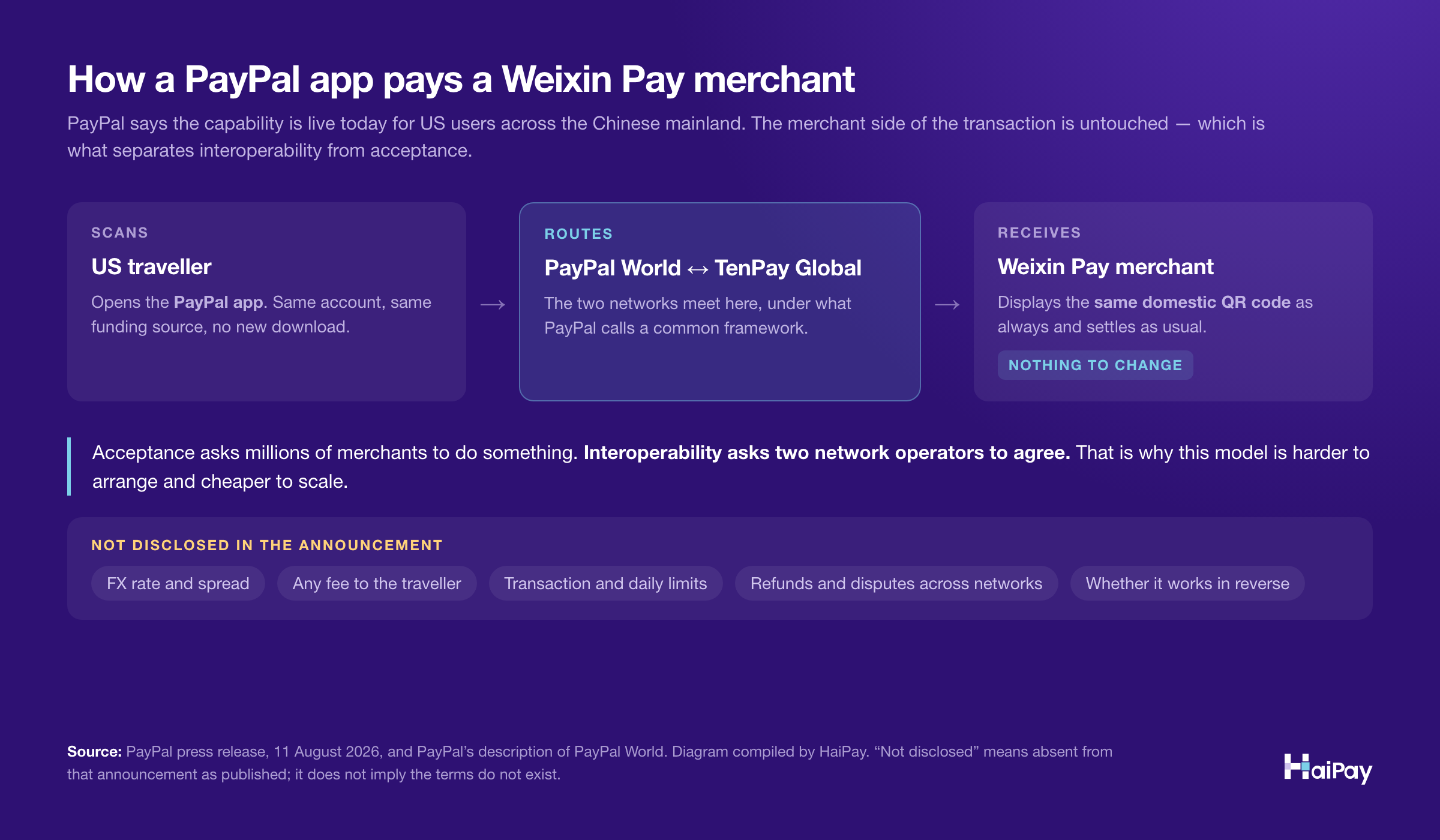
Acceptance asks millions of merchants to do something. Interoperability asks two network operators to agree. This is the second kind, and that is why it is worth reading closely.
August 13th, 2026
Last updated: August 13
Key takeaways
- US PayPal users can now scan Weixin Pay QR codes at merchants across the Chinese mainland.
- PayPal says the in-store QR experience is available today, routed through PayPal World and TenPay Global.
- The merchant displays the same domestic QR code and settles as usual; nothing changes on their side.
- PayPal World was announced with five connections in July 2025; this is the first PayPal has declared available.
- The UPI and Weixin Pay corridors run in opposite directions; neither is the return leg of the other.
- FX terms, fees, limits, dispute handling and whether the corridor runs in reverse were not disclosed.
Data highlight
68000000international visitors
International visitor arrivals to China in 2025, cited by PayPal as context for the launch
Calendar year 2025
Figure cited by PayPal in its announcement of 11 August 2026, which states that China welcomed more than 68 million international visitors in 2025, up 15.5 per cent year over year. It counts all international arrivals to China and is used here as the market context PayPal itself gave for the launch. It is not a count of US visitors, not a count of PayPal users travelling to China, and not a measure of transactions on the new capability. PayPal did not publish a usage figure.
“Travel should be about experiencing a new destination, not figuring out how to pay.”
A US traveller in China can now pay at a Weixin Pay merchant by opening the PayPal app and scanning the merchant's QR code. No Chinese bank account, no local wallet, no app store detour.
PayPal announced the capability on 11 August and said it is available today for US PayPal users at Weixin Pay merchants across the Chinese mainland — a network the company describes as covering tens of millions of merchants.
The mechanism is PayPal World, which PayPal describes as "a cross-border payment network that connects wallets and platforms under a common framework." The counterparty on the Chinese side is TenPay Global, Tencent's cross-border payment platform.
What Is Actually Being Connected
Two wallets that were never designed to talk to each other now do, at the point of sale, without either side asking the user to switch apps.
That is a narrower and more interesting claim than "PayPal works in China." The traveller keeps their existing account, existing funding source and existing app. What changes is that the QR code presented by a Chinese merchant — a domestic instrument, generated inside a domestic scheme — is now readable by a foreign wallet.
For the merchant, nothing changes. They display the same code, receive the same settlement, and do not need to know that the scanning app was not Weixin.
▸
What PayPal World Actually Connects
PayPal World was announced on 23 July 2025 with five connections named at once: Weixin Pay through Tenpay Global, UPI through NPCI International, Mercado Pago, and PayPal and Venmo themselves. PayPal described the launch partners as representing nearly two billion users.
Set side by side, the five do not describe one network. They describe several different arrangements pointing in different directions, at different stages.
▸
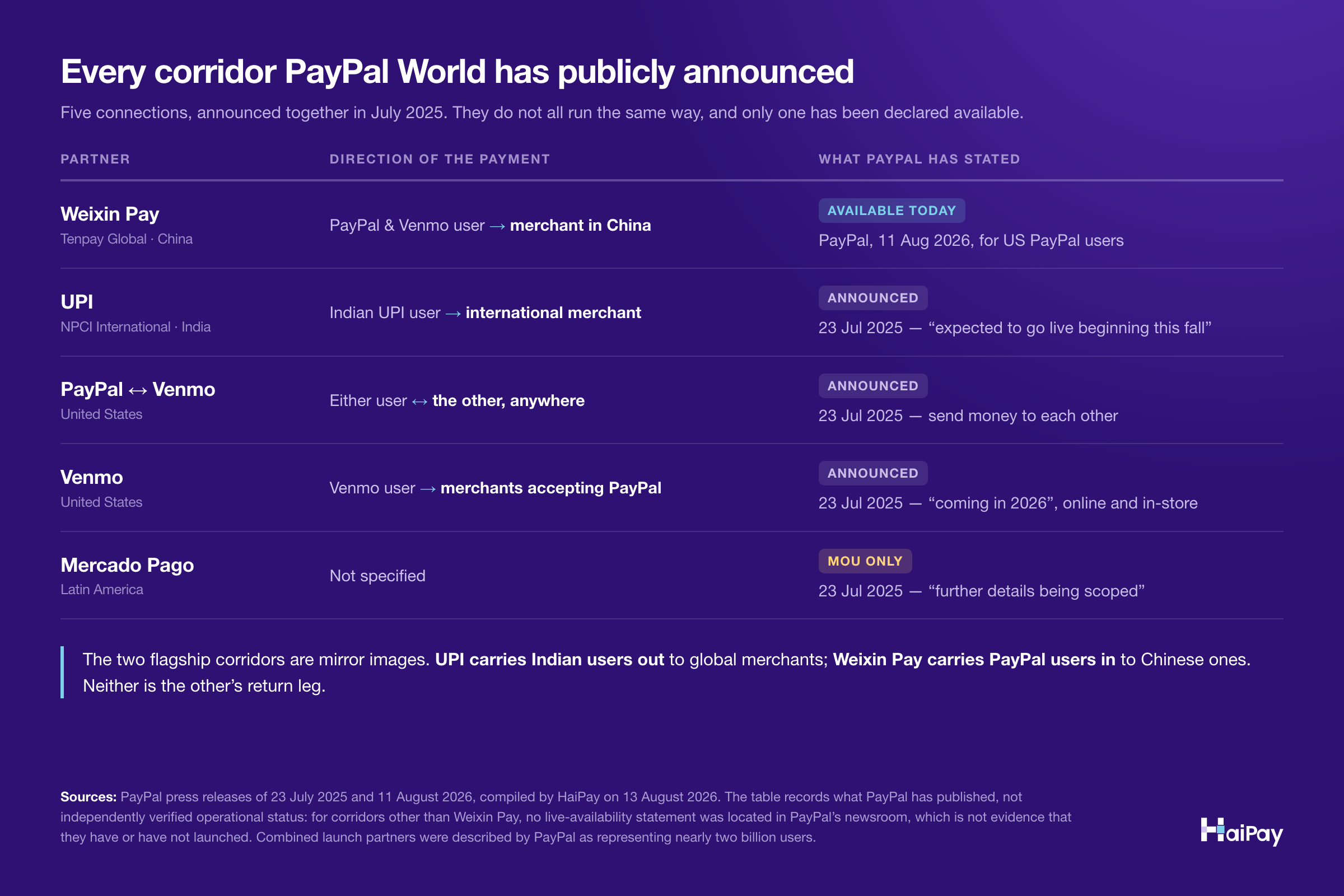
The two headline corridors are mirror images of each other. UPI carries Indian users outward, letting them pay international merchants that accept PayPal. Weixin Pay carries PayPal users inward, letting them pay Chinese merchants. Neither is the return leg of the other, and a traveller going the opposite way on either route is not served by the announcement.
Mercado Pago, named as a launch partner thirteen months ago, remains a memorandum of understanding with "further details being scoped" in PayPal's own words. The Venmo-to-PayPal-merchant capability was described at launch as "coming in 2026."
This matters for reading the 11 August news correctly. It is the first corridor PayPal has publicly declared available rather than announced, and it is one direction of one route.
Why Interoperability Is the Harder Problem
Acceptance and interoperability are often discussed as the same thing. They are not.
Acceptance means a merchant is enabled to take a foreign instrument, which usually requires the merchant, their acquirer, or both to do something: sign an agreement, add a scheme, update a terminal. Interoperability means two existing networks agree a common framework and the merchant's side is untouched.
The second is harder to arrange and far cheaper to scale, because the cost sits with two operators rather than with millions of merchants. It is also the model that has been repeatedly proposed for cross-border QR payments in Asia and has repeatedly stalled on the same questions: whose rules govern the transaction, who holds the customer relationship, and who carries the foreign exchange.
The Numbers PayPal Gave, and What They Measure
PayPal cited China welcoming more than 68 million international visitors in 2025, up 15.5% year over year, and tens of millions of Weixin Pay merchants in the Chinese mainland.
Both figures describe the size of the opportunity rather than the size of the product. The visitor number counts all international arrivals, not US arrivals and not PayPal users among them. The merchant number counts the Weixin Pay network, not merchants who have seen a PayPal-originated transaction.
Neither is a usage figure, and neither should be reported as one.
What Has Not Been Disclosed
The announcement establishes that the capability exists. It does not answer the questions a payments team would ask next.
It does not state the foreign exchange rate or spread applied to the transaction, whether any fee is charged to the traveller, how the rate compares with a card transaction on the same purchase, what transaction or daily limits apply, how refunds and disputes are handled across the two networks, or whether the flow works in the other direction — a Chinese Weixin Pay user paying at a PayPal-accepting merchant abroad.
The absence of the reverse direction is the most consequential gap. A one-way corridor serves inbound tourism. A two-way corridor would begin to look like the wallet interoperability the industry has been describing for a decade.
The Executives on the Record
Alexander Bellabarba, senior vice president of global product solutions at PayPal, framed the launch in traveller terms: "Travel should be about experiencing a new destination, not figuring out how to pay."
Wenhui Yang, chief executive of TenPay Global in Singapore, put it as network-building: "TenPay Global is committed to working with PayPal World, to build a more open and inclusive global payment network together."
Read against each other, the two quotes describe different things. One is a consumer feature. The other is infrastructure. Which of the two this becomes depends on questions the announcement leaves open — and on whether the corridor eventually runs both ways.
How to cite
HaiPay News, "PayPal Users Can Now Pay Weixin Pay Merchants in China", https://www.haipay.net/news/paypal-world-weixin-pay-china-qr-payments, August 13th, 2026
About the author
Crystal
Digital Public Relations
A digital PR specialist with a Master's in Journalism & Communication from UNSW. Started as an intern at ABC Australia, now leads public relations at Haipay, crafting press releases and media strategies that bring brand stories to life.
Reviewed by WeiJun TangEditorial policy