1,869 Banks on FedNow, and No Way to Know Who Can Send
The Federal Reserve publishes three lists for the FedNow Service. The longest, 1,869 banks and credit unions, tells you who is connected. The shortest, 55 technology vendors, tells you what each one can do. The capability data exists; it is attached to the wrong list for anyone trying to send money.
August 24th, 2026
Last updated: August 24
Key takeaways
- The Federal Reserve's FedNow participant list carried 1,869 institutions as of 17 August 2026.
- That is about 22% of the roughly 8,495 federally insured US banks and credit unions.
- The participant file records name, city and state, and no send or receive capability.
- The Fed does publish capability flags, but only for its 55 certified service providers.
- Forty-nine of those 55 vendors support sending; the equivalent figure for banks is not published.
- Thirty-six institutions act as settlement agents or liquidity providers, one for every 52 participants.
Data highlight
22.0percent
Share of US federally insured depository institutions listed as FedNow participants
2026-08-17 to 2026-08-24
Count of institution rows in the Federal Reserve's published FedNow participating financial institutions spreadsheet, divided by the sum of active insured institutions reported by the FDIC BankFind API and federally insured credit unions reported by the NCUA. The participant file dated 17 August 2026 contains 1,869 institution rows across 52 states and territories, with columns for organisation name, city and state only. The FDIC BankFind API returned 4,245 active insured institutions on 24 August 2026 and the NCUA reported 4,250 federally insured credit unions for the first quarter of 2026, giving a denominator of about 8,495. The two denominators are measured on different dates and on different statutory bases, so the ratio is approximate. The file records no send or receive capability, so this figure describes connection rather than the ability to originate a payment. FedNow went live on 20 July 2023.
The Federal Reserve publishes the list of banks and credit unions connected to FedNow, its instant payment service, as a spreadsheet anyone can download. The version dated 17 August 2026 contains 1,869 institutions.
The United States has roughly 8,495 federally insured banks and credit unions. Three years and one month after FedNow went live, the service reaches about 22% of them.
Counting the list
The file has three columns — organisation name, city, state — and 1,869 rows of institutions. They span 52 states and territories. Texas contributes the most at 151, or 8.1% of the roll, followed by Illinois at 119. At the other end, Delaware and Alaska have four each. One row has no state recorded at all; the cell reads #N/A.
Six hundred and three names contain "credit union", "CU" or "FCU", about a third of the list. That is a rough classification by name rather than by charter, but it indicates that credit unions are well represented rather than absent.
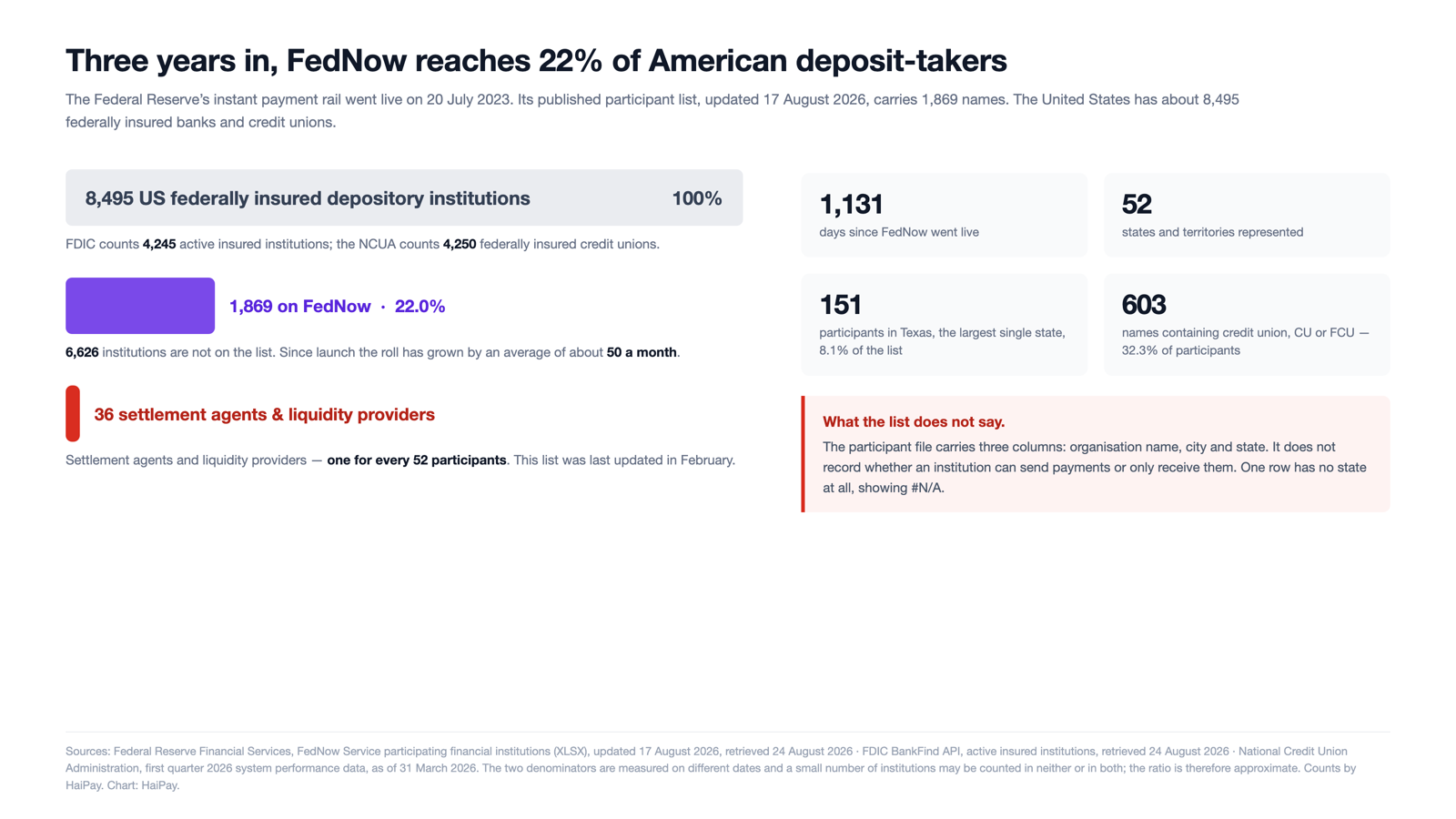
For a denominator, the Federal Deposit Insurance Corporation's own database returns 4,245 active insured institutions, and the National Credit Union Administration reported 4,250 federally insured credit unions for the first quarter of 2026. The two are measured on different dates and a handful of institutions may sit awkwardly between the categories, so 8,495 is an approximation rather than a census. It is close enough to make the point: about 6,600 American deposit-takers are not on the FedNow list.
Averaged across the 1,131 days since launch, the roll has grown by roughly 50 institutions a month.
Thirty-six institutions hold the liquidity layer
The Fed publishes two other lists alongside the participants. One names the settlement agents and liquidity providers — institutions that hold settlement balances or provide funding on behalf of other participants. There are 36 of them, one for every 52 participants.
That concentration is not surprising. Small banks and credit unions generally do not run their own instant-payment liquidity operations; correspondent banks and corporate credit unions do it for them. But it is worth noticing that a rail marketed on its breadth of participation rests, for funding purposes, on a list short enough to read in a minute. That list was last updated on 23 February, six months ago, while the participant list is refreshed regularly.
What the spreadsheet does not tell a business
The participant file records who is connected. It does not record what they can do.
FedNow participants can join in different capacities. An institution may receive payments only, or send and receive; it may support requests for payment; it may handle liquidity management transfers. These are materially different things. A supplier being paid instantly cares that its bank can receive. A business paying suppliers cares that its bank can send. The published participant list distinguishes neither.
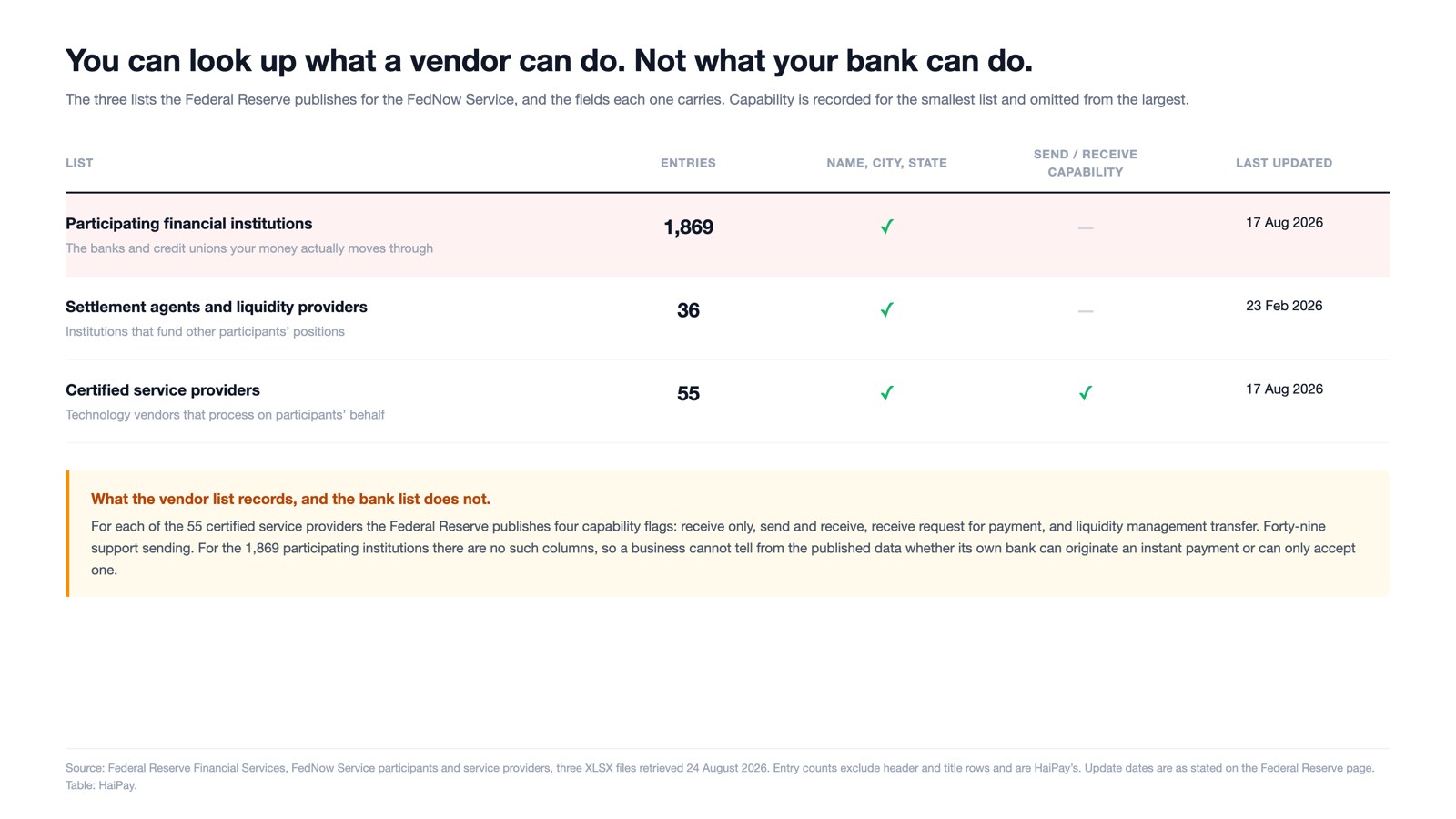
The information exists, and the Fed publishes it — for a different group. Its list of 55 certified service providers, the technology vendors that process FedNow traffic on behalf of banks, carries four capability columns: receive only, send and receive, receive request for payment, and liquidity management transfer. Forty-nine of the 55 support sending. Twenty-five support requests for payment. Nineteen support liquidity management transfers.
So a business can look up in seconds whether a software vendor it has never heard of supports outbound instant payments, and cannot look up whether its own bank does. The asymmetry runs the wrong way round for the party actually trying to move money.
Why this matters more than the headline count
Participant counts are the standard measure of instant-payment progress, and they flatter. A rail where most connected institutions can only receive is a rail that works in one direction for most of its users. The United Kingdom, the euro area and Brazil all went through versions of this problem, and in each case the interesting number was never how many institutions had connected but how many could originate.
For a merchant or a payroll operator deciding whether to build on FedNow, "1,869 institutions" is the wrong figure to plan against. The right one is not published.
What is established and what is not
Established: the Federal Reserve's participant file dated 17 August 2026 lists 1,869 institutions across 52 states and territories, with three columns and no capability field. Texas accounts for 151. The settlement agents and liquidity providers list contains 36 names and was last updated 23 February 2026. The certified service providers list contains 55 names with four capability columns, of which 49 support send and receive. The FDIC reports 4,245 active insured institutions and the NCUA 4,250 federally insured credit unions.
Not established: how many of the 1,869 can send rather than only receive, which the Fed does not publish in these files; how many institutions are connected indirectly through a correspondent without appearing on the list; FedNow transaction volumes, which are not in these datasets; and whether the 8,495 denominator double-counts or misses institutions at the margins, since the two regulators count on different dates and different bases. The credit union share is inferred from institution names, not from charter data. We did not attempt to match the participant list against the FDIC or NCUA registers institution by institution.
The narrow reading is that the Federal Reserve publishes exactly enough to count its instant payment rail and not enough to use it.
How to cite
HaiPay News, "1,869 Banks on FedNow, and No Way to Know Who Can Send", https://www.haipay.net/news/fednow-1869-participants-no-send-capability, August 24th, 2026
About the author
Crystal
Digital Public Relations
A digital PR specialist with a Master's in Journalism & Communication from UNSW. Started as an intern at ABC Australia, now leads public relations at Haipay, crafting press releases and media strategies that bring brand stories to life.
Reviewed by WeiJun TangEditorial policy