The Bank of England Already Has an Innovation Objective
The UK has bolted a secondary objective onto a financial regulator before. The Financial Services and Markets Act 2023 did it, and attached a reporting duty to Parliament. That duty required two reports, not an annual cycle. Both have been made, and it expired on 29 August 2025.
August 27th, 2026
Last updated: August 27
Key takeaways
- Section 30D(2) of the Bank of England Act 1998 already gives the Bank a secondary innovation objective.
- Section 30D(4) limits it to four entity types: recognised CCPs and CSDs, and third country CCPs and CSDs. Payment systems are excluded.
- The phrase "so far as reasonably possible" appears verbatim in four provisions governing the Bank and the PRA.
- FSMA 2023 section 26 required two reports per regulator, not an annual cycle. Both were made and the duty lapsed on 29 August 2025.
- The PRA's secondary competitiveness objective was disapplied from its Basel 3.1 implementation by transitional provision.
- No draft clause has been published, and the announcement is absent from HM Treasury's gov.uk publication feed as of 27 August 2026.
Data highlight
2reports
Statutory reports on the secondary competitiveness and growth objective required from each regulator by FSMA 2023 section 26
29 August 2023 to 29 August 2025
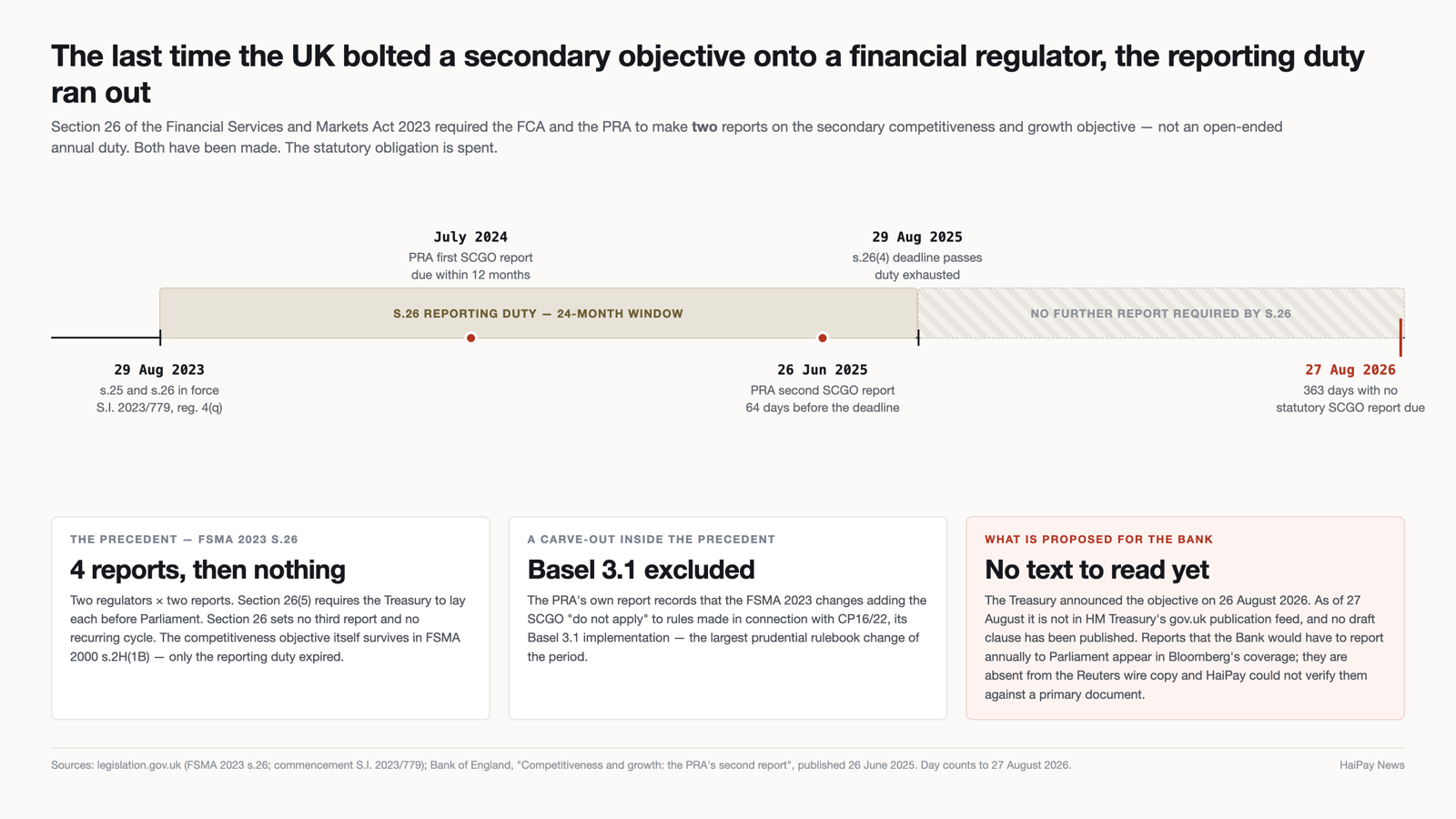
Read from the text of section 26 of the Financial Services and Markets Act 2023 as in force on 27 August 2026. Section 26(1) requires each regulator to make two reports to the Treasury on how it has complied with its duty to advance the competitiveness and growth objective. Section 26(3) requires the first before the end of 12 months beginning with the day section 25 came into force, and section 26(4) the second before the end of 24 months. Section 26(5) requires the Treasury to lay a copy of each before Parliament. Section 26(7)(a) defines "regulator" as the FCA and the PRA, so the section provides for four reports in total. Section 26 came into force on 29 August 2023 by S.I. 2023/779, reg. 4(q). The PRA made its first report in July 2024, as recorded in its second report, and published the second on 26 June 2025, 64 days before the 29 August 2025 deadline. Section 26 provides for no third report. This figure describes the reporting duty attached by the 2023 Act only; the objective itself continues in FSMA 2000 s.2H(1B). HaiPay did not check whether any other instrument imposes a separate recurring reporting duty on the same objective.
“This is core central banking - using our own infrastructure and balance sheet, and our convening power at the heart of the financial system, to ensure trust in money and drive responsible innovation in payments in support of long-term economic growth.”
The Treasury said on Wednesday 26 August that it plans to give the Bank of England a new secondary objective to support innovation in payment systems and digital money such as stablecoins, with financial stability remaining the Bank's primary responsibility. The stated purpose is to help ensure regulation keeps pace with changes in payments technology. Bank of England Deputy Governor Sarah Breeden welcomed the announcement.
The framing in most coverage is that the Bank is being handed an innovation mandate for the first time. It is not. The Bank already holds a secondary innovation objective, written in statute, using almost exactly the words a new one would use. Reading it is the fastest way to understand what Wednesday's announcement would and would not change.
The Bank already has a secondary innovation objective
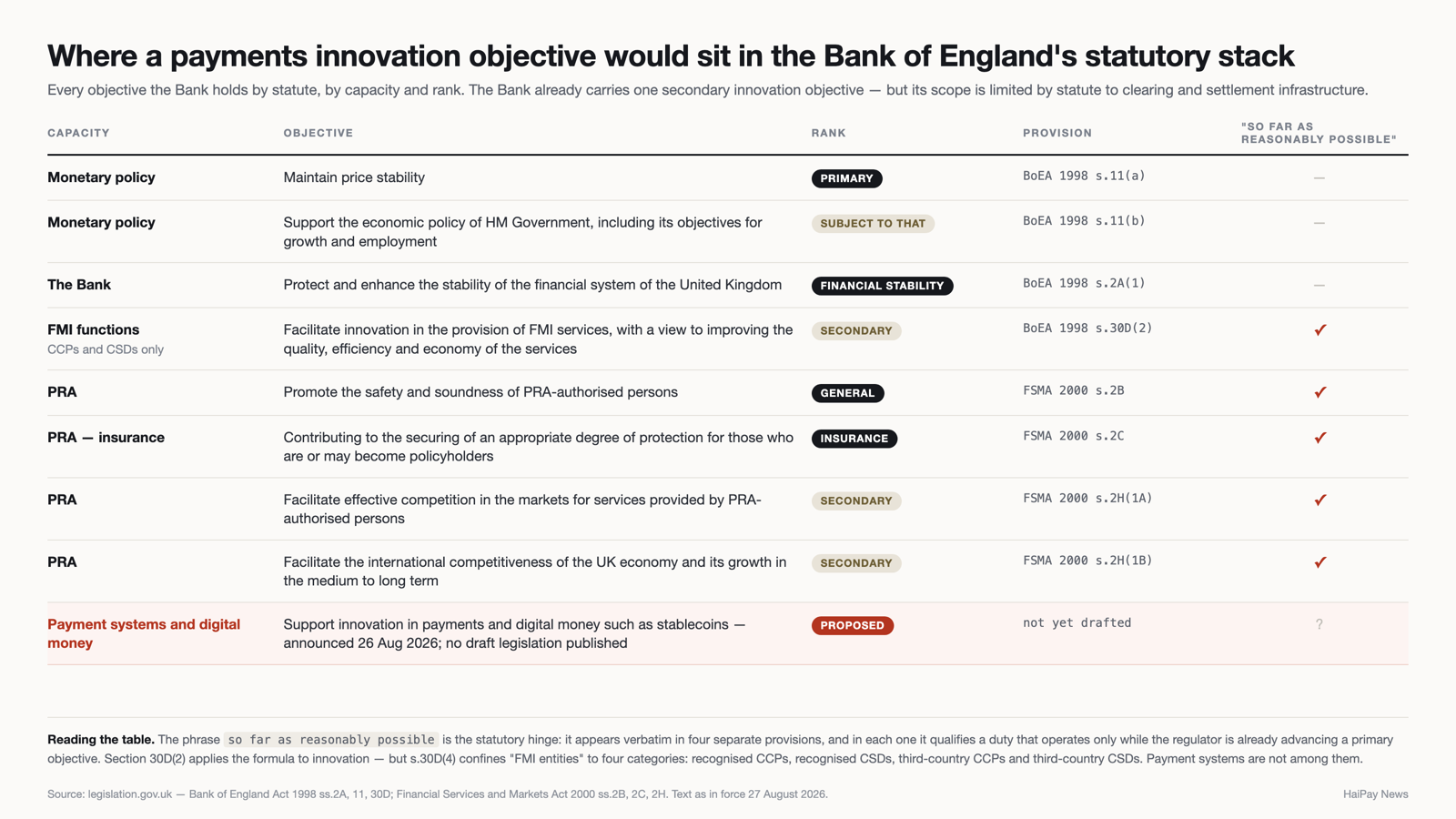
Section 30D(2) of the Bank of England Act 1998 provides that, in exercising its FMI functions in a way that advances the Financial Stability Objective, the Bank must, so far as reasonably possible, act in a way which, as a secondary objective, facilitates innovation in the provision of FMI services — including in the infrastructure used for that purpose — with a view to improving the quality, efficiency and economy of the services.
That is an innovation objective, it is secondary, and it is already law. What limits it is not its wording but its reach. Section 30D(4) defines "FMI entities" exhaustively, and the list has four items: a recognised central counterparty, a recognised CSD, a third country central counterparty, and a third country CSD.
All four are clearing and settlement infrastructure. Payment systems are not among them. So the gap Wednesday's announcement addresses is real — but it is a gap in scope, not a gap in concept. The drafting template already exists in the same Act.
What "secondary" does to a duty
UK financial services legislation uses a consistent formula for secondary objectives, and the formula is more restrictive than the word "objective" suggests. The phrase so far as reasonably possible appears verbatim in four separate provisions governing the Bank and the PRA: section 2B(1) and section 2C(1) of the Financial Services and Markets Act 2000, section 2H(1) of the same Act, and section 30D(2) of the Bank of England Act 1998.
In each case the qualifier does the same work. The secondary duty is engaged only while the regulator is already acting to advance a primary objective, and even then only to the extent reasonably possible. The Bank's monetary policy remit has the same shape: section 11(a) requires it to maintain price stability, and section 11(b) requires it to support the Government's economic policy — but only "subject to that."
The PRA states the hierarchy plainly in its own reporting: the primary objectives rank above the secondary objectives. A secondary objective is a tie-breaker and a reporting obligation. It is not a licence to trade away the primary one.
The last time the UK did this, the reporting duty expired
There is a recent precedent, and it has already run its full course. The Financial Services and Markets Act 2023 gave the FCA and the PRA a secondary competitiveness and growth objective, now found at section 1EB and section 2H(1B) of FSMA 2000 respectively. Section 26 of the 2023 Act attached a reporting duty to it.
That duty was finite. Section 26(1) requires each regulator to make two reports to the Treasury — not an annual cycle. Section 26(3) sets the first at twelve months from commencement and section 26(4) sets the second at twenty-four months. Section 26(5) requires the Treasury to lay each before Parliament. Section 26 provides for no third report.
Section 26 came into force on 29 August 2023 under S.I. 2023/779, reg. 4(q). The PRA made its first report in July 2024 and published its second on 26 June 2025, sixty-four days inside the statutory deadline of 29 August 2025. Counting the FCA, the section produced four reports in total. As of today, 27 August 2026, three hundred and sixty-three days have passed since that deadline, and no further report is due under section 26. The objective itself survives in FSMA 2000; only the obligation to account for it to Parliament lapsed.
The carve-out inside the precedent
One detail in the PRA's second report deserves more attention than it has had. The report records, twice, that the FSMA 2023 changes adding the secondary competitiveness and growth objective do not apply when the PRA makes rules, technical standards or policies in connection with consultation paper CP16/22 — its implementation of the Basel 3.1 standards.
Basel 3.1 was the largest prudential rulebook change the PRA undertook in the period the reports cover. The flagship secondary objective was disapplied from the flagship policy, by transitional provision. Anyone modelling what a payments innovation objective will mean in practice should ask which policies, if any, would sit outside it.
What we could not verify
HaiPay checked HM Treasury's gov.uk publication feed twice on 27 August, with different queries. The 26 August payments innovation announcement does not appear in it. No draft clause or consultation document has been published, so there is at present no legislative text to read.
Several outlets report that the Bank would be required to report annually to Parliament on advancing the objective, and quote City Minister Lucy Rigby. Those details appear in Bloomberg's coverage. They are absent from the Reuters wire copy that HaiPay was able to read in full, and we could not confirm them against a primary document. We are therefore not treating the annual reporting requirement as established. If it is enacted in those terms it would be a materially stronger accountability mechanism than the 2023 precedent, which is precisely why it is worth confirming rather than repeating.
What to watch
Three questions will determine whether this is a change in the Bank's incentives or a change in its paperwork. First, the scope definition: whether the new objective reaches payment systems recognised under the Banking Act 2009, systemic stablecoin issuers, or both, and whether it borrows section 30D(4)'s technique of an exhaustive list. Second, the reporting: whether the duty is genuinely recurring or finite in the manner of section 26. Third, the carve-outs: whether any major workstream is excluded by transitional provision, as Basel 3.1 was.
Until a clause is published, the most reliable guide to what the Bank thinks its payments role already is remains its own words. Six months before the announcement, Deputy Governor Sarah Breeden told a payments regulation summit that money and payments sit at the heart of the Bank's monetary and financial stability role, and called driving responsible innovation in payments core central banking. The open question is what a statutory objective adds to a job the Bank already says it is doing.
How to cite
HaiPay News, "The Bank of England Already Has an Innovation Objective", https://www.haipay.net/news/boe-innovation-objective-already-exists, August 27th, 2026
About the author
Crystal
Digital Public Relations
A digital PR specialist with a Master's in Journalism & Communication from UNSW. Started as an intern at ABC Australia, now leads public relations at Haipay, crafting press releases and media strategies that bring brand stories to life.
Reviewed by WeiJun TangEditorial policy