The SEC Would Let a Blockchain Be the Share Register
The US Securities and Exchange Commission has proposed rewriting the rules that govern transfer agents, the firms that keep the official record of who owns a company's shares. One line in the 116-page release matters more than the rest: the amended definition "would permit a transfer agent to utilize a blockchain or other distributed ledger technology as its master securityholder file."
September 7th, 2026
Last updated: September 7
Key takeaways
- The SEC proposes letting a transfer agent keep the master securityholder file on a blockchain.
- The master securityholder file is the legal register of share ownership. The rules date from 1977.
- Form TA-2 would newly ask how many issues run on distributed ledger technology, and by tokenization model.
- No US regulator currently publishes a count of share registers running on a distributed ledger.
- Of the 175 numbered requests for comment, 19 concern distributed ledger, blockchain or tokenization.
- There were 327 registered transfer agents at 30 June 2026; 143 handled under 1,000 transfers in 2025.
Data highlight
19of 175 numbered requests for comment
Numbered requests for comment in the SEC's transfer agent rules proposal that concern distributed ledger technology, blockchain, tokenization or digital wallets
7 September 2026
Counted by HaiPay on 7 September 2026 from the full text of the Securities and Exchange Commission's Transfer Agent Rules proposal, Release No. 34-106246, File No. S7-2026-30, published in the Federal Register on 4 September 2026 at 91 FR 56946 and running 116 pages, retrieved from the Federal Register full-text API. The release contains 175 numbered requests for comment, numbered 1 to 175 and beginning after the first Request for Comment heading. Reading each in turn, 19 of them refer to distributed ledger technology, blockchain, tokenization or digital wallets, which is 10.9 per cent; they are questions 21, 30, 36, 37, 41, 46, 47, 50, 80, 82, 83, 84, 87, 88, 95, 99, 105, 113 and 116. Across the whole release the string tokeniz appears 62 times, distributed ledger 38 times, blockchain 26 times, crypto asset three times and stablecoin once, and the phrase digital asset does not appear. The release states that the amended definition would permit a transfer agent to use a blockchain or other distributed ledger technology as its master securityholder file, or a component of it, but would not mandate it. The rules being amended, Rules 17ad-1 through 17ad-7, were adopted on 16 June 1977. Proposed Form TA-2 questions would require reporting of the number of issues using physical certificates, the number for which distributed ledger technology maintained the master securityholder file, and the number by tokenization model. The Commission's economic baseline records an estimated 327 registered transfer agents as of 30 June 2026, of which approximately 253 filed a Form TA-2 for the 2025 reporting period and 143 received fewer than 1,000 items for transfer, about 57 per cent of filers, while 55 are supervised by a banking regulator. Comments are due by 3 November 2026, 60 days after publication. This is a proposal and has not been adopted. HaiPay did not contact the Commission or any transfer agent.
The US Securities and Exchange Commission has proposed rewriting the rules that govern transfer agents, the firms that keep the official record of who owns a company's shares. One line in the 116-page release matters more than the rest.
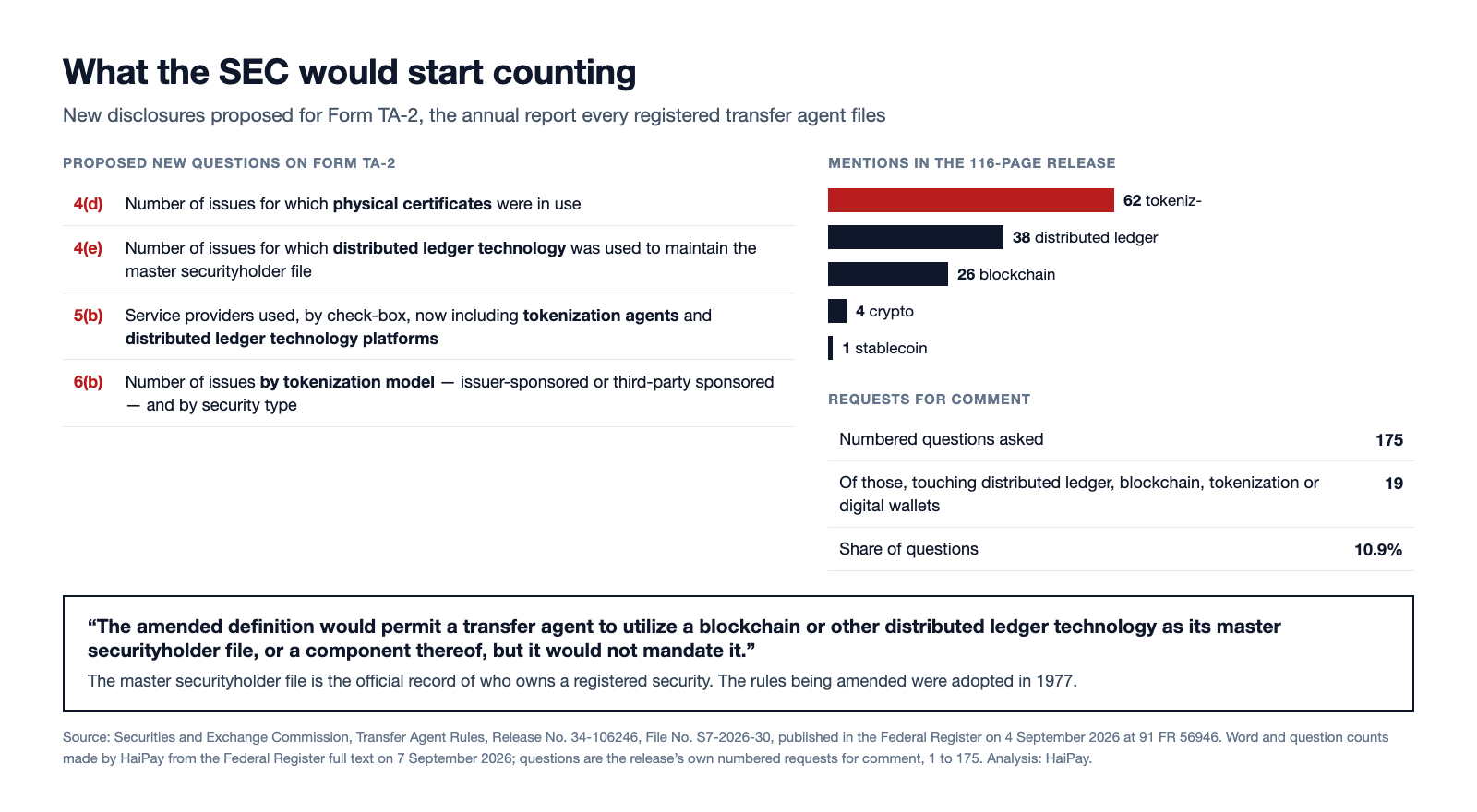
The amended definition, the Commission writes, "would permit a transfer agent to utilize a blockchain or other distributed ledger technology as its master securityholder file, or a component thereof, but it would not mandate it."
The master securityholder file is the legal register of ownership. The rules being amended were adopted on 16 June 1977.
What a transfer agent actually is
A transfer agent maintains the issuer's securityholder records, processes transfers, pays dividends and handles corporate actions. When a company says you own 100 of its shares in registered form, the transfer agent's file is what says so. It is the piece that decides whether a token is a share or a claim on someone else's share.
That is why permitting the file itself to sit on a distributed ledger is not a technology footnote. It is the difference between a token that references an entry in a database and a token that is the entry.
The Commission is careful about how far it goes. It permits, it does not require, and the choice remains subject to the issuer's governing documents, the law of its state of organisation, and the rules of exchanges and the Depository Trust Company. It is opening a door, not walking through it.
The SEC would start counting tokenization
The more immediately useful part, for anyone trying to size this market, is the reporting. Form TA-2 is the annual report every registered transfer agent files. The proposal would add questions asking for the number of issues for which physical certificates were in use, the number for which distributed ledger technology was used to maintain the master securityholder file, and the number by tokenization model, split between issuer-sponsored and third-party sponsored.
It would also add "tokenization agents" and "distributed ledger technology platforms" to the check-box list of service providers a transfer agent must name.
No US regulator currently publishes a count of securities whose ownership register runs on a distributed ledger. If this is adopted as proposed, one would exist, filed annually, by issuer count and by model.
Elsewhere the release contemplates a digital wallet address as the unique identifier in position detail for a tokenized security, and a blockchain wallet address as a form of securityholder contact information alongside a phone number or an email.
Read what it is, not what it is called
It would be easy to file this as a crypto rulemaking. It is not.
Across the whole release the word "tokeniz-" appears 62 times, "distributed ledger" 38 and "blockchain" 26. "Digital asset" does not appear at all; where the Commission needs the term it writes "crypto asset," three times. The vocabulary is securities recordkeeping, not payments.
"Stablecoin" appears exactly once, and it is worth the detour. Asking about the rule on segregating issuer and securityholder funds, the Commission questions whether it "should address whether stablecoins and tokenized deposits can be funds (in addition to cash) and whether the bank account could be a bank's custodial wallet." That is one sentence in a 116-page document about share registers, and it is a live question about what counts as money.
The release also asks 175 numbered questions. HaiPay counted them and read each one: 19, or 10.9%, touch distributed ledger technology, blockchain, tokenization or digital wallets. The other 156 are about turnaround times, lost securityholder searches, restrictive legends, record differences and who has to file what.
Several of the 19 are genuinely open. The Commission asks whether specific requirements should apply to using a blockchain as a master securityholder file, how to handle records that exist solely on a ledger the transfer agent does not exclusively control, and whether transferring a tokenized security on a blockchain should automatically move the position on the official file. Those are unresolved questions, not settled policy.
The industry that would have to do it
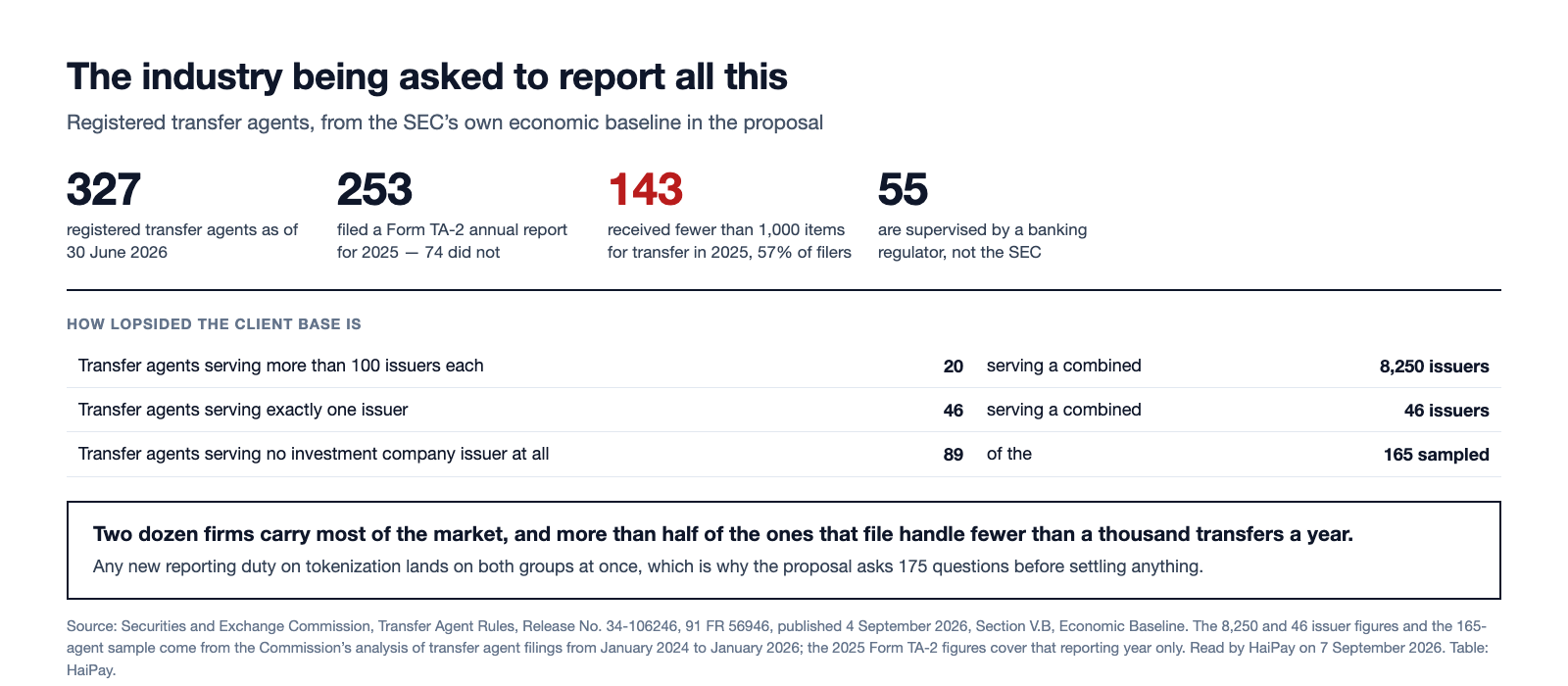
The SEC's own economic baseline is worth reading before assuming this reshapes anything quickly. There were an estimated 327 registered transfer agents as of 30 June 2026. For the 2025 reporting period roughly 253 filed a Form TA-2, so about 74 did not. Of those that filed, 143 received fewer than 1,000 items for transfer in the year, around 57%. And 55 are supervised by a banking regulator rather than the SEC.
The client base is just as lopsided. Twenty transfer agents serve more than 100 issuers each, 8,250 issuers between them. Forty-six serve exactly one issuer. In a sample of 165, 89 do not service a single investment company.
A tokenization disclosure regime lands on two very different populations at once: a couple of dozen firms running most of the American share registry, and a long tail of small operators for whom a new annual question is a real cost.
What HaiPay could not establish
How many securities currently have a master securityholder file on a distributed ledger. That is precisely the number the proposal would create, and it does not exist yet, so the release does not state it and neither does this piece.
Whether the proposal will be adopted, in this form or at all. It is a proposal with a comment period, and the Commission asks 175 questions because it has not decided.
Which firms are building this. The release refers to market participants seeking to bring blockchain-native transfer agents into the US market but names none. HaiPay did not contact the Commission or any transfer agent.
What to watch
The comment file. Comments are due by 3 November 2026, 60 days after publication, under file number S7-2026-30, and the letters will show which firms actually intend to run a share register on a ledger.
Whether proposed question 4(e) survives adoption unchanged, because that single line is what turns tokenized securities from an anecdote into a published annual figure.
And whether any final rule attaches conditions to using a blockchain as the master securityholder file. The proposal asks whether it should. The answer determines whether the door the Commission has opened is one anyone can walk through.
This piece reads a proposed rule. It is not legal or investment advice, and anyone affected should read the release itself.
How to cite
HaiPay News, "The SEC Would Let a Blockchain Be the Share Register", https://www.haipay.net/news/sec-transfer-agent-blockchain-share-register, September 7th, 2026
About the author
Crystal
Digital Public Relations
A digital PR specialist with a Master's in Journalism & Communication from UNSW. Started as an intern at ABC Australia, now leads public relations at Haipay, crafting press releases and media strategies that bring brand stories to life.
Reviewed by WeiJun TangEditorial policy