Seven Conditions, Three Years, and a Cease-or-Divest Clause
On 14 August the Office of the Comptroller of the Currency published a nineteen-page letter granting a national trust bank charter application to World Liberty Trust Company, National Association. The document grants something narrower than the headlines: preliminary conditional approval, revocable, carrying seven conditions the OCC can enforce as if they were an enforcement action.
August 18th, 2026
Last updated: August 18
Key takeaways
- The OCC granted preliminary conditional approval only; final authorisation to commence business has not been given.
- Seven conditions are attached, and the decision states they are enforceable under 12 USC 1818.
- One condition requires the bank to conform, cease or divest its stablecoin business to comply with the GENIUS Act.
- Capital floors are specific: $20m tier 1, and 180 days of wind-down operating expenses held separately in liquid assets.
- Every senior officer and director appointment needs prior OCC non-objection for the first three years.
- The OCC denied the same charter type to Wise National Trust 24 days earlier, on compliance and management grounds.
Data highlight
7conditions
Numbered conditions attached to the OCC's preliminary conditional approval, enforceable under 12 USC 1818
As decided 14 August 2026
The decision lists seven numbered conditions and states they are conditions imposed in writing by a Federal banking agency within the meaning of 12 USC 1818 and are enforceable under it. They cover the limit to trust company operations and the BHC Act definition, conformity with the GENIUS Act on pain of cease or divest, prior notice and non-objection for business plan deviations, a $20 million tier 1 capital floor with liquidity carve-outs, 180 days of wind-down operating expenses, prior non-objection for senior officers and directors, and an independent internal audit manager. Four of the seven run for the bank's first three years of operation. A separate list of eleven preopening requirements is not counted in this figure, and the count does not measure how the conditions will be supervised or enforced in practice.
On 14 August the Office of the Comptroller of the Currency published a nineteen-page letter granting a national trust bank charter application to World Liberty Trust Company, National Association. It was widely reported as a bank charter for a Trump-linked crypto venture.
The document itself grants something narrower: preliminary conditional approval, revocable, carrying seven conditions the OCC can enforce as if they were an enforcement action, one of which lets the regulator order the applicant's core business to stop.
What was actually granted
The letter opens by defining its own limits. The OCC states it has granted preliminary conditional approval only, that final approval and authorisation to commence business under 12 USC 27(a) will not be granted until all preopening requirements are met, and that until final approval it retains the right to modify, suspend or rescind the approval should any interim development warrant it.
The proposed bank would be a wholly owned subsidiary of WLTC Holdings LLC, a Delaware company, with its main office in Bay Harbor Islands, Florida. Its planned activities are stablecoin issuance, redemption and reserve maintenance in a non-fiduciary capacity; digital asset custody as a fiduciary; and conversion services letting custody customers exchange approved stablecoins for USD1.
It intends to issue USD1 to institutional clients nationwide, taking that role from BitGo Bank & Trust, National Association, which the OCC describes as the current exclusive issuer and custodian for the token.
Two structural points get lost in summary. The bank does not intend to be federally insured, and condition one requires that it must not meet the definition of "bank" under section 2(c)(1)-(2) of the Bank Holding Company Act. The OCC also records that the approval was made on the understanding the bank will apply for Federal Reserve Bank stock under 12 USC 222.
The seven conditions at a glance
The conditions are set out in a numbered list in the decision. Four of the seven carry an explicit end date; three do not, and none of them starts running in earnest until a second approval the OCC has not yet given.
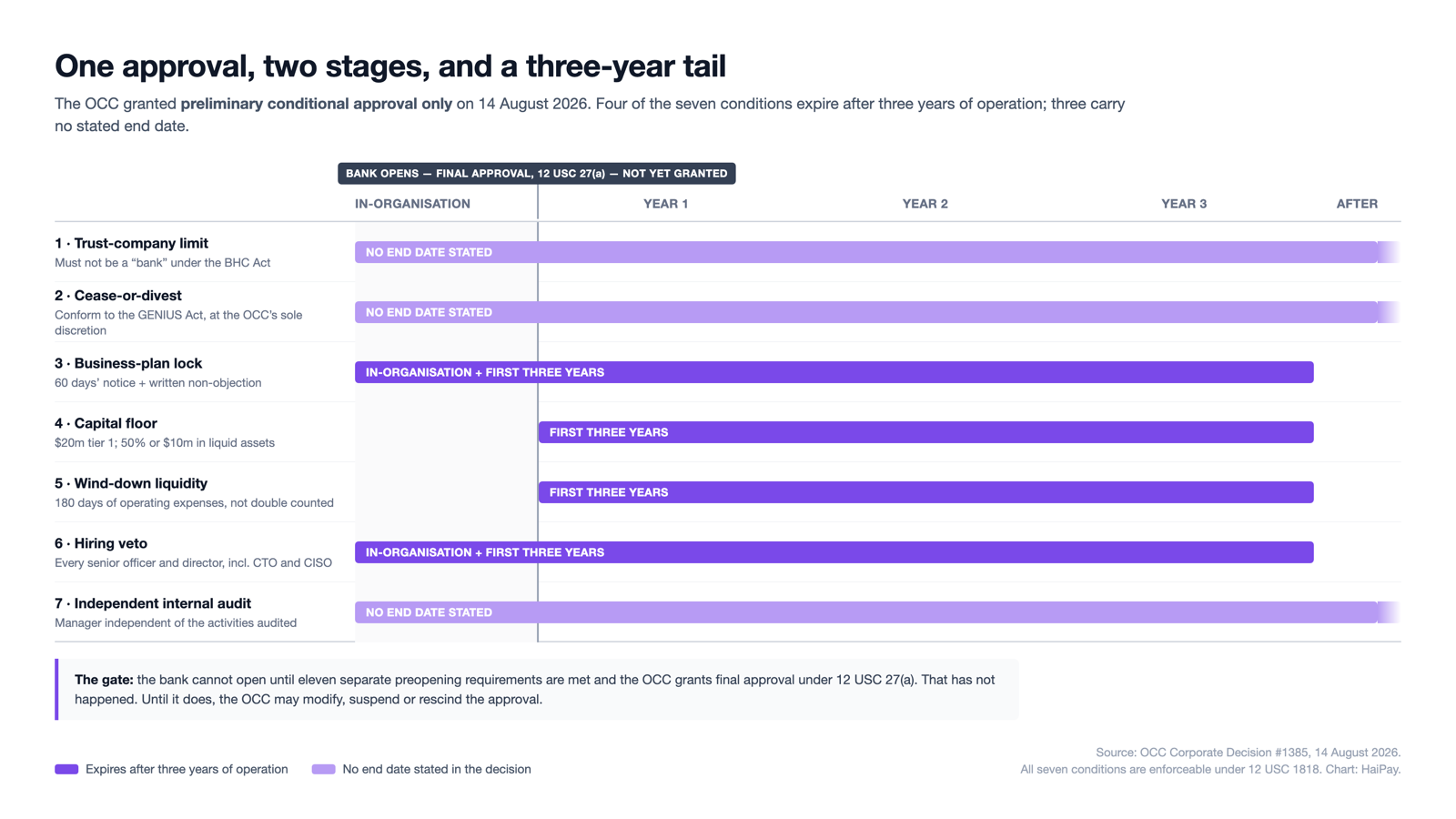
Figure 1. One approval, two stages, and a three-year tail. Four of the seven conditions expire after three years of operation; three carry no stated end date. The bank cannot open until eleven preopening requirements are met and the OCC grants final approval under 12 USC 27(a), which it has not. Source: OCC Corporate Decision #1385. Chart: HaiPay.
The chart above shows how long each condition runs. The table below sets out what each one actually requires.
# | What it requires |
|---|---|
1 | Limit operations to those of a trust company and related activities as stated in the business plan. The bank must not meet the definition of "bank" under section 2(c)(1)-(2) of the Bank Holding Company Act. |
2 | If and to the extent necessary, conform, cease or divest proposed activities — including stablecoin issuance and redemption — to comply with the GENIUS Act, implementing regulations and future law. Compliance is determined in the sole discretion of the OCC. |
3 | Give the Specialty Asset Supervisory Office 60 days' prior written notice of any significant deviation from the business plan or operations, and obtain a written determination of no objection first. Significant deviation includes material changes to products and services and to risk and operating limits. |
4 | Maintain at least $20 million in tier 1 capital, of which the greater of 50% or $10 million must be held in Eligible Liquid Assets, and assess capital and liquidity quarterly, holding more where the risk profile warrants. |
5 | Maintain 180 days of operating expenses in Eligible Liquid Assets, not double counted against condition 4. The 180 days must cover expenses applying in a distressed, wind-down scenario. |
6 | Obtain a letter of no objection from the OCC before appointing any senior executive officer or director. The definition is expanded to include the Chief Compliance Officer, BSA Officer, Chief Technology Officer, Chief Information Security Officer, Chief Trust Officer and designated fiduciary officers. |
7 | Designate and retain a qualified internal audit manager, independent of the activities audited, with no responsibility for the day-to-day operations under review. |
Conditions attached to OCC preliminary conditional approval of World Liberty Trust Company, N.A., 14 August 2026. Source: OCC Corporate Decision #1385.
The decision then states that these are conditions imposed in writing by a Federal banking agency within the meaning of 12 USC 1818, and are enforceable under it. The sections below take the three that carry the most weight for a payments business.
Condition two is a cease-or-divest clause
The condition with the sharpest teeth is the second, and it is aimed at the business the charter exists to enable.
It requires the bank, if and to the extent necessary, to conform, cease or divest its proposed activities — including stablecoin issuance and redemption — to comply with the GENIUS Act, any implementing regulations, and any other applicable laws that take effect in future. Compliance is to be determined, in the letter's words, in the sole discretion of the OCC.
In its analysis section the OCC spells out the consequence: if the bank's stablecoin activities do not comply with the GENIUS Act and implementing regulations, the condition requires the bank to cease or divest those activities. The OCC adds that it has no indication the bank will be unable to comply.
That is a charter granted before the rulebook governing its main product is finished, with a clause reserving the power to shut that product down once the rules arrive.
Capital and liquidity are specified in dollars
Three conditions put numbers on the balance sheet, and each runs for the bank's first three years of operation.
The bank must maintain at least $20 million in tier 1 capital, of which the greater of 50% or $10 million must be held in what the OCC defines as Eligible Liquid Assets. It must also assess its capital and liquidity quarterly and hold more if its risk profile, strategy or growth warrants.
Separately, it must hold 180 days of operating expenses in Eligible Liquid Assets, and the letter states this amount must not be double counted against the capital requirement. The definition is deliberately conservative: the 180 days must cover fixed and variable expenses that would apply in a distressed, wind-down scenario, and need not include costs that arise only in normal operation, such as research and development.
Eligible Liquid Assets are themselves narrowly drawn — unencumbered cash, deposits at insured institutions maturing within 90 days, US government obligations maturing within 90 days, and anything else the OCC gives written non-objection to. They exclude any obligation of an affiliate, and anything pledged or otherwise encumbered.
For anyone tracking what US supervisors expect of a national trust bank issuing a dollar stablecoin, these are the first concrete figures in this case, and they are wind-down figures rather than going-concern ones.
A three-year leash on the business plan and the hiring
Condition three requires sixty days' prior written notice to the OCC's Specialty Asset Supervisory Office before any significant deviation from the business plan, and a written determination of no objection before making it. The letter defines a significant deviation to include material changes to products and services as well as changes to risk and operating limits. It runs through the in-organisation period and the first three years.
Condition six extends the same logic to people. Before appointing any senior executive officer or any director, the bank must submit the information required by the Comptroller's Licensing Manual and receive a letter of no objection. The definition of senior executive officer is expanded beyond the regulation to include the Chief Compliance Officer, the Bank Secrecy Act Officer, the Chief Technology Officer, the Chief Information Security Officer, the Chief Trust Officer and any designated fiduciary officers.
Condition seven requires a qualified internal audit manager who is independent of the activities audited and holds no day-to-day responsibility for the operations under review.
The letter then states that these conditions are conditions imposed in writing by a Federal banking agency within the meaning of 12 USC 1818, and are enforceable under it. That is the provision governing cease-and-desist and civil money penalty proceedings.
Eleven more requirements before the doors open
Beyond the seven conditions sits a separate list of eleven requirements the bank must satisfy before requesting its preopening examination and before final approval.
They include accrual-basis financial statements under GAAP; an independent external audit, which the OCC expects to be repeated annually for at least three years after opening; directors owning qualifying shares; adequate fidelity bond coverage; the president sitting on the board; biographical and financial reports from anyone subscribing to 10% or more of the initial stock; board-adopted BSA and OFAC policies with staff training, completed no later than the preopening examination request; a security programme meeting the interagency customer-information safeguards; and a full description of the final information systems and operations architecture, including a schematic drawing, submitted for written non-supervisory-objection.
A letter must also reach the OCC at least sixty days before the bank plans to open.
Seven comments from four commenters, answered in the document
The OCC records that it received seven comments from four commenters, and it answers them in the decision rather than separately.
Two commenters questioned the OCC's authority to charter the bank, arguing the proposed activities do not align with precedent on fiduciary activities at national trust banks. Three said the OCC and the applicant had not provided enough information or time for meaningful comment; the OCC replies that filings and the comment period complied with its rules, and notes the commenters were nonetheless able to file voluminous comments.
One commenter raised whether stablecoin issuance amounts to accepting a deposit, which would require FDIC insurance. The OCC's answer runs through the GENIUS Act: payment stablecoins are defined as not including a digital asset that is a deposit, are not subject to FDIC insurance, cannot be represented as insured, and a Federal qualified payment stablecoin issuer is defined to include an uninsured national bank.
Four commenters raised potential conflicts of interest involving the bank, the President and his family, Alexander and Zachary Witkoff, and United Arab Emirati investors in World Liberty Financial. Three suggested the bank could receive preferential treatment because the Comptroller is a presidential appointee. The OCC states that approvals of this kind are made under authority delegated to career staff, that career staff reviewed the application and will supervise the bank, and that staff acted consistently with statutory duties and ethical obligations.
On a further comment invoking the Emoluments Clause and national security in connection with purchases of WLFI tokens, the OCC records that the bank will not issue, custody or deal in WLFI tokens and treats those questions as outside the scope of the application. Passivity commitments from certain US and non-US investors, dated 13 July 2026, are attached as an exhibit.
Twenty-four days earlier, the same charter was refused
On 21 July 2026 the OCC denied a national trust bank charter to Wise National Trust, the application HaiPay covered in July. The grounds were compliance and supervisory concerns tied to a 2025 multistate consent order, and a finding that the proposed management had not demonstrated adequate competence in US national banking law, fiduciary requirements and bank-level anti-money-laundering obligations.
Twenty-four days later the same charter type produced a conditional yes. Read side by side, the two decisions are less a contradiction than a demonstration of how the instrument works: where the OCC could not get comfort on compliance history and management, it refused; where it could not get certainty about a future rulebook, it granted approval and wrote the uncertainty into enforceable conditions — capital floors, wind-down liquidity, prior non-objection on every senior hire, a business-plan lock, and a clause that can end the stablecoin business.
What is established and what is not
Established: preliminary conditional approval was granted on 14 August 2026 under OCC Control No. 2026-Charter-344521, proposed charter number 25407, with seven conditions enforceable under 12 USC 1818 and eleven further preopening requirements. The bank is not to be federally insured and must not meet the BHC Act definition of a bank. The OCC answered seven comments from four commenters inside the decision.
Not established: when or whether final approval will be granted, when the bank will open, whether the GENIUS Act implementing regulations will require any change to the stablecoin business, how large USD1 issuance will be under the new structure, what the transition from BitGo involves operationally, and whether the bank will hold capital above the stated floors.
The narrow reading is that a charter application has cleared its first stage on terms that leave the regulator holding several levers, and that none of the reporting hinges on the one document that has not been written yet.
How to cite
HaiPay News, "Seven Conditions, Three Years, and a Cease-or-Divest Clause", https://www.haipay.net/news/occ-world-liberty-trust-charter-seven-conditions, August 18th, 2026
About the author
Crystal
Digital Public Relations
A digital PR specialist with a Master's in Journalism & Communication from UNSW. Started as an intern at ABC Australia, now leads public relations at Haipay, crafting press releases and media strategies that bring brand stories to life.
Reviewed by WeiJun TangEditorial policy