FinCEN's Border Order Dropped Arizona and California
On 4 September FinCEN published a renewed geographic targeting order requiring money services businesses near the southwest border to report cash transactions of $1,000 or more. Arizona and California are not in it. Six months ago they were.
September 7th, 2026
Last updated: September 7
Key takeaways
- FinCEN reissued its southwest border cash-reporting order. Arizona and California are no longer covered.
- The order names 304 ZIP codes in eight counties: five in Texas, three in New Mexico.
- Four Arizona counties covered in full in March, holding 5,715,551 people in 2020, are out.
- FinCEN's announcement lists the eight remaining counties and never mentions Arizona or California.
- A geographic targeting order lasts 180 days. This one has run continuously for 512.
- Covered businesses report cash of $1,000 to $10,000, against a $10,000 standard threshold.
Data highlight
304ZIP codes
ZIP codes named in the covered geographic area of FinCEN's southwest border geographic targeting order published 4 September 2026
7 September 2026
Counted by HaiPay on 7 September 2026 from the full text of Federal Register document 2026-18194, retrieved from the Federal Register full-text API. The order names 304 distinct ZIP codes in eight counties, and no ZIP code is listed twice: El Paso County, Texas 144; Bernalillo County, New Mexico 47; Hidalgo County, Texas 31; Dona Ana County, New Mexico 30; Cameron County, Texas 21; San Juan County, New Mexico 17; Webb County, Texas 10; and Maverick County, Texas 4, giving 210 in Texas and 94 in New Mexico. The order it replaces, Federal Register document 2026-04641 published 10 March 2026, defined the covered area as whole counties in Arizona, Texas and New Mexico plus eleven named ZIP codes in California, and covered Maricopa, Pima, Santa Cruz and Yuma counties in Arizona and San Diego and Imperial counties in California. Neither Arizona nor California appears in the September order. The four Arizona counties, covered in their entirety, had a combined 2020 census population of 5,715,551 per Wikipedia. FinCEN's news release of 2 September 2026, read in full on 7 September 2026, lists the eight remaining counties and does not contain the words Arizona or California. The order requires a Currency Transaction Report for cash transactions of $1,000 or more but not more than $10,000, filed within 30 days, against a $10,000 standard threshold and a 15-day standard deadline under 31 CFR 1010.306(a)(1). It runs from 3 September 2026 to 1 March 2027 and took effect the day before it was published. It is the fourth in an unbroken series beginning 14 April 2025, so the order has been in force for 512 consecutive days as of this reading under an authority that caps a single order at 180 days. HaiPay did not contact FinCEN, did not reconcile the ZIP code lists against postal or census boundary files, and does not claim the covered area grew or shrank in area.
On 4 September FinCEN published a renewed geographic targeting order requiring money services businesses near the southwest border to report cash transactions of $1,000 or more. Arizona and California are not in it.
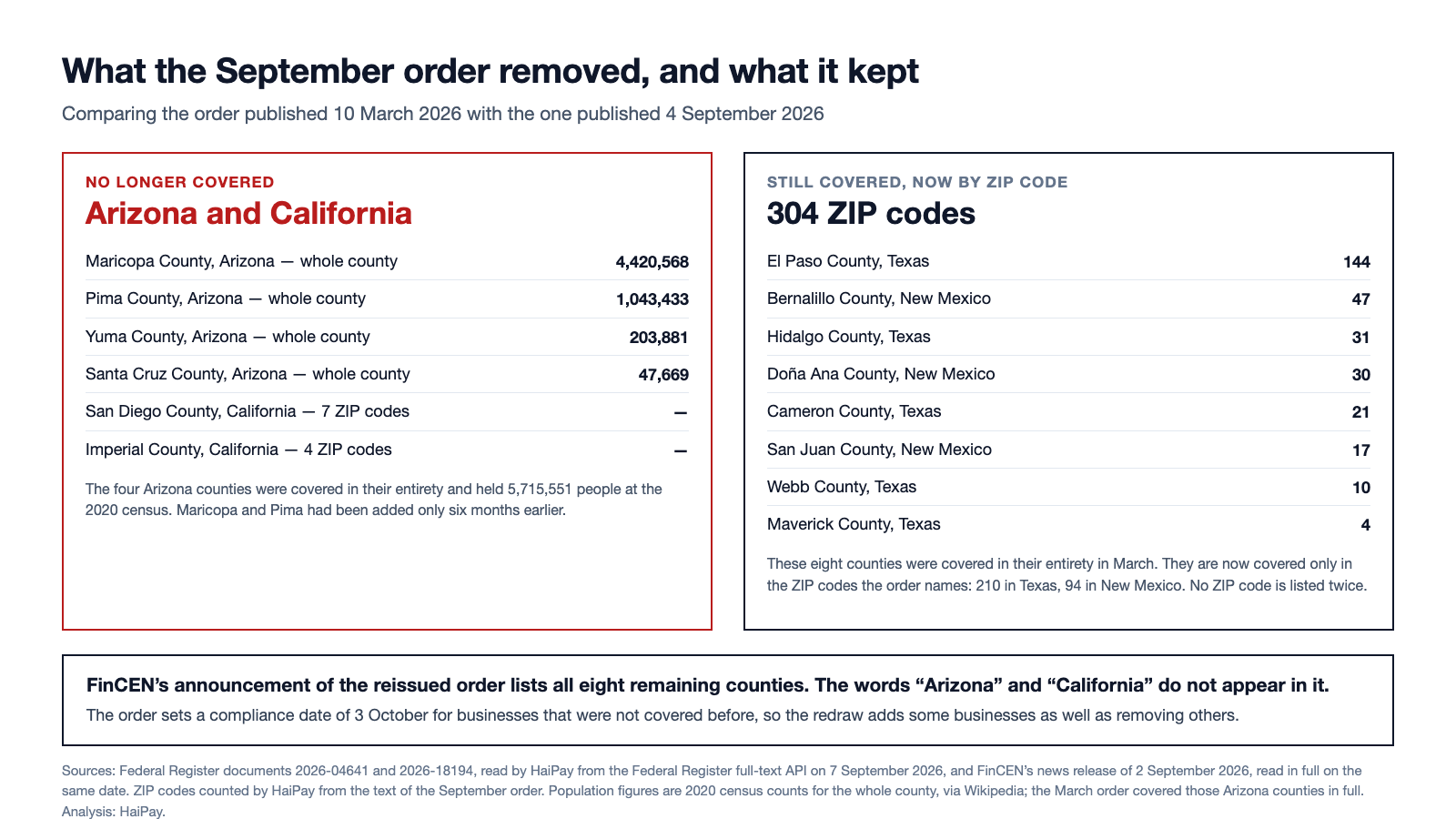
Six months ago they were. The order this one replaces covered four Arizona counties in full, including Maricopa and Pima, and eleven California ZIP codes across San Diego and Imperial counties. The new order covers eight counties in Texas and New Mexico and nothing else.
What the order requires
A geographic targeting order lets the Treasury lower a reporting threshold in a named area for a maximum of 180 days at a time. Inside that area, a money services business must file a Currency Transaction Report for any cash transaction of $1,000 or more but not more than $10,000. The ordinary threshold is $10,000. It must verify the customer's identity and record the specific identifying document used, and "known customer" is expressly not acceptable. Each report carries the code MSB0926GTO in field 45.
The filing window is 30 days. The standard deadline for a Currency Transaction Report is 15 days, set by 31 CFR 1010.306(a)(1), so covered businesses get double the usual time.
One line in the order is worth quoting for anyone who has to operate it: when submitting, the business "may receive a warning that the transaction is below $10,000" and is told to ignore the warning and continue.
Three hundred and four ZIP codes
The March order named whole counties. This one names ZIP codes, 304 of them, and no ZIP code appears twice.
El Paso County alone accounts for 144. Bernalillo County in New Mexico, which contains Albuquerque, accounts for 47. Then Hidalgo 31, Dona Ana 30, Cameron 21, San Juan 17, Webb 10 and Maverick 4. By state: 210 in Texas, 94 in New Mexico.
Switching from counties to ZIP codes is not automatically a narrowing, and the order indicates it is not. It sets a compliance date of 3 October for businesses that were not covered under the March order, which means the redraw brings some businesses in as well as leaving others out. Which ones, and how many, the order does not say.
The announcement does not mention the removal
FinCEN published a news release on 2 September announcing the reissued order. HaiPay read it in full.
It lists the covered counties correctly: Bernalillo, Dona Ana and San Juan in New Mexico, and Cameron, El Paso, Hidalgo, Maverick and Webb in Texas. The words "Arizona" and "California" do not appear anywhere in it. Neither does any statement that the covered area changed.
Nothing obliges an agency to describe a renewal by what it no longer contains, and the order itself is public and unambiguous. But the four Arizona counties dropped were covered in their entirety and held 5,715,551 people at the 2020 census. Maricopa and Pima had been added only six months earlier, in the March order, and are now out again after a single 180-day term.
The release also describes the order as effective "for 180 days after publication." The order sets its own period as 3 September 2026 to 1 March 2027, and it took effect on 3 September, the day before it was published.
A 180-day instrument in its 512th day
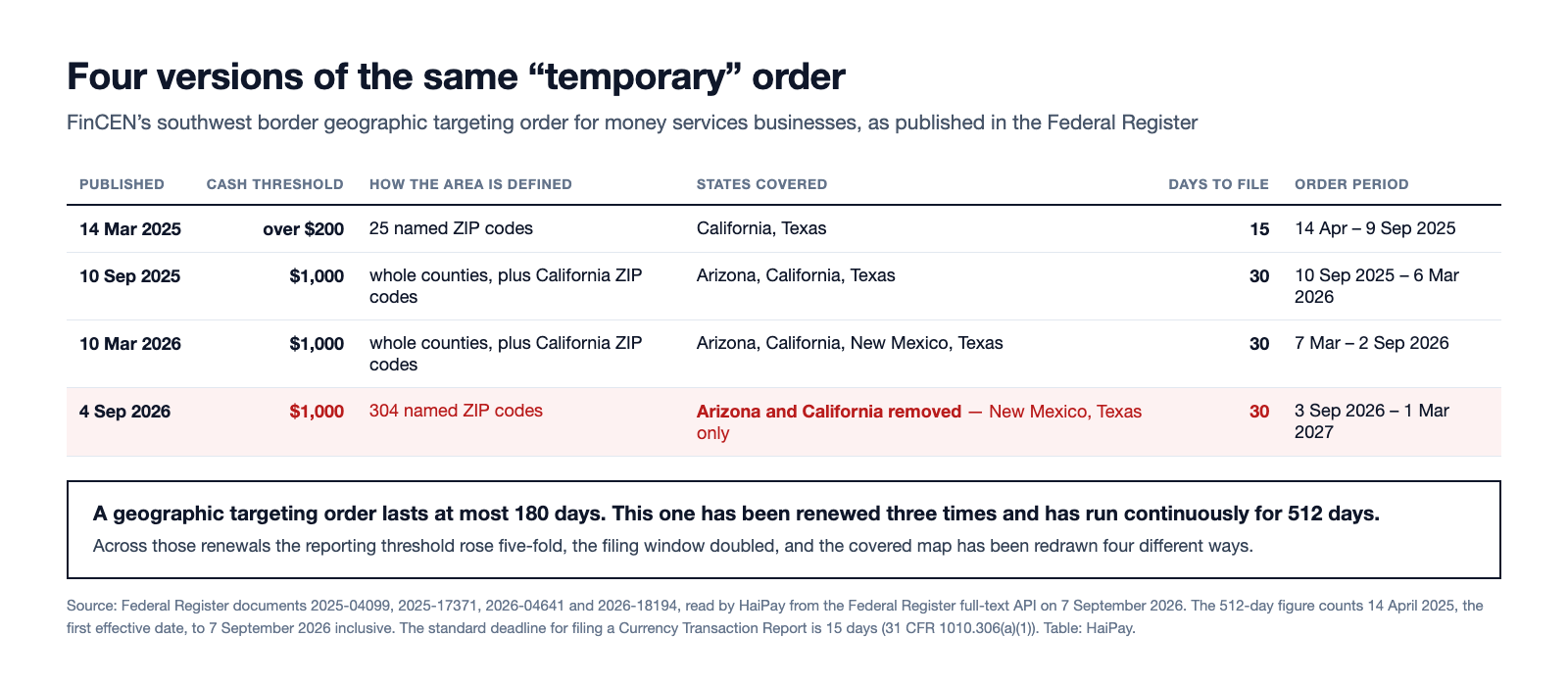
This is the fourth order in the series. The first was published on 14 March 2025 and took effect on 14 April. Each subsequent order has begun the day after the previous one ended, with no gap: 10 September 2025, 7 March 2026, and now 3 September 2026.
Counting from the first effective date to this reading, the southwest border order has been continuously in force for 512 days under an authority that caps any single order at 180.
The terms have not held still across those renewals. The original threshold was more than $200; since September 2025 it has been $1,000, five times higher. The filing window was 15 days; since September 2025 it has been 30. The covered area has been defined by ZIP code, then by whole county, then by ZIP code again, and has at various points included two, three or four states.
One further constraint carries over unchanged. A footnote records that the government remains enjoined by court order from applying the March 2025 order to certain money services businesses in Texas, and those businesses stay outside the definition of a covered business while the injunctions hold. The order does not identify them or the cases.
What HaiPay could not establish
Why Arizona and California were removed. The order gives no reasoning, and the news release does not mention the change. HaiPay did not contact FinCEN.
How many businesses are affected, in either direction. Neither document counts covered businesses, and HaiPay did not attempt to estimate one from licensing registers.
Whether the ZIP code lists exhaust the eight named counties. HaiPay counted and de-duplicated them as published but did not reconcile them against postal or census boundary files, so nothing here claims the area grew or shrank in square miles.
HaiPay did check that no other geographic targeting order covers Arizona or California. Because an order expires after 180 days at most, only those published since about March 2026 could still be running, and there are two: this one, and a separate order covering banks and money transmitters in Hennepin and Ramsey counties, Minnesota, which reports cross-border funds transfers of $3,000 or more and runs to 6 February 2027.
What to watch
The 3 October compliance date, by which the newly covered businesses must be filing. Whether the March 2027 renewal restores Arizona and California, keeps the ZIP code format, or moves the threshold again. And the Texas injunctions, because a ruling in those cases would change who the order actually reaches without a word of it appearing in the Federal Register.
This piece reads public documents. It is not compliance advice, and any business that may be covered should read the order itself.
How to cite
HaiPay News, "FinCEN's Border Order Dropped Arizona and California", https://www.haipay.net/news/fincen-border-gto-drops-two-states, September 7th, 2026
About the author
Crystal
Digital Public Relations
A digital PR specialist with a Master's in Journalism & Communication from UNSW. Started as an intern at ABC Australia, now leads public relations at Haipay, crafting press releases and media strategies that bring brand stories to life.
Reviewed by WeiJun TangEditorial policy
3 sources
- Federal Register
Geographic Targeting Order Imposing Recordkeeping and Reporting Requirements on Certain Money Services Businesses Along the Southwest Border, 4 September 2026
- Federal Register
Geographic Targeting Order Imposing Recordkeeping and Reporting Requirements on Certain Money Services Businesses Along the Southwest Border, 10 March 2026
- Financial Crimes Enforcement Network
FinCEN Reissues Order Requiring Transparency from MSBs Along Southwest Border