NewsPayouts
15 Million Pix Between Midnight and 6am, Every Day
Between midnight and six in the morning, Brazilians make about 15.4 million instant payments. That is 6.4% of the day's volume, and it is the quietest stretch of the twenty-four hours.
Key takeaways 6
- Brazil's central bank publishes average Pix volume in each of the 48 half-hour buckets of a day. Almost no one else does.
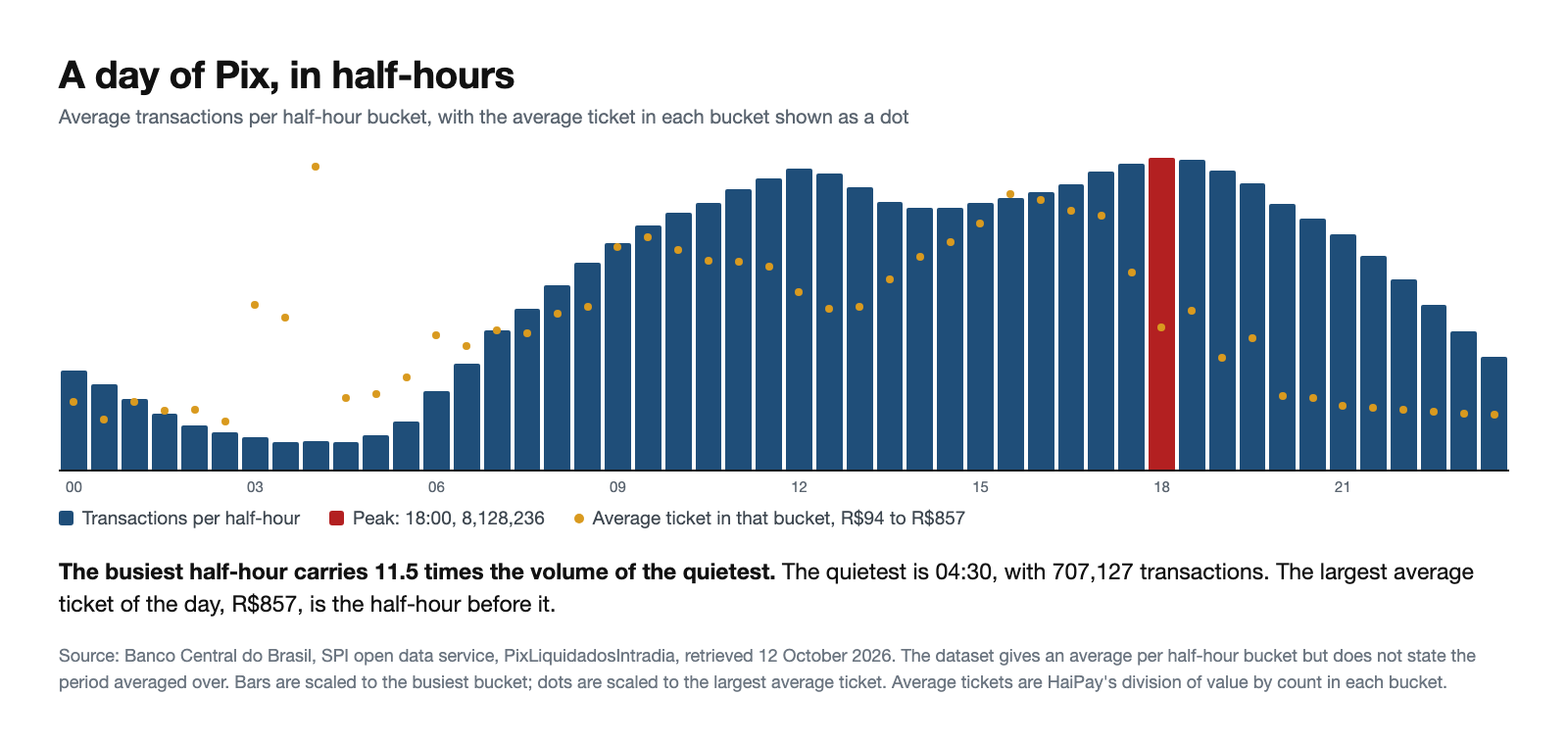
- The quietest half-hour, 04:30, carries 707,127 transactions. The busiest, 18:00, carries 8,128,236: 11.5 times more.
- The peak is after work, not at lunch. Volume stays above six million per half-hour until nine in the evening.
- The average ticket runs the other way: R$94 at 02:30, R$774 at 15:30, and R$857 at 04:00, the highest of the day.
- The daily file has 2,168 rows since November 2020. The busiest day is 4 September 2026 at 318,116,744 transactions.
- A secondary routing channel has averaged 0.28% of transactions since 2023, peaking at 3.32% on a month end.
Between midnight and six in the morning, Brazilians make about 15.4 million instant payments. That is 6.4% of the day's volume, and it is the quietest stretch of the twenty-four hours.
The number comes from a file the central bank publishes alongside its Pix settlement statistics: the average volume in each half-hour of the day, all 48 of them.
The shape of a day
Volume bottoms out at 04:30, with 707,127 transactions in the half-hour. It peaks at 18:00, with 8,128,236. The busiest half-hour carries 11.5 times the quietest.
The curve climbs steeply from 05:00, crosses five million by 08:30, and then does something unusual: it plateaus through the middle of the day rather than peaking at lunchtime. There is a small dip after 12:30, a recovery through the afternoon, and the real maximum comes at six in the evening, after work.
By the time it is 21:00 the country is still making more than six million payments every half-hour. The day does not end so much as taper.
More than half of all volume, 53.8%, falls between 09:00 and 18:00. Another 30.2% comes after six in the evening.
The ticket runs the other way
Divide value by volume in each bucket and a second pattern appears, almost the inverse of the first.
Late at night the average Pix is small: R$116 at 23:30, R$94 at 02:30, the lowest of the day. These are the payments of people splitting a bill or paying a driver.
In business hours the average triples. It is R$645 at 09:30 and R$774 at 15:30, which is what invoices, payroll and supplier settlement look like.
And then there is 04:00. The average ticket in that half-hour is R$857, the highest of the entire day, on a volume of 748,520. It is the only point in the profile where a high average ticket sits on a very low count. The file does not say what those payments are, and this article does not guess.
Six years of the daily file
The same service publishes a settled-volume row for every day since Pix went live on 3 November 2020. There are 2,168 of them.
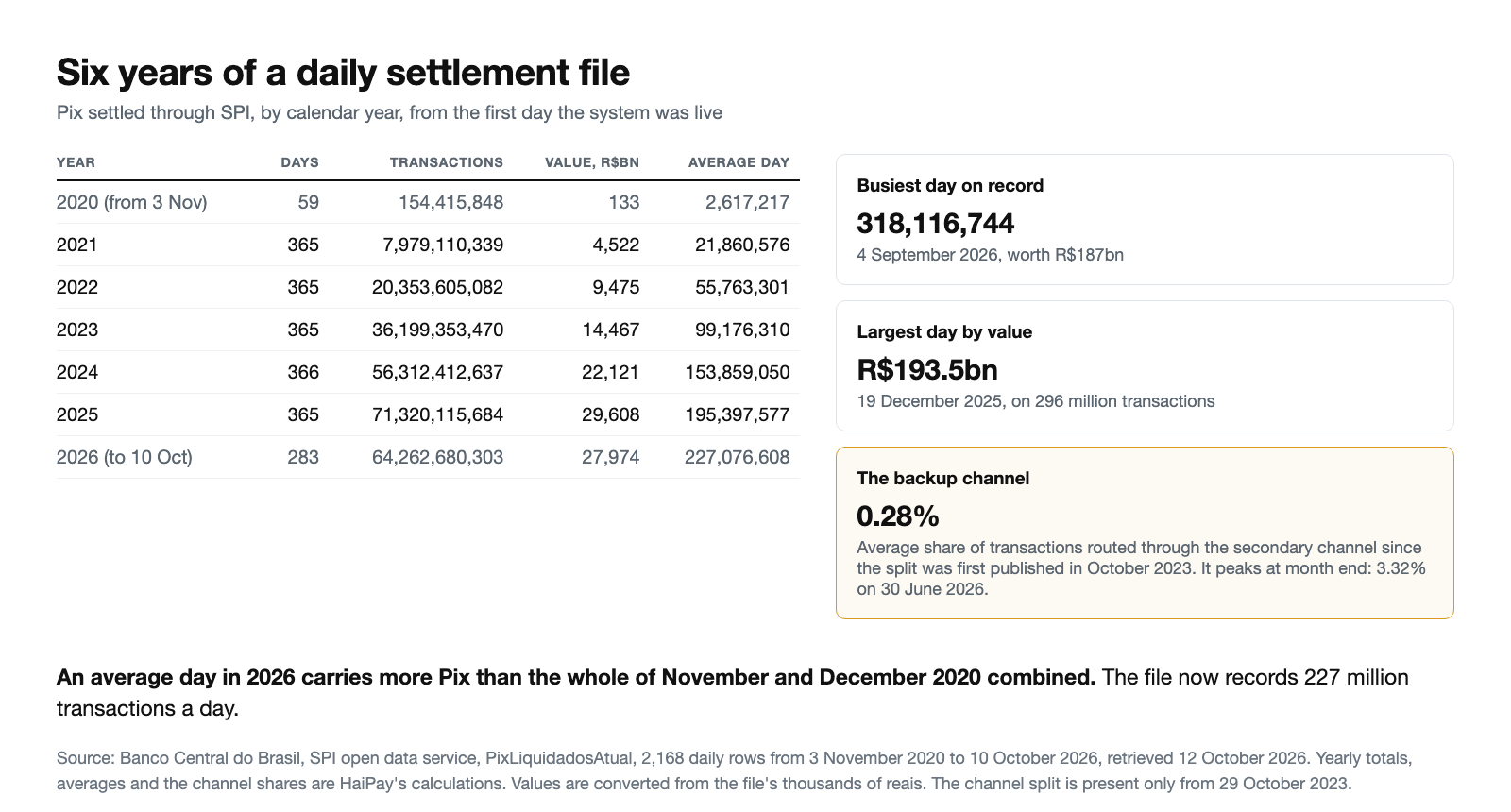
The yearly totals: 8.0 billion transactions in 2021, 20.4 billion in 2022, 36.2 billion in 2023, 56.3 billion in 2024, 71.3 billion in 2025. By 10 October 2026 the year already stands at 64.3 billion, averaging 227 million a day.
The busiest single day on record is 4 September 2026, with 318,116,744 transactions worth R$187 billion. The largest day by value is 19 December 2025, at R$193.5 billion on 296 million transactions, which is the shape you would expect of the week before Christmas.
The line almost nobody looks at
Since October 2023 the daily file has split volume between a primary and a secondary channel. The secondary channel averages 0.28% of transactions.
It is not evenly spread. The highest readings are month ends: 3.32% on 30 June 2026, 3.15% on 31 July 2024, 3.07% on 29 December 2025. On the days when Brazilian payment volume is heaviest, roughly one transaction in thirty goes down the second path.
For anyone who operates a rail, that is the most interesting column in the file. It is a public, daily measurement of how often the main route is not the one taken.
Why this matters outside Brazil
Two things.
The first is the 24-hour profile itself. Instant payment schemes are usually sold on speed, and their operators publish totals. Almost none publish the clock. If you are sizing infrastructure, staffing a fraud desk, or deciding when a batch can safely run, the difference between 707,000 and 8.1 million transactions in a half-hour is the whole design problem, and here it is published.
The second is that the profile does not look like a card profile. Cards peak around lunch and early evening and go quiet overnight. This one stays above two million transactions per half-hour at midnight and still has three-quarters of a million at half past four in the morning. A rail that settles continuously gets used continuously.
What this is not
The intraday file gives averages per half-hour but does not state the period they are averaged over, so the profile should be read as a typical day rather than any particular one.
The daily file's last row is the day of retrieval and may be incomplete; the records and yearly totals quoted here are not affected, but the 10 October figure should not be read as a full day.
Values are converted from the thousands of reais the file uses. No conversion to other currencies is attempted.
The dataset records settlement through SPI. It is not a measure of what consumers experienced, and the channel split is published without any explanation of what the secondary channel is or when it is used.
HaiPay did not contact the Banco Central do Brasil.
What to watch
Whether the evening peak keeps moving. At 18:00 it currently sits after the working day; the shape of that curve is the clearest available record of when a country's economy actually transacts.
Whether the secondary-channel share rises as volume grows. It has been published for three years and has never averaged above a third of a per cent.
And whether any other instant scheme publishes its own clock. Until one does, Brazil is the only country whose payment day can be read off a public file.
Data highlight
15388860 transactions
Average Pix transactions between midnight and 06:00 on a typical day, 6.4 per cent of the daily total, from the central bank's half-hourly intraday file
intraday averages and daily rows from 3 November 2020 to 10 October 2026, retrieved 12 October 2026
Read the methodology and limitations
Methodology and limitations
Compiled by HaiPay on 12 October 2026 from the Banco Central do Brasil's open data service for the Sistema de Pagamentos Instantâneos at olinda.bcb.gov.br, using two datasets retrieved in full. PixLiquidadosIntradia returns 48 half-hour buckets, each with an average transaction count and an average value; the dataset gives no indication of the period over which the averages are taken, so the profile is reported as a typical day rather than a specific one.
PixLiquidadosAtual returns 2,168 daily rows from 3 November 2020 to 10 October 2026, each with a date, a transaction count, a primary-channel count, a secondary-channel count and a total value. The intraday figures quoted are the dataset's own: the lowest bucket is 04:30 with 707,127 transactions and the highest is 18:00 with 8,128,236. The ratio of 11.5 between them, the share calculations and every average ticket are HaiPay's. Summing the 48 buckets gives 239,471,207 transactions and R$106.5 billion for a typical day.
Grouping those buckets gives 15,388,860 transactions, or 6.4 per cent, between 00:00 and 06:00; 128,867,034, or 53.8 per cent, between 09:00 and 18:00; and 72,413,795, or 30.2 per cent, from 18:00 to midnight. Average tickets are HaiPay's division of each bucket's value by its count, which gives R$94.02 at 02:30 as the lowest, R$116.15 at 23:30, R$645.25 at 09:30, R$773.61 at 15:30, R$375.12 at the 18:00 peak, R$165.08 at the 04:30 trough and R$856.67 at 04:00 as the highest of the day.
Note that the two datasets express value differently: in the daily file the Total column is in thousands of reais, which reconciles with the file's own Media column, while in the intraday file the value column is in reais; HaiPay checked both against the per-transaction averages before using them, and all reais figures in this article are stated on that basis.
From the daily file, yearly totals computed by HaiPay are 154,415,848 transactions over 59 days in 2020 from 3 November, 7,979,110,339 in 2021, 20,353,605,082 in 2022, 36,199,353,470 in 2023, 56,312,412,637 in 2024, 71,320,115,684 in 2025 and 64,262,680,303 over 283 days of 2026 to 10 October, with corresponding values of R$133bn, R$4,522bn, R$9,475bn, R$14,467bn, R$22,121bn, R$29,608bn and R$27,974bn, and average days of 2.6 million, 21.9 million, 55.8 million, 99.2 million, 153.9 million, 195.4 million and 227.1 million transactions.
The busiest day in the file by count is 4 September 2026 with 318,116,744 transactions worth R$186.9 billion, and the largest by value is 19 December 2025 at R$193.5 billion on 296,018,475 transactions.
The primary and secondary channel columns are populated only from 29 October 2023, giving 1,078 days with a split; across those days the secondary channel averages 0.284 per cent of transactions, with a maximum of 3.32 per cent on 30 June 2026 and further high readings of 3.15 per cent on 31 July 2024, 3.07 per cent on 29 December 2025, 2.87 per cent on 31 July 2025 and 2.77 per cent on 30 June 2025; the observation that the highest readings fall at month ends is HaiPay's.
The dataset publishes the channel split without defining what the secondary channel is or when it is used, and this article does not supply a definition. The final row of the daily file is the day of retrieval and may be incomplete, so the 10 October 2026 row is excluded from any claim about a complete day; the records and yearly totals above are unaffected because they do not depend on it.
The comparison of the card profile with the Pix profile is a characterisation by HaiPay and is not drawn from these datasets. The datasets measure settlement through SPI and are not a measure of what an end user experienced. HaiPay did not contact the Banco Central do Brasil.
Term definition
- Intraday profile
- The distribution of a payment system's volume across the hours of a day. Brazil publishes one for Pix in 48 half-hour buckets; most schemes publish only daily or monthly totals.
- Average ticket
- Value divided by count. In the Pix profile it moves inversely to volume, from R$94 in the small hours to R$857 at 04:00 and R$774 in the mid-afternoon.
- Secondary channel
- The second routing path recorded in the daily settlement file since October 2023. It averages 0.28 per cent of transactions and peaks at month ends; the dataset does not define it.
4 sources
- Banco Central do Brasil
- Banco Central do Brasil
- Banco Central do Brasil
- Banco Central do Brasil
How to cite
HaiPay News, "15 Million Pix Between Midnight and 6am, Every Day", https://www.haipay.net/news/pix-intraday-profile-half-hour, 12 October 2026