NewsPayouts
Mexico's Remittances Fell for the First Time Since 2013
Mexico received $65.1 billion in personal remittances in 2025, according to the World Bank. That is 4.2% less than the $67.9 billion of 2024.
Key takeaways 6
- Mexico received $65.1 billion in remittances in 2025, down 4.2% from $67.9 billion, the first fall since 2013.
- Mexico’s remittances had risen every year from 2014 to 2024, nearly tripling from $24.0 billion.
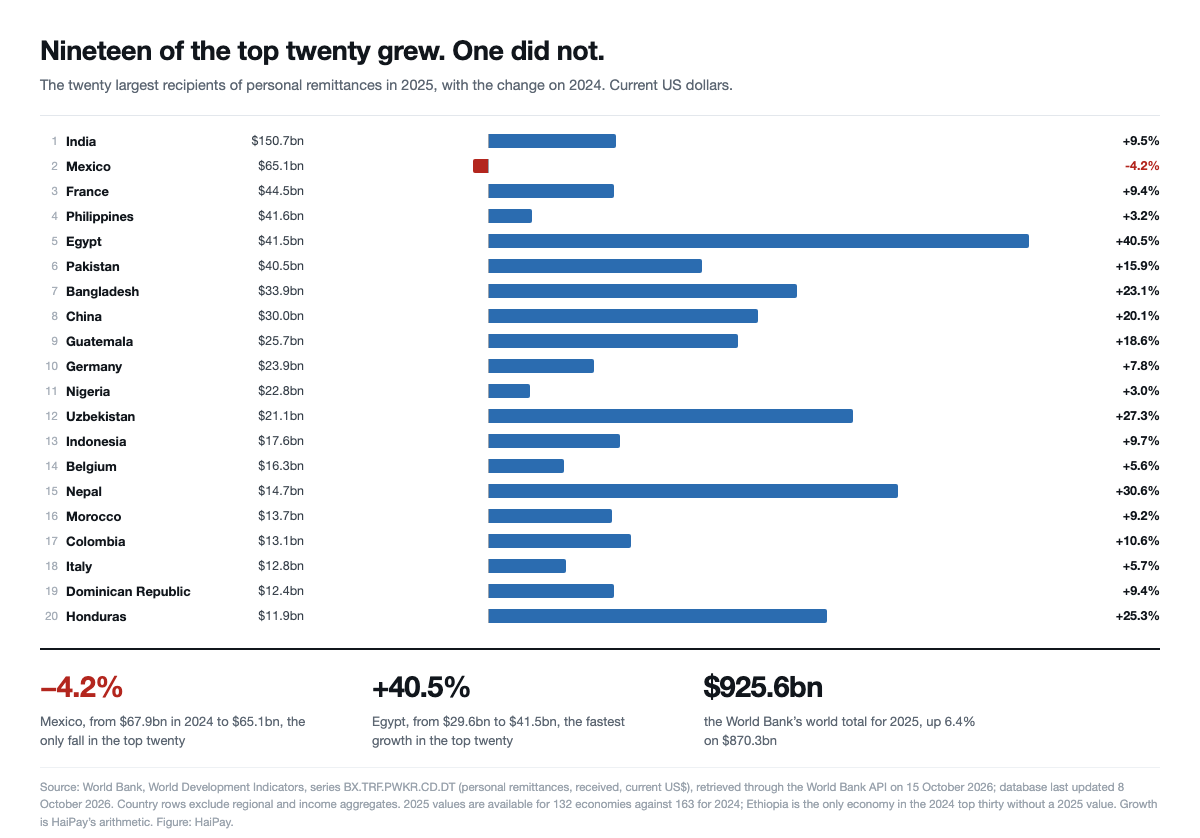
- Mexico was the only one of the 20 largest recipients to decline; the world total rose 6.4% to $925.6 billion.
- India received $150.7 billion, up 9.5%; Egypt rose fastest in the top 20, up 40.5% to $41.5 billion.
- Sending $200 to Mexico cost 2.65% in 2023, under the 3% target; 44 of 92 countries met it.
- Remittances equal 57.7% of Tajikistan’s GDP, which in 2023 was also one of four countries costing over 10% to send to.
Mexico received $65.1 billion in personal remittances in 2025, according to the World Bank. That is 4.2% less than the $67.9 billion of 2024.
It is the first annual fall since 2013. And among the twenty economies that received the most, it is the only one.
Eleven years up, then down
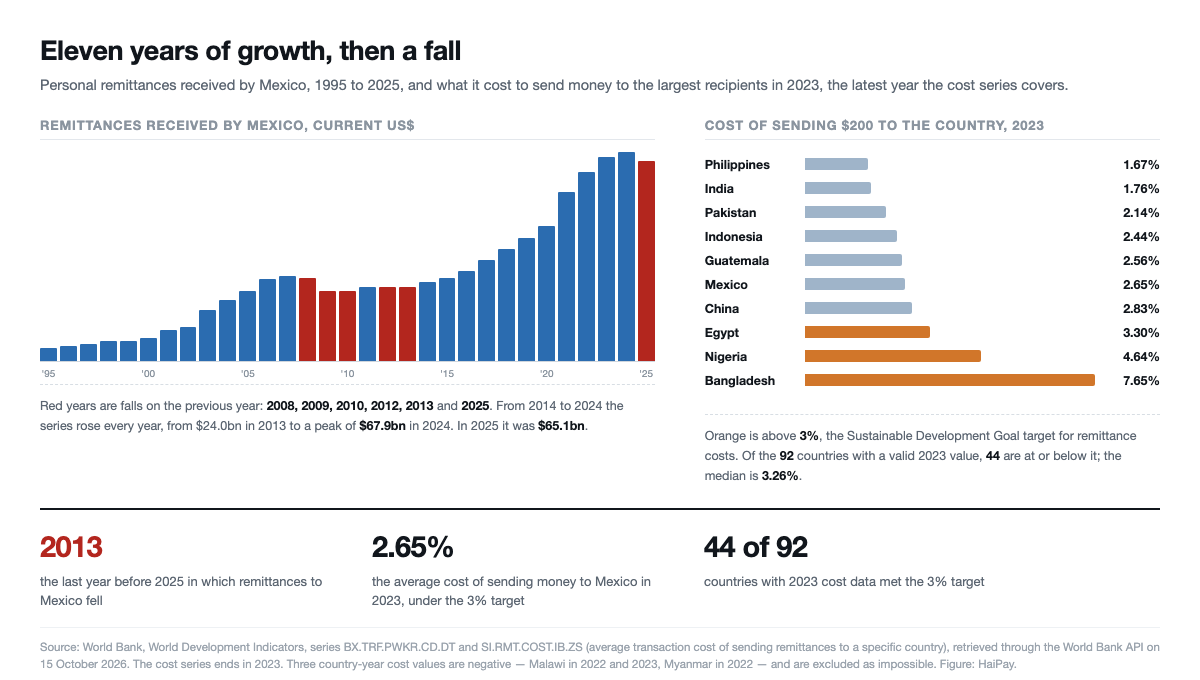
The World Bank’s series for Mexico runs from 1995. Its previous falls came in 2008, 2009 and 2010, with two more small ones in 2012 and 2013.
From 2014 to 2024 the figure rose every single year, from $24.0 billion to $67.9 billion. That is eleven consecutive increases, and the amount nearly tripled.
The 2025 figure breaks that run. The drop is $2.8 billion, which leaves Mexico still the second-largest recipient in the world, well ahead of France in third. The change is in direction, not in rank.
Everyone else grew
The world total, on the World Bank’s own aggregate, rose 6.4% to $925.6 billion.
India received $150.7 billion, up 9.5%, more than twice Mexico’s total. The Philippines rose 3.2%, Pakistan 15.9%, Bangladesh 23.1%, Guatemala 18.6%.
Egypt rose fastest among the top twenty: 40.5%, from $29.6 billion to $41.5 billion. Two years earlier, in 2023, it had received $19.5 billion. Its 2025 total is more than double that.
Nepal grew 30.6% and Uzbekistan 27.3%. Honduras, the twentieth-largest recipient, grew 25.3%.
France, Germany and Belgium appear in the top twenty because the World Bank’s measure includes compensation of cross-border workers alongside money sent home by migrants. They are recipients in the accounting sense, not in the sense most people mean by remittances.
Where it matters most
Size and dependence are different rankings. As a share of the economy, the largest recipients in 2025 are Tajikistan, where remittances equal 57.7% of GDP, Tonga at 39.3%, Nepal at 32.3%, Honduras at 30.1% and El Salvador at 27.5%.
Mexico’s remittances are 3.6% of its GDP. The fall is large in dollars and modest relative to the economy.
What it costs to send
The World Bank also tracks what a $200 transfer costs to each receiving country, though that series runs only to 2023.
In 2023, sending $200 to Mexico cost 2.65% on average across the providers the bank tracks — under the 3% target set in the Sustainable Development Goals. India was 1.76% and the Philippines 1.67%. Bangladesh was 7.65%.
Of the 92 countries with a valid 2023 value, 44 were at or below 3%. The median was 3.26%, so the typical receiving country is still just above the target. Four were above 10%: Cuba at 19.63%, Angola 12.78%, Sierra Leone 10.34% and Tajikistan 10.33% — which means Tajikistan, the most remittance-dependent economy in 2025, was in 2023 also one of the four most expensive to send money to.
Why this matters
Remittances are one of the largest cross-border payment flows that exist, and for most of the last decade the only question about them was how fast they would grow. Mexico’s 2025 figure is the first time in eleven years that the world’s second-largest recipient has moved the other way.
For payment providers serving transfers into Mexico, a 4.2% fall in the total is a meaningful change in the pool of transfers being competed for. The World Bank series records what Mexico received, not where it came from, so it cannot show which sending corridors fell. For everyone else, the 19 other large recipients growing at between 3% and 40% say the global market is still expanding — just not everywhere.
What this is not
These are World Bank estimates for the most recent year, and they are revised as countries finalise their balance-of-payments data. The 2025 figures, including the size of Mexico’s fall, may change.
The data record how much was received, not why. This article does not attribute Mexico’s decline to any cause, and none should be read into it.
2025 values exist for 132 economies, against 163 for 2024. Ethiopia is the only one of the thirty largest 2024 recipients without a 2025 figure.
The cost series is two years older than the volume series and prices a $200 transfer. It is not the cost of every transfer actually made. Three values in it are negative, and therefore impossible — Malawi in 2022 and 2023 and Myanmar in 2022 — and are excluded.
HaiPay did not contact the World Bank or the Bank of Mexico.
What to watch
Whether the revision moves Mexico back above zero. A 4.2% fall in a preliminary estimate is large enough to survive most revisions, but not certain to.
Whether Egypt’s jump holds. Doubling in two years is a large move in a series that also fell sharply in 2022 and 2023, from $31.5 billion to $19.5 billion.
And whether the cost series catches up. The volume data now run to 2025 and the price data stop at 2023, which means the most recent change for the world’s second-largest recipient has no price to set against it yet.
Data highlight
-4.2 per cent
Change in personal remittances received by Mexico in 2025, to $65.1 billion, the first annual fall since 2013 and the only decline among the 20 largest recipients
2024 to 2025
Read the methodology and limitations
Methodology and limitations
Compiled by HaiPay on 15 October 2026 from the World Bank’s World Development Indicators, retrieved through the World Bank API, database last updated 8 October 2026.
Three series were used: BX.TRF.PWKR.CD.DT, personal remittances received in current US dollars; BX.TRF.PWKR.DT.GD.ZS, the same as a share of GDP; and SI.RMT.COST.IB.ZS, the average transaction cost of sending remittances to a specific country, which the World Bank defines as the average total cost, as a percentage of the amount sent, of sending USD 200 through each remittance service provider in its Remittance Prices Worldwide database.
Personal remittances are the sum of personal transfers and compensation of employees as defined in the IMF’s Balance of Payments Manual, which is why economies with large cross-border workforces, such as France, Germany and Belgium, rank highly. Country rankings exclude the World Bank’s regional and income aggregates. For 2025, received values are available for 132 economies against 163 for 2024; of the 30 largest recipients in 2024, Ethiopia is the only one without a 2025 value.
The world total of $925.6 billion for 2025 and $870.3 billion for 2024 is the World Bank’s own aggregate, not a sum by HaiPay. Mexico received $67.91 billion in 2024 and $65.09 billion in 2025, a fall of 4.2 per cent; across the series from 1995 its previous falls were in 2008, 2009, 2010, 2012 and 2013, and it rose in every year from 2014 to 2024, from $23.98 billion in 2013.
Among the 20 largest recipients in 2025, Mexico is the only one whose 2025 value is below its 2024 value.
The other nineteen, with HaiPay’s growth figures, are India $150.7 billion (+9.5 per cent), France $44.5 billion (+9.4), the Philippines $41.6 billion (+3.2), Egypt $41.5 billion (+40.5), Pakistan $40.5 billion (+15.9), Bangladesh $33.9 billion (+23.1), China $30.0 billion (+20.1), Guatemala $25.7 billion (+18.6), Germany $23.9 billion (+7.8), Nigeria $22.8 billion (+3.0), Uzbekistan $21.1 billion (+27.3), Indonesia $17.6 billion (+9.7), Belgium $16.3 billion (+5.6), Nepal $14.7 billion (+30.6), Morocco $13.7 billion (+9.2), Colombia $13.1 billion (+10.6), Italy $12.8 billion (+5.7), the Dominican Republic $12.4 billion (+9.4) and Honduras $11.9 billion (+25.3).
Egypt received $19.53 billion in 2023, so its 2025 value is more than double that of two years earlier. As a share of GDP in 2025 the most dependent economies are Tajikistan at 57.7 per cent, Tonga at 39.3, Nepal at 32.3, Honduras at 30.1 and El Salvador at 27.5; Mexico’s share is 3.6 per cent. The cost series ends in 2023.
For that year 93 economies have a value, of which three country-year values in the series are negative and therefore impossible: Malawi in 2022 and 2023 and Myanmar in 2022. Excluding Malawi’s 2023 value leaves 92 economies with a valid 2023 cost, of which 44 are at or below 3 per cent, the target set under Sustainable Development Goal 10.c, and the median is 3.26 per cent; four exceed 10 per cent, namely Cuba at 19.63, Angola at 12.78, Sierra Leone at 10.34 and Tajikistan at 10.33.
The 2023 cost of sending money to Mexico is 2.65 per cent, to India 1.76, to the Philippines 1.67, to Egypt 3.30, to Nigeria 4.64 and to Bangladesh 7.65. Every growth rate, share, count and median above is HaiPay’s arithmetic on the World Bank’s published values, except the world totals. Three limits apply. Remittance figures for the most recent year are estimates that the World Bank revises as national balance-of-payments data are finalised, so the 2025 values, and the size of Mexico’s fall, may change.
The cost series is two years older than the volume series and describes the price of a $200 transfer, not the cost of every transfer actually made. And the data record how much was received, not why, so this article does not attribute Mexico’s decline to any cause. HaiPay did not contact the World Bank or the Bank of Mexico.
Term definition
- Personal remittances
- The World Bank and IMF measure of money received from abroad by households: personal transfers plus compensation of employees working across a border. It is why France and Germany rank among the largest recipients.
- Remittance cost
- The World Bank’s average total cost, as a percentage of the amount, of sending USD 200 to a country through the providers in its Remittance Prices Worldwide database. The series currently ends in 2023.
- SDG 10.c
- The Sustainable Development Goal target to reduce remittance costs to below 3 per cent. In 2023, 44 of 92 countries with valid data met it and the median was 3.26 per cent.
5 sources
- World Bank
- World Bank
- World Bank
Average transaction cost of sending remittances to a specific country (%)
- World Bank
- World Bank
World Development Indicators: personal remittances, received
How to cite
HaiPay News, "Mexico's Remittances Fell for the First Time Since 2013", https://www.haipay.net/news/mexico-remittances-first-fall-since-2013, 15 October 2026