NewsLocal Payments
Pix Automático Hits 8.9m Payments, Still 0.12% of Pix
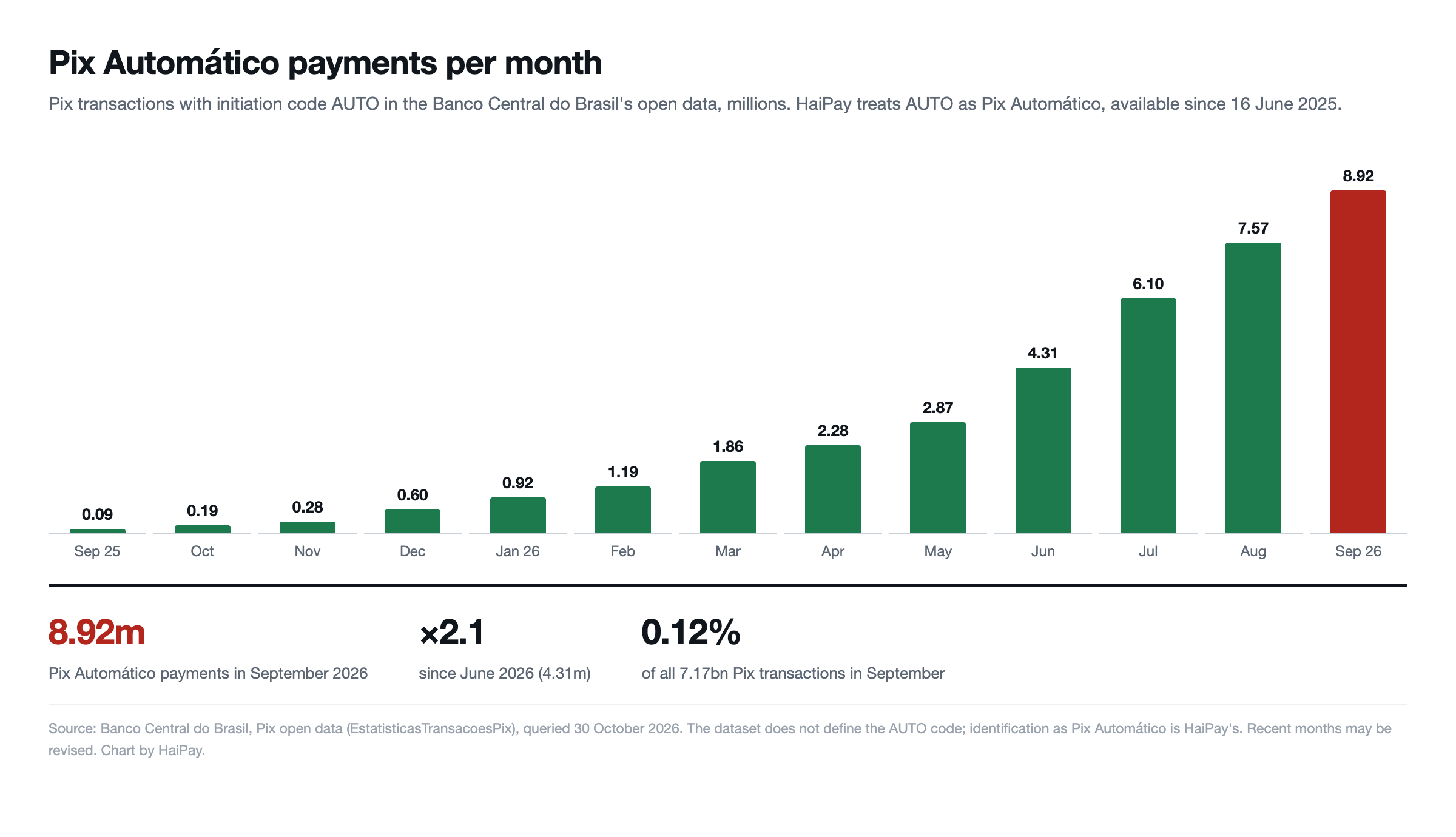
Brazilians made 8.92 million Pix Automático payments in September 2026, more than double June's 4.31 million and 97 times a year earlier, according to a HaiPay analysis of Banco Central do Brasil open data. Recurring Pix was still 0.12% of the 7.17 billion Pix transactions that month.
Key takeaways 6
- Pix Automático payments reached 8.92 million in September 2026, by HaiPay's reading of central bank data.
- That is more than double June 2026's 4.31 million and 97 times September 2025.
- Recurring payments were 0.12% of September's 7.17 billion Pix transactions.
- 95% of Pix Automático payments in September were from individuals to businesses.
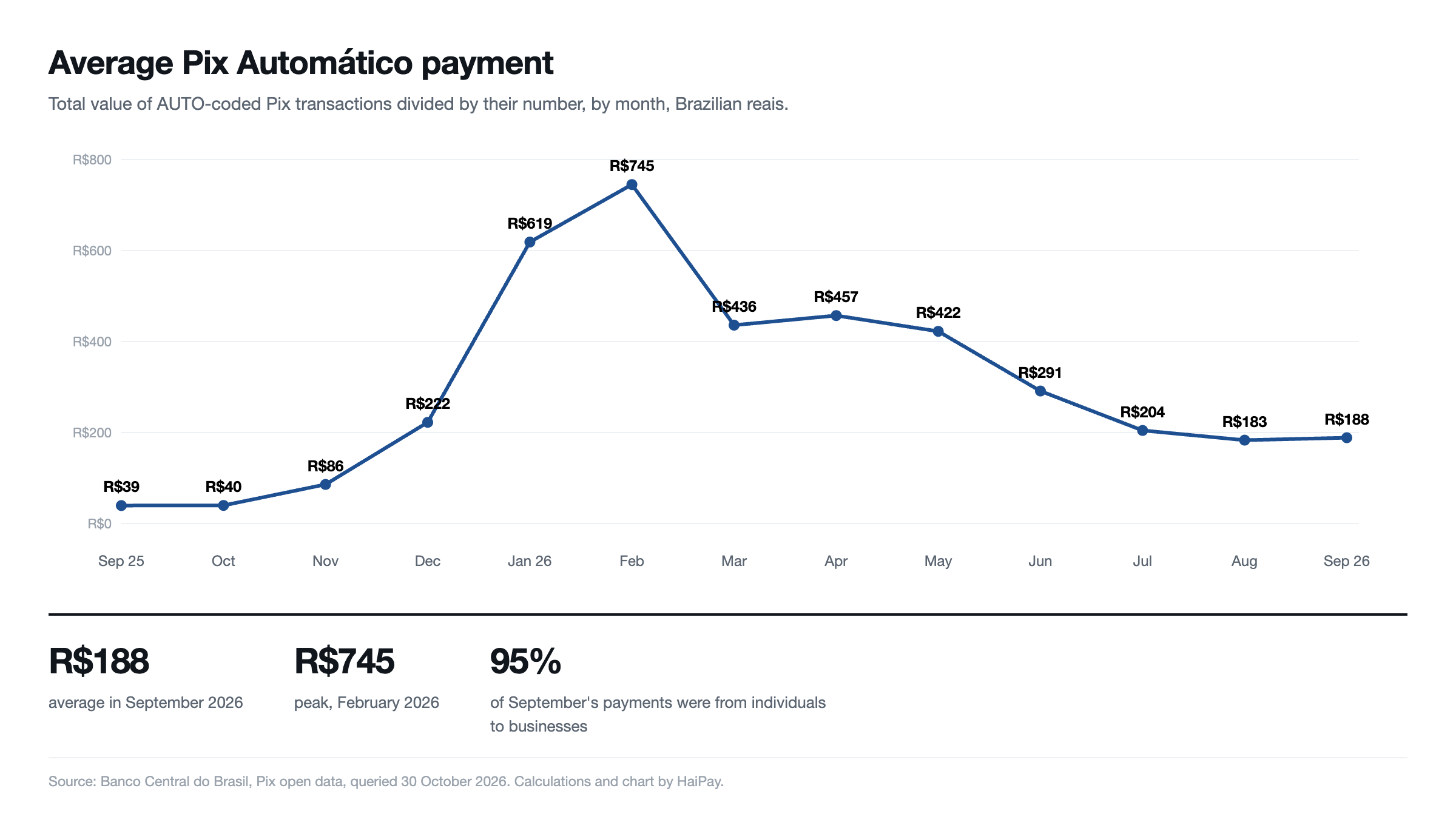
- The average payment was R$188, down from R$745 in February 2026.
- The central bank's dataset codes these payments AUTO but does not define the code.
Brazilians made 8.92 million payments through Pix Automático, the recurring version of the central bank's instant payment system, in September 2026, according to a HaiPay analysis of Banco Central do Brasil open data. That was more than double the 4.31 million in June and 97 times the 92,278 of September 2025.
It remains a small part of Pix. The 8.92 million recurring payments were 0.12% of the 7.17 billion Pix transactions in September, and their R$1.68 billion was 0.05% of the R$3.23 trillion moved through Pix that month.
Subscriptions and bills, mostly paid by people
Pix Automático lets a payer authorise a company once to collect recurring payments, such as utility bills or subscriptions, without approving each one. The central bank set its rules in Resolução BCB nº 402 in July 2024 and required participants to offer it from 16 June 2025.
In September 2026, 8.44 million of the 8.92 million payments, or 95%, were from individuals to businesses, with most of the rest between businesses. The average payment was R$188, down from a peak of R$745 in February 2026.
How HaiPay counted
The central bank's dataset groups payments by how they were initiated and gives these payments the code AUTO. Its documentation does not define that code. HaiPay treats it as Pix Automático because it first appears in June 2025, with 155 transactions, the month the service became available, and because nearly all its payments go to businesses.
What this does not show
The data do not show which companies collect Pix Automático payments, how many authorisations are active or how many payments failed. The central bank has not described the AUTO code, so the identification is HaiPay's, and recent months may be revised. HaiPay did not contact the central bank.
What to watch
Whether monthly Pix Automático payments pass 10 million in October.
Whether the average payment settles or keeps falling as more small subscriptions move to it.
And whether the central bank publishes its own figures or a definition for the AUTO code.
About HaiPay's local payment methods
HaiPay, which publishes this news section, offers local payment methods through one integration covering more than 150 methods. For Brazil, its local payment page lists Pix alongside Visa, Mastercard, Apple Pay and Google Pay. The page does not say whether Pix Automático is supported. Learn more about HaiPay's local payment methods.
Data highlight
8,920,718 transactions
Pix transactions with initiation code AUTO (Pix Automático) in Brazil's central bank open data
September 2026
HaiPay summed Pix transactions with initiation code AUTO in the central bank's EstatisticasTransacoesPix open data for September 2026: 8,920,718 transactions worth R$1,681,193,019.91, against 7,169,724,394 Pix transactions in total (0.12%). The dataset does not define AUTO; HaiPay treats it as Pix Automático because it first appears in June 2025, the launch month.
Data as of 30 October 2026 · UTC
Methodology and limitations
Compiled by HaiPay on 30 October 2026 from the Banco Central do Brasil's Pix open data service (EstatisticasTransacoesPix), queried for each month from June 2025 to September 2026. HaiPay summed transaction counts and values by month and by initiation method. The dataset labels a group of transactions with the initiation code AUTO. Its documentation does not describe that code. HaiPay treats AUTO as Pix Automático because the code first appears in June 2025, with 155 transactions, the month Resolução BCB nº 402 made Pix Automático available from 16 June, and because its transactions are almost all payments to businesses. This is HaiPay's reading, not a central bank definition. Shares are AUTO transactions divided by all Pix transactions in the same month. Average value is total AUTO value divided by AUTO transactions. The central bank may revise recent months. HaiPay did not contact the central bank.
Data and research materials
- Pix Automático (AUTO-coded Pix) by month, September 2025 to September 2026 (HaiPay) ↓CSV · 2 KB
Thirteen monthly rows compiled by HaiPay from the Banco Central do Brasil's Pix open data (EstatisticasTransacoesPix), queried 30 October 2026. Columns: month, transactions and value with initiation code AUTO, average value, AUTO transactions from individuals to businesses (P2B) and between businesses (B2B), all Pix transactions and value, and the AUTO share of transactions. The dataset does not define the AUTO code; HaiPay treats it as Pix Automático, which became available on 16 June 2025.
HaiPay's charts and the CSV table on this page may be reused with attribution to HaiPay and a link to this article. The underlying figures are the Banco Central do Brasil's Pix open data; the identification of the AUTO code and the calculations are HaiPay's.
Term definition
- Pix Automático
- A Pix feature that lets a payer authorise a company once to collect recurring payments, available in Brazil since 16 June 2025.
- Initiation method
- How a Pix payment is started, such as by Pix key, QR code, manual entry or a payment initiator; the central bank's open data report it for each transaction group.
- P2B
- A payment from an individual (person) to a business.
3 sources
- Banco Central do Brasil
Pix open data: EstatisticasTransacoesPix
Banco Central do Brasil Pix open data, EstatisticasTransacoesPix, queried 30 October 2026 for June 2025 to September 2026: monthly transaction counts and values by initiation method (FORMAINICIACAO) and nature (NATUREZA). September 2026: 7,169.7 million Pix transactions worth R$3,225.1 billion; 8.92 million with initiation code AUTO worth R$1.68 billion.
Accessed 30 October 2026 · UTC
- Banco Central do Brasil
Documentation of the Pix open data service, read 30 October 2026: it describes the initiation codes INIC, QRES, QRDN, MANU and DICT; it does not describe the AUTO code.
Accessed 30 October 2026 · UTC
- Banco Central do Brasil
Resolução BCB nº 402, de 22 de julho de 2024
Resolução BCB nº 402 of 22 July 2024: sets the rules for Pix Automático and requires participants to make its initiation available from 16 June 2025; Pix Automático is not optional for certain participants.
Accessed 30 October 2026 · UTC
How to cite
HaiPay News, "Pix Automático Hits 8.9m Payments, Still 0.12% of Pix", https://www.haipay.net/news/pix-automatico-recurring-payments-september-2026, 30 October 2026