NewsLocal Payments
Lazada Launches PayNow Deep-Linking via Antom as MAS Sets End-2027 National Standards
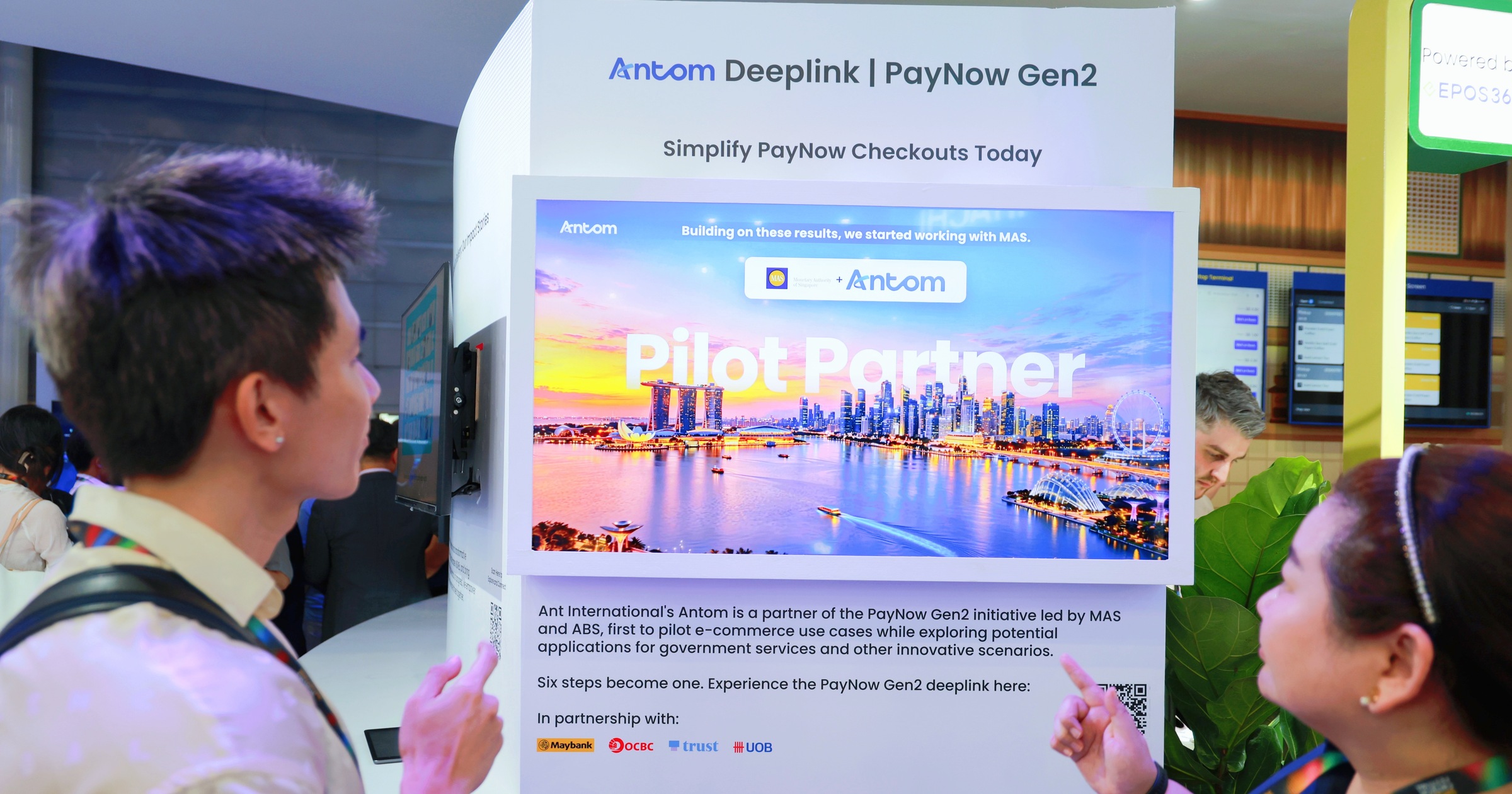
Ant International launched PayNow deep-linking on Lazada Singapore on 18 November 2026, cutting mobile bank-app checkout to one step. Antom reported about a 9% early uplift in successful transactions, moving observed pilot flows from 84.64% to 93.73%. However, same-day Monetary Authority of Singapore (MAS) and Association of Banks in Singapore (ABS) disclosures show live use currently covers OCBC customers only.
Key takeaways 5
- Antom enabled PayNow deep-linking on Lazada Singapore, replacing 6+ manual QR screenshot steps with a single app-to-app handoff.
- MAS and ABS report live PayNow deep-linking currently serves OCBC customers on Lazada checkouts and CPFB payment pages only.
- Antom pilot data showed success rising from 84.64% to 93.73% and time falling from 61.72s to 50.80s, with sample size undisclosed.
- In an MAS consumer survey (N=559), 38% had abandoned a PayNow checkout, citing app-switching (71%) and QR saving (57%).
- Common PayNow deep-linking standards and a central facility target end-2027, with progressive rollouts starting early 2028.
On 18 November 2026, Ant International announced that its merchant payments arm Antom launched Singapore's first live e-commerce PayNow deep-linking checkout on Lazada. The rollout arrived alongside the Monetary Authority of Singapore (MAS) and Association of Banks in Singapore (ABS) Phase 2 implementation roadmap for PayNow Generation 2 (PayNow Gen2).
PayNow is Singapore's national near-instant bank transfer and QR payment rail. Until now, paying with PayNow on mobile e-commerce checkouts required shoppers to save a QR image and upload it manually inside their banking app.
What went live on 18 November, and where it works today
Headline summaries framed Antom's Lazada integration as an immediate market-wide shift for PayNow checkout. Footnotes in the same-day MAS and ABS publications narrow that live scope significantly.
Footnotes in the Joint Media Release and the Phase 2 Report state that live PayNow deep-linking currently serves OCBC customers on Lazada checkouts and Central Provident Fund Board (CPFB) payment pages. Shoppers banking with other PayNow institutions still rely on standard QR fallback until participating banks connect or central standards arrive.
Separately, Antom's Southeast Asian subsidiary 2C2P by Antom partnered with Singapore's Government Technology Agency (GovTech) on a proof of concept for GovWallet. That prototype ran at the Singapore FinTech Festival from 18 to 20 November 2026.
Source: MAS and ABS, "MAS and ABS Set Out PayNow Generation 2 Implementation Roadmap" (Footnote 2, 18 November 2026; accessed 20 November 2026); MAS and ABS, "PayNow Generation 2 Phase 2 Report" (Section 3.3 Footnote 3, 18 November 2026; accessed 20 November 2026); Ant International, "Ant International Pioneers PayNow Deep-Linking for E-Commerce" (18 November 2026; accessed 20 November 2026).
Why QR screenshot checkouts lose mobile orders
In a standard mobile browser checkout, PayNow forces buyers through six or more manual actions. Shoppers generate a QR code, take a screenshot, save it to their photo gallery, open a banking app, upload the image, approve payment, and switch back manually.
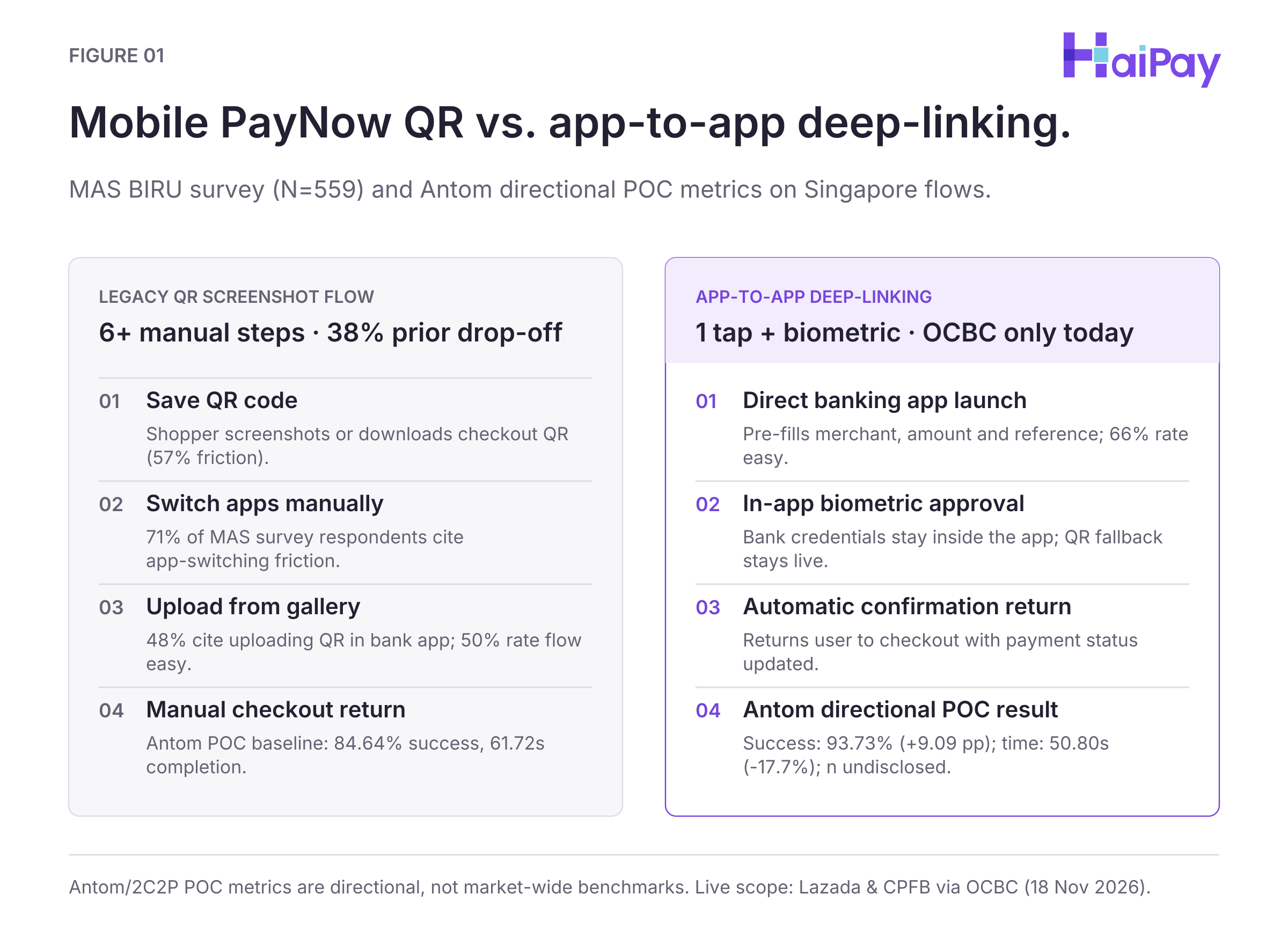
An internal MAS Behavioural Insights and Research Unit (BIRU) survey of 559 Singapore consumers quantified that drop-off. Thirty-eight percent of respondents reported having abandoned a PayNow purchase previously. Respondents cited app-switching (71%), saving QR codes (57%), and uploading QR codes (48%) as their main friction points.
Sixty-six percent rated deep-linking easy or very easy, compared with 50% for the current QR flow. However, only 13% of current non-users indicated an intention to start using PayNow because of deep-linking.
In Chapter 6.2 of the Phase 2 Report, Antom and 2C2P by Antom published early metrics behind their "~9% uplift" headline:
- Payment success rate: Rose from 84.64% to 93.73% across observed live Singapore proof-of-concept deployments (+9.09 percentage points).
- Checkout completion time: Fell from 61.72 seconds to 50.80 seconds, saving roughly 11 seconds (-17.7%).
- Manual steps: Condensed from six or more actions to a single tap plus biometric authorisation inside the bank app.
The report labels these figures as directional proof-of-concept observations, not a market-wide benchmark across all issuers. Neither Ant International nor the Phase 2 Report discloses transaction sample size, measurement dates, or whether results reflect a controlled split test.
Source: MAS and ABS, "PayNow Generation 2 Phase 2 Report" (Section 4.2.2, Footnote 7, Footnote 8, and Section 6.2.5, 18 November 2026; accessed 20 November 2026).
From bilateral links to a central rail: the 2027–2028 roadmap
In June 2026, MAS and ABS published a Phase 1 study built from consultations with 37 organisations across 11 benchmarked jurisdictions. That study aimed to pilot PayNow and NETS QR interoperability by end-2026 and target deep-linking readiness within a year.
Comparing that June 2026 study against the 18 November 2026 Phase 2 roadmap shows several delivery dates moving into 2027 and 2028. The November roadmap sets out seven coordinated workstreams governed with Singapore Payments Network (SPaN) and Banking Computer Services (BCS).
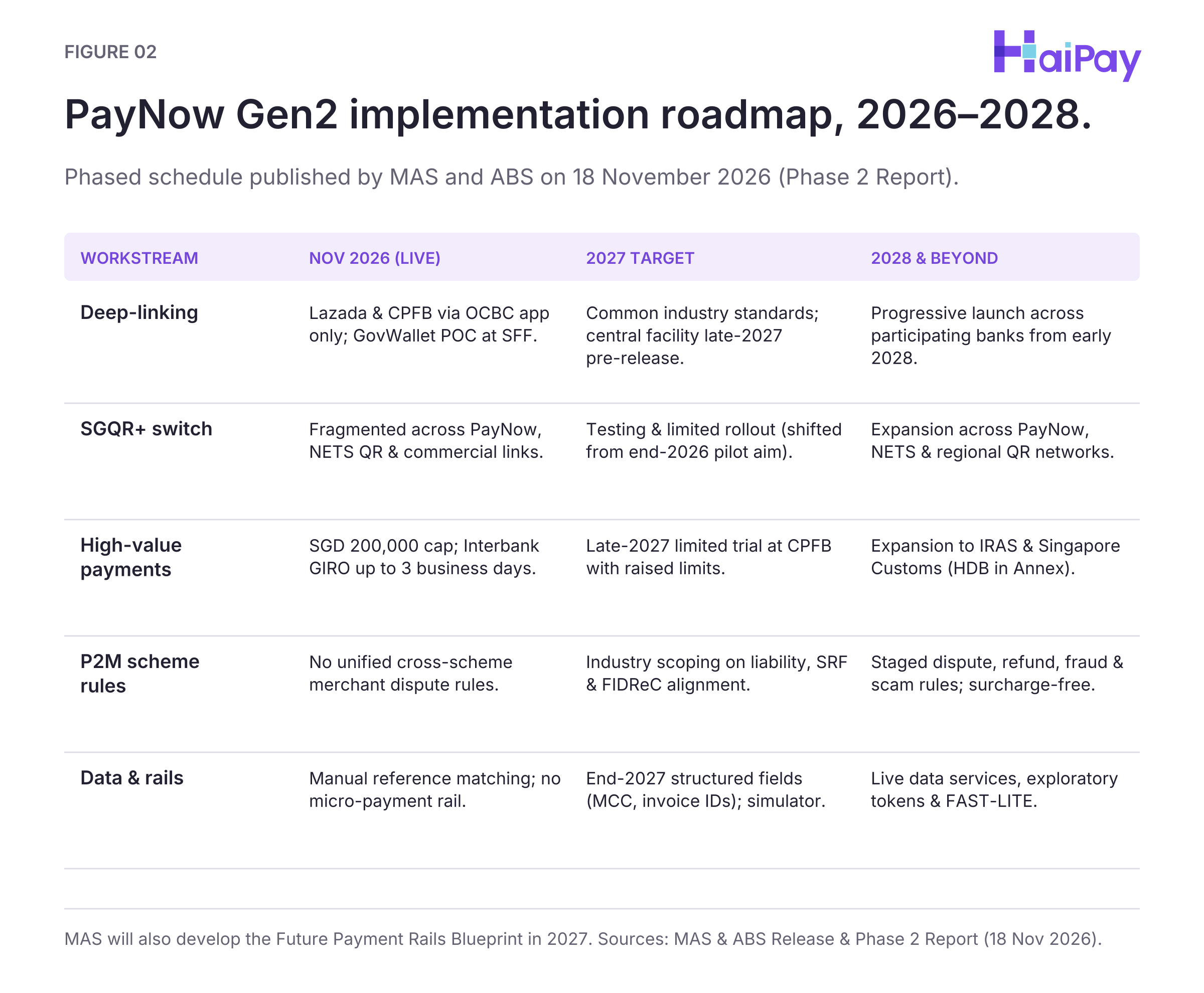
PayNow Gen2 Workstream | Live State (Nov 2026) | 2027 Target Milestone | 2028 & Beyond Milestone | Lead / Named Entities |
|---|---|---|---|---|
Deep-linking | Live on Lazada and CPFB via OCBC app only | Common industry standards and late-2027 central facility pre-release | Progressive launch across participating banks from early 2028 | MAS, ABS, SPaN, BCS, OCBC, Antom |
QR interoperability (SGQR+) | Fragmented across PayNow, NETS QR, and commercial links | Pre-release testing and limited rollout (shifted from end-2026 target) | Expansion across PayNow, NETS, and regional QR networks | MAS, ABS, SPaN, BCS, NETS, Ant International |
Inclusive QR apps | Enhanced NETS app and Wise support visitor PayNow QR | Ongoing rollout for visitors and financially dependent residents | Broader visitor and non-standard-bank resident coverage | MAS, ABS, NETS, Wise |
Micropayments / FAST-LITE | No live low-cost micro-rail | Simulator testing for cost-optimised rail and programmable prototype | Candidate micropayment rail rollout alongside Fast and Secure Transfers (FAST) | MAS, ABS, SPaN, BCS |
High-value payments | Standard SGD 200,000 PayNow limit; Interbank GIRO takes up to 3 business days | Late-2027 limited trial with CPFB at raised whitelisted limits | Expansion to Inland Revenue Authority of Singapore (IRAS) and Singapore Customs (plus HDB in Annex roadmap) | MAS, ABS, CPFB, IRAS, Customs |
PayNow P2M scheme rules | No unified scheme-wide merchant dispute rules | Industry scoping across liability, Shared Responsibility Framework, and Financial Industry Disputes Resolution Centre (FIDReC) alignment | Staged rollout of dispute, refund, fraud, and scam rules | MAS, ABS, SPaN |
Smarter business payments | Manual payment reference matching common | Richer structured data fields (MCC, invoice IDs) from end-2027 | Live data services plus exploratory tokenisation testing | MAS, ABS, BCS |
MAS also stated it will develop a Future Payment Rails Blueprint in 2027 to design a multi-rail architecture beyond PayNow Gen2. Meanwhile, Ant International expects to join the first two waves onboarding the SGQR+ switch, enabling cross-border visitor payments from Alipay+ partner e-wallets and bank apps.
Source: MAS and ABS, "PayNow Generation 2 Study" (25 June 2026; accessed 20 November 2026); MAS and ABS, "PayNow Generation 2 Implementation Roadmap" (18 November 2026; accessed 20 November 2026); MAS and ABS, "PayNow Generation 2 Phase 2 Report" (Sections 3.3, 4.4–4.7, 18 November 2026; accessed 20 November 2026).
What merchants should check before waiting for end-2027
Cross-border merchants cannot rely on bilateral deep-linking alone while central standards remain over a year away. Payment teams serving Singapore can audit three operational areas today instead of waiting for 2028:
- Instrument PayNow checkout steps separately. Track QR generation, image save latency, app-switch drop-off, and return-redirect failures rather than aggregate conversion alone. For market-specific setups, review Singapore payment gateway requirements.
- Keep dynamic QR fallback active. Retain standard QR display whenever a payer's bank lacks app-to-app invocation. In Chapter 6.6 of the Phase 2 Report, DBS noted that deep-linked checkouts require link verification and consistent status callbacks to prevent duplicate attempts; see how alternative payment methods work for fallback design context.
- Prepare reconciliation and refund workflows. From end-2027, structured PayNow fields will add merchant category codes (MCCs) and invoice references for automated matching. In 2028, SPaN will phase in person-to-merchant (P2M) dispute and refund rules while keeping PayNow surcharge-free for consumers. Teams mapping multi-market bank rails can review supported options under local payment methods.
Source: MAS and ABS, "PayNow Generation 2 Phase 2 Report" (Sections 4.2.4, 4.6.4, 4.7.4, and 6.6.5–6.6.6, 18 November 2026; accessed 20 November 2026).
Data highlight
6+ steps → 1 mobile PayNow checkout
Manual PayNow QR screenshot-and-upload flow condensed into a single app-to-app deep-link redirect
18 November 2026 (MAS/ABS Phase 2 Report & Ant International)
Read the methodology and limitations
Data as of 18 November 2026 · UTC
Methodology and limitations
Compiled on 20 November 2026 from three primary publications dated 25 June 2026 and 18 November 2026: the MAS and ABS PayNow Generation 2 Phase 1 joint media release, the MAS and ABS PayNow Generation 2 Implementation Roadmap joint media release and full Phase 2 Report, and Ant International's announcement on Antom's Lazada and GovWallet integrations. Trade-press summaries were inspected separately to identify omitted scope footnotes and consumer survey figures. HaiPay did not contact MAS, ABS, OCBC, Ant International, or Lazada for unpublished sample sizes or bank-specific conversion data.
Data note
Ant International (Antom and 2C2P by Antom) reported in MAS and ABS's PayNow Generation 2 Phase 2 Report (18 November 2026, Section 6.2.5 and Footnote 7) that observed live proof-of-concept deployments cut manual actions from six or more steps to one tap plus biometric authorisation, lifted payment success rates from 84.64% to 93.73% (+9.09 percentage points, stated as ~9% in its press release), and reduced completion time from 61.72 to 50.80 seconds (-17.7%).
The report classifies these figures as directional observations rather than a market-wide benchmark across all flows and issuers, and neither document discloses transaction sample size (n), observation window dates, or control design. Same-day MAS and ABS disclosures (Joint Media Release Footnote 2 and Phase 2 Report Footnote 3) note that live deep-linking currently operates on Lazada checkouts and Central Provident Fund Board (CPFB) payment pages via the OCBC app.
Data and research materials
- PayNow Gen2 Roadmap and Checkout Telemetry Dataset (CSV, 18 Nov 2026) ↓CSV · 7 KB
10-row structured dataset compiling Singapore's 7 PayNow Generation 2 workstreams (2026-2028), Antom directional Lazada/POC checkout metrics, and MAS BIRU (N=559) consumer friction survey shares.
HaiPay's graphics and the CSV file on this page may be reused with attribution to HaiPay and a link to this article.
Term definition
- PayNow deep-linking
- An app-to-app handoff that opens a payer's mobile banking app from an online checkout with pre-filled PayNow payment details, then redirects back to the merchant confirmation page.
- SGQR+ switch
- Singapore's proposed national QR routing switch connecting participating domestic schemes (including PayNow and NETS QR) and overseas QR networks at the routing layer.
- SPaN
- Singapore Payments Network, a not-for-profit entity established by MAS and ABS to administer and govern Singapore's national payment schemes, including upcoming 2028 PayNow person-to-merchant dispute rules.
4 sources
- The Association of Banks in Singapore
MAS and ABS Set Out PayNow Generation 2 Implementation Roadmap
Joint MAS and ABS media release (18 November 2026) outlining the five 2027-2028 PayNow Gen2 implementation streams, Footnote 2 (live deep-linking on Lazada and CPFB via OCBC), and Footnote 3 (CPFB, IRAS, Singapore Customs expansion).
Accessed 20 November 2026 · UTC
- Monetary Authority of Singapore
Official Phase 2 report (18 November 2026) containing MAS BIRU consumer survey (N=559), Footnote 3 (OCBC live scope), Footnote 7 & Section 6.2.5 (Antom 84.64% to 93.73% and 61.72s to 50.80s directional POC metrics), and Section 6.6 (DBS lessons).
Accessed 20 November 2026 · UTC
- The Association of Banks in Singapore
MAS and ABS Chart Instant Payments Enhancements with PayNow Generation 2 Study
Phase 1 joint release (25 June 2026) recording consultations with 37 organisations across 11 benchmarked jurisdictions, original end-2026 SGQR+ pilot target, and GIRO up-to-three-business-day processing baseline.
Accessed 20 November 2026 · UTC
- Ant International
Ant International announcement (18 November 2026) reporting Lazada ~9% early uplift via Antom, six-plus manual steps to one step, 2C2P-GovTech GovWallet proof of concept at SFF (18-20 Nov 2026), and SGQR+ onboarding wave expectation.
Accessed 20 November 2026 · UTC
How to cite
HaiPay News, "Lazada Launches PayNow Deep-Linking via Antom as MAS Sets End-2027 National Standards", https://www.haipay.net/news/lazada-paynow-deep-linking-singapore-gen2-roadmap, 21 November 2026