NewsLocal Payments
Five Years After Pix, Brazil Still Paid 4.1 Billion Boletos
Brazilians paid 4.08 billion boletos in 2025, up from 3.00 billion in 2019, the year before Pix launched, according to central bank data. Pix now handles 79.6 billion payments a year, but the boleto has plateaued rather than collapsed, and its value has kept rising.
Key takeaways 6
- Brazil paid 4.08 billion boletos in 2025, up from 3.00 billion in 2019, the year before Pix launched, central bank data show.
- Boleto numbers peaked at 4.20 billion in 2022 and were 2.8% below that peak in 2025.
- From January to September 2026 boletos fell 3.2% on a year earlier, while Pix payments rose 18.5%.
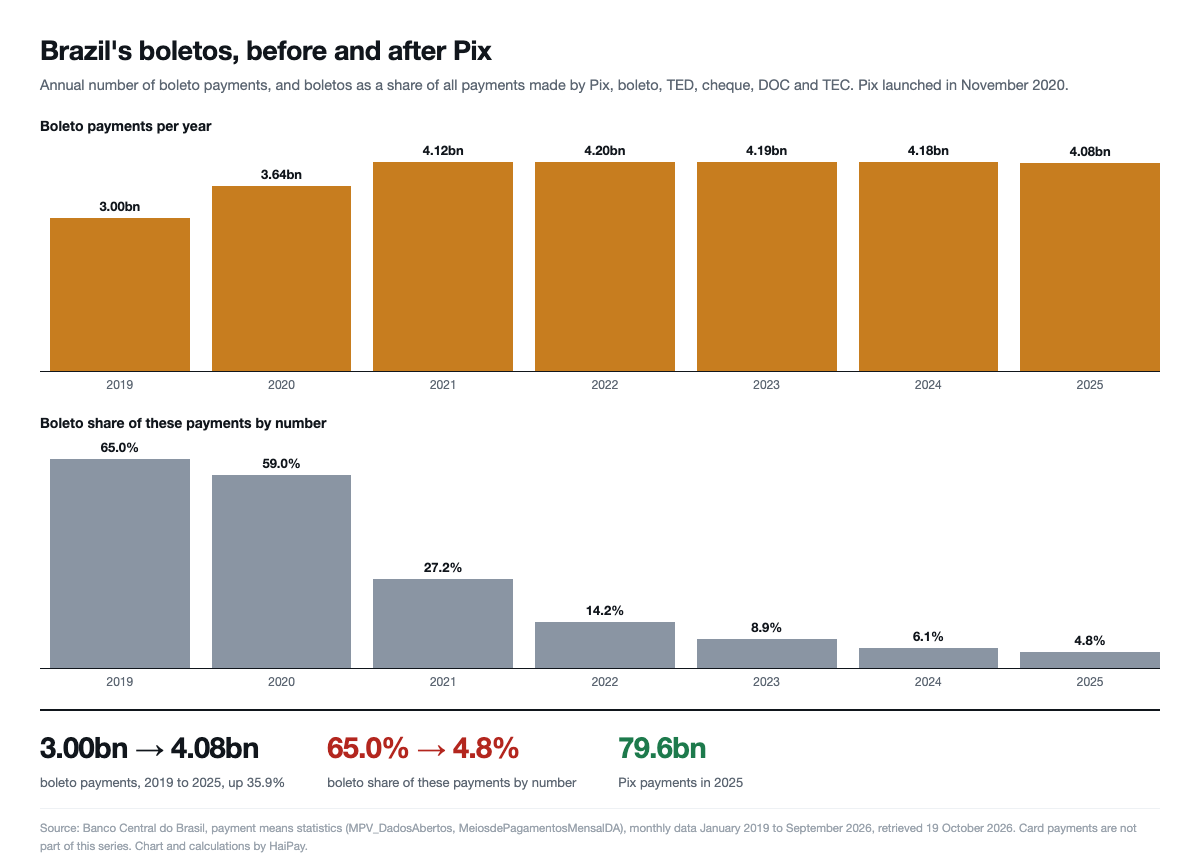
- Boletos were 65.0% of payments across six instruments in 2019 and 4.8% in 2025; Pix made 79.6 billion payments.
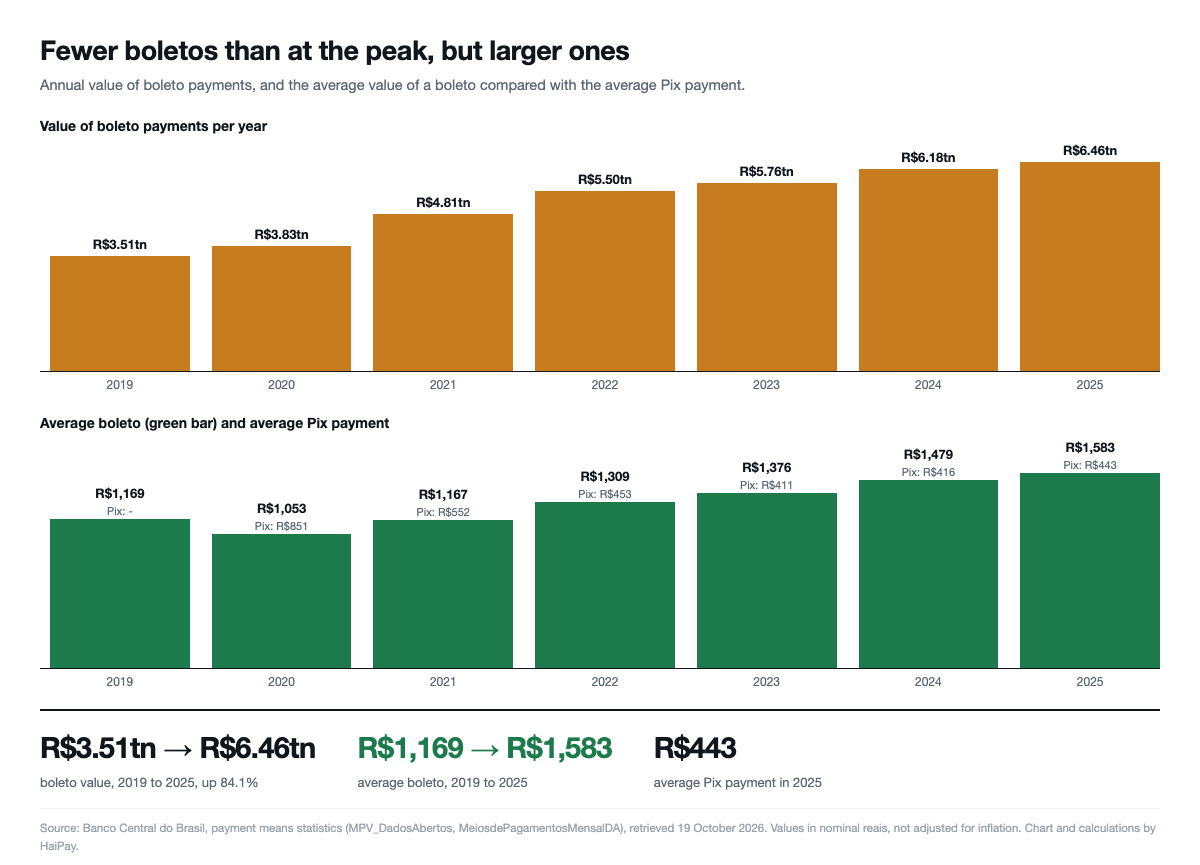
- Boleto value rose 84.1% to R$6.46 trillion from 2019 to 2025, and the average boleto from R$1,169 to R$1,583.
- Values are nominal and card payments are not in the series; the data do not show who still pays by boleto.
Brazilians paid 4.08 billion boletos in 2025, according to monthly payment statistics from the Banco Central do Brasil. That is more than in 2019, the year before Pix launched, when they paid 3.00 billion.
Pix has grown far larger, to 79.6 billion payments in 2025. But it has not replaced the boleto, the bank payment slip Brazilians use for bills, invoices and online purchases. It has grown around it.
A plateau, not a collapse
Boleto payments rose from 3.00 billion in 2019 to 4.12 billion in 2021 and peaked at 4.20 billion in 2022. Since then they have barely moved: 4.19 billion in 2023, 4.18 billion in 2024 and 4.08 billion in 2025, 2.8% below the peak.
The decline is now visible but slow. From January to September 2026 there were 2.96 billion boleto payments, 3.2% fewer than in the same months of 2025. Pix payments rose 18.5% over the same period.
What has collapsed is the boleto’s share. Across the six payment types in the central bank’s series, boletos were 65.0% of payments in 2019 and 4.8% in 2025.
Larger payments, rising value
While the number of boletos has flattened, their value has kept rising. Boletos carried R$3.51 trillion in 2019 and R$6.46 trillion in 2025, an 84.1% increase.
That means the average boleto has grown, from R$1,169 in 2019 to R$1,583 in 2025 and R$1,674 so far in 2026. The average Pix payment in 2025 was R$443.
The older instruments around the boleto have faded faster. Cheque payments fell 72.9% between 2019 and 2025, to 99.2 million. DOC transfers, 205 million in 2019, are zero in the data from March 2024.
Why this matters
For anyone selling into Brazil, the boleto is still a payment method that has to be supported, not a legacy option to switch off. Four billion payments a year is a large flow by any standard, and the rising average suggests it is increasingly used for larger bills and invoices rather than small purchases.
It also tempers the story of Pix as a replacement for everything. Pix has taken almost all of the growth in Brazilian payments, but the boleto’s absolute volume has fallen only slightly from its peak.
What this is not
Values are in nominal reais. Part of the rise in boleto value and average size reflects inflation over the period.
The series counts payments, not who makes them or what they pay for. It cannot show which bills or purchases remain on boletos.
Card payments are not in this series, so the shares compare the boleto with Pix, TED, cheques and the discontinued DOC and TEC only. HaiPay did not contact the Banco Central do Brasil.
What to watch
Whether the 2026 decline speeds up. A fall of 3.2% in nine months is the clearest drop since Pix launched, but still small.
Whether the average boleto keeps rising. If it does, the boleto is becoming a business and bill-payment instrument rather than a consumer one.
And whether monthly boleto payments fall below 300 million. They have not done so since June 2020.
Data highlight
4.08 billion payments
Number of boleto payments in Brazil in 2025, up from 3.00 billion in 2019, the year before Pix launched, while their share of interbank payments fell from 65.0 to 4.8 per cent
2019 to 2025, with January to September 2026
Read the methodology and limitations
Methodology and limitations
Compiled by HaiPay on 19 October 2026 from the Banco Central do Brasil payment means statistics, retrieved through the Olinda open data API as the monthly series MeiosdePagamentosMensalDA in the service MPV_DadosAbertos. The series reports, for each month, the number of payments in thousands and their value in millions of reais for six instruments: Pix, boleto, TED, cheque, DOC and TEC. The latest month in the data is September 2026. Card payments are not part of this series, so shares refer to the six instruments only. Annual figures are sums of the twelve months. Boleto payments numbered 3,004.3 million in 2019, 3,640.0 million in 2020, 4,120.0 million in 2021, 4,200.3 million in 2022, 4,186.1 million in 2023, 4,181.7 million in 2024 and 4,082.2 million in 2025, so 2025 was 35.9 per cent above 2019 and 2.8 per cent below the 2022 peak; the highest single month was March 2022, at 380.7 million. Their value was R$3,510.5 billion in 2019 and R$6,462.3 billion in 2025, 84.1 per cent higher, and the average boleto, value divided by number, rose from R$1,169 to R$1,583. From January to September 2026 boleto payments numbered 2,957.9 million, 3.2 per cent fewer than in the same months of 2025, while their value rose 3.7 per cent to R$4,951.9 billion, an average of R$1,674. Pix, launched in November 2020, handled 79,646.7 million payments worth R$35,302.4 billion in 2025, an average of R$443, and its number of payments from January to September 2026 was 18.5 per cent above the same months of 2025. Boletos were 65.0 per cent of the number of payments across the six instruments in 2019 and 4.8 per cent in 2025, and 12.5 per cent and 7.3 per cent of their value. Cheque payments fell from 365.5 million in 2019 to 99.2 million in 2025, or 72.9 per cent, and DOC and TEC payments are zero from March 2024. Every annual total, share, change and average is HaiPay’s arithmetic on the published monthly values. Three limits apply. Values are nominal and not adjusted for inflation, so part of the rise in boleto value and average size reflects price growth over the period. The series counts payments, not the people or businesses that make them, and does not split boletos by purpose, so it cannot show which bills or purchases remain on boletos. And because card payments are excluded, the shares describe the interbank instruments in the series, not all payments in Brazil. HaiPay did not contact the Banco Central do Brasil.
Data note
HaiPay calculation from the Banco Central do Brasil payment means statistics (Olinda API, MPV_DadosAbertos, MeiosdePagamentosMensalDA), monthly data from January 2019 to September 2026, retrieved 19 October 2026. Annual figures sum twelve months. Boleto payments were 3,004.3 million in 2019, peaked at 4,200.3 million in 2022 and were 4,082.2 million in 2025; their value rose from R$3,510.5 billion to R$6,462.3 billion and the average boleto from R$1,169 to R$1,583. From January to September 2026 boletos fell 3.2 per cent on a year earlier. Pix handled 79,646.7 million payments in 2025.
Shares cover six instruments only (Pix, boleto, TED, cheque, DOC, TEC); card payments are excluded. Values are nominal, not adjusted for inflation.
Data and research materials
- Brazil payment means, monthly, January 2019 to September 2026 (Banco Central do Brasil) ↓CSV · 11 KB
- Boleto and Pix annual totals and shares, 2019-2025 (HaiPay calculations) ↓CSV · 1 KB
HaiPay’s charts and the two CSV tables on this page may be reused with attribution to HaiPay and a link to this article. The underlying statistics are published by the Banco Central do Brasil; reuse of the source data is governed by the central bank’s terms, not by HaiPay.
Term definition
- Boleto
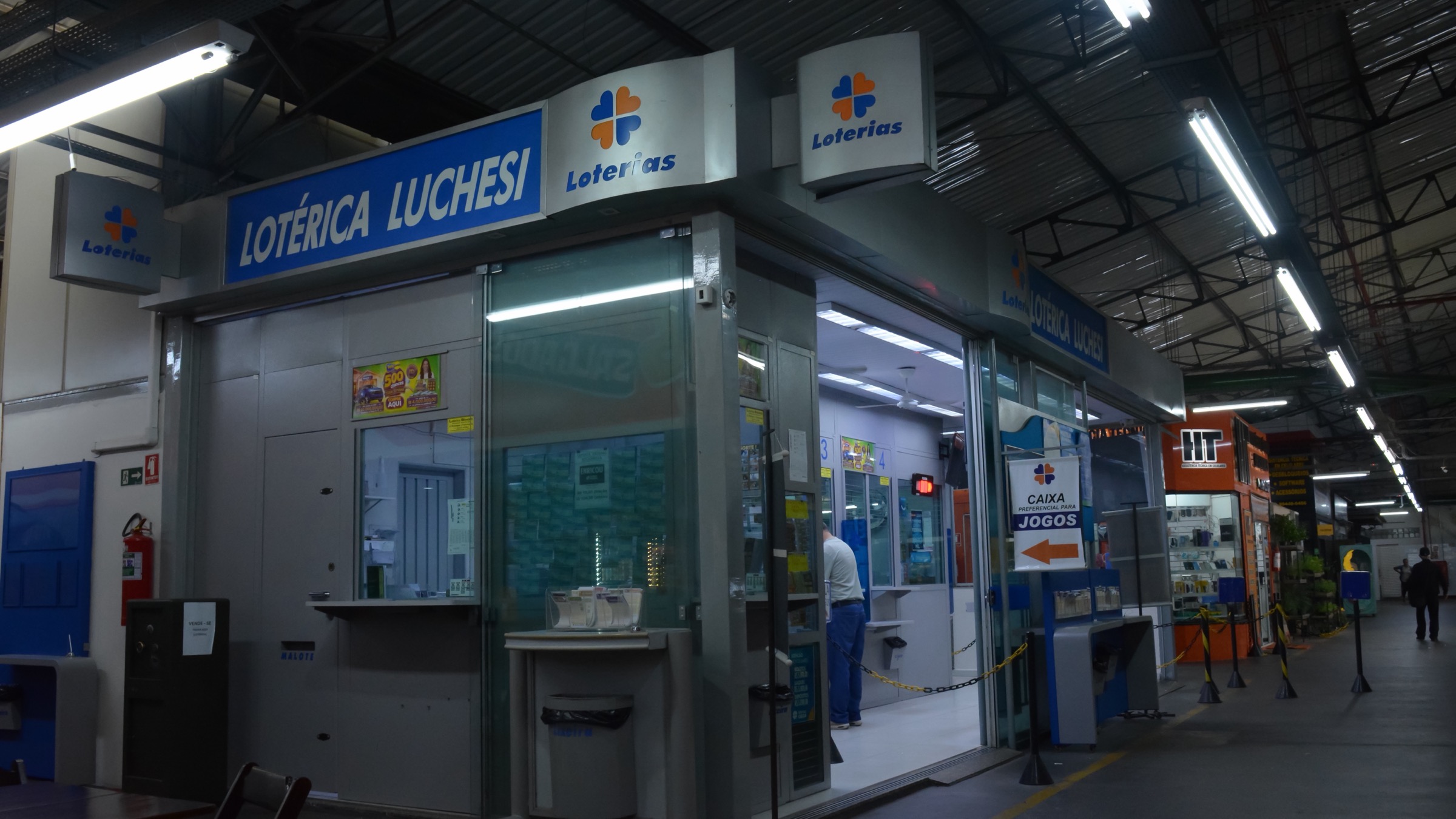
- A Brazilian bank payment slip with a barcode, issued by a seller or biller and paid at a bank, lottery outlet, app or internet banking. Brazilians paid 4.08 billion in 2025.
- Pix
- Brazil’s instant payment system, run by the central bank and launched in November 2020. It handled 79.6 billion payments in 2025.
- TED
- A Brazilian interbank credit transfer settled the same day. It handled 778.3 million payments in 2025, down from 1,033.4 million in 2019.
3 sources
- Banco Central do Brasil
Payment means statistics, monthly (MeiosdePagamentosMensalDA), Olinda open data API
Monthly number and value of Pix, boleto, TED, cheque, DOC and TEC payments from January 2019 to September 2026. Source of every figure in this article.
Accessed 19 October 2026 · UTC
- Banco Central do Brasil
Estatisticas de Meios de Pagamentos, open data catalogue entry
Catalogue entry describing the payment means datasets and their resources.
Accessed 19 October 2026 · UTC
- Banco Central do Brasil
The central bank’s page for its payment means statistics, for readers who want the published tables.
Accessed 19 October 2026 · UTC
How to cite
HaiPay News, "Five Years After Pix, Brazil Still Paid 4.1 Billion Boletos", https://www.haipay.net/news/brazil-boletos-four-billion-after-pix, 19 October 2026