


MCC Codes: Merchant Category Code Lookup for Merchants
Reviewed by WeiJun Tang










Last updated: September 7th, 2026
Insights
Classify the business customers actually pay, not the label you prefer.
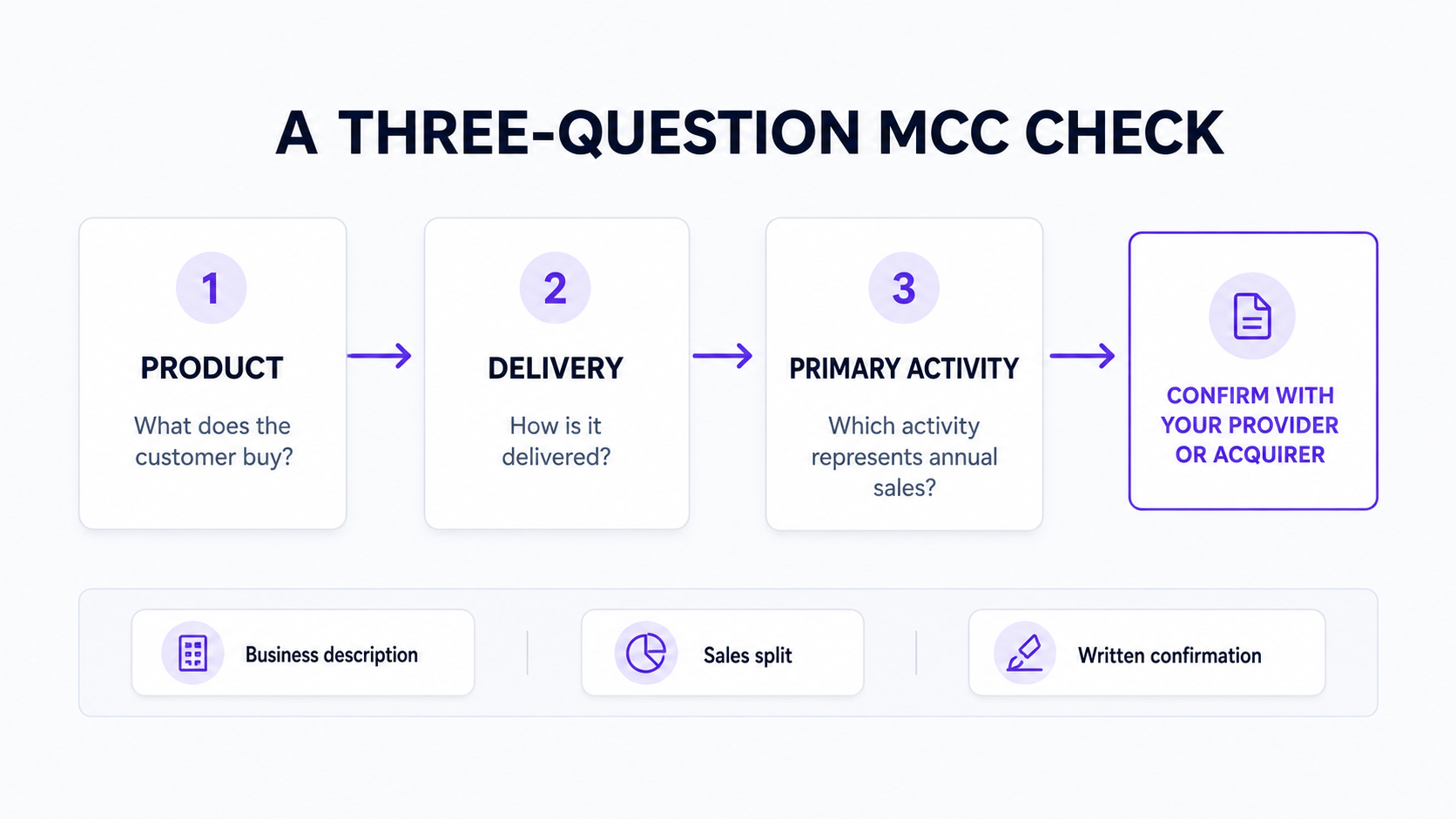
Product: What does the customer receive?
Delivery: Is it downloaded, streamed, shipped, performed, or used at a venue?
Primary activity: Which line represents annual sales, and are any lines subject to separate handling?
Treat the lookup table as a shortlist. Confirm the transmitted four-digit code with your payment service provider or acquirer and keep the decision record.
A merchant category code (MCC) is a four-digit number that classifies a merchant by its primary business activity.
The code is carried in card-payment messages and helps payment participants identify the business category behind a transaction. The merchant can describe its products and business model, but the payment service provider or acquirer confirms the code used for card acceptance. If your company sells several things, do not choose the code that sounds most convenient. Start with the activity that best represents the business, then document any separate line that may need different treatment.
This guide provides a focused MCC lookup for digital businesses, software companies, subscription merchants, and ecommerce operators. It is a working reference, not a substitute for the code list and onboarding decision used by your acquirer.
What does MCC mean in card payments?
MCC means merchant category code. ISO 18245:2023 defines code values for classifying merchants by the business, trade, or services they supply in retail financial transactions.
Visa's April 2026 Merchant Data Standards Manual describes an MCC as a four-digit number assigned to a merchant’s primary business. It says the primary business is determined by annual sales volume in local currency, while noting that some codes identify a specific merchant or transaction type. Mastercard's 2024 merchant booklet similarly requires a valid code that reasonably and fairly describes the merchant’s primary business.
Three parties have different roles:
- Merchant: explains what it sells, how customers receive it, where it operates, and which activity generates its sales.
- Payment service provider or acquirer: maps that evidence to the applicable card-network code and submits the MCC in payment messages.
- Card network and issuer: receive the classification in the payment flow and may use it within network rules, reporting, controls, or risk processes.
An MCC classifies the merchant activity; it does not explain why one particular payment was declined or disputed. For transaction-level diagnosis, keep the MCC beside the actual response or dispute code instead of treating the category as the answer.
MCC code lookup for common digital and ecommerce businesses
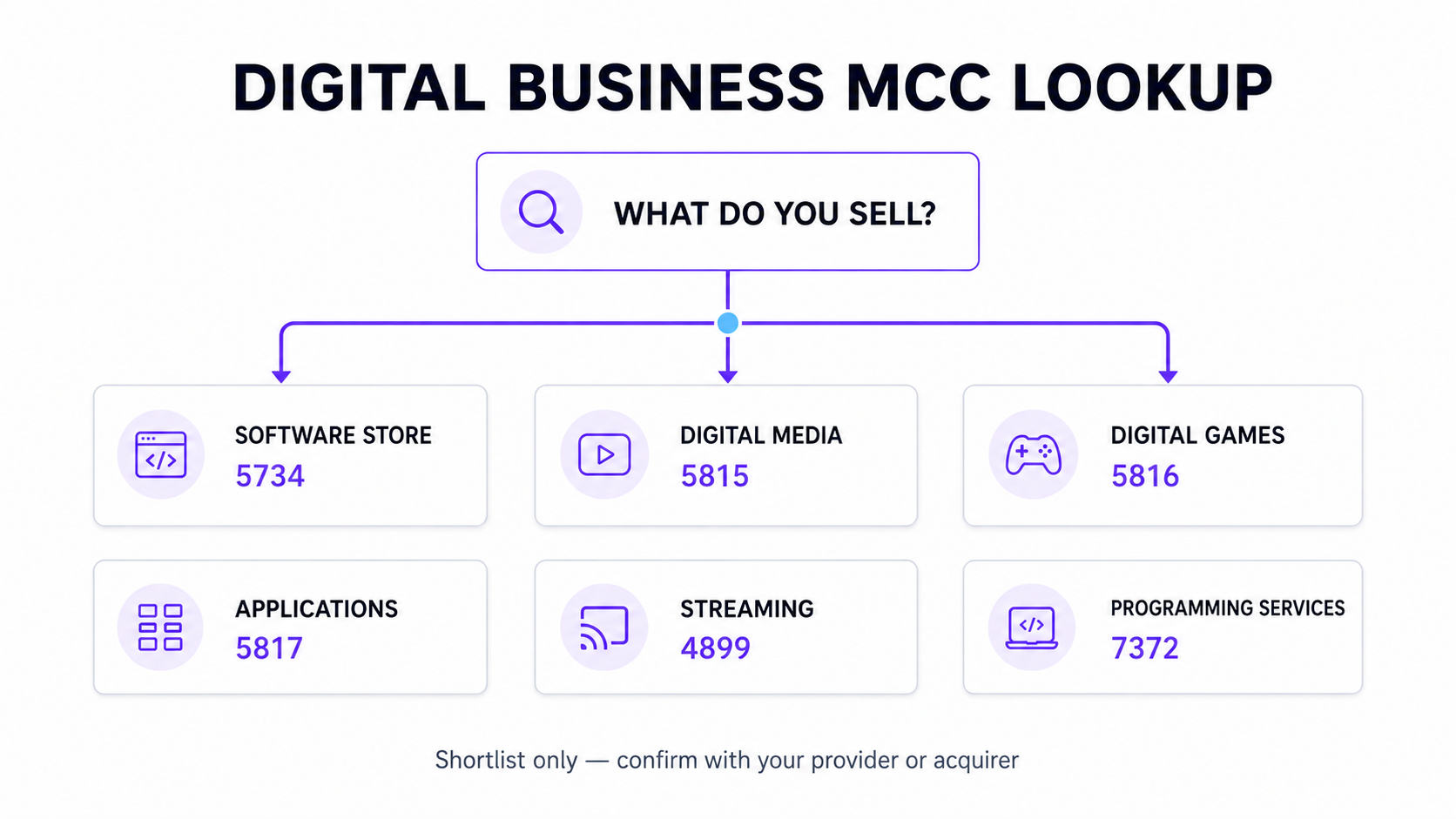
Use the table to identify candidate categories, then verify the final code with your payment service provider or acquirer. The descriptions below are shortened for scanning; the Visa manual's detailed MCC list contains the inclusions, exclusions and special handling needed for a final decision.
MCC | Official category, shortened | When it may fit | Boundary to check |
|---|---|---|---|
4816 | Computer Network/Information Services | Internet access, network, or information services | Do not use it as a generic code for every online business |
4899 | Cable, Satellite, Pay TV/Radio/Streaming Services | Ongoing delivery of television, radio, or streaming content for a fee or subscription | Distinguish streaming access from one-time digital media sales |
5734 | Computer Software Stores | Sale of computer software, sometimes with related hardware | Electronically delivered applications may fall under 5817 instead |
5815 | Digital Goods Media | Electronically delivered books, movies, artwork/images, or music | Subscription streaming is treated separately in Visa’s manual |
5816 | Digital Goods — Games | Games delivered in electronic form | Gambling and skilled-game wagering can trigger separate rules or categories |
5817 | Digital Goods — Applications (Excludes Games) | Electronically delivered applications or software other than games | Distinguish the sale of an app from programming or systems-design services |
5818 | Digital Goods — Large Digital Goods Merchant | Qualifying large-volume digital-goods merchants | This is not a general fallback; volume and regional criteria apply |
5968 | Direct Marketing — Continuity/Subscription Merchant | Certain products sold through a direct-marketing subscription model | Recurring billing alone does not make every merchant a 5968 merchant |
7372 | Computer Programming, Data Processing, and Integrated Systems Design Services | Programming, systems design, website design, data entry, or data processing | Distinguish a service engagement from selling packaged software or an app |
7399 | Business Services, Not Elsewhere Classified | Business services without a more specific category | Use a specific category when one accurately describes the activity |
7994 | Video Game Arcades/Establishments | Physical venues operating video-game or amusement machines | It is not the code for electronically delivered games |
8999 | Professional Services, Not Elsewhere Classified | Professional services without a more specific category | Accounting, legal, consulting, and other named services can have specific codes |
5812 | Eating Places and Restaurants | Restaurants preparing food and drink for consumption | Fast-food and drinking-place categories are separate |
5814 | Fast Food Restaurants | Quick-service prepared food, including qualifying delivery activity | Distinguish it from full-service restaurants and grocery retail |
The table deliberately avoids labels such as “safe,” “low-risk,” or “high-approval.” A code is a classification, not a promised payment outcome. The commercial and risk treatment of a merchant still depends on the network, region, acquiring setup, product, delivery method, transaction pattern, and merchant agreement.
Choose a candidate MCC with three questions
The most useful evidence is not your marketing tagline. It is a plain description of what the customer buys, how it is delivered, and where the revenue comes from.
1. What does the customer actually buy?
Describe the deliverable, not the technology behind your company.
- A downloadable game is different from access to a physical arcade.
- An electronically delivered application is different from custom programming work.
- A streamed media library is different from a one-time ebook or music download.
- A subscription box is different from software billed monthly.
If your answer is “a platform,” go one level deeper. A platform may sell software access, digital content, professional services, marketplace transactions, or a combination. Those activities are not interchangeable for classification.
2. How does the customer receive it?
Delivery can separate otherwise similar products:
- Electronic delivery: app, game, file, digital artwork, or software access.
- Continuous access: streaming, membership, or another ongoing service.
- Physical delivery: goods shipped to the customer.
- Human service: programming, design, consulting, instruction, or another performed service.
- Physical venue: restaurant, arcade, hotel, or other location-based service.
Record the checkout flow, customer receipt, product page, and service agreement. These show how the business works in practice.
3. Which activity represents the business?
Visa’s guidance for multiple lines of business points to the activity with the highest annual sales volume in local currency. The manual also allows additional identifiers or MCCs when separate lines are appropriate, and it contains special handling for certain high-integrity-risk activities.
Do not flatten a regulated, restricted, or materially different line into a broad code just because another activity earns more revenue. Escalate the full business model to the acquirer and let its onboarding team apply the relevant network and regional rules.
The digital-business MCC boundaries merchants often confuse
Software product or software service?
The difference is the deliverable. The category boundaries below follow Visa's detailed MCC descriptions.
- 5734 can fit the sale of computer software.
- 5817 covers applications or non-game software delivered electronically under Visa’s listing.
- 7372 covers programming, data processing, and integrated systems-design services.
A software company can therefore have different candidate codes depending on whether customers buy a packaged product, receive an electronically delivered application, or hire the company to build and operate a custom system. Billing monthly does not answer that question.
Game, arcade, or wagering activity?
Visa lists 5816 for digitally delivered games and 7994 for physical video-game arcades or establishments. The same manual identifies special treatment for some wagering-related activity. A game publisher, arcade operator, and wagering product should not be grouped together merely because each uses the word “game.”
Streaming subscription or digital media sale?
Visa’s April 2026 descriptions separate 4899 for ongoing television, radio, or streaming delivery from 5815 for electronically delivered media such as books, movies, artwork/images, or music. Look at whether the customer receives a digital item or ongoing access to a content service.
Does every subscription merchant use MCC 5968?
No. Recurring billing is a payment schedule, not a business category. Visa’s description of 5968 covers a direct-marketing continuity or subscription model. It also says that merchants outside direct marketing that happen to offer recurring purchases should use the code that best describes the business. The manual routes streaming and qualifying digital-goods subscriptions to their relevant categories.
This is an important onboarding control: do not choose 5968 only because your checkout has a monthly plan.
Can one business have more than one MCC?
It can, but multiple MCCs are an acquirer-led configuration decision, not a merchant shortcut for routing each transaction to the most favorable category.
Start with one evidence pack for each materially distinct line:
Evidence field | What to record |
|---|---|
Legal entity and trading name | Which entity contracts with the customer and which name appears at checkout |
Product or service | What the customer receives, using plain language |
Delivery method | Download, app access, streaming, shipment, professional service, or physical venue |
Sales share | Annual sales by line in local currency, with the measurement period |
Customer journey | Product page, checkout, receipt, descriptor, and support path |
Operational separation | Separate storefronts, merchant IDs, terms, fulfillment, or accounting records |
Restricted activity check | Any regulated, high-integrity-risk, age-restricted, wagering, financial, or other sensitive activity |
Visa’s examples for multiple business lines show that the main sales line can determine the general MCC while separate identifiers may be appropriate for distinct lines. The correct setup depends on the facts and the applicable acquiring program.
How to find the MCC currently used for your business
A public code list explains what a number means; it does not prove which code your acquirer is transmitting for your merchant account.
Use this order:
- Check your onboarding or merchant-account record. Look for
MCC,merchant category code,acceptor business code, orbusiness category. - Check the payment dashboard or account profile. Some providers expose the category even when they do not display the raw four-digit code.
- Ask support or your account manager for the transmitted code. Name the legal entity, merchant ID, website, and payment channel.
- Compare it with the current network description. Use the applicable card-network manual, not an undated third-party list.
- Document the confirmation. Keep the date, provider, code, supporting description, and ticket or email reference.
If you are examining a card statement as a customer, the displayed category may help, but it is not a substitute for the merchant’s acquiring record. Different merchant IDs, business lines, locations, or payment arrangements can produce different classifications.
How to correct a merchant category code
Do not edit a checkout label and assume the payment classification changed. Raise a review with the payment service provider or acquirer responsible for the merchant account.
Send a compact evidence pack:
- current MCC and merchant ID, if known;
- legal entity and trading name;
- website and checkout URL;
- product or service descriptions;
- delivery method;
- annual sales split by business line;
- subscription or recurring-payment model, if applicable;
- regions and payment channels;
- requested category and the rule description supporting it;
- launch date or date the business model changed.
Ask for a written outcome. If the provider declines the requested change, ask which business fact or rule boundary controls its decision. Do not repeatedly reopen the same request without new evidence.
Mastercard's 2024 merchant booklet places responsibility on acquirers to provide a valid and accurate MCC in payment messages. It also notes that an invalid or obsolete MCC in the cited presentment message can be rejected. That makes the provider/acquirer the correct correction route.
How MCC relates to declines and chargebacks
MCC belongs in your payment record, but it should remain one field among many.
For declined payments
A change in decline patterns may justify checking whether the merchant profile, product mix, or MCC changed. It does not prove that the MCC caused the declines. Use the actual gateway, acquirer, and network response fields first. The credit card decline codes guide explains how to separate those layers and what the raw code can support.
For disputes
Keep the MCC with the original transaction data, but respond to the dispute that actually arrived. The reason code, transaction state, deadline, and relevant evidence control the operational response. Use the chargeback process guide for the workflow, then check the chargeback reason codes reference for the claim category.
If the customer already received or was promised a credit, determine whether you should refund, accept, or challenge before moving money again. The chargeback vs refund guide provides that transaction-state decision.
MCC review checklist before launch or a business-model change
Run this review before a new merchant account goes live and whenever the product, delivery method, entity, or revenue mix changes materially.
- Describe the deliverable: one sentence a customer would understand.
- Identify delivery: digital file, app, streaming access, physical shipment, human service, or venue.
- Measure the main activity: annual sales by line, in local currency, with a dated period.
- Separate sensitive lines: regulated, restricted, wagering, financial, age-restricted, or other special activity.
- Compare close codes: include the reason each near-match does or does not fit.
- Confirm with the provider/acquirer: record the merchant ID, code, date, and reviewer.
- Align the customer record: website, checkout, receipt, descriptor, and support explanation describe the same business.
- Recheck after change: new product, delivery model, acquisition, entity, region, storefront, or revenue shift.
The practical goal is not to find the most attractive MCC. It is to maintain a classification that accurately describes the business your customers are paying.
For payment pricing or onboarding terms, review HaiPay pricing and confirm the applicable merchant category, region, payment method, and contract terms with the team. HaiPay publishes this article and may provide payment services to eligible merchants; this guide does not guarantee onboarding, pricing, authorization, or dispute outcomes. This content is general information, not legal, financial or compliance advice.
Source notes
- ISO 18245:2023, Retail financial services — Merchant category codes, Edition 2, published February 2023; accessed 3 September 2026.
- Visa, Merchant Data Standards Manual, April 2026, especially pp. 19–24, 74–76 and 82; accessed 3 September 2026.
- Mastercard, Quick Reference Booklet—Merchant Edition, 16 April 2024, especially pp. 21–23; accessed 3 September 2026.
This content is payment-operations information, not legal, tax, financial, or investment advice. Card-network rules belong to the networks, not HaiPay. Network, regional, acquirer, provider, and merchant-agreement requirements can differ. Sources and code descriptions were checked on 3 September 2026.
FAQ
An MCC, or merchant category code, is a four-digit number used in retail card payments to classify a merchant by its business activity. The merchant describes the business, while the payment service provider or acquirer confirms the code used for card acceptance.
Check the merchant onboarding record, payment dashboard, or account profile first. If the raw code is not shown, ask the payment service provider or acquirer which MCC is transmitted for the merchant ID, then keep the written confirmation with its date and supporting business description.
The merchant provides information about its products, services, delivery method, and business model. The payment service provider or acquiring institution maps that information to the applicable category and submits the MCC in card-payment messages. The final process can vary by provider, network, region, and acquiring program.
Yes, separate MCCs or merchant identifiers may be appropriate when a business has materially different lines of activity. This is an acquirer-led setup decision. The merchant should provide sales by line, delivery methods, storefronts, contracts, and any restricted activities rather than assigning a different code to each transaction itself.
No. Recurring billing is a payment schedule, not a business category. Visa describes 5968 for certain direct-marketing continuity or subscription merchants and directs other recurring businesses to the code that best describes what they sell. Streaming and digital goods can have different categories.
The answer depends on the deliverable and delivery method. Visa lists 5734 for computer software stores, 5817 for electronically delivered applications other than games, 5816 for digitally delivered games, and 7372 for programming and systems-design services. Confirm the final code with the acquirer.
An inaccurate merchant profile can justify investigation, but an MCC alone does not prove why a specific payment failed. Diagnose the actual gateway, acquirer, and network response codes first. Ask the provider to verify the merchant profile if decline patterns changed after an MCC or business-model change.
Request a classification review from the payment service provider or acquirer. Provide the current merchant ID and MCC, legal entity, website, product description, delivery method, annual sales split by line, regions, and any restricted activity. Ask for the confirmed outcome in writing.
