NewsPayouts
Swift Deferred Address Cutover; 5 Pages Still Say Nov 14
Swift deferred its 2026 structured-address change, yet five live official guidance pages still presented 14 November as the operative date two days later. HaiPay found no evidence that the old network validation was actually activated.
Key takeaways 6
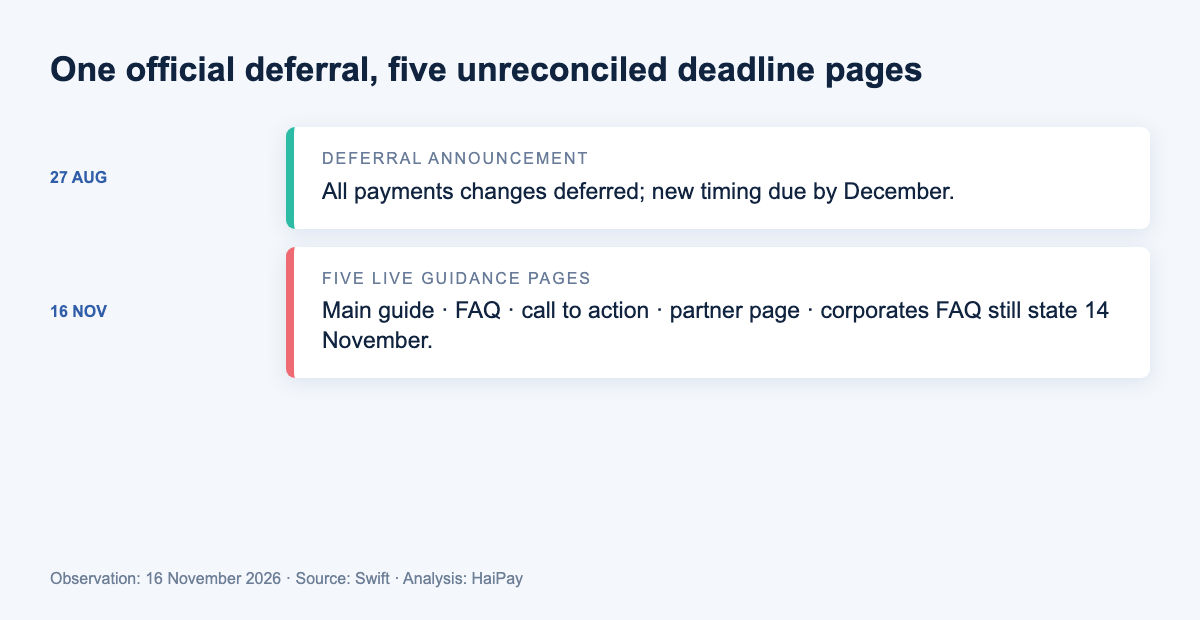
- Swift's 27 August announcement deferred all payments changes and promised a new structured-address timeline by December.
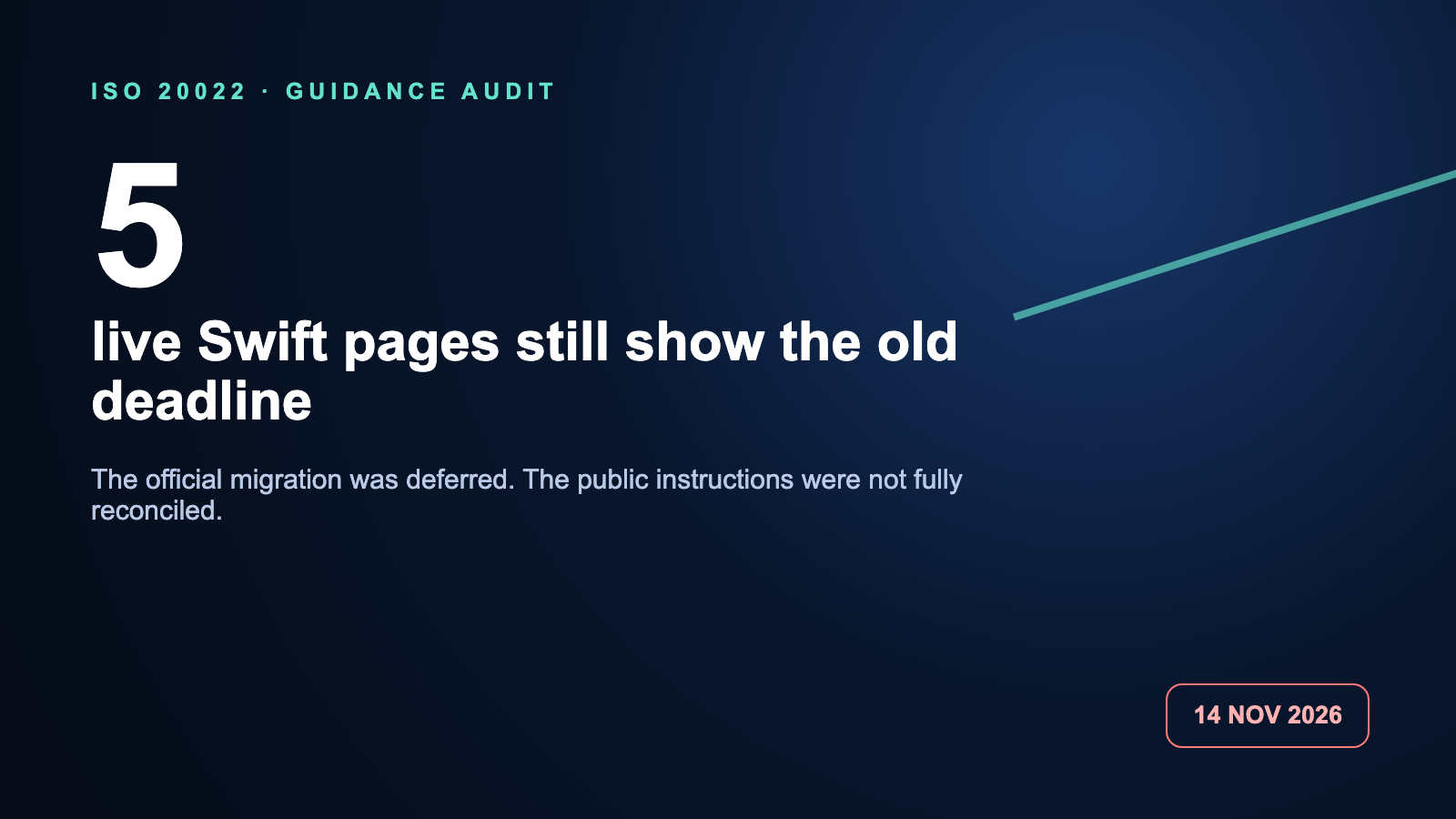
- Five live Swift pages observed on 16 November still presented 14 November as the operative deadline.
- The five-page count measures unreconciled public guidance, not five separate rules or confirmed network enforcement.
- September data showed unstructured addresses in 50.2% of debtor and 52.7% of creditor elements observed.
- Structured and hybrid formats require Town Name and a two-letter Country Code; BIC-only identification can remain valid for agents.
- No evidence reviewed by HaiPay establishes that the old network validation was activated or that a payment was rejected.
Swift deferred the structured-address cutover in its 2026 payments release, but its public guidance did not move in one direction. On 16 November, two days after the original deadline, five live Swift pages still presented 14 November 2026 as the operative structured-address date.
The conflicting pages are the main removal guide, a detailed FAQ, the May call-to-action newsletter, a technology-partner page and the corporates FAQ. The last is especially clear: it links Swift's August extension immediately above an answer that still says payments with unstructured addresses will be rejected after 14 November.
The later deferral announcement postponed all payments changes
Swift's 27 August announcement says it will defer all payments changes in Standards Release 2026. For structured addresses, it said it would consult banks, central banks, payment market infrastructures, market-practice groups and corporates, then provide an update by December at the latest. The September CBPR+ roadmap repeats that a new timeline will be defined by December.
That announcement is later and more specific about the deferral than the five guidance pages. It means the original 14 November date cannot responsibly be presented as a confirmed current Swift deadline. But the announcement does not say institutions should stop preparing: structured and hybrid addresses can already travel through the network, and Swift encourages implementation to continue.
Five pages still present the old date as operative
The main guide says fully unstructured messages may be rejected or delayed from 14 November. The FAQ goes further, saying non-compliant CBPR+ messages will be NAK'd at network level and that no contingency exists. The May newsletter says only structured or hybrid addresses will be accepted after that date. The partner and corporate pages repeat the same cutover.
HaiPay's count is a website-guidance count, not a count of separate rules. It also does not prove that Swift actually switched on the old validation, that a bank rejected a payment, or that each domestic high-value payment system changed its own timetable. Those operational outcomes require separate evidence.
About half of observed elements were still unstructured
Swift's September observation shows that the readiness gap persisted after the extension was announced. In pacs.008 CBPR+ traffic, 25.2% of debtor elements contained a structured address, 19.8% a hybrid address, 50.2% an unstructured address and 4.8% no address. Structured and hybrid formats together accounted for 45.0%. For creditor elements, the corresponding combined share was 33.7%; 52.7% contained an unstructured address and 13.7% contained no address.
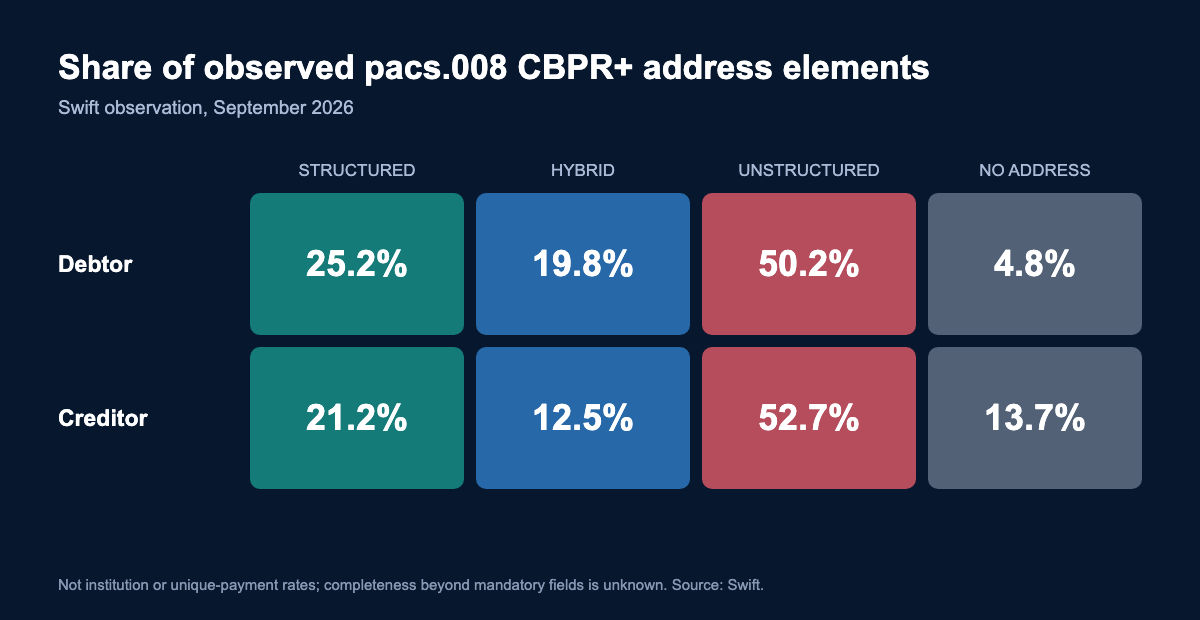
These percentages describe address XML elements in pacs.008 CBPR+ traffic, not institutions or unique payments. Swift's public page does not give the observation window or sampling method. The figures do not establish whether every address contained all information beyond mandatory fields, and a message without an address is not automatically non-compliant. For an agent, a BIC can remain a valid identifier instead of name and address.
The target format is clear even while the date is not
When the deferred change eventually takes effect, any postal address provided for an in-scope party or agent in a CBPR+ payment message must use a fully structured or hybrid format, subject to Swift's listed message exceptions. Both formats require Town Name and an ISO two-letter Country Code in designated fields, and a hybrid address can retain up to two free-text address lines. An agent identified by BIC does not also need a postal address. Swift lists six message identifiers outside the rule: admi.024, camt.025, camt.052, camt.053, camt.054 and camt.060.
What to watch
The next decisive update is Swift's promised timing decision, due by December at the latest. It should replace or annotate the five conflicting pages, identify the applicable CBPR+ usage-guideline version and separate Swift-network validation from the schedules of domestic market infrastructures. Until then, institutions should not treat a live web page alone as a final implementation baseline; they need the latest formal release documentation and confirmation from their relevant network or bank.
About HaiPay's mass payouts
HaiPay, which publishes this news section, offers mass payouts to local bank accounts and electronic wallets through a single API or batch upload, with automatic currency conversion and built-in AML and KYC automation. This is separate from Swift's CBPR+ messaging rules; HaiPay is not claiming participation in Swift or that its payout routes are unaffected by address requirements. Available routes, required beneficiary data, funding arrangements, limits and fees must be confirmed with the team. Learn more about HaiPay's mass payouts.
Data highlight
5 live public guidance pages
Live Swift pages still presenting the original 14 November deadline
Observed 16 November 2026
Counted on 16 November 2026 from five accessible Swift pages that explicitly presented 14 November 2026 as operative: the main guide, removal FAQ, May call-to-action, partner-compliance page and corporates FAQ. The count does not establish network enforcement or payment rejection.
Data as of 16 November 2026 · UTC
Methodology and limitations
Compiled by HaiPay on 16 November 2026 from Swift's 27 August deferral announcement, its September CBPR+ roadmap and five public guidance pages: the unstructured-address landing page, removal FAQ, May call-to-action newsletter, partner-compliance page and corporates FAQ. HaiPay counted a page only when the page itself remained publicly accessible and explicitly presented 14 November 2026 as the operative date. The five are not independent policies. The count does not establish that Swift applied the old validation on 14 November, that any payment was rejected, or that every domestic market infrastructure followed the extension. Adoption percentages are Swift's September 2026 observations of address XML elements in pacs.008 CBPR+ traffic; they are not institution-level or unique-payment adoption rates, and the public page does not provide the observation window or sampling method. HaiPay added structured and hybrid shares to calculate 45.0% for debtor and 33.7% for creditor elements. The Paypers was used only to cross-check the August extension. HaiPay did not contact Swift, any market infrastructure or any financial institution.
Data and research materials
- Swift structured-address guidance audit and September adoption data (HaiPay) ↓CSV · 3 KB
14 rows compiled by HaiPay on 16 November 2026 from Swift public pages: one deferral announcement, five live pages presenting the original deadline and eight month-level September address observations scoped to pacs.008 CBPR+ traffic.
HaiPay's charts and CSV may be reused with attribution to HaiPay and a link to this article. Swift source material remains subject to its publisher's terms.
Term definition
- CBPR+
- Swift's market-practice framework for ISO 20022 cross-border payments and reporting messages.
- Structured address
- A postal address whose components, including Town Name and Country Code, are placed in designated data fields.
- Hybrid address
- A postal address with mandatory structured Town Name and Country Code plus a limited number of free-text address lines.
- NAK
- A negative acknowledgement indicating that a message failed validation or was not accepted.
- BIC
- Business Identifier Code used to identify a financial institution on financial messaging networks.
8 sources
- Swift
Primary announcement published 27 August and updated 21 September: all payments changes deferred; structured-address timing to be set through consultation with an update by December at the latest.
Accessed 16 November 2026 · UTC
- Swift
CBPR+ roadmap beyond November 2025
September roadmap: Swift will define a new timeline for payments-related changes, including postal-address requirements, by December 2026 at the latest.
Accessed 16 November 2026 · UTC
- Swift
Unstructured address data is being removed. Are you ready?
Live page observed 16 November: still presents 14 November as the date from which fully unstructured messages may be rejected or delayed; provides September adoption percentages.
Accessed 16 November 2026 · UTC
- Swift
ISO 20022: The removal of unstructured address
Live FAQ observed 16 November: still says network-level NAK begins 14 November and the November deadline must be adhered to.
Accessed 16 November 2026 · UTC
- Swift
ISO 20022 in bytes for payments: Call-to-action for November 2026
Live newsletter observed 16 November: still says only structured or hybrid addresses will be accepted after 14 November; its publication date is 1 May 2026.
Accessed 16 November 2026 · UTC
- Swift
ISO 20022 CBPR+ compliance for partners
Live technology-partner page observed 16 November: still states that address data must be structured or hybrid from 14 November.
Accessed 16 November 2026 · UTC
- Swift
Live corporates FAQ observed 16 November: links the August extension but still states that unstructured addresses will be rejected from 14 November.
Accessed 16 November 2026 · UTC
- The Paypers
Swift extends ISO 20022 structured address deadline
Independent report of 27 August confirming Swift's extension and the promised December timing update; official Swift documents control the article's page count and technical detail.
Accessed 16 November 2026 · UTC
How to cite
HaiPay News, "Swift Deferred Address Cutover; 5 Pages Still Say Nov 14", https://www.haipay.net/news/swift-address-deadline-five-live-pages-conflict, 16 November 2026