NewsPayouts
Meridian FX Tests 4 Failures Across 3 Payment Systems
Three central banks coordinated three simulated payment-system environments in Project Meridian FX APAC. Four tested failures ended in settlement or full unwind, but the experiment was not a live service.
Key takeaways 6
- Project Meridian FX APAC linked three simulated wholesale settlement environments, not three live payment systems.
- The trial covered real-time gross and multilateral net FX payment-versus-payment use cases.
- Four exception scenarios ended in completed settlement or full unwind, leaving no single FX leg settled.
- The report discloses no settlement speed, throughput, transaction count or numerical liquidity saving.
- Technical coordination does not by itself establish legal settlement finality in every jurisdiction.
- The report states a 2028 BoE commitment; participation does not imply equivalent commitments by MAS or BoT.
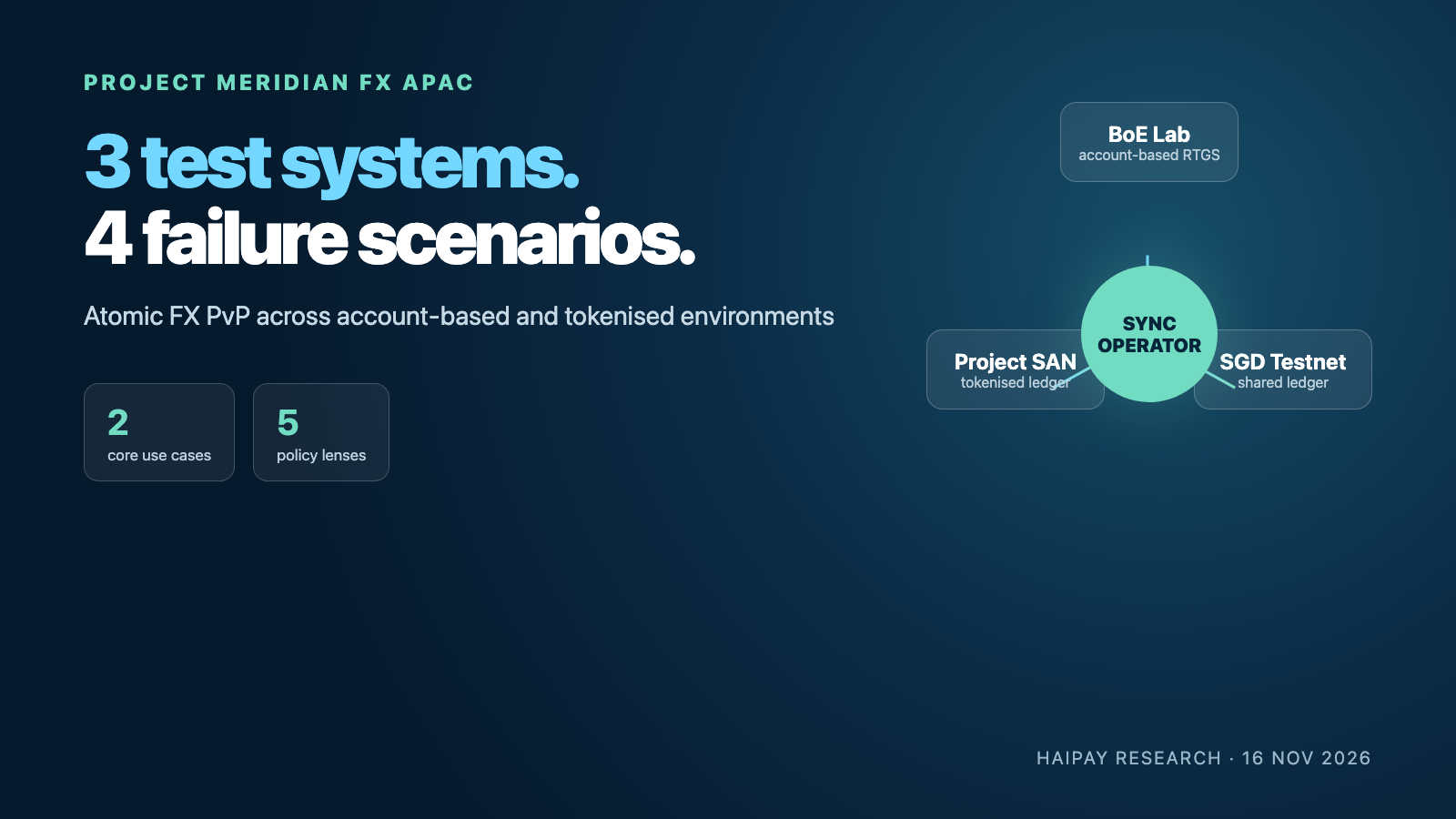
The Bank of England, Monetary Authority of Singapore and Bank of Thailand linked three simulated wholesale settlement environments in Project Meridian FX APAC. Results published on 13 November describe two payment-versus-payment use cases and four exception scenarios. In every tested exception, the synchronisation operator either completed settlement or unwound the transaction without leaving one currency leg settled on its own.
That result belongs to a proof of concept, not a live cross-border settlement service. The trial used stylised participants, configurable balances, a limited number of simulated transactions and overlapping system availability. It did not reproduce the full foreign-exchange trade lifecycle, live participants or production operating conditions.
Three payment-system tests shared one synchronisation workflow
The experiment connected separate non-production payment-system environments operated for the Bank of England, Bank of Thailand and Monetary Authority of Singapore. Partior built, integrated and tested the synchronisation operator prototype as technical and delivery partner.
The reports describe four stages: settlement instruction, matching, fund reservation and settlement request. The operator coordinated settlement status across the three systems. Its design relied on authorised access, balance reservation, settlement instructions, status information, idempotency and reliable event delivery.
Where a native capability was missing, the test used controlled escrow and release processes. For multilateral net settlement, the operator calculated net positions itself in all three environments. Those choices increased the operator's role and responsibility.
Four tested exception scenarios preserved PvP integrity
The technical report tested insufficient funds, an invalid account identifier, a multilateral net cycle combining both problems, and an infrastructure outage. The operator distinguished failures before and after the point of commitment. It retried or reversed steps according to the scenario so that no test ended with only one FX leg settled.
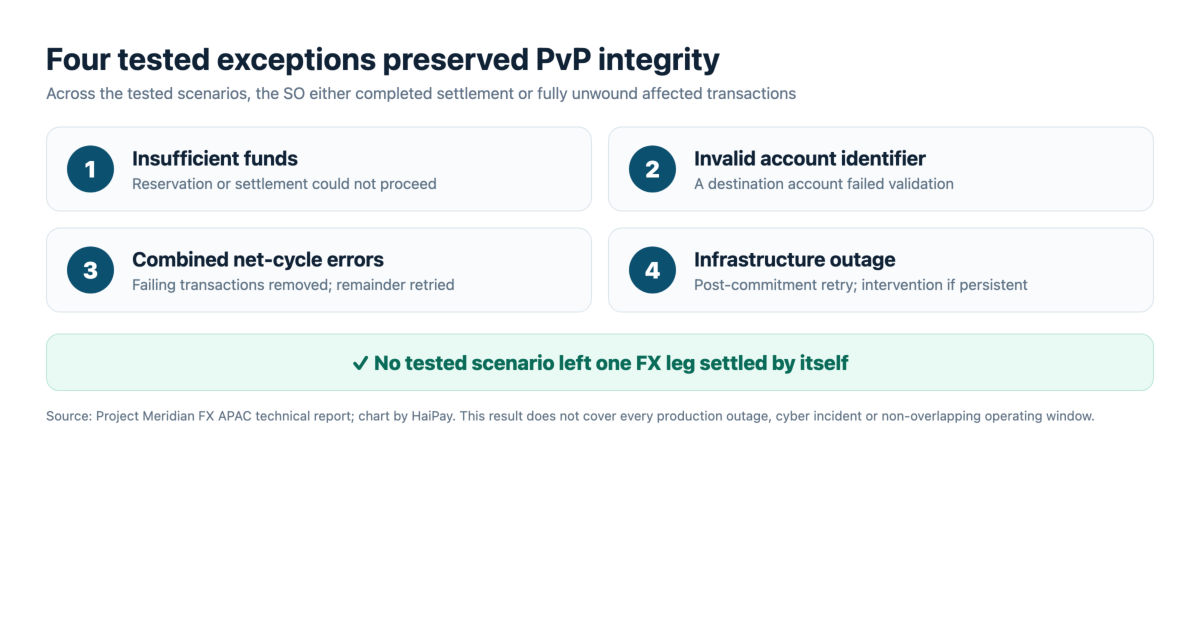
The outcome shows that payment-versus-payment integrity can be maintained across the tested architectures under the tested faults. It does not show how the design would behave under every production outage, cyber incident, participant failure or non-overlapping operating window.
Netting worked, but the report gives no savings percentage
The second use case applied multilateral netting before coordinated settlement. The report says this can reduce liquidity needs if funds remain reserved through the process, but it publishes no numerical liquidity saving. It also gives no settlement speed, throughput, transaction count or live-value result. Those omissions prevent a quantitative comparison with existing FX settlement arrangements.
Technical coordination is not legal settlement finality
The policy report evaluates access and assurance, regulatory perimeter and oversight, settlement finality, governance and accountability, and data and information sharing. It says existing frameworks can provide building blocks, but not a ready-made model. A coordinated technical sequence across payment systems does not by itself determine when a transfer is legally final in each jurisdiction.
The report states a 2028 commitment only for the Bank of England
The Bank of England says it is committed to launching synchronisation in 2028. The project summary says participation does not imply an equivalent implementation commitment or a particular policy direction by MAS or the Bank of Thailand. Participation in the experiment therefore should not be read as a three-country launch plan.
What to watch
The reports identify possible future work including broader currencies and operating conditions, more jurisdictions, industry participation, non-overlapping operating hours, earmark expiry and prolonged outages. A production proposal would also need clear operator governance, access standards, oversight allocation, data-sharing rules and jurisdiction-specific legal-finality analysis. The reports also identify delivery-versus-payment as a possible extension beyond FX.
About HaiPay's mass payouts
HaiPay, which publishes this news section, offers mass payouts to local bank accounts and electronic wallets through a single API or batch upload, with automatic currency conversion and built-in AML and KYC controls. This is commercial payout infrastructure, not wholesale central-bank settlement; HaiPay is not claiming participation in Project Meridian FX APAC or access to the tested synchronisation operator. Available routes, funding arrangements, limits and fees must be confirmed with the team. Learn more about HaiPay's mass payouts.
Data highlight
4 exception scenarios
Exception scenarios tested without leaving an individual FX leg settled
Project results published 13 November 2026
Counted from the official technical report: insufficient funds, invalid account identifier, a multilateral net cycle combining both errors, and an infrastructure outage. In each tested case, the operator completed settlement or fully unwound the transaction without leaving one FX leg settled.
Data as of 16 November 2026 · UTC
Methodology and limitations
Compiled by HaiPay on 16 November 2026 from the Bank of England's Project Meridian FX APAC executive summary, technical report, policy report and joint media release, cross-checked against the Monetary Authority of Singapore project page, the Bank of Thailand release and The Paypers. HaiPay counted the three simulated wholesale settlement environments, two core use cases, four exception scenarios, four settlement stages and five policy lenses exactly as enumerated in the reports. The proof of concept used stylised participants, configurable balances, a limited number of simulated transactions and overlapping availability windows. It did not reproduce a full FX trade lifecycle, live participants or production operating conditions, and it did not test non-overlapping hours or earmark expiry. The reports disclose no settlement-speed, throughput, transaction-count or numerical liquidity-saving result. Technical coordination is not treated as legal settlement finality. HaiPay did not contact the central banks, Partior or trial participants.
Term definition
- Payment versus payment (PvP)
- A settlement mechanism designed so that the transfer of one currency occurs only if the transfer of the other currency also occurs.
- Synchronisation operator
- The coordinating component that matches instructions, monitors reserved funds and issues settlement requests across separate payment systems.
- Earmarking
- Reservation of funds for a specified transaction so they cannot be spent elsewhere while settlement is pending.
- Multilateral netting
- Offsetting multiple participants' obligations to produce smaller net positions before settlement.
- Settlement finality
- The point at which a transfer becomes irrevocable and unconditional under the applicable law and system rules.
7 sources
- Bank of England
Project Meridian FX APAC: Executive summary and introduction
Primary summary published 13 November 2026: three simulated wholesale settlement environments, two use cases, project limitations, five policy lenses and the separate implementation positions of the three central banks.
Accessed 16 November 2026 · UTC
- Bank of England
Project Meridian FX APAC: Technical report
Primary technical report: four-stage synchronisation workflow, four exception scenarios, system-specific workarounds, key capabilities, tested outcomes and proof-of-concept limitations.
Accessed 16 November 2026 · UTC
- Bank of England
Project Meridian FX APAC: Policy report
Primary policy report: access and assurance, regulatory perimeter and oversight, settlement finality, governance and accountability, and data and information sharing.
Accessed 16 November 2026 · UTC
- Bank of England
Joint release: the three central banks completed the experiment; Partior was the technical and delivery partner; the Bank of England plans a live synchronisation interface in 2028.
Accessed 16 November 2026 · UTC
- MAS
MAS publication hub dated 13 November 2026 linking the executive, technical and policy reports.
Accessed 16 November 2026 · UTC
- Bank of Thailand
Project Meridian FX APAC demonstrates synchronised cross-border FX settlement
Bank of Thailand release providing the Thai central bank's description of the project and its exploratory status.
Accessed 16 November 2026 · UTC
- The Paypers
BoE, MAS, and Bank of Thailand complete synchronised FX trial
Independent report dated 13 November 2026 summarising the synchronised FX trial; official reports control the technical detail and all counts.
Accessed 16 November 2026 · UTC
How to cite
HaiPay News, "Meridian FX Tests 4 Failures Across 3 Payment Systems", https://www.haipay.net/news/meridian-fx-three-test-systems-four-failures, 16 November 2026