NewsRegulation
RBI Changes Five References in Payment Aggregator Rules
RBI changed five numbered paragraphs in its 11 November Payment Aggregator rule update, redirecting four compliance references and expanding one repeal clause.

Key takeaways 6
- Five numbered regulatory paragraphs differ between RBI's September 2025 and 11 November 2026 versions.
- The changes redirect KYC, net-worth, cyber-resilience and outsourcing references to newer RBI instruments.
- Paragraph 20 adds two 2010 circular identifiers to the repealed intermediary-account direction.
- The ₹15 crore application and ₹25 crore third-financial-year net-worth thresholds are unchanged.
- The ₹25 lakh PA-CB transaction cap and ₹40 lakh/₹5 lakh due-diligence thresholds are also unchanged.
- The comparison identifies text changes; it does not provide a legal interpretation of the incorporated rules.
The Reserve Bank of India changed five numbered regulatory paragraphs when it updated its Payment Aggregator Master Direction on 11 November 2026, a HaiPay comparison with the original 15 September 2025 version shows.
The edits redirect payment aggregators to newer rules on know-your-customer definitions, net-worth computation, cyber resilience and outsourcing. A fifth edit expands the list of old intermediary-account circulars named in a repeal clause. The comparison did not find a change to the direction's headline capital or transaction thresholds.
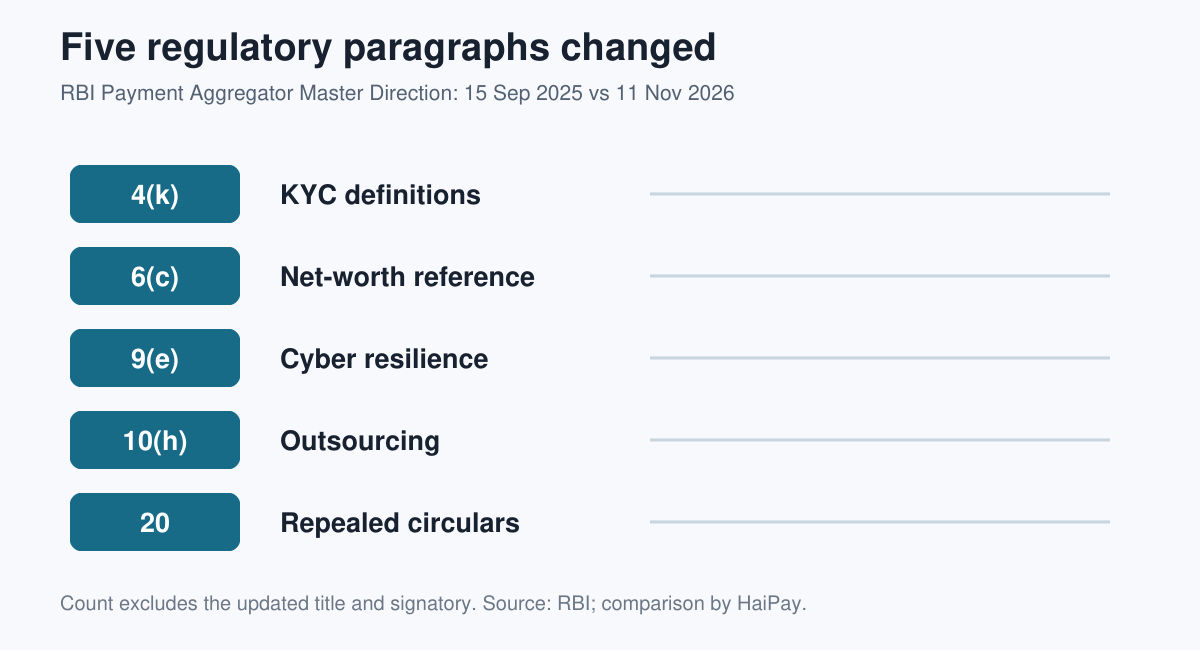
Five numbered paragraphs differ
Paragraph 4(k) now takes its KYC terms from RBI's November 2025 Commercial Banks KYC Directions rather than the 2016 KYC Direction. Paragraph 6(c) now sends readers to the June 2026 Master Directions on Authorisation to operate a Payment System for net-worth computation, replacing a January 2015 circular.
Paragraph 9(e) replaces its July 2024 cyber-resilience reference with RBI's 5 November 2026 Master Directions on Cyber Resilience and Digital Payment Security Controls for non-bank Payment System Operators. Paragraph 10(h) replaces three older outsourcing references with the 2025 Managing Risks in Outsourcing Directions and the 2021 framework for outsourcing payment and settlement activities.
The repeal clause names two more 2010 circulars
Paragraph 20 previously named one circular dated 24 November 2009 concerning accounts and settlement for electronic-payment intermediaries. The updated text also names circulars dated 20 and 28 December 2010 under the same subject.
The paragraph still preserves the exception for an existing online payment aggregator whose authorisation application remains pending with RBI. Adding the identifiers makes the cross-reference more complete; the text reviewed does not state that a new class of payment aggregator became subject to the repeal on 11 November.
The ₹15 crore and ₹25 crore thresholds are unchanged
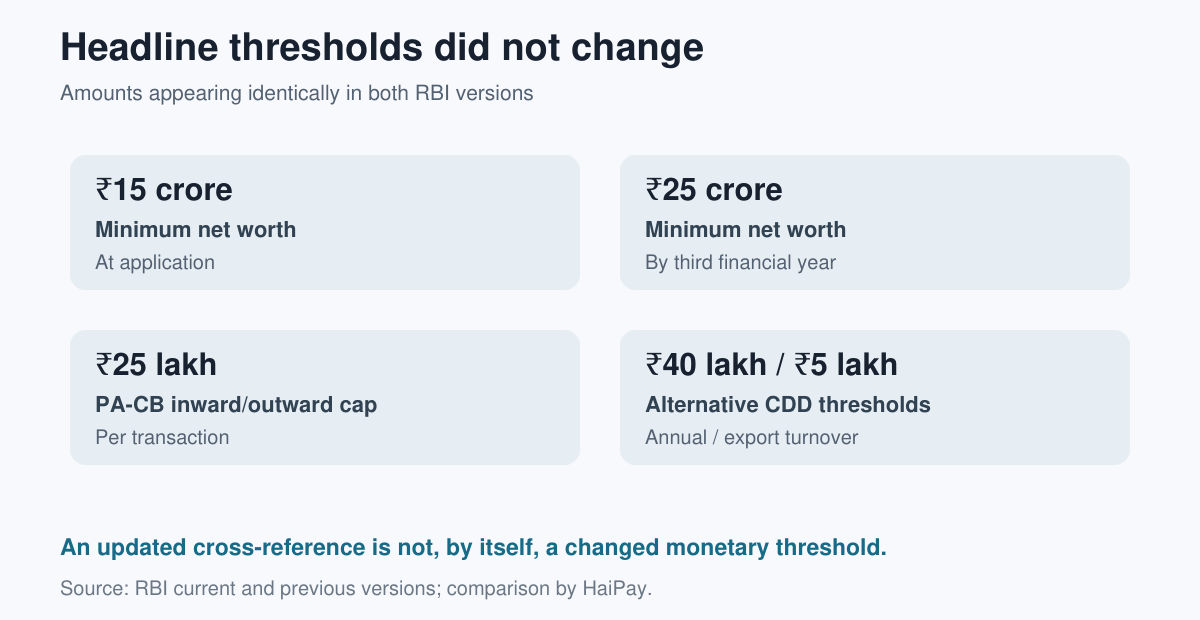
Both versions require ₹15 crore in minimum net worth when an entity applies and ₹25 crore by the end of the third financial year after authorisation. Both also retain the ₹25 lakh maximum for each inward or outward cross-border payment-aggregator transaction.
The alternative merchant due-diligence route likewise keeps annual turnover thresholds of ₹40 lakh, or ₹5 lakh in annual export turnover. Those repeated amounts matter because an updated date on a consolidated rule does not mean every provision changed.
What the comparison does not establish
The five-paragraph count measures visible text differences between two RBI versions. It does not determine whether the newer documents alter an aggregator's obligations beyond the wording of the Master Direction itself, and it is not legal advice. Companies must read each incorporated direction and obtain professional advice for their circumstances.
What to watch
RBI's previous-versions page currently shows the September 2025 text as the only archived baseline for this Master Direction. Future updates should be checked paragraph by paragraph, with particular attention to whether the capital, transaction, merchant-due-diligence or escrow provisions themselves change rather than only their references.
About HaiPay's local payments
HaiPay, which publishes this news section, offers local payment methods through hosted checkout, frontend components, API integration and payment links. Its product page describes multi-currency settlement for selected markets. HaiPay has no stated relationship with RBI, and this article does not claim that HaiPay is an Indian payment aggregator. Method availability, settlement currencies, fees and local requirements depend on the merchant and market. Learn more about HaiPay's local payments.
Data highlight
5 regulatory paragraphs
Changed regulatory paragraphs in RBI Payment Aggregator Master Direction
15 September 2025 to 11 November 2026
HaiPay compared the visible text of RBI's official 15 September 2025 and 11 November 2026 versions after collapsing whitespace. Five numbered regulatory paragraphs differ: 4(k), 6(c), 9(e), 10(h) and 20. The updated title and signatory are excluded.
Data as of 11 November 2026 · UTC
Methodology and limitations
Compiled by HaiPay on 18 November 2026 by comparing the Reserve Bank of India's Payment Aggregator Master Direction updated 11 November 2026 with RBI's archived 15 September 2025 version. HaiPay extracted the visible text from both official RBI pages, collapsed whitespace and ran a line-level comparison. Five numbered regulatory paragraphs changed: 4(k), 6(c), 9(e), 10(h) and 20. The updated title and signatory were excluded from the count. Paragraph 4(k) redirects KYC definitions from the 2016 KYC Direction to the 2025 Commercial Banks KYC Directions. Paragraph 6(c) redirects net-worth computation from a 2015 circular to the 15 June 2026 payment-system authorisation directions. Paragraph 9(e) points to the 5 November 2026 cyber-resilience directions. Paragraph 10(h) replaces three older outsourcing references with the 2025 outsourcing directions and the 2021 PSO outsourcing framework. Paragraph 20 adds two 2010 circular identifiers to the previously named 2009 intermediary-account circular. HaiPay found identical text in both versions for the ₹15 crore application net-worth threshold, ₹25 crore third-financial-year threshold, ₹25 lakh PA-CB transaction cap and ₹40 lakh/₹5 lakh merchant-turnover thresholds. The comparison identifies text changes, not RBI's legal interpretation or the effect of the incorporated documents. HaiPay did not contact RBI.
Data and research materials
- RBI Payment Aggregator Master Direction changes, 2025 to 2026 (HaiPay) ↓CSV · 2 KB
Eleven rows compiled by HaiPay on 18 November 2026 from RBI's current and previous Payment Aggregator Master Direction versions. Lists five changed regulatory paragraphs and six retained monetary or structural measures, including net-worth, cross-border transaction and merchant-turnover thresholds.
HaiPay's comparison charts and research CSV may be reused with attribution to HaiPay and a link to this article. RBI source documents remain subject to RBI's terms; the cover photograph remains subject to CC BY-SA 4.0.
Term definition
- Payment aggregator
- An entity that collects customer payments through merchant interfaces and subsequently settles the funds to merchants, under RBI's definition.
- PA-O
- An online payment aggregator, where the acceptance device and payment instrument are not physically close during the transaction.
- PA-CB
- A payment aggregator facilitating cross-border current-account transactions for onboarded merchants through e-commerce.
- Net worth
- The capital measure used by RBI for payment-aggregator authorisation and ongoing requirements.
- Cross-reference
- A provision directing the reader to another rule, circular, framework or definition.
3 sources
- Reserve Bank of India
Master Direction on Regulation of Payment Aggregator (PA), updated 11 November 2026
Primary current version. Labels the Master Direction as updated 11 November 2026 and contains the five changed regulatory paragraphs.
Accessed 18 November 2026 · UTC
- Reserve Bank of India
Master Direction on Regulation of Payment Aggregator (PA), 15 September 2025 version
Primary archived RBI version issued 15 September 2025, used as the comparison baseline.
Accessed 18 November 2026 · UTC
- Reserve Bank of India
Primary referenced direction dated 5 November 2026, now cited by paragraph 9(e) of the Payment Aggregator Master Direction.
Accessed 18 November 2026 · UTC
How to cite
HaiPay News, "RBI Changes Five References in Payment Aggregator Rules", https://www.haipay.net/news/rbi-payment-aggregator-rules-five-reference-updates, 18 November 2026