NewsRegulation
RBI Lists LivQuik’s Aggregator Application as Withdrawn
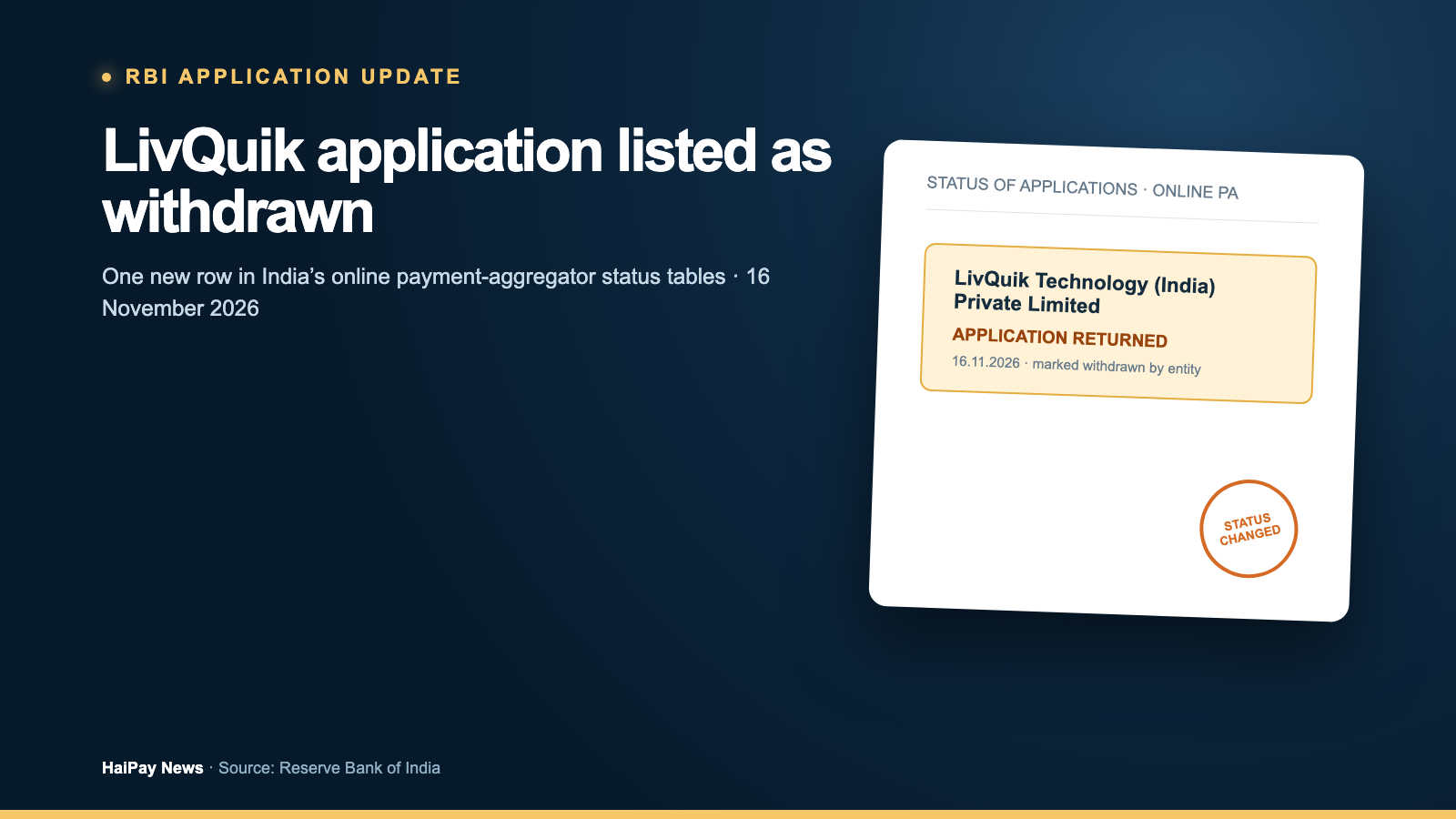
The Reserve Bank of India’s 16 November status page records LivQuik’s online payment-aggregator application as returned and marks it as withdrawn by the entity. It was the only added negative-status payment-aggregator row since the 16 October snapshot.
Key takeaways 6
- RBI’s 16 November list records LivQuik’s online payment-aggregator application as returned that day.
- RBI’s withdrawal marker says the application was withdrawn by the company; the filing gives no reason.
- LivQuik was the only added negative-status PA row between the 16 October and 16 November snapshots.
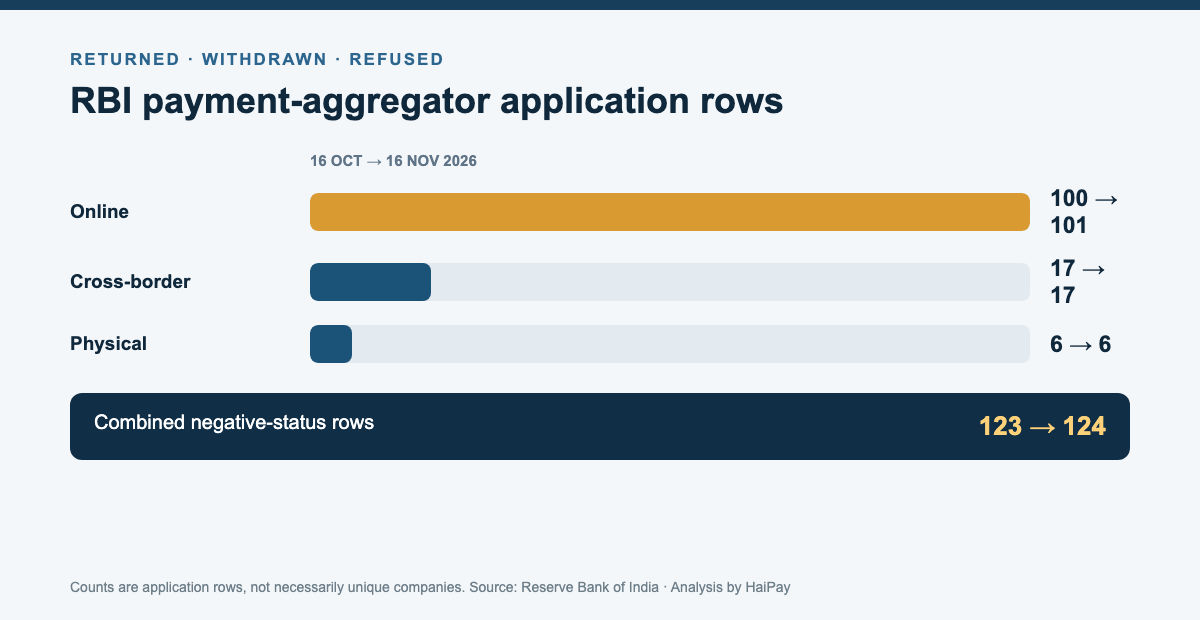
- Returned, withdrawn or refused PA application rows rose from 123 to 124 across online, cross-border and physical categories.
- RBI says existing online PAs with returned applications were advised to stop aggregation and close nodal or escrow accounts within 180 days.
- The filing does not show affected merchants, volumes, migration plans or whether LivQuik will apply again.
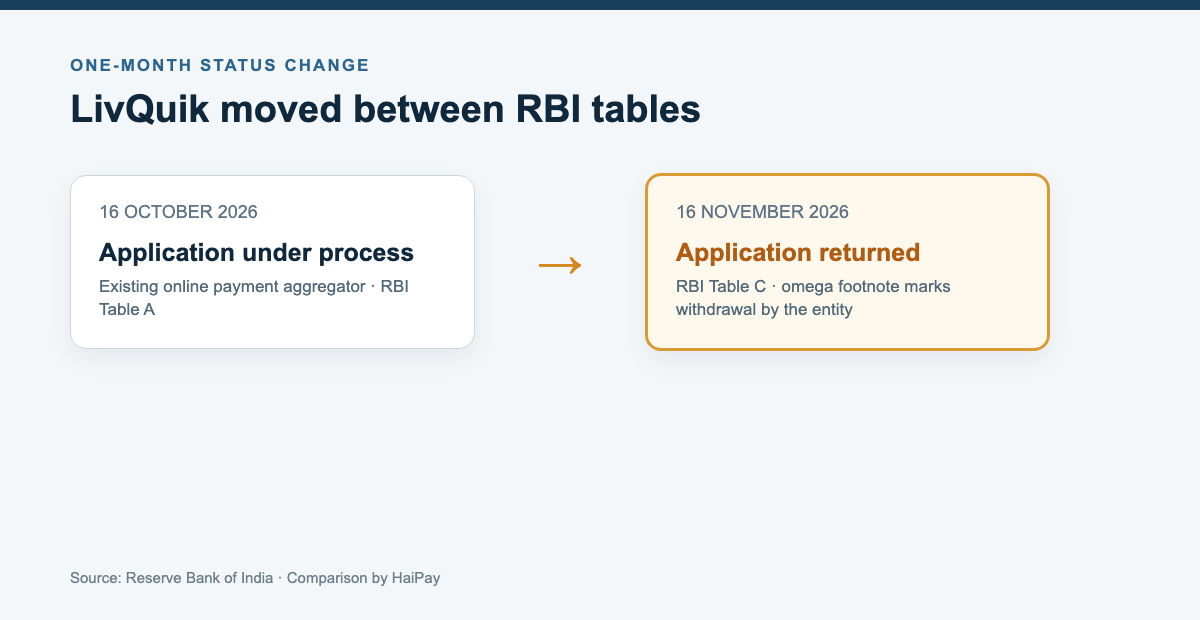
The Reserve Bank of India has moved LivQuik Technology (India) Private Limited from its list of existing online payment aggregators with an application under process to the table of applications returned, withdrawn or refused.
The status page dated 16 November records the application as returned that day. An omega marker beside LivQuik’s name points to RBI’s footnote saying the application was withdrawn by the entity. The filing gives no reason for the withdrawal.
One row changed in a month
HaiPay compared the RBI page dated 16 November with the version dated 16 October. LivQuik was the only row added across the three payment-aggregator tables for applications returned, withdrawn or refused, and no row was removed. The combined count rose from 123 to 124.
The online table increased from 100 entries to 101. The cross-border table remained at 17 and the physical payment-aggregator table at six. These are application rows, not necessarily unique companies: the same company can appear in more than one category or capacity.
RBI gives existing aggregators 180 days after a return
RBI labels LivQuik an existing online payment aggregator. Above Table C, the regulator says existing PAs whose applications were returned were advised to stop online payment-aggregation activity and close their nodal or escrow accounts within 180 days from the return date.
That wording does not mean the application was a licence valid until withdrawal. Elsewhere on the same page, RBI says an in-principle authorisation is not an authorisation under Section 7 of the Payment and Settlement Systems Act. It also distinguishes existing applicants, which may continue unless advised otherwise, from new applicants, which cannot begin operations before authorisation.
What the filing does not establish
The page does not identify LivQuik’s affected merchants, transaction volume, nodal or escrow banks, migration arrangements or future application plans. It does not say that services stopped immediately on 16 November, and the 180-day instruction is not evidence that every merchant relationship will continue for the full period.
The row-level comparison also measures changes to one RBI web page. It is not a complete count of all authorisation decisions made during the month, because a company that received a certificate could leave an application table without appearing in the negative-status tables. Certificates must be checked separately.
What to watch
The next points to verify are whether RBI publishes a later status change for LivQuik, whether the company makes a public operational announcement and whether the regulator’s certificate list changes. Merchants using any Indian payment aggregator should rely on current RBI records and direct provider notices rather than infer their own service timeline from a single application row.
About HaiPay’s local payments
HaiPay, which publishes this news section, offers regional payment methods for local checkout preferences through hosted checkout, frontend components, API integration and payment links. Its product page lists India methods including UPI, PhonePe, Paytm, Google Pay, Visa and Mastercard, with multi-currency settlement described for selected markets. This is separate from RBI’s LivQuik application update and does not imply a relationship with LivQuik. Availability, settlement currencies, fees and local requirements must be confirmed for each merchant and market. Learn more about HaiPay’s local payments.
Data highlight
1 added application row
New negative-status payment-aggregator application rows between RBI snapshots
16 October to 16 November 2026
HaiPay compared RBI’s payment-aggregator application tables dated 16 October and 16 November 2026. LivQuik was the only added row across the returned, withdrawn or refused online, cross-border and physical tables; no row was removed.
Data as of 16 November 2026 · UTC
Methodology and limitations
Compiled by HaiPay on 17 November 2026 by comparing the Reserve Bank of India’s status page for applications under the Payment and Settlement Systems Act, 2007, as dated 16 October 2026 and 16 November 2026. The RBI replaces the page when it updates the list, so HaiPay used the 16 October HTML archived for its earlier reporting and downloaded the 16 November page from the same RBI URL. Rows in the online, cross-border and physical payment-aggregator return, withdrawal or refusal tables were normalized by company name, applicant type, action and date. The comparison found one added row and no removed rows: LivQuik Technology (India) Private Limited, an existing online payment aggregator, application returned on 16 November 2026. The omega marker beside LivQuik maps to RBI’s footnote that the application was withdrawn by the entity. The total across the three negative-status tables rose from 123 to 124: online from 100 to 101, cross-border remained 17 and physical remained 6. RBI does not state why LivQuik withdrew, whether it will reapply, how many merchants are affected or when individual merchant arrangements may change. HaiPay did not contact RBI or LivQuik.
Data and research materials
- RBI LivQuik payment-aggregator status change, 16 Oct to 16 Nov 2026 (HaiPay) ↓CSV · 1 KB
Four-row comparison of LivQuik’s online payment-aggregator application status and the total returned, withdrawn or refused payment-aggregator application rows across RBI’s online, cross-border and physical tables on 16 October and 16 November 2026.
HaiPay’s charts and CSV may be reused with attribution to HaiPay and a link to this article. Reserve Bank of India source material remains subject to its publisher’s terms.
Term definition
- Payment aggregator
- An entity that collects customer payments for merchants and subsequently settles the funds to those merchants, as defined by RBI.
- Existing payment aggregator
- A payment aggregator already operating when RBI’s authorisation framework required it to apply; RBI’s page distinguishes these applicants from new PAs that cannot start before authorisation.
- Application returned
- RBI’s published status for an application placed in its returned, withdrawn or refused table. The LivQuik row is additionally marked as withdrawn by the entity.
- Nodal or escrow account
- An account structure used to receive and settle merchant funds under RBI’s payment-aggregator framework.
1 sources
- Reserve Bank of India
Status of Applications received under Payment and Settlement Systems Act, 2007 — As on 16.11.2026
Primary source. Table C lists LivQuik as an existing online payment aggregator whose application was returned on 16 November 2026; the omega marker is defined as an application withdrawn by the entity. The same section gives the 180-day instruction for existing PAs with returned applications.
Accessed 17 November 2026 · UTC
How to cite
HaiPay News, "RBI Lists LivQuik’s Aggregator Application as Withdrawn", https://www.haipay.net/news/rbi-livquik-payment-aggregator-application-withdrawn, 17 November 2026