NewsAI & API Payments
Open USD Shows 954M OUSD Supply and 266 Named Partners
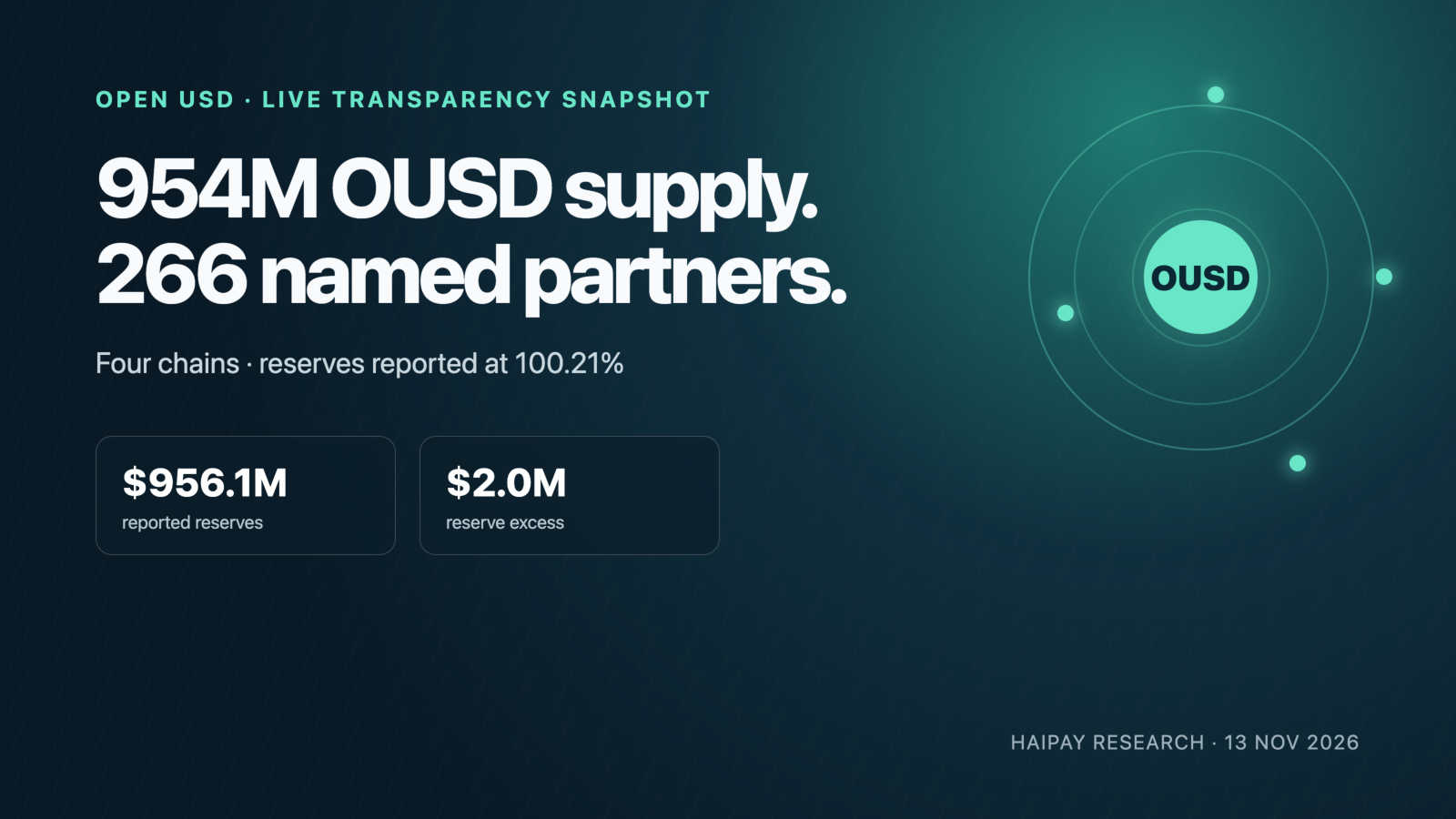
Bridge's public API reported 954.1 million OUSD in circulation and US$956.1 million in reserves on 13 November. Open Standard's official list contained 266 named partners by HaiPay's count, but the list does not establish 266 live integrations.
Key takeaways 6
- Bridge's API showed 954.1m OUSD and US$956.1m in reserves on 13 November.
- Reserves exceeded on-chain supply by about US$2.0m, a 100.21% ratio.
- Open Standard's official page listed 266 named partners; listing does not prove live integration.
- OUSD launched on Ethereum, Solana, Base and Tempo on 30 September 2026.
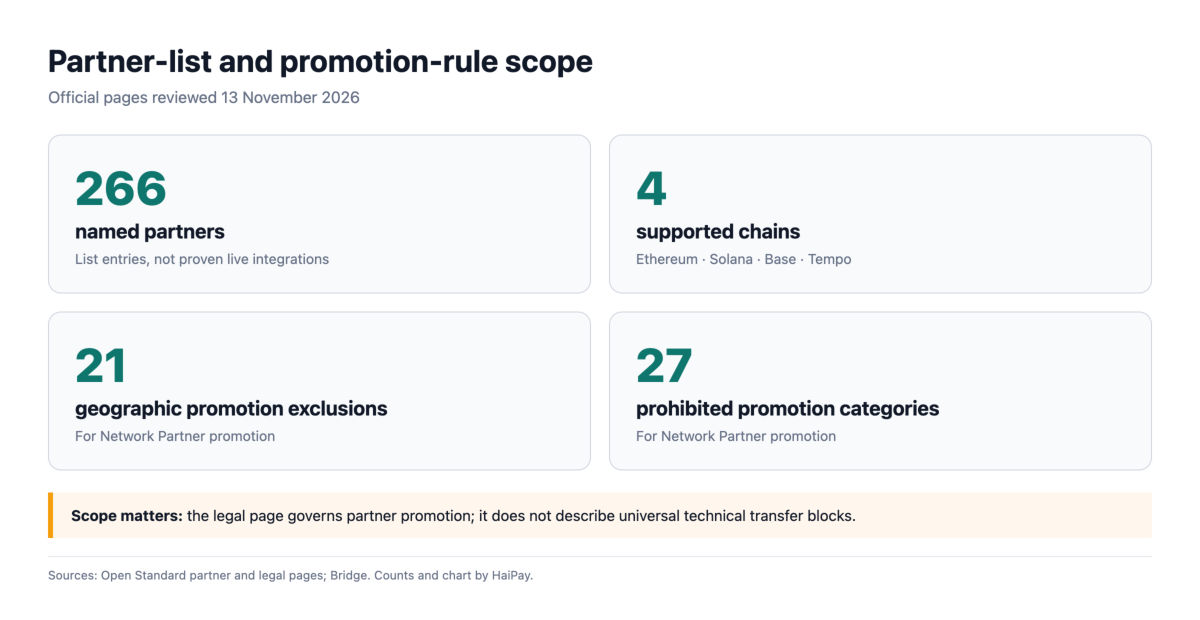
- Partner promotion rules list 21 geographic entries and 27 prohibited-use categories.
- The live API is not an accountant's attestation, and its component rows did not fully reconcile to total reserves.
Bridge's public transparency API reported 954.1 million Open USD tokens in circulation and US$956.1 million in total reserves at 03:00 UTC on 13 November. The resulting collateralisation ratio was 100.21%, with reserves exceeding supply by about US$2.0 million.
The official Open Standard partner page, updated two days earlier, contained 266 named organisations by HaiPay's count. That number measures entries on a list, not completed integrations, active users or payment volume.
Reserves exceeded supply by $2.0 million
Open USD, or OUSD, is issued by Bridge, a Stripe company. It launched on 30 September on Ethereum, Solana, Base and Tempo. Bridge's documentation describes its transparency endpoint as a public, no-key interface for circulating supply, reserve assets and collateralisation.
Bridge's reserve page displayed cash at 11.4% and Treasuries at 88.6%. It says the Treasury allocation can include money-market funds holding Treasury-bill ladders with less than three months' duration. The raw API snapshot listed cash and Treasury components that were US$1.94 million below the total-reserve field, however. Because Bridge did not explain that difference in the reviewed material, HaiPay does not present those two rows as a complete reserve reconciliation.
The dashboard links monthly accountant attestations, but the live API is not itself an attestation. At the time of review, the page showed links for August and September 2026. The US$2.0 million excess is therefore a calculation from a point-in-time API snapshot, not a guarantee that reserves or redemption conditions cannot change.
The partner list has 266 names, not 266 proven integrations
HaiPay counted every name from Aave through zerohash once and found no exact duplicates. The list spans banks, card networks, payment companies, wallets, exchanges and blockchain infrastructure providers. Stripe, Visa, Mastercard, Shopify, Coinbase, Airwallex and Western Union are among the names.
The list does not show which partners have launched OUSD in production, how much volume each handles or whether every listed company has implemented the token. Those measures should not be inferred from membership alone.
Promotion rules exclude 21 geographic entries and 27 use cases
Open Standard's legal page says Network Partners may promote OUSD globally except in 21 geographic entries, including the European Economic Area and 20 named countries or territories. It also lists 27 categories for which partners may not promote OUSD, from adult services and gambling to mixing, deceptive practices and weapons.
The language is about promotion by Network Partners. It does not establish that every on-chain transfer involving a listed place or use case is technically blocked, so the counts should not be read as a map of transaction availability.
The launch date was September 30
Official posts from Open Standard, Bridge and Stripe date OUSD's launch to 30 September. The Open USD homepage separately describes a 12 November public event featuring the first live payments on OUSD. HaiPay therefore does not use 12 November as the token's launch date.
What to watch
The next useful disclosures would be supply by chain, transaction and redemption volume, named production launches, and the next monthly attestation. A reconciliation explaining how the API's component rows relate to total reserves would also make the real-time report easier to audit.
About HaiPay's mass payouts
HaiPay, which publishes this news section, offers mass payouts to local bank accounts and electronic wallets through a single API or batch upload, with automatic currency conversion and built-in AML and KYC controls. Available routes include Brazil Pix and selected markets in Latin America, Asia and Africa. This is conventional payout infrastructure; HaiPay is not claiming to support OUSD or any stablecoin rail. Payout funding arrangements, limits and fees depend on the route and must be confirmed with the team. Learn more about HaiPay's mass payouts.
Data highlight
266 named partners
Names on the official Open Standard partner list
Partner page updated 11 November 2026
HaiPay counted each named entry from Aave through zerohash once on Open Standard's partner page, updated 11 November 2026. The count measures list entries, not completed integrations, active users or transaction volume.
Data as of 13 November 2026 · UTC
Methodology and limitations
Compiled by HaiPay on 13 November 2026 from Bridge's public OUSD transparency API and reserve dashboard, Open Standard's partner and legal pages, official launch releases from Open Standard and Stripe, and an independent CoinDesk launch report. The API snapshot at 03:00:32 UTC reported 954,085,237.49664 OUSD on-chain, US$956,085,354.91 in total reserves and a collateralisation ratio of 1.0021; HaiPay calculated excess reserves of US$2,000,117.41336. The API's listed cash and Treasury components were US$1,940,906.21 below its total-reserve field, so HaiPay does not treat those component rows as a complete reconciliation and uses the reserve page's displayed 11.4%/88.6% allocation only as a nearby dashboard snapshot. HaiPay counted each named partner from Aave through zerohash once on the official list updated 11 November, finding 266 names and no exact duplicates. HaiPay separately counted 21 geographic entries and 27 prohibited-use categories on the legal page. Those rules concern Network Partner promotion and are not treated as universal technical transfer blocks. The real-time API is not an accountant's attestation, and a listed partner is not assumed to have a live production integration. HaiPay did not contact Bridge, Stripe, Open Standard or any listed partner.
Data and research materials
- Open USD supply, reserves, partner and promotion-rule counts (HaiPay) ↓CSV · 2 KB
12 rows compiled by HaiPay on 13 November 2026 from the Bridge transparency API and reserve dashboard, Open Standard partner and legal pages, and official launch records. Includes raw snapshot values, disclosed counts and HaiPay calculations with scope caveats.
HaiPay's charts and CSV may be reused with attribution to HaiPay and a link to this article. The underlying API and official lists are published by Bridge and Open Standard; reuse of their source material is governed by their terms.
Term definition
- Stablecoin
- A digital token designed to maintain a stable value against a reference asset; OUSD is designed to track the US dollar.
- On-chain supply
- Tokens recorded as circulating on supported blockchain networks at the time of the snapshot.
- Collateralisation ratio
- Reported reserve assets divided by circulating on-chain supply; Bridge reported 1.0021, or 100.21%, in the reviewed snapshot.
- Attestation
- An accountant's examination and report on specified information at a stated date; a live dashboard is not itself an attestation.
9 sources
- Bridge
Open USD live transparency API
Public no-key API snapshot at 03:00:32 UTC on 13 November 2026: 954,085,237.49664 OUSD on-chain, US$956,085,354.91 total reserves and a 1.0021 collateralisation ratio.
Accessed 13 November 2026 · UTC
- Bridge
Nearby dashboard snapshot showing the four chains, displayed reserve allocation, reserve policy and available monthly attestation links.
Accessed 13 November 2026 · UTC
- Open Standard
Official list updated 11 November 2026. HaiPay counted 266 named entries from Aave through zerohash; listing does not prove a live production integration.
Accessed 13 November 2026 · UTC
- Open Standard
Geographic restrictions and prohibited use cases
Official rules for Network Partner promotion. HaiPay counted 21 geographic entries and 27 prohibited-use categories; these are not described as universal technical transfer blocks.
Accessed 13 November 2026 · UTC
- Open Standard
Official launch post dated 30 September 2026, identifying Ethereum, Solana, Base and Tempo and four integration paths.
Accessed 13 November 2026 · UTC
- Stripe
OUSD is now available on Stripe
Stripe's 30 September release confirming availability on Stripe and naming Bridge, Privy and Stripe Issuing infrastructure.
Accessed 13 November 2026 · UTC
- Bridge
Documentation for the public no-key stablecoin transparency endpoint and its reported fields.
Accessed 13 November 2026 · UTC
- CoinDesk
Open USD takes on Tether, Circle with a different stablecoin model
Independent launch report, published 24 September and updated 30 September 2026, confirming the four launch chains and describing the Open Standard model.
Accessed 13 November 2026 · UTC
- Open USD
Homepage reviewed 13 November 2026. Its 12 November section describes a public event featuring the first live payments on OUSD; it is not used as the token's official launch date.
Accessed 13 November 2026 · UTC
How to cite
HaiPay News, "Open USD Shows 954M OUSD Supply and 266 Named Partners", https://www.haipay.net/news/open-usd-954m-supply-266-partners, 13 November 2026