NewsDigital Wallets
OPay Halts NYSE IPO; Lending Was 60% of Its Revenue
OPay decided on 30 October not to complete its New York Stock Exchange listing, a day after its US registration became effective, citing a regulatory inquiry in a jurisdiction it called immaterial to its business. Its prospectus shows lending, not payments, brought in 59.5% of its US$467.1 million first-half revenue.

Key takeaways 6
- OPay decided on 30 October not to complete its NYSE IPO, citing a regulatory inquiry.
- Its registration became effective on 29 October, the date of its underwriting agreement.
- The base offering was 16 million ADSs at an expected US$19-21, or US$304m-336m.
- Lending made up 59.5% of OPay's US$467.1m revenue in H1 2026, up from 53.8% in 2024.
- Payments fees fell to 27.9% of revenue; Nigeria provided 89.5%.
- GTV rose 143% in H1 2026; transaction revenue rose 87%, to about 3.9 cents per US$100.
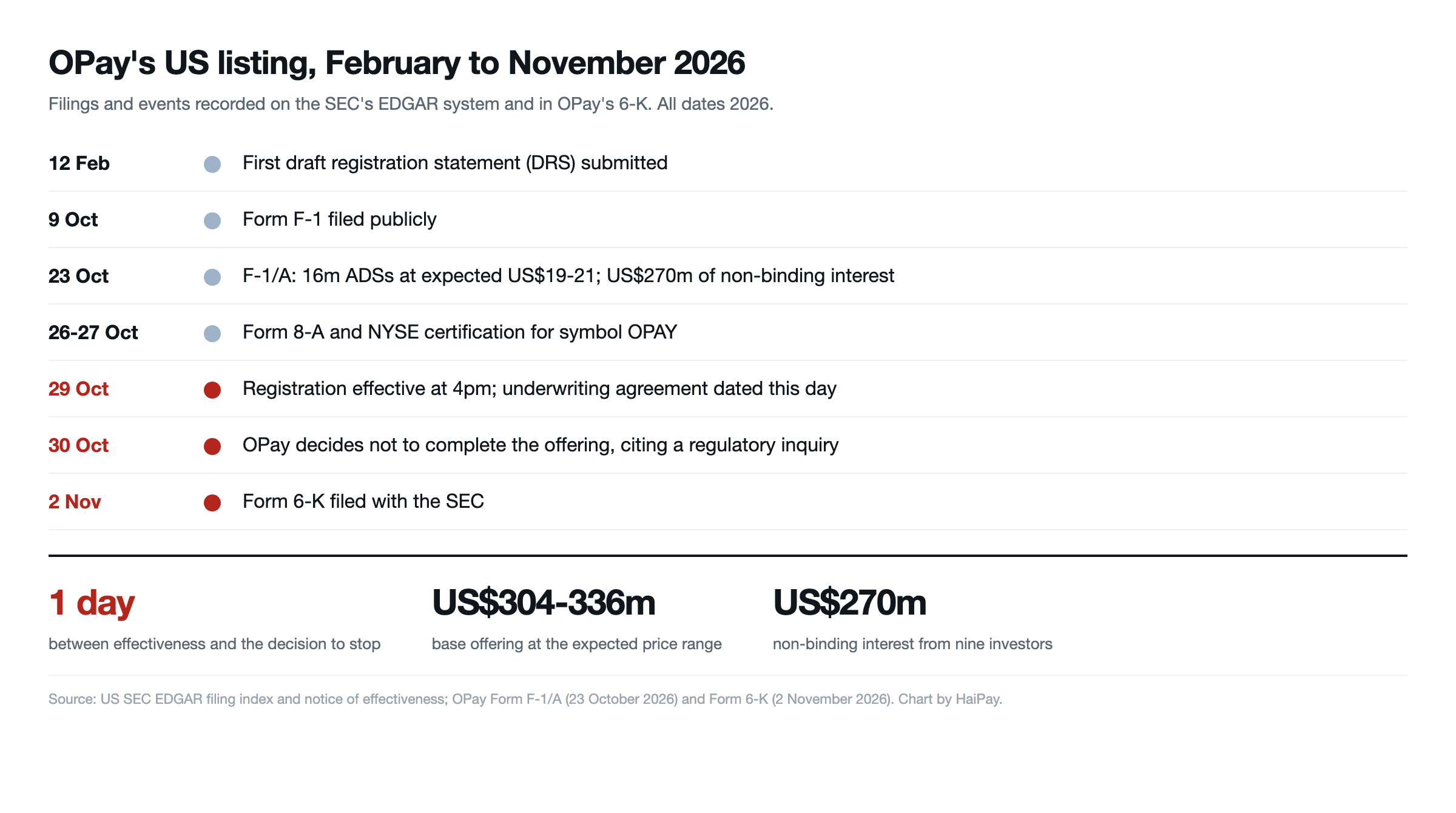
OPay Limited, a payments and lending app whose business is mostly in Nigeria, has called off its planned listing on the New York Stock Exchange a day after its US registration took effect. In a Form 6-K filed with the US Securities and Exchange Commission on 2 November, the Singapore-headquartered company said it decided on 30 October not to complete the offering "following a recent regulatory inquiry relating to a jurisdiction immaterial to the Company's business operations".
The SEC's records show OPay's registration statement became effective at 4pm on 29 October, and the underwriting agreement OPay signed with its banks is dated the same day. It and the underwriters agreed to terminate that agreement on 30 October, and its American depositary shares (ADSs) will not start trading. OPay did not name the jurisdiction or describe the inquiry.
What the prospectus showed
OPay planned to sell 16 million ADSs at an expected US$19 to US$21 each, or US$304 million to US$336 million before any over-allotment. Nine investors had indicated non-binding interest in buying up to US$270 million of them, and Stanbic Africa Holdings, a member of Standard Bank Group, had agreed to buy up to US$200 million of shares in a private placement alongside the offering.
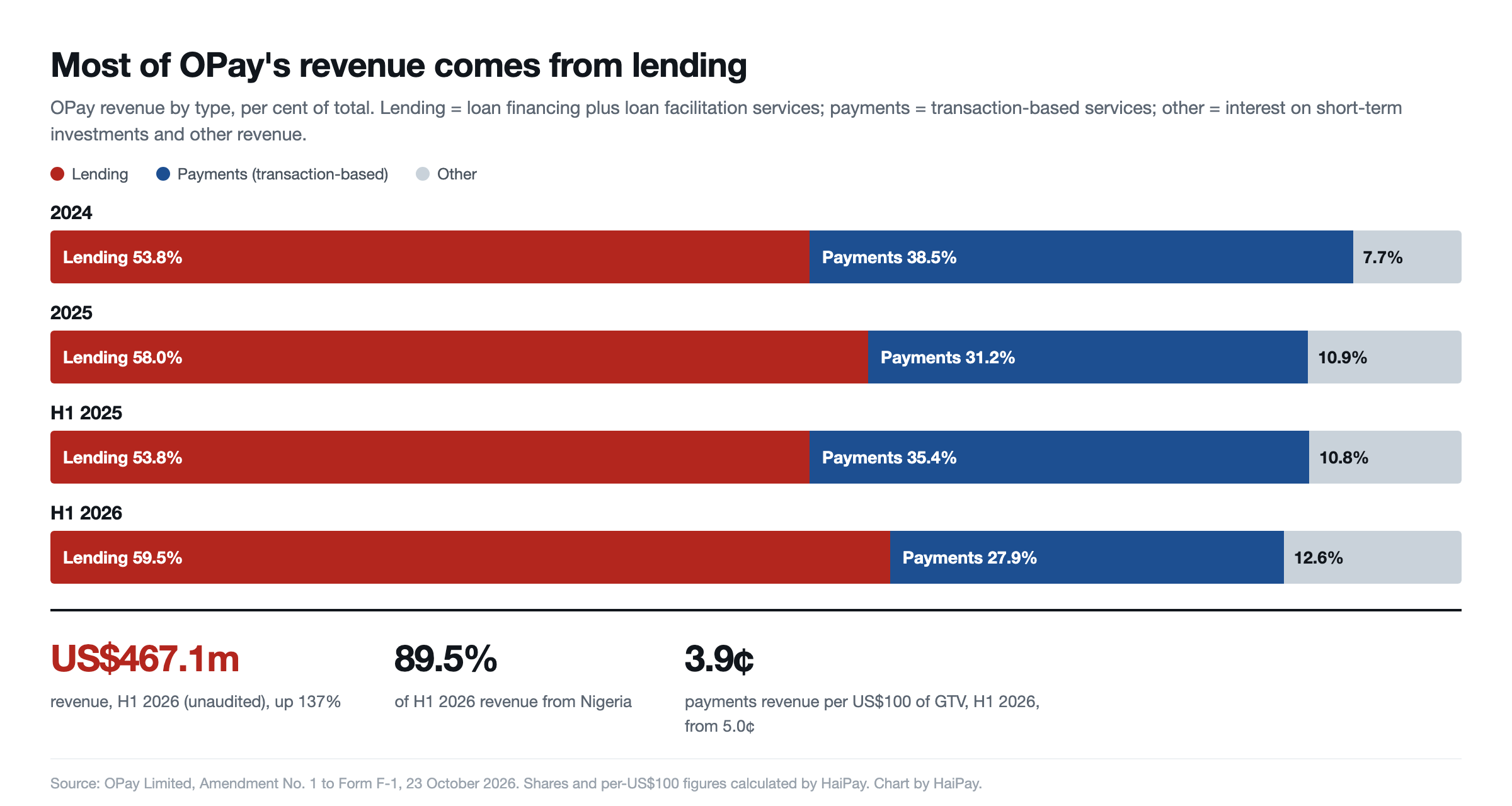
The filing shows OPay as much a lender as a payments company. Loan financing and loan facilitation services brought in 59.5% of its US$467.1 million of revenue in the first half of 2026, up from 53.8% in 2024, by HaiPay's count. Fees from payments, which OPay calls transaction-based services, fell to 27.9% from 38.5%. Nigeria provided 89.5% of revenue.
Payments volume grew faster than payments revenue
The gross transaction value (GTV) on OPay's platform rose 143% to US$339.1 billion in the first half of 2026, while transaction-based revenue rose 87% to US$130.6 million. By HaiPay's calculation, that is about 3.9 cents of transaction revenue for every US$100 of GTV, down from 5.0 cents a year earlier. Net income was US$90.9 million in the half, against US$21.7 million a year before.
What this does not show
The filings do not say what the regulatory inquiry concerns or which country it relates to. The figures for the first half of 2026 are unaudited, and the prospectus does not say that GTV and transaction revenue are measured on the same basis, so the per-US$100 figure is approximate. No final offering price was filed. HaiPay did not contact OPay.
What to watch
Whether OPay asks the SEC to withdraw its registration statement or tries to list again once the inquiry ends.
Whether the company or a regulator says which jurisdiction is involved.
And whether Stanbic's planned investment, which depended on the offering, goes ahead in another form.
About HaiPay's payouts to Nigeria and Egypt
HaiPay, which publishes this news section, offers mass payouts to bank accounts and e-wallets through a single API, with batch uploads, automatic currency conversion and AML and KYC checks. Its payout table lists First Bank, Access Bank, Zenith Bank, GTBank and UBA for Nigeria, and OPay among the destinations for Egypt. Learn more about HaiPay's mass payouts.
Data highlight
59.5 %
Share of OPay's revenue from loan financing and loan facilitation services, six months to 30 June 2026
January-June 2026
In OPay's Amendment No. 1 to Form F-1 (23 October 2026), loan financing services revenue was US$236,115 thousand and loan facilitation services US$41,567 thousand in the six months to 30 June 2026 (unaudited), out of total revenue of US$467,060 thousand: 50.6% plus 8.9%, or 59.5%. In 2024 the same two lines were 53.8% of US$205,731 thousand.
Data as of 3 November 2026 · UTC
Methodology and limitations
Compiled by HaiPay on 3 November 2026 from OPay Limited's filings with the U.S. Securities and Exchange Commission: the Form 6-K announcing the termination of its offering, Amendment No. 1 to its Form F-1 registration statement of 23 October 2026, the SEC's notice of effectiveness and the company's EDGAR filing list. Lending revenue is the sum of the loan financing services and loan facilitation services lines in the prospectus revenue table; percentages are as reported or calculated from the reported US dollar figures. Transaction-based revenue per US$100 of gross transaction value (GTV) is transaction-based services revenue divided by GTV for the same period; the prospectus does not state that GTV and transaction-based revenue are defined on the same basis, so this ratio is approximate. The base offering size is 16 million ADSs multiplied by the expected price range; no final price was filed. Figures for the six months to June are unaudited. The prospectus does not say what the regulatory inquiry concerns, and the 6-K does not name the jurisdiction. HaiPay did not contact OPay.
Data and research materials
- OPay revenue by type and market, GTV and net income, 2024 to H1 2026, from its F-1/A (HaiPay) ↓CSV · 1 KB
Four rows (2024, 2025, and the six months to June 2025 and 2026) compiled by HaiPay on 3 November 2026 from OPay Limited's Amendment No. 1 to Form F-1 filed with the US SEC on 23 October 2026. Columns: revenue by type in US$ thousands, total revenue, lending and transaction-based shares, Nigeria revenue and share, gross transaction value in US$ billions, transaction-based revenue per US$100 of GTV in cents (HaiPay calculation), and net income. Half-year figures are unaudited.
HaiPay's charts and the CSV table on this page may be reused with attribution to HaiPay and a link to this article. The underlying figures are from OPay's SEC filings; the shares and per-US$100 figures are HaiPay's calculations.
Term definition
- Form 6-K
- A report a foreign private issuer files with the US SEC to disclose information it makes public in its home market or to its investors.
- Notice of effectiveness
- The SEC's record that a registration statement has become effective, after which the registered securities may be sold.
- Gross transaction value (GTV)
- The total value of transactions processed on a platform in a period, before fees.
4 sources
- U.S. Securities and Exchange Commission
OPay Limited Form 6-K, Exhibit 99.1: Termination of Previously Announced Initial Public Offering
Form 6-K dated 30 October 2026, filed 2 November 2026: on 30 October OPay decided not to complete its initial public offering following a recent regulatory inquiry relating to a jurisdiction the company calls immaterial to its business operations; the company and underwriters agreed to terminate the underwriting agreement dated 29 October 2026; the ADSs will not commence trading on the NYSE.
Accessed 3 November 2026 · UTC
- U.S. Securities and Exchange Commission
OPay Limited Amendment No. 1 to Form F-1 Registration Statement
Amendment No. 1 to Form F-1 filed 23 October 2026: 16,000,000 ADSs offered at an expected US$19.00-21.00 each (up to 2,400,000 more on over-allotment), each ADS representing ten ordinary shares, NYSE symbol OPAY; nine investors indicated non-binding interest of up to US$270 million in aggregate; concurrent private placement by Stanbic Africa Holdings of up to US$200 million; revenue by type and by market for 2024, 2025 and the six months to June 2025 and 2026; GTV of US$166.2 billion (2024), US$358.0 billion (2025), US$139.3 billion and US$339.1 billion (six months to June 2025 and 2026); representatives of the underwriters Citigroup Global Markets, Deutsche Bank AG Hong Kong Branch, The Standard Bank of South Africa and CICC Hong Kong Securities.
Accessed 3 November 2026 · UTC
- U.S. Securities and Exchange Commission
Notice of Effectiveness, OPay Limited Form F-1 (File No. 333-299385)
SEC notice of effectiveness for registration statement 333-299385: effective 29 October 2026 at 16:00.
Accessed 3 November 2026 · UTC
- U.S. Securities and Exchange Commission
EDGAR filing index for OPay Limited (CIK 0002103076)
OPay's EDGAR filing list, read 3 November 2026: draft registration statement first submitted 12 February 2026; Form F-1 filed 9 October; amendment 23 October; Form 8-A12B 26 October; NYSE certification 27 October; effectiveness 29 October; Form 6-K 2 November. No final prospectus (Form 424B4) or withdrawal request (Form RW) was listed.
Accessed 3 November 2026 · UTC
How to cite
HaiPay News, "OPay Halts NYSE IPO; Lending Was 60% of Its Revenue", https://www.haipay.net/news/opay-ipo-terminated-lending-revenue-share-2026, 3 November 2026