NewsDigital Wallets
Chime's Payments Revenue Share Falls to 62% as MyPay Grows
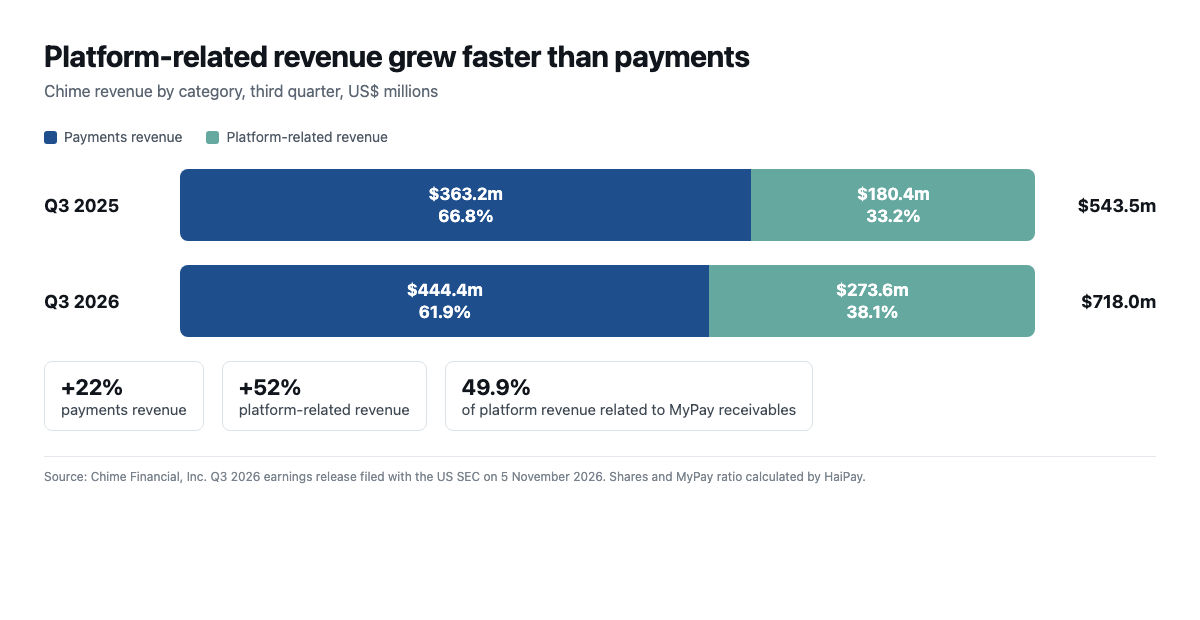
Payments revenue made up 61.9% of Chime's total revenue in Q3 2026, down from 66.8% a year earlier, while revenue related to MyPay receivables reached nearly half of platform-related revenue, by HaiPay's calculation.
Key takeaways 6
- Payments produced 61.9% of Chime revenue in Q3 2026, down from 66.8% a year earlier.
- Payments revenue grew 22% to US$444.4m; platform-related revenue grew 52% to US$273.6m.
- US$136.4m related to MyPay receivables was 49.9% of platform revenue, by HaiPay's count.
- Payments revenue was about US$1.15 per US$100 of Purchase Volume, up from roughly US$1.12.
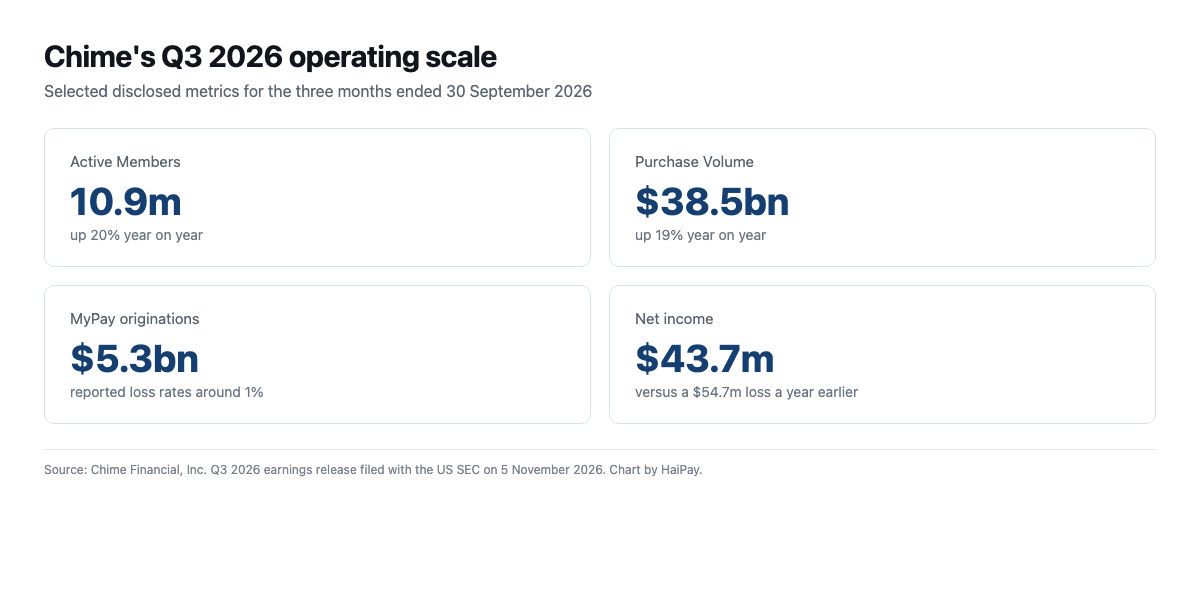
- MyPay originations reached US$5.3bn; Chime said loss rates were around 1%.
- Credit cards rose to 29% of Purchase Volume from 16%; credit interchange revenue rose US$83.3m.
Chime generated US$444.4 million of payments revenue in the third quarter of 2026, equal to 61.9% of its US$718.0 million total revenue. The share was 66.8% a year earlier, a fall of 4.9 percentage points, by HaiPay's calculation from the company's SEC filings.
Payments revenue grew 22% from a year earlier, while platform-related revenue rose 52% to US$273.6 million, faster than both payments and total revenue. Chime said US$136.4 million of that platform revenue was related to MyPay receivables — 49.9% of the category and 19.0% of total revenue.
Payments revenue rose with purchase volume
Purchase Volume rose 19% to US$38.478 billion. That puts payments revenue at about US$1.15 for every US$100 of purchase volume, against US$1.12 a year earlier, using the directly disclosed volumes for both periods.
Chime defines payments revenue mainly as interchange earned when members use branded debit and credit cards. Credit cards rose to 29% of Purchase Volume from 16%, and Chime said credit-card interchange revenue increased by US$83.3 million. That mix provides context for the higher revenue per US$100, but the filing does not isolate a single cause. Active Members rose 20% to 10.9 million and ARPAM rose 10% to US$270.
MyPay changed the revenue mix
MyPay lets eligible members access part of their pay before payday. Chime reported US$5.3 billion of MyPay originations in the quarter, an annualised revenue run rate above US$500 million and transaction profit of US$80 million. It said loss rates were around 1%. Of the US$93.2 million increase in platform-related revenue, Chime attributed US$48.0 million to MyPay, US$20.9 million to Instant Loans and US$15.6 million to outbound instant transfer fees.
Instant Loans originations were US$381 million, and Chime said more than 20% of Active Members had used the product. Transaction and risk losses rose by US$18.6 million from a year earlier, including increases of US$16.1 million from Instant Loans and US$8.8 million from MyPay, partly offset by US$7.4 million fewer losses from transaction disputes.
Other developments
Chime recorded net income of US$43.7 million, against a US$54.7 million loss a year earlier. It also agreed to buy Stride Bank for US$590 million in cash. The deal requires approvals from the Office of the Comptroller of the Currency and the Federal Reserve, and Chime expects it to close in the first half of 2027.
The company also announced a restructuring affecting about 9% of its workforce and expected US$17.1 million of net cash charges. It said the reduction was intended to shift resources towards priority areas; the filings do not quantify future savings.
What this does not show
The US$136.4 million is revenue related to MyPay receivables, not a full profit measure for MyPay. Chime does not break out all direct funding, servicing and credit costs by product. Its payments and platform categories are revenue lines, not separate operating segments. The company is a financial-technology company, not a bank; banking services are provided by partner banks.
What to watch
The next points to watch are whether payments revenue continues to grow more slowly than platform-related revenue, whether MyPay loss rates remain around 1% as originations expand, and whether the Stride Bank acquisition receives regulatory approval on Chime's timetable.
About HaiPay's virtual cards
HaiPay, which publishes this news section, offers US dollar virtual cards on Visa or Mastercard from programmes in the United States, Hong Kong and Singapore, described for advertising spend, AI subscriptions and API credits. The cards carry 3-D Secure and billing-address (AVS) verification. Each card can have its own spending limit, and merchant and merchant-category locks can be set in the dashboard or through a card issuing API. Which programme fits depends on the business, the merchant and where the transaction takes place. Learn more about HaiPay's virtual cards.
Data highlight
61.9 % of total revenue
Payments revenue as a share of Chime total revenue in the third quarter of 2026
July-September 2026
Chime payments revenue of US$444.434 million divided by total revenue of US$718.001 million in Q3 2026 equals 61.9%. The same calculation for Q3 2025 is US$363.156 million divided by US$543.519 million, or 66.8%, a decline of 4.9 percentage points using unrounded figures. HaiPay's calculation from Chime's SEC-filed earnings release; figures are unaudited.
Data as of 12 November 2026 · UTC
Methodology and limitations
Compiled by HaiPay on 12 November 2026 from Chime Financial, Inc.'s third-quarter 2026 earnings release filed with the US Securities and Exchange Commission on 4 November 2026 and Form 10-Q filed on 5 November 2026. Payments share divides payments revenue by total revenue. Platform share uses the same denominator. MyPay-associated share divides the US$136.4 million that Chime said was related to MyPay receivables by platform-related revenue. Payments revenue per US$100 divides payments revenue by Purchase Volume. Purchase Volume of US$38.478 billion for Q3 2026 and US$32.305 billion for Q3 2025 comes directly from the Form 10-Q. Revenue shares and ratios are HaiPay's calculations. Figures are unaudited. HaiPay did not contact Chime.
Data and research materials
- Chime revenue mix, Purchase Volume and MyPay calculations, Q3 2026 and Q3 2025 (HaiPay) ↓CSV · 2 KB
13 rows compiled by HaiPay on 12 November 2026 from Chime Financial, Inc.'s third-quarter 2026 earnings release and Form 10-Q filed with the SEC. Columns show reported total, payments and platform-related revenue, MyPay-related revenue, Purchase Volume, Active Members and net income, plus HaiPay-calculated revenue shares and payments revenue per US$100 of Purchase Volume. Purchase Volume and Active Members for both periods are directly disclosed in the Form 10-Q.
HaiPay's charts and CSV table may be reused with attribution to HaiPay and a link to this article. The reported figures are from Chime's SEC filings; revenue shares and ratios are HaiPay's calculations.
Term definition
- Payments revenue
- Revenue Chime earns mainly from interchange when members use Chime-branded debit and credit cards.
- Platform-related revenue
- Chime's revenue category for products and services outside payments, including revenue related to MyPay receivables.
- MyPay
- A Chime product that allows eligible members to access part of their pay before payday, subject to the product's terms.
- Purchase Volume
- The dollar value of purchases made with Chime-branded debit and credit cards during the period.
4 sources
- U.S. Securities and Exchange Commission
Chime Reports Third Quarter 2026 Financial Results
Dated and filed 4 November 2026: total, payments and platform-related revenue; US$136.4 million related to MyPay receivables; Active Members, ARPAM, MyPay and Instant Loans originations, loss-rate commentary, net income and the Stride Bank transaction.
Accessed 12 November 2026 · UTC
- U.S. Securities and Exchange Commission
Chime Financial, Inc. Form 10-Q for the quarter ended September 30, 2026
Quarter ended 30 September 2026: revenue definitions and disaggregation; payments costs; transaction and risk losses; restructuring charge; bank-partner and processing costs; unaudited financial statements.
Accessed 12 November 2026 · UTC
- U.S. Securities and Exchange Commission
EDGAR filing index for Chime Financial, Inc. Form 8-K
Filed 4 November 2026, accession 0001795586-26-000052. Used to confirm the earnings-release filing date and attached Exhibit 99.1.
Accessed 12 November 2026 · UTC
- Reuters
Chime shares jump as Stride deal puts fintech on path to bank charter
Independent Reuters report dated 9 September 2026 on Chime's agreed US$590 million acquisition of Stride Bank and the bank-charter implications; accessed through Reuters syndication on Investing.com.
Accessed 12 November 2026 · UTC
How to cite
HaiPay News, "Chime's Payments Revenue Share Falls to 62% as MyPay Grows", https://www.haipay.net/news/chime-q3-2026-payments-revenue-share-mypay, 12 November 2026