NewsFraud & Risk
Magento Got 21 Days to Patch Last Year. Now It Gets Three.
In October 2025 the United States added a flaw in Adobe Commerce to its list of vulnerabilities known to be under active attack, and gave federal agencies twenty-one days to fix it.

Key takeaways 6
- CISA's median remediation window held at 21 days for four years, then fell to 3 days in 2026.
- The last 21-day deadline anywhere in the catalogue was added on 5 March 2026.
- Of 134 entries added since 1 June 2026, 106 carry a 3-day window and 28 carry 14; none carries 21.
- Adobe Commerce and Magento have appeared five times; the windows run 14 days, 21, 21, 3 and 3.
- The two 3-day Magento entries came sixteen days apart in September 2026, eleven months after a 21-day one.
- The deadlines bind US federal civilian agencies only. No merchant or payment firm is covered by them.
In October 2025 the United States added a flaw in Adobe Commerce to its list of vulnerabilities known to be under active attack, and gave federal agencies twenty-one days to fix it.
In September 2026 it added two more. Each came with a three-day deadline.
Four years of twenty-one days
CISA's Catalog of Known Exploited Vulnerabilities is a list of software flaws that someone has been caught exploiting in the wild. It now holds 1,741 entries. Every one carries the date it was added and the date by which federal civilian agencies must have remediated it.
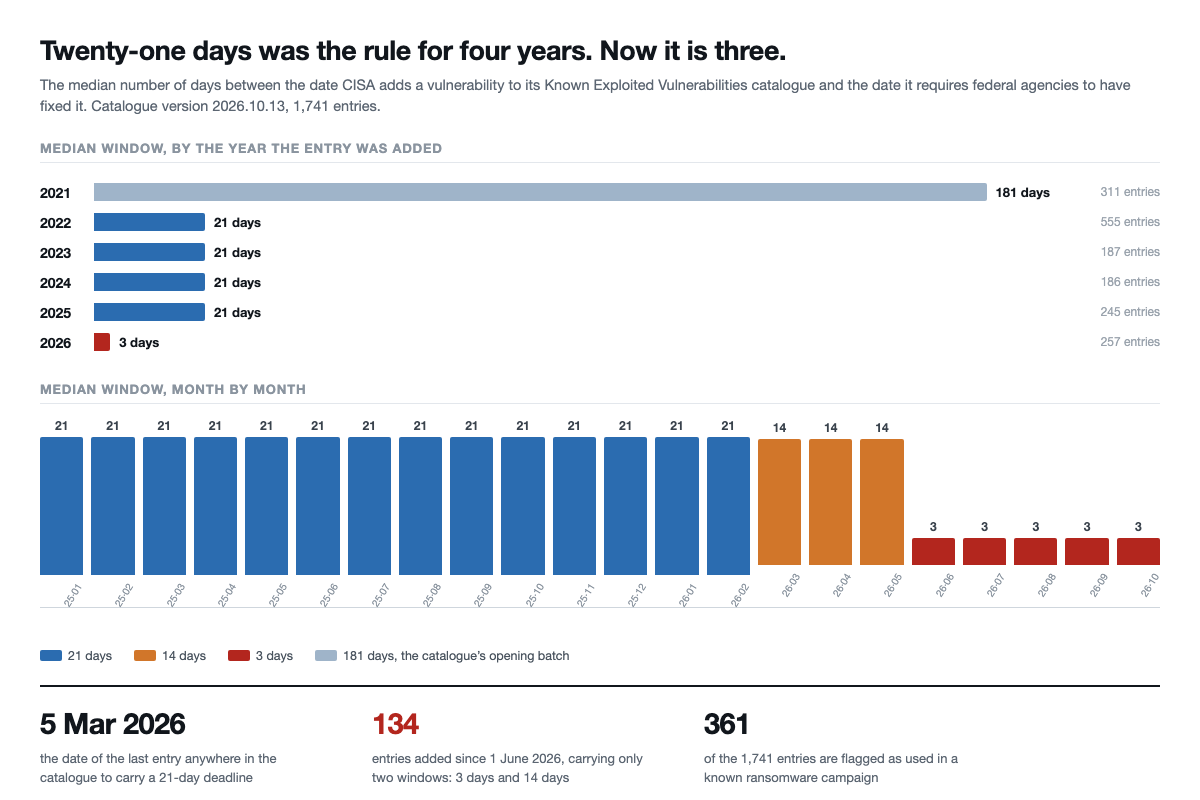
Subtract one from the other and you get the window. For four years it barely moved. The median was 21 days in 2022, 21 in 2023, 21 in 2024 and 21 in 2025 — 1,173 entries across those four years, and 21 days is the most common window on 1,025 of the catalogue's entries overall.
In 2026 the median is 3.
Two steps, not one
Month by month the change comes in two moves rather than a single announcement.
The median holds at 21 days every month from January 2025 through February 2026. In March, April and May 2026 it is 14. From June 2026 onward it is 3, in every month including the eleven entries added so far in October.
The last entry anywhere in the catalogue to carry a 21-day deadline was added on 5 March 2026. The first three-day deadline arrived earlier, on 27 January 2026, against a Fortinet flaw, but it was an outlier for four months before it became the rule.
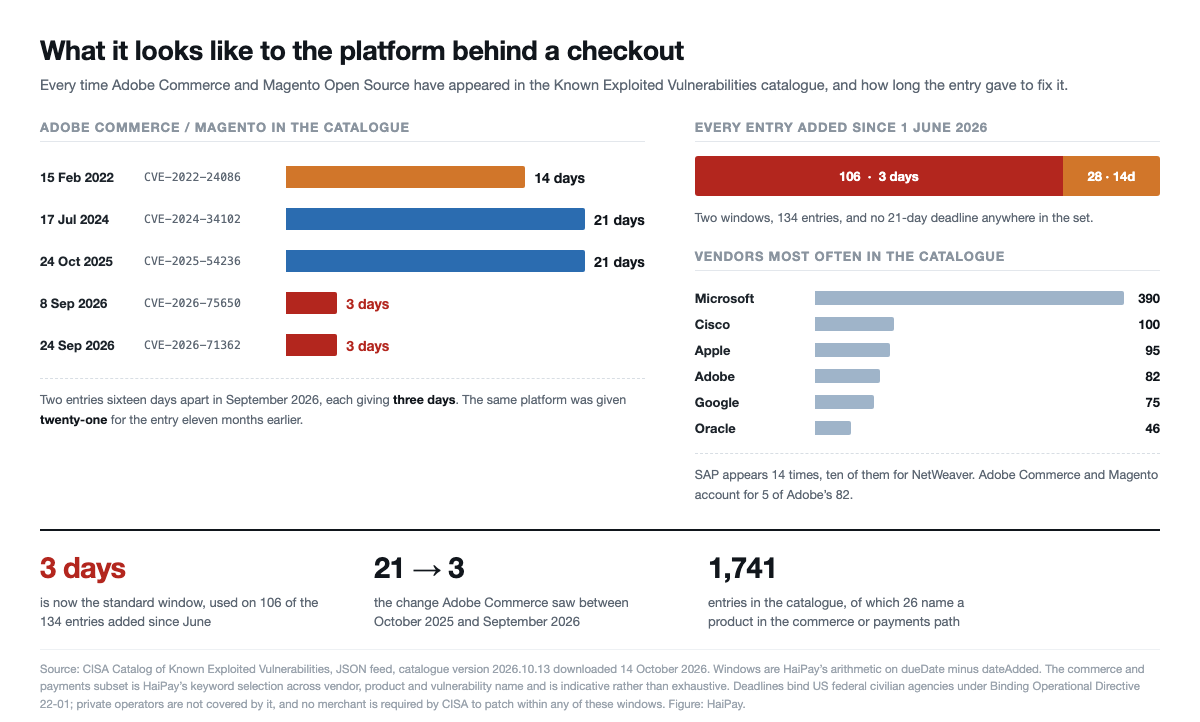
Of the 134 entries added since 1 June 2026, 106 carry three days and 28 carry fourteen. Not one carries twenty-one.
What that looks like from a checkout
Adobe Commerce and Magento Open Source have appeared in the catalogue five times. The windows they were given run 14 days, 21, 21, 3, 3.
The two three-day entries came sixteen days apart in September 2026. The twenty-one-day entry before them was eleven months earlier.
SAP appears fourteen times, ten of those for NetWeaver. Adobe appears eighty-two times in total; Flash Player is thirty-three of them and ColdFusion sixteen, which is a reminder that most of this catalogue is not about commerce at all. Twenty-six of the 1,741 entries name something in the commerce or payments path on HaiPay's reading, and that reading is indicative rather than exhaustive.
Who this actually binds
It is worth being blunt about this, because the number is easy to misread. These deadlines bind United States federal civilian agencies under Binding Operational Directive 22-01. They do not bind merchants, acquirers, gateways or anyone else.
What they do is set a public, dated expectation of how fast a known-exploited flaw ought to be closed, published by a government that can see incident reporting the rest of us cannot. Card scheme rules, insurers, enterprise customers and procurement questionnaires have all tended to converge on whatever that number is.
Which is why a change from twenty-one days to three is worth noticing even if you have no federal obligation at all. The benchmark moved by a factor of seven, and it moved without most of the industry's patch cycles moving with it.
Why this matters
A three-day window is shorter than a lot of change-freeze policies. It is shorter than many merchants' regression test cycles. For a platform like Adobe Commerce, which sits directly in the checkout path and is typically customised, three days from disclosure to patched-in-production is a demanding target and an honest one to plan against.
The practical question is not whether you are legally covered by the directive. It is whether, if a flaw in your commerce platform appeared on that list tomorrow, you could be patched by Friday. The catalogue has made that question measurable, and it has quietly made the answer harder.
What this is not
This is not a measurement of how fast anyone actually patches. The catalogue records deadlines set by CISA, not remediation that occurred. No completion data is published, and none is implied here.
The deadlines apply to US federal civilian agencies only. No merchant or payment firm is required by CISA to patch within any of these windows.
The 2021 median of 181 days reflects the catalogue's opening batch, which carried one distant deadline for a large backlog of older flaws. It was not a policy of six-month windows, and it is shown separately for that reason.
The commerce and payments subset of 26 entries comes from HaiPay's keyword selection across vendor, product and vulnerability name. It is indicative, not exhaustive, and a different keyword list would return a different number.
The catalogue is amended continuously. These are the figures in version 2026.10.13, released on 13 October and downloaded on 14 October 2026. HaiPay did not contact CISA or any vendor named here.
What to watch
Whether three days holds or compresses further. Six entries in the catalogue's history have carried a one-day deadline, all of them in 2025, against Citrix, Microsoft and Cisco products.
Whether fourteen days survives as the softer tier. Twenty-eight of the 134 entries since June still carry it, which suggests CISA is grading severity rather than applying one rule to everything.
And whether anything in the payments stack lands on the list next. Five Adobe Commerce entries in four years is not a pattern yet. A sixth, with a three-day window, would start to be one.
Data highlight
3 days
Median remediation window on entries added to the CISA Known Exploited Vulnerabilities catalogue in 2026, against 21 days in each of the four preceding years
Catalogue version 2026.10.13
Read the methodology and limitations
Methodology and limitations
Compiled by HaiPay on 14 October 2026 from the Cybersecurity and Infrastructure Security Agency's Catalog of Known Exploited Vulnerabilities, downloaded in full as JSON from cisa.gov. The file identifies itself as catalogue version 2026.10.13, released 13 October 2026, and contains 1,741 entries. Each entry carries, among other fields, the vendor, the product, the CVE identifier, the date CISA added it, the date by which federal civilian agencies must have remediated it, and a flag for known use in ransomware campaigns.
The remediation window used throughout this article is HaiPay's arithmetic: the due date minus the date added, for every entry that carries both. Grouped by the year an entry was added, the median window is 181 days across 311 entries in 2021, 21 days across 555 in 2022, 21 across 187 in 2023, 21 across 186 in 2024, 21 across 245 in 2025 and 3 days across 257 in 2026.
The 2021 figure reflects the catalogue's opening batch of 3 November 2021, which carried a single distant deadline for a large backlog, and should not be read as a policy of six-month windows. Month by month the change is two steps rather than one: the median is 21 days in every month from January 2025 through February 2026, 14 days in March, April and May 2026, and 3 days in every month from June 2026 through the 11 entries added so far in October.
Across the whole catalogue the four most common windows are 21 days on 1,025 entries, 14 days on 277, 181 days on 238 and 3 days on 132. The last entry anywhere in the catalogue to carry a 21-day deadline was added on 5 March 2026. The first 3-day deadline was added on 27 January 2026, against a Fortinet entry, CVE-2026-24858. Of the 134 entries added on or after 1 June 2026, 106 carry a 3-day window and 28 carry 14 days; no 21-day window appears among them.
The shortest windows in the catalogue's history are six entries carrying a single day, all added in 2025: two Citrix NetScaler entries, three Microsoft SharePoint entries and two Cisco Secure Firewall entries. On the commerce side, HaiPay selected entries whose vendor, product or vulnerability name matches a keyword list covering commerce platforms, payment terms and enterprise order-to-cash software; that selection returns 26 of the 1,741 entries and is indicative rather than exhaustive.
Adobe Commerce and Magento Open Source account for five of them: CVE-2022-24086 added 15 February 2022 with a 14-day window, CVE-2024-34102 added 17 July 2024 with 21 days, CVE-2025-54236 added 24 October 2025 with 21 days, and CVE-2026-75650 and CVE-2026-71362 added on 8 and 24 September 2026 with 3 days each. SAP appears 14 times in the catalogue, ten of those for NetWeaver, and Adobe 82 times in total, of which Flash Player is 33 and ColdFusion 16.
Across all 1,741 entries, 361 are flagged as used in a known ransomware campaign and 81 carry a forensic triage flag. Every count, median and window above is HaiPay's arithmetic on the catalogue file; CISA publishes the entries and none of these derived figures. Two limits apply throughout. The deadlines bind United States federal civilian executive branch agencies under Binding Operational Directive 22-01; private operators, including every merchant and payment firm, are not subject to them, and nothing in this article says otherwise.
And the catalogue is amended continuously, so this is a single reading of the file published on 13 October 2026. HaiPay did not contact CISA or any vendor named here.
Term definition
- Known Exploited Vulnerabilities catalogue
- CISA's list of software flaws confirmed to be under active exploitation. It holds 1,741 entries and each carries a date added and a remediation due date for US federal civilian agencies.
- Remediation window
- The gap between the date CISA adds an entry and the date it requires the fix to be in place. It is not published as a field; it is the subtraction of the two dates the catalogue does publish.
- Binding Operational Directive 22-01
- The 2021 directive that makes the catalogue's deadlines mandatory for United States federal civilian executive branch agencies. It does not apply to private operators.
3 sources
- Cybersecurity and Infrastructure Security Agency
- Cybersecurity and Infrastructure Security Agency
- Cybersecurity and Infrastructure Security Agency
How to cite
HaiPay News, "Magento Got 21 Days to Patch Last Year. Now It Gets Three.", https://www.haipay.net/news/kev-patch-deadline-three-days, 14 October 2026