NewsFraud & Risk
Cash App Gave Money Back Three Times in 10,178 Complaints.
Between October last year and this week, Americans filed 39,455 complaints with their federal consumer regulator about money transfers, wallets and virtual currency.
Key takeaways 6
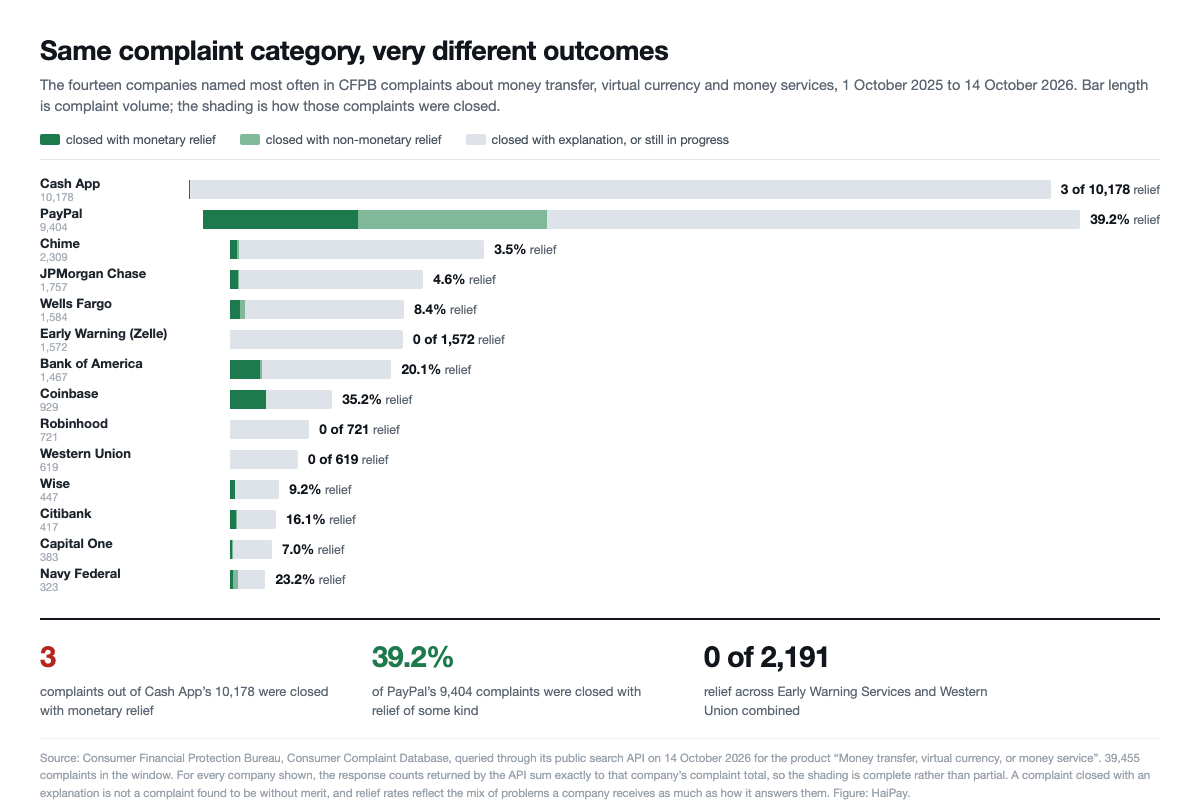
- Block, which runs Cash App, received 10,178 of these complaints and closed three with monetary relief.
- PayPal received 9,404 and closed 39.2% with relief — 1,661 monetary and 2,027 non-monetary.
- Early Warning Services, which operates Zelle, closed all 1,572 of its complaints with an explanation and no relief.
- Western Union closed all 619 the same way; Robinhood closed 712 of 721 with 9 still in progress.
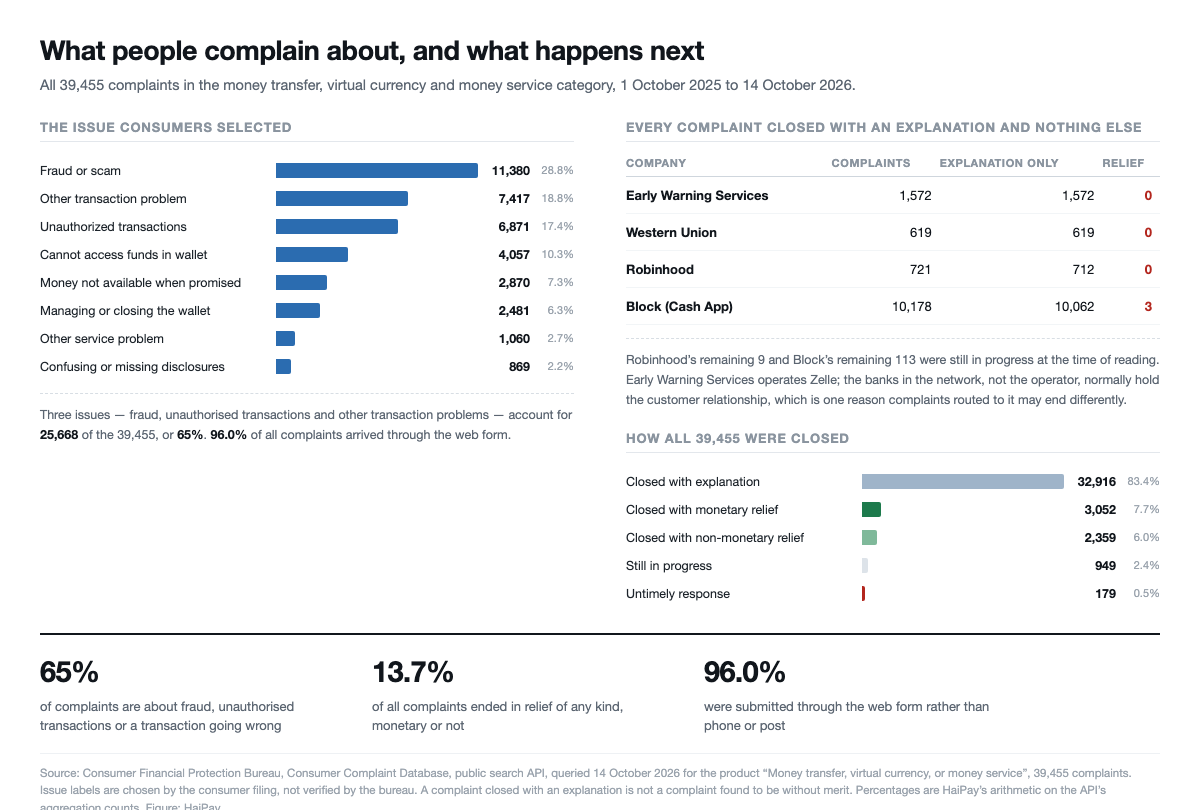
- Across all 39,455 complaints, 7.7% ended in monetary relief and 13.7% in relief of any kind.
- Fraud or scam is the largest single issue at 11,380 complaints, 28.8% of the category.
Between October last year and this week, Americans filed 39,455 complaints with their federal consumer regulator about money transfers, wallets and virtual currency.
Block, which runs Cash App, received 10,178 of them. Three were closed with money going back to the customer.
The same category, very different answers
The Consumer Financial Protection Bureau publishes every complaint it forwards to a company, along with how that company closed it. The closure types are narrow: an explanation, non-monetary relief, monetary relief, or still in progress.
PayPal received 9,404 complaints in this category, almost as many as Block. It closed 1,661 with monetary relief and 2,027 with non-monetary relief — 39.2% ended in relief of some kind.
Coinbase closed 35.2% of its 929 with relief. Bank of America, 20.1% of 1,467. Citibank, 16.1%. Wise, 9.2%. Chime, 3.5% of 2,309.
Block closed 10,062 of its 10,178 with an explanation, had 113 still in progress, and gave monetary relief three times.
Three companies at zero
Early Warning Services, which operates the Zelle network, received 1,572 complaints. All 1,572 were closed with an explanation. Not one carries relief of any kind, and none was still in progress at the time of reading.
The Western Union Company received 619. All 619 closed with an explanation.
Robinhood received 721 and closed 712 with an explanation, with 9 outstanding.
Before this is read as a verdict, the arithmetic needs a check that is easy to skip: are those zeroes real, or is the data simply incomplete for those firms? For every company above, the response-type counts returned by the API add up exactly to that company's complaint total. Nothing is missing. The zeroes are zeroes.
What the zeroes do not mean
They do not mean the complaints were meritless. The bureau does not verify what a consumer writes, and a complaint closed with an explanation may be one the company had already resolved, or one about a problem it is not the party able to fix.
They also do not mean these companies are worse at handling problems. A relief rate reflects what kind of complaints a firm receives as much as how it answers them. A company whose inbox is dominated by scam reports — where the customer authorised the payment and the firm is not the party at fault — will show a low rate for structural reasons.
Early Warning Services is the clearest case. It runs the Zelle network; the banks inside that network hold the customer relationship and the accounts. A complaint routed to the network operator rather than the bank has a different set of available outcomes before anyone reads it.
What the numbers do show is that firms in the same regulatory category, answering complaints with the same four labels, are landing in very different places. That is worth knowing whichever way the explanation runs.
What people are actually complaining about
Fraud or scam is the single largest issue at 11,380 complaints, 28.8% of the total. Add other transaction problems at 7,417 and unauthorised transactions at 6,871 and the three together are 65% of everything filed.
Below those: 4,057 complaints about not being able to reach money already sitting in a wallet, 2,870 about money not arriving when promised, and 2,481 about opening, managing or closing a wallet account.
Across all 39,455, relief of any kind was the outcome 13.7% of the time. Monetary relief alone, 7.7%.
Why this matters
This is the only public, company-level record of what happens after a payment goes wrong in the United States. It is not a complete picture of complaint handling — most disputes never reach a regulator — but it is the part anyone can audit.
For a payments operator the useful read is not the league table. It is the structure underneath it. The firms at the top of this list are the ones holding the customer relationship for peer-to-peer transfers, and peer-to-peer transfers are where authorised-push-payment fraud lands. Two-thirds of these complaints are a transaction that went wrong, and the dominant single issue is a scam.
The second read is about where a complaint can actually be resolved. When the brand a consumer complains about is a network rather than their bank, the complaint arrives somewhere that may not be able to refund anything. That is a design feature of how these rails are organised, and it shows up cleanly in a public database.
What this is not
The bureau does not verify the facts of a complaint. Publication is not a finding against any company, and nothing here should be read as one.
Complaint volume is not a quality measure. It tracks customer numbers and transaction volumes before it tracks anything else, and no company in this list publishes figures that would let those be normalised here.
Issue labels are chosen by the consumer filing the complaint, not assigned by the bureau. "Fraud or scam" is what the person selected from a menu.
Company names are reproduced as the database records them. Block, Inc. is the entity behind Cash App; Early Warning Services, LLC operates Zelle; TransferWise Ltd is the entity Wise files under.
This is one reading, taken on 14 October 2026, of a database that is updated continuously. HaiPay did not contact the bureau or any company named here.
What to watch
Whether the 113 complaints in progress at Block change its figure. Three in 10,178 is a number with almost no room to move downward and a great deal of room to move up.
Whether Early Warning Services stays at zero. A single complaint closed with relief would be the first in 1,572.
And whether the scam share keeps rising. It is already the largest issue in the category, and it is the one where the gap between who receives the complaint and who can resolve it is widest.
Data highlight
3 of 10,178 complaints
Complaints about Block, Inc. in the CFPB money transfer category closed with monetary relief, out of 10,178 received in the year to 14 October 2026
Complaints received 1 October 2025 to 14 October 2026
Read the methodology and limitations
Methodology and limitations
Compiled by HaiPay on 14 October 2026 from the Consumer Financial Protection Bureau's Consumer Complaint Database, queried through its public search API at consumerfinance.gov. The query filtered to the product category "Money transfer, virtual currency, or money service" and to complaints received between 1 October 2025 and 14 October 2026, returning 39,455 complaints. The API refused requests carrying a custom user agent, so all queries were made with a standard browser user agent; no authentication is required and the data is public.
Company figures come from re-running the same query once per company, taking the company names exactly as the database records them.
The fourteen companies named most often are Block, Inc. with 10,178 complaints, Paypal Holdings, Inc with 9,404, Chime Financial Inc with 2,309, JPMorgan Chase with 1,757, Wells Fargo with 1,584, Early Warning Services, LLC with 1,572, Bank of America with 1,467, Coinbase, Inc. with 929, Robinhood Markets with 721, The Western Union Company with 619, TransferWise Ltd with 447, Citibank with 417, Capital One with 383 and Navy Federal Credit Union with 323.
HaiPay checked, for every company shown, that the response-type counts returned by the API sum exactly to that company's complaint total, so the outcome split is complete rather than partial; they do. Across all 39,455 complaints the closure types are 32,916 closed with an explanation, 3,052 closed with monetary relief, 2,359 closed with non-monetary relief, 949 still in progress and 179 recorded as an untimely response, and 38,674 are flagged as having received a timely response against 781 that are not.
Relief rates computed by HaiPay are 39.2 per cent of PayPal's complaints closed with relief of some kind (1,661 monetary and 2,027 non-monetary), 35.2 per cent of Coinbase's (325 monetary, 2 non-monetary), 23.2 per cent of Navy Federal's, 20.1 per cent of Bank of America's, 16.1 per cent of Citibank's, 9.2 per cent of TransferWise's, 8.4 per cent of Wells Fargo's, 7.0 per cent of Capital One's, 4.6 per cent of JPMorgan Chase's and 3.5 per cent of Chime's. Four companies sit apart.
Early Warning Services closed all 1,572 of its complaints with an explanation, with no relief of any kind and nothing in progress. The Western Union Company closed all 619 the same way. Robinhood closed 712 of 721 with an explanation and had 9 in progress. Block, Inc. closed 10,062 of 10,178 with an explanation, had 113 in progress and closed 3 with monetary relief.
By issue, as selected by the consumer filing rather than verified by the bureau, the largest categories are fraud or scam with 11,380 complaints, other transaction problem with 7,417, unauthorized transactions or other transaction problem with 6,871, trouble accessing funds in a mobile or digital wallet with 4,057, money not available when promised with 2,870 and managing, opening or closing a mobile wallet account with 2,481. The first three together are 25,668, or 65.1 per cent of the total.
By channel, 37,885 complaints arrived through the web form, 1,093 by phone, 294 by referral and 183 by post, so 96.0 per cent were filed on the web. Monthly volumes over the window are flat rather than trending, running between 2,707 and 4,247 with no sustained direction. Every percentage, sum and ratio above is HaiPay's arithmetic on the API's aggregation counts; the bureau publishes the counts and none of the derived figures. Four limits apply and matter.
The bureau does not verify the facts of a complaint, and publishing one is not a finding against the company. A complaint closed with an explanation is not a complaint found to be without merit: the company may have resolved the problem before the complaint was filed, or may not be the party able to resolve it.
A relief rate reflects the mix of problems a company receives as much as how it answers them, and a firm receiving a higher share of scam reports in which it is not the party at fault will show a lower rate for reasons that are not about its conduct. And Early Warning Services operates the Zelle network while the banks in that network normally hold the customer relationship, which is one structural reason complaints routed to the operator may close differently.
HaiPay did not contact the Consumer Financial Protection Bureau or any company named here.
Term definition
- Closed with explanation
- The most common outcome in the CFPB database: the company answered the complaint without providing money or any other remedy. It is not a finding that the complaint lacked merit, and it covers cases a company had already resolved.
- Monetary relief
- A closure type recording that the company returned money to the consumer. It accounts for 3,052 of the 39,455 complaints in this category, or 7.7 per cent.
- Consumer Complaint Database
- The CFPB's public record of complaints it forwards to companies, with the company's closure type attached. The bureau does not verify the facts a consumer submits, and publication is not a finding against the company.
5 sources
- Consumer Financial Protection Bureau
Consumer Complaint Database search API, money transfer category
- Consumer Financial Protection Bureau
- Consumer Financial Protection Bureau
Consumer Complaint Database search API, Early Warning Services
- Consumer Financial Protection Bureau
- Consumer Financial Protection Bureau
How to cite
HaiPay News, "Cash App Gave Money Back Three Times in 10,178 Complaints.", https://www.haipay.net/news/cfpb-money-transfer-complaint-outcomes, 14 October 2026