NewsRegulation
IRS May Now Run Card Tax Payments. Credit Fees Stay at 1.75%
A Treasury rule in force from 19 October 2026 lets the IRS contract directly for card payments of tax and pay the processor itself, provided it recoups every dollar from card payers. The IRS’s approved processors still charge at least 1.75% by credit card, a rate unchanged since early 2025 and down from 1.96% in January 2022.
Key takeaways 6
- A Treasury rule in force from 19 October 2026 lets the IRS contract for card tax payments and pay the processor fee itself.
- The IRS must recoup any such fee in full from card payers, and the fee cannot be refunded as tax.
- The lowest credit card fee on the IRS processor page is 1.75%, at Pay1040; ACI Payments charges 1.85%.
- In January 2022 three processors were listed and the lowest credit card fee was 1.96%.
- Fees at both remaining processors have not changed since early 2025, when payUSAtax left the list.
- On a $10,000 tax payment the card fee is $175 or $185, or $289 or $295 by commercial card.
A Treasury rule that took effect on 19 October 2026 lets the Internal Revenue Service contract directly for card payments of tax and pay the processing fee itself, as long as it recovers every dollar from the people paying by card.
For now, the fees taxpayers see have not changed. The IRS page listing approved card processors, last reviewed or updated on 14 October, still shows two companies, and the lowest credit card fee on it is 1.75%.
What the rule does
The rule implements a 2019 change in the Taxpayer First Act. Until now, the IRS could contract with card processors but was barred from paying them, so taxpayers who wanted to pay by card were sent to third-party processors that charge their own fee.
Under the final regulation, the IRS may pay a fee under such a contract but must recoup the full amount as a reimbursement fee added to the tax payment. That fee is not a tax and cannot be refunded as one. In negotiating, the IRS must seek to minimise the fees it pays.
The Treasury and the IRS adopted their July 2024 proposal without change. They received eight comments and cancelled the public hearing because no one asked to speak. The rule itself does not set up any payment process or sign any contract.
What card payers pay now
HaiPay read the IRS card payment page in 35 archived copies from January 2022 to October 2026, and live on 20 October.
In January 2022 the page listed three processors, and the lowest credit card fee was 1.96%. By February 2025 payUSAtax was gone; the page says it no longer accepts payments on behalf of the IRS. The two that remain cut their fees at the same point: Pay1040 to 1.75% and ACI Payments to 1.85%, each with a $2.50 minimum. Neither has changed since.
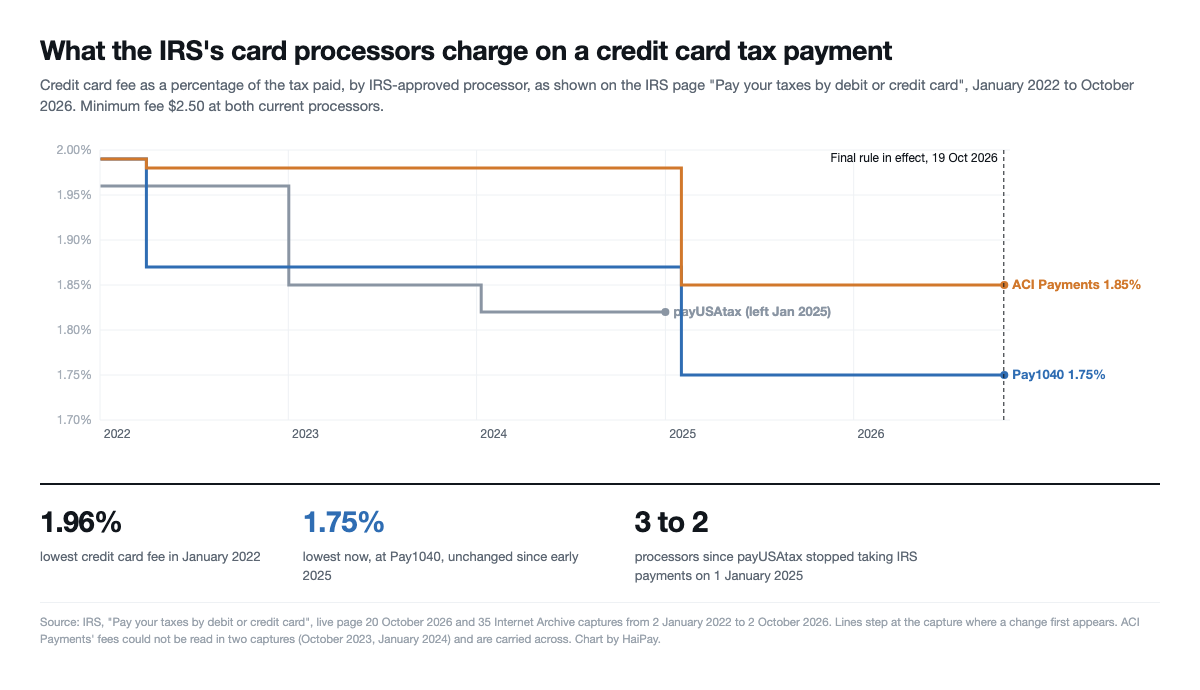
Caption: Credit card fee on a federal tax payment by IRS-approved processor, January 2022 to October 2026. Source: IRS card payment page and Internet Archive captures; chart by HaiPay.
Alt: Step line chart of credit card fees on federal tax payments at IRS-approved processors from 2022 to 2026, falling from between 1.96% and 1.99% in January 2022 to 1.75% at Pay1040 and 1.85% at ACI Payments, with payUSAtax leaving in January 2025
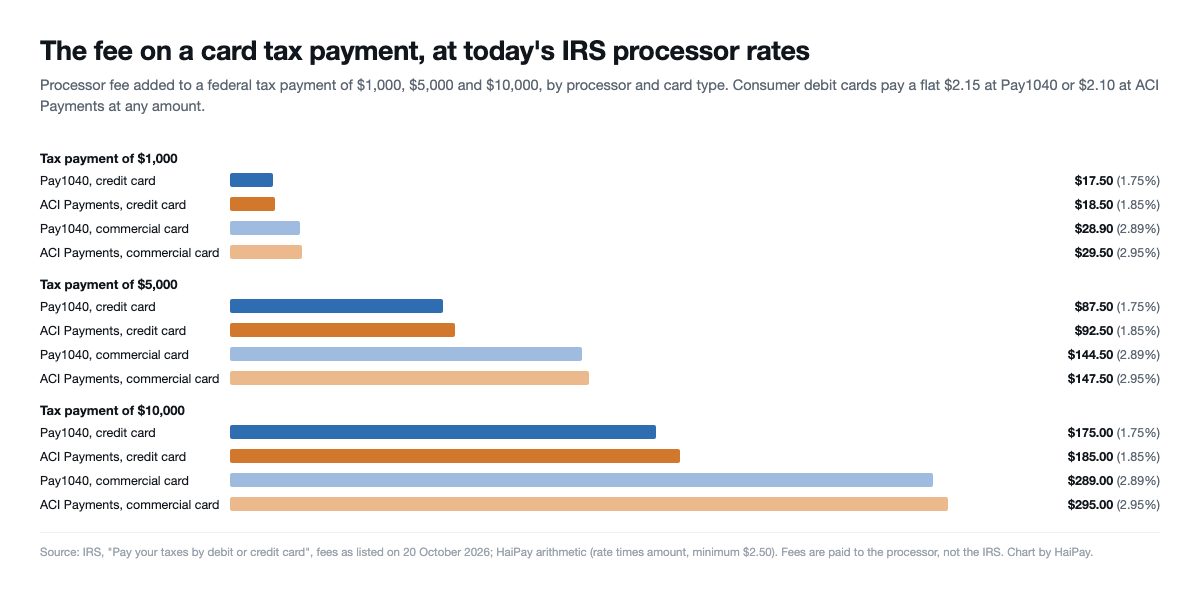
Consumer debit cards pay a flat fee, $2.15 at Pay1040 and $2.10 at ACI Payments. In January 2022 ACI charged $2.00 on debit payments up to $1,000. Commercial cards pay 2.89% and 2.95%.
On a $10,000 tax payment, that comes to $175 or $185 by consumer credit card and $289 or $295 by commercial card.
Why this matters
For payment processors, the rule allows a new kind of contract, in which the IRS is the merchant and pays the processor instead of the taxpayer paying it directly. For taxpayers, a channel run that way would not be free: whatever the IRS pays, card payers must cover in full. What could change is who negotiates the rate.
The IRS page says no part of the current fees goes to the IRS, and that businesses can deduct them.
What this does not show
The rule sets no fee level and names no contract. The fee history comes from archived copies of one IRS page, captured roughly monthly since mid-2024 and quarterly before that, so a change is dated to the first copy that shows it. HaiPay did not contact the IRS or the processors.
What to watch
Whether the IRS signs a contract under the new authority before the 2027 filing season, and at what fee.
Whether a reimbursement fee on a direct IRS channel comes in below 1.75%.
And whether a third processor returns to the IRS list
Data highlight
1.75 %
Lowest credit card fee charged on a federal tax payment by an IRS-approved card payment processor
1 February 2025 to 20 October 2026
Read the methodology and limitations
Methodology and limitations
Compiled by HaiPay on 20 October 2026. The rule is the Treasury Department and IRS final regulation TD 10060, published in the Federal Register on 19 October 2026 (91 FR 65980, document 2026-21267) and read in full from the Federal Register’s full-text endpoint. Fee data come from the IRS page Pay your taxes by debit or credit card (irs.gov/payments/pay-your-taxes-by-debit-or-credit-card), read live on 20 October 2026, when it was marked last reviewed or updated on 14 October 2026, and in 35 Internet Archive captures dated from 2 January 2022 to 2 October 2026, roughly one a month from mid-2024 and one a quarter before that; one further capture, of 1 April 2024, was empty and is excluded. For each capture HaiPay recorded every listed processor with its consumer debit card fee, credit card fee, minimum fee and, where shown, commercial card fee. A change is dated to the first capture that shows it, so its true date may be up to a month or a quarter earlier. ACI Payments’ fees could not be read in the captures of 2 October 2023 and 10 January 2024 and are treated as unchanged across them. In January 2022 three processors were listed: payUSAtax at 1.96% by credit card with a $2.69 minimum and $2.55 by debit card, Pay1040 at 1.99% with a $2.58 minimum, and ACI Payments, formerly Official Payments, at 1.99% with a $2.50 minimum and $2.00 by debit card for payments up to $1,000. By the 1 February 2025 capture payUSAtax was no longer listed as a processor, and the page said it no longer accepted payments on behalf of the IRS; Pay1040 then charged 1.75% and ACI Payments 1.85%, both with a $2.50 minimum, with consumer debit fees of $2.15 and $2.10 and commercial card fees of 2.89% and 2.95%. These figures are identical in every capture since and on the live page. Fees on example payments are HaiPay’s arithmetic: the rate times the amount, subject to the minimum. HaiPay did not contact the IRS, the Treasury Department or the processors.
Data note
HaiPay reading of the IRS page Pay your taxes by debit or credit card, live on 20 October 2026 and in 35 Internet Archive captures from 2 January 2022 to 2 October 2026. The lowest credit card fee among IRS-approved processors was 1.96% (payUSAtax) in January 2022 and 1.75% (Pay1040) from the 1 February 2025 capture onward; ACI Payments charges 1.85%, both with a $2.50 minimum. payUSAtax stopped accepting IRS payments by that capture, leaving two processors. Fees are identical in every capture since and on the live page.
A change is dated to the first capture that shows it. The final rule, TD 10060 (91 FR 65980), in force from 19 October 2026, lets the IRS pay a processor fee only if it recoups the full amount from card payers.
Data and research materials
- IRS-approved card processor fees on federal tax payments, Jan 2022 to Oct 2026 (IRS page captures, HaiPay transcription) ↓CSV · 4 KB
Every card payment processor listed on the IRS page Pay your taxes by debit or credit card in 35 Internet Archive captures from 2 January 2022 to 2 October 2026 and on the live page of 20 October 2026, with the consumer debit card fee in dollars, the credit card fee in per cent, the credit card minimum fee and, where shown, the commercial card fee. One row per processor per capture. Transcribed by HaiPay; captures in which a processor’s fees could not be read are omitted.
Term definition
- Reimbursement fee
- Under the IRS rule in force from 19 October 2026, the charge the IRS must add to a card tax payment to recover in full any fee it pays a processor. It is not a tax and is not refundable as one.
- Convenience fee
- The fee a third-party processor adds to a card tax payment. IRS-approved processors charge 1.75% or 1.85% by credit card, with a $2.50 minimum; none of it goes to the IRS.
- Commercial card
- A credit or debit card issued to a business. IRS-approved processors charge 2.89% or 2.95% on tax paid with one, against 1.75% or 1.85% on a consumer credit card.
5 sources
- Federal Register
Regulations Regarding Payment of Tax by Commercially Acceptable Means
The final rule: effective and applicable from 19 October 2026; the IRS may pay a fee under a card contract only if it recoups the full amount from card payers; the reimbursement fee is not refundable as tax; eight comments, hearing cancelled, proposal adopted without change.
Accessed 20 October 2026 · UTC
- Internal Revenue Service
Pay taxes by card or digital wallet
The current list of IRS-approved card processors and their fees on 20 October 2026: Pay1040 at $2.15 debit, 1.75% credit and 2.89% commercial, ACI Payments at $2.10, 1.85% and 2.95%, $2.50 minimum; the statement that no part of the fee goes to the IRS.
Accessed 20 October 2026 · UTC
- Internet Archive
Pay your taxes by debit or credit card, captured 2 January 2022
The January 2022 baseline: three processors, with the lowest credit card fee 1.96% at payUSAtax and ACI Payments charging $2.00 on debit payments up to $1,000.
Accessed 20 October 2026 · UTC
- Internet Archive
Pay your taxes by debit or credit card, captured 1 February 2025
The first capture showing the current fees and the notice that payUSAtax no longer accepts payments on behalf of the IRS.
Accessed 20 October 2026 · UTC
- Federal Register
Update of Regulations Regarding Payment of Tax by Commercially Acceptable Means
The July 2024 proposal that the final rule adopted without change.
Accessed 20 October 2026 · UTC
How to cite
HaiPay News, "IRS May Now Run Card Tax Payments. Credit Fees Stay at 1.75%", https://www.haipay.net/news/irs-direct-card-tax-payments-rule-processor-fees, 20 October 2026