NewsRegulation
Crypto Firms Took 51 of 112 New EU Payment Licences in 2026
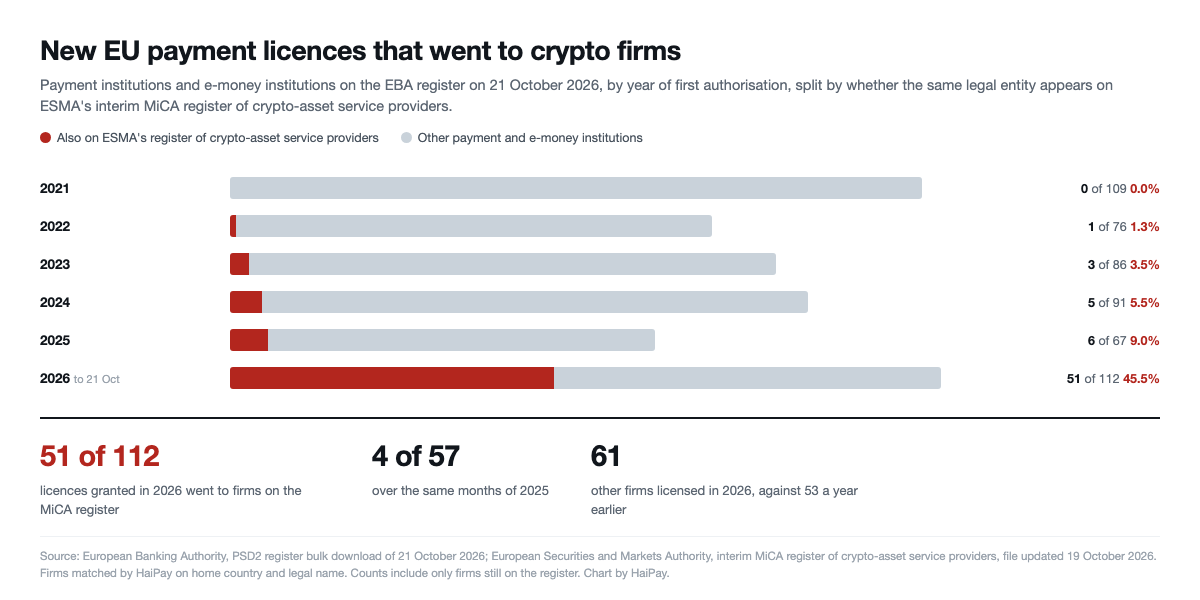
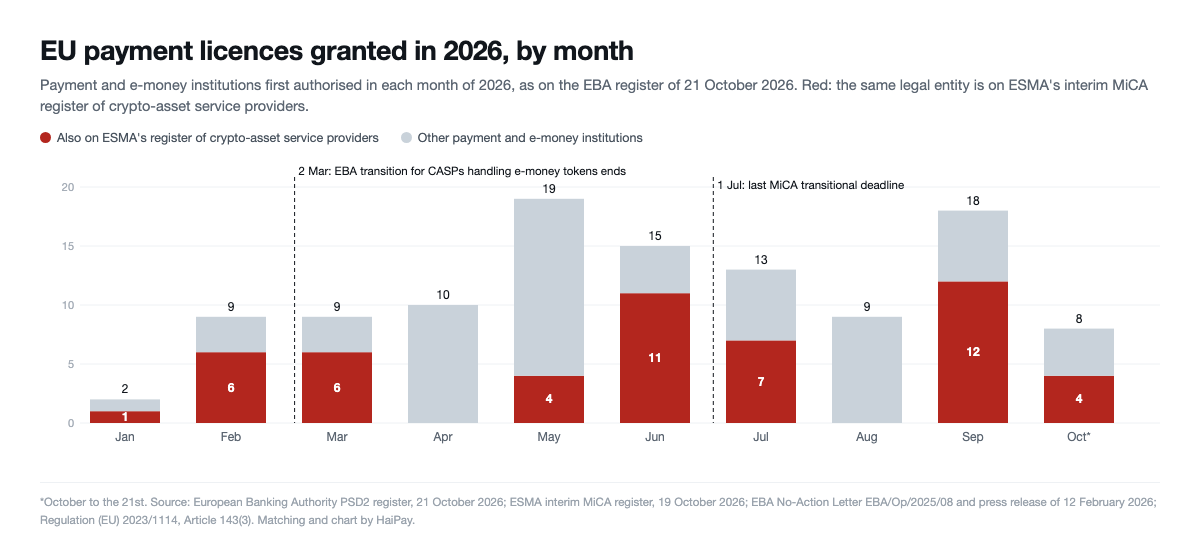
Crypto firms took 51 of the 112 payment and e-money institution licences granted in the EU and EEA from January to 21 October 2026, according to the EBA and ESMA registers, against 4 of 57 over the same months of 2025. The surge followed an EBA deadline of 2 March 2026 for crypto firms handling e-money tokens to hold a payment licence.
Key takeaways 6
- 51 of the 112 EU payment and e-money licences granted in 2026 went to firms on ESMA’s MiCA crypto register.
- Over the same months of 2025 the figure was 4 of 57.
- They include OKX Europe, Coinbase Luxembourg, Robinhood Europe, Ripple Payments Europe and MoonPay Europe.
- France accounts for 14 of the 51, Malta 11 and Luxembourg 6.
- Twelve were licensed around the EBA’s 2 March 2026 deadline for crypto firms handling e-money tokens.
- Excluding crypto firms, 61 licences were granted in 2026, against 53 a year earlier.
Of the 112 payment and e-money institution licences granted across the EU and EEA so far in 2026, 51 went to firms that are also registered crypto-asset service providers under the EU’s Markets in Crypto-Assets Regulation, MiCA.
Over the same months of 2025, it was 4 of 57.
HaiPay matched the European Banking Authority’s register of payment firms, downloaded on 21 October, against the European Securities and Markets Authority’s register of crypto firms, updated on 19 October.
Who got the licences
Most of the 51, 43, are payment institution licences; the other eight are e-money licences. They include OKX Europe, Coinbase Luxembourg, Robinhood Europe, Ripple Payments Europe and MoonPay Europe, which received its e-money licence on 8 October.
France accounts for 14 of the 51, Malta for 11 and Luxembourg for 6.
Excluding crypto firms, 61 payment and e-money licences were granted in 2026, against 53 over the same months last year. Almost all of this year’s increase came from crypto firms.
▼
Two deadlines
Twelve of the 51 were licensed between 1 February and 12 March. In June 2025 the EBA told national supervisors that crypto firms handling e-money tokens, such as euro stablecoins, as a payment service need a payment licence, and gave them until 2 March 2026. In February the EBA told supervisors to let firms still waiting for a licence carry on only under set conditions, and to have the rest stop those services.
Another 11 were licensed in June, ahead of 1 July 2026, the latest date until which MiCA lets crypto firms operating under national law continue without a MiCA authorisation.
The flow has not stopped. Between 23 September and 21 October, 20 firms were added to the EBA register. Twelve of them are crypto firms.
▼
Why this matters
For payment companies and merchants, the new licence holders are potential competitors and partners: exchanges and wallet providers that can now move euros and e-money tokens under the same licence as a payment institution. For the crypto firms, it means holding two authorisations under two EU laws, a duplication the EBA has itself told EU lawmakers to avoid in the long term.
What this does not show
Firms were matched on legal name and home country, so a payment licence held by a different company in the same group is not counted. The register lists only firms authorised today, so firms that have since given up a licence are missing from every year. Being on the crypto register does not mean a firm uses its payment licence for crypto. HaiPay did not contact the EBA, ESMA or any firm named here.
What to watch
Whether crypto firms keep taking a large share of new licences now that both deadlines have passed.
Whether the EU’s new payment rules remove the need for two authorisations.
And how many crypto firms that did not get a payment licence have stopped offering e-money token services.
Data highlight
51 of 112 licences
Payment and e-money institution licences first granted in the EU and EEA from 1 January to 21 October 2026 that went to firms also on ESMA’s register of crypto-asset service providers
1 January to 21 October 2026
Read the methodology and limitations
Methodology and limitations
Compiled by HaiPay on 21 October 2026 from two official registers. The first is the European Banking Authority’s PSD2 register, downloaded as the bulk file download-PSDMD-202610210000 published on 21 October 2026 and checked against the SHA-256 hash the EBA publishes with it. HaiPay kept the 1,041 entries of type PSD_PI (authorised payment institutions) and 432 of type PSD_EMI (authorised electronic money institutions), 1,463 distinct entity codes, and dated each by the earliest of its authorisation dates (ENT_AUT). The second is the European Securities and Markets Authority’s interim MiCA register of crypto-asset service providers, the file CASPS.csv last modified on 19 October 2026, with 379 entries. A payment or e-money institution is counted as a crypto firm when its legal name, after removing punctuation and the legal form, matches the legal name of a registered crypto-asset service provider in the same home country. Four entities whose names match a crypto firm only at group level, such as Bitpanda Payments GmbH against Bitpanda GmbH and Bybit Payments GmbH against Bybit EU GmbH, are not counted. On that basis 73 payment or e-money institutions are on the crypto register. By year of first authorisation, the share of new licences going to such firms was 0 of 109 in 2021, 1 of 76 in 2022, 3 of 86 in 2023, 5 of 91 in 2024, 6 of 67 in 2025 and 51 of 112 from 1 January to 21 October 2026: 43 of 85 payment institution licences and 8 of 27 e-money licences. Over 1 January to 21 October 2025 the figure was 4 of 57. Among the 51, France accounts for 14, Malta 11 and Luxembourg 6. Twelve of the 51 were first authorised between 1 February and 12 March 2026, and 11 in June. Comparing the register with HaiPay’s copy of 23 September 2026, 20 entities were added in four weeks, 12 of them crypto firms, and 2 were removed. The register lists only firms authorised now, so firms that have since left are not counted in any year. Being on ESMA’s register does not mean a firm’s payment licence is used for crypto activity. HaiPay did not contact the EBA, ESMA, any national authority or any firm named here.
Data note
HaiPay matching of the EBA PSD2 register bulk file of 21 October 2026 (1,041 payment institutions and 432 e-money institutions, dated by earliest authorisation) against ESMA’s interim MiCA register of crypto-asset service providers (CASPS.csv, 19 October 2026, 379 entries), on legal name without legal form and home country. Group-level name matches are excluded.
Of licences first granted from 1 January to 21 October 2026, 51 of 112 went to firms on the crypto register (43 of 85 payment institution, 8 of 27 e-money); over the same period of 2025, 4 of 57. Counts include only firms still on the register.
Data and research materials
- EU payment and e-money institutions licensed since 2021 and whether each is on ESMA’s MiCA crypto register (EBA, ESMA, HaiPay matching) ↓CSV · 40 KB
Every payment institution and e-money institution on the European Banking Authority’s PSD2 register of 21 October 2026 first authorised from 1 January 2021, with its EBA entity code, type, home country, legal name and first authorisation date, and, where HaiPay matched it on legal name and home country to ESMA’s interim MiCA register of crypto-asset service providers (19 October 2026), the matched LEI, registered name and MiCA authorisation or notification date. 541 rows.
HaiPay’s charts and the CSV match table on this page may be reused with attribution to HaiPay and a link to this article. The underlying registers are published by the European Banking Authority and the European Securities and Markets Authority; reuse of the source data is governed by their terms, not by HaiPay.
Term definition
- Crypto-asset service provider
- A firm authorised or notified under the EU’s MiCA regulation to provide services such as custody, exchange or transfer of crypto-assets. ESMA’s interim register listed 379 entries on 19 October 2026.
- E-money token
- A crypto-asset under MiCA that aims to keep a stable value by referencing one official currency, such as a euro stablecoin. The EBA treats some transfers of them as payment services.
- Payment institution
- A non-bank firm licensed under the EU’s second Payment Services Directive to provide payment services. 1,041 were on the EBA register on 21 October 2026.
5 sources
- European Banking Authority
EBA PSD2 register, bulk download of 21 October 2026
The 1,473 payment institution and e-money institution entries on the register on 21 October 2026, with home country, legal name and first authorisation date; file verified against the EBA’s published SHA-256 hash.
Accessed 21 October 2026 · UTC
- European Securities and Markets Authority
Interim MiCA register: crypto-asset service providers
The 379 entries on ESMA’s interim register of crypto-asset service providers, used to identify which payment and e-money institutions are the same legal entity as a registered crypto firm.
Accessed 21 October 2026 · UTC
- European Banking Authority
The June 2025 No-Action Letter (EBA/Op/2025/08) under which crypto firms that transact e-money tokens as payment services need a PSD2 licence after a transition period.
Accessed 21 October 2026 · UTC
- European Banking Authority
The 12 February 2026 press release confirming that the transition period ended on 2 March 2026 and that firms without a licence should stop the services concerned.
Accessed 21 October 2026 · UTC
- EUR-Lex
Regulation (EU) 2023/1114 on markets in crypto-assets (MiCA)
MiCA Article 143(3): crypto firms operating under national law before 30 December 2024 could continue until 1 July 2026 at the latest.
Accessed 21 October 2026 · UTC
How to cite
HaiPay News, "Crypto Firms Took 51 of 112 New EU Payment Licences in 2026", https://www.haipay.net/news/crypto-firms-eu-payment-licences-2026-mica-psd2, 21 October 2026