Four Agent Payment Protocols, and One Versioned Release.
September 4th, 2026
Last updated: September 4
Key takeaways
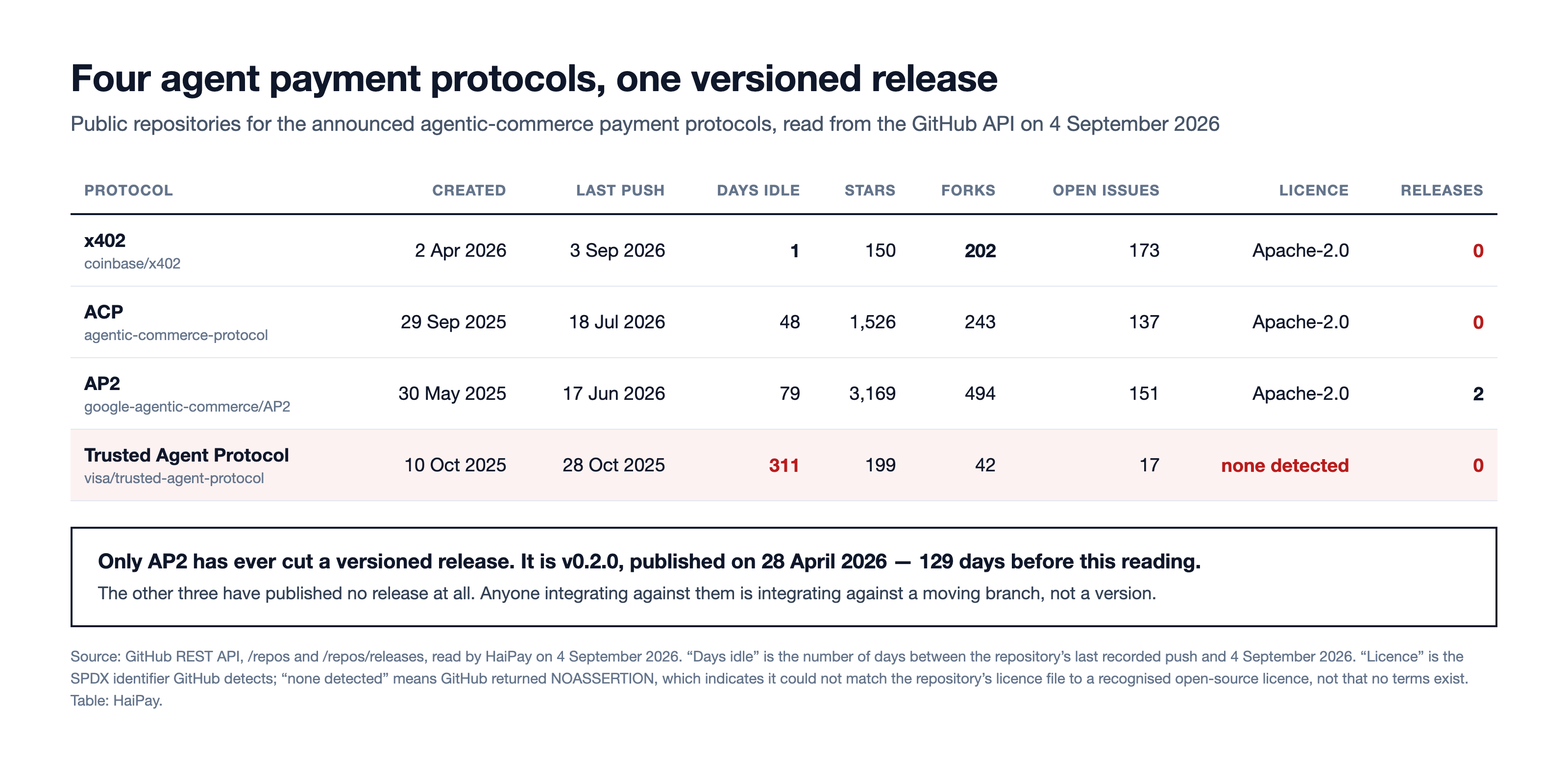
- Four announced agent payment protocols have public repositories; only one has ever published a versioned release.
- That release is AP2 v0.2.0, published on 28 April 2026, 129 days before this reading.
- x402, the Agentic Commerce Protocol and Visa Trusted Agent Protocol have published no release at all.
- Visa's repository was created on 10 October 2025, last pushed 18 days later, and has been idle 311 days.
- It is also the only one of the four without an open-source licence GitHub recognises.
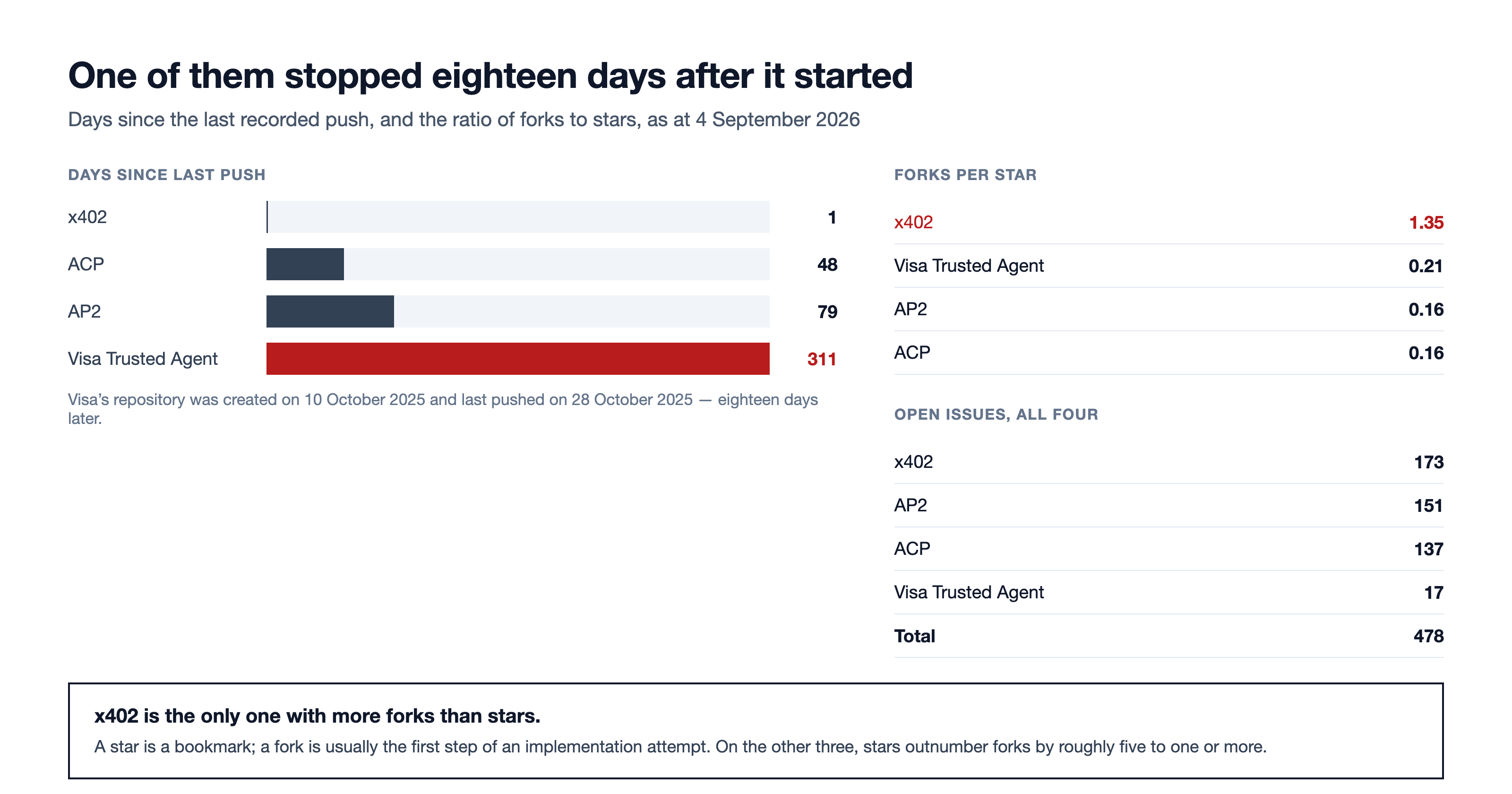
- x402 is the only one with more forks than stars, at 202 forks against 150 stars.
Data highlight
1of 4 protocols
Announced agent payment protocols whose public repository has ever published a versioned release
4 September 2026
Read by HaiPay from the GitHub REST API on 4 September 2026, using the /repos and /repos/releases endpoints for the four public repositories associated with announced agent payment protocols: coinbase/x402, agentic-commerce-protocol/agentic-commerce-protocol, google-agentic-commerce/AP2 and visa/trusted-agent-protocol. Only google-agentic-commerce/AP2 returned any releases, two in total, the most recent being v0.2.0 published on 28 April 2026, which is 129 days before this reading. The other three returned an empty releases list. On the same reading, days since the last recorded push were 1 for x402, 48 for the Agentic Commerce Protocol, 79 for AP2 and 311 for visa/trusted-agent-protocol, which was created on 10 October 2025 and last pushed on 28 October 2025. GitHub reported an Apache-2.0 licence for three repositories and NOASSERTION for visa/trusted-agent-protocol, meaning it could not match that repository's licence file to a recognised open-source licence rather than that no terms exist. Star, fork and open-issue counts on the same reading were 150, 202 and 173 for x402; 1,526, 243 and 137 for the Agentic Commerce Protocol; 3,169, 494 and 151 for AP2; and 199, 42 and 17 for visa/trusted-agent-protocol, giving 478 open issues in total; GitHub open-issue counts include open pull requests. A GitHub search for an official Mastercard repository for Agent Pay returned only third-party projects, so Mastercard is excluded from the four. These figures measure repository activity only and do not measure adoption, production readiness or transaction volume, and they change continuously.
Four payment protocols for AI agents have been announced with real corporate weight behind them: x402 from Coinbase, the Agentic Commerce Protocol from OpenAI and Stripe, the Agent Payments Protocol from Google, and Visa's Trusted Agent Protocol. All four have a public repository. On 4 September, exactly one of them had ever published a versioned release.
That release is AP2 v0.2.0, and it went out on 28 April 2026 — 129 days ago. The other three have published none.
What a release means, and why zero is the interesting number
A repository with no releases is not abandoned. It usually means the work is happening on a branch that anyone can read and nobody can pin.
For most open-source projects that is unremarkable. For a payment protocol it is the whole question. An acquirer, a wallet or a merchant platform that wants to support agent-initiated payments has to write code against something stable enough to certify, and then keep supporting the customers who integrated last quarter. "The main branch as of today" is not a thing you can put in a partner contract.
So the count of published releases across all four protocols is a fair proxy for how much of this is buildable now, and the count is one. Version 0.2.0, at that: a number the maintainers themselves are using to say the interface may still move.
Two of the four are moving quickly
Nothing here suggests the work has stopped. Two repositories were pushed within the last fifty days.
x402 was pushed on 3 September, the day before this reading. It has 150 stars and 202 forks, and 173 open issues.
The Agentic Commerce Protocol was last pushed on 18 July, 48 days ago, with 1,526 stars and 137 open issues. AP2 was last pushed on 17 June, 79 days ago, and is by some distance the most starred of the four at 3,169.
Across all four repositories there are 478 open issues. That is a live design argument, not a finished specification, which is consistent with three of the four having nothing to version yet.
The exception is Visa
Visa's Trusted Agent Protocol repository was created on 10 October 2025. It was last pushed on 28 October 2025, eighteen days later. As at 4 September 2026 that is 311 days without a recorded push.
It is also the only one of the four where GitHub does not detect a recognised open-source licence. The API returns NOASSERTION, which means GitHub could not match the licence file to a licence it knows — not that no terms exist, but not something an engineering team can clear in five minutes either. The other three are Apache-2.0.
None of this means the protocol is dead. Visa may be developing it privately, may have folded it into a partner programme behind its developer portal, or may be waiting on the wider standards process. But a public repository that has not moved in ten months is telling any external developer who finds it that this is not where the work is, and Visa has not said where the work is instead.
Mastercard, meanwhile, has an Agent Pay developer portal that resolves. A GitHub search for an official Mastercard repository for it returned only third-party projects.
Forks are the number worth watching
Stars and forks both get quoted as popularity. They mean different things. A star is a bookmark. A fork is usually the first step of somebody trying to run the thing.
x402 is the only one of the four with more forks than stars: 202 against 150, a ratio of 1.35. On the other three, stars outnumber forks by roughly five to one or more — AP2 at 0.16 forks per star, ACP at 0.16, Visa at 0.21.
That does not make x402 the winner. It has the fewest stars of the four and no release. But the shape of its attention is different from the others: proportionally more people cloning it than filing it away, which is what you would expect of something people are attempting to implement rather than track.
What these numbers are not
They are repository activity, and nothing else. Not adoption, not transaction volume, not production readiness, not whether any real merchant has taken a real payment through any of them.
Stars, forks and issue counts move continuously, so every figure here is a reading taken on 4 September 2026 and will not reproduce exactly on another day. Open-issue counts on GitHub include open pull requests. A protocol can also be specified perfectly well outside GitHub, in a standards body or a PDF, and none of that would appear in this measurement.
HaiPay did not contact Coinbase, Google, OpenAI, Stripe, Visa or Mastercard, and did not attempt to implement any of the four.
What to watch
Three things, all countable from the same source. Whether any of the three zero-release protocols cuts a first version, which would be the clearest signal that one of them considers its interface stable enough to support. Whether AP2 moves past 0.x. And whether Visa's repository gets a push, or whether Visa says publicly where the Trusted Agent Protocol work now lives.
This piece reads public repository metadata. It is not an assessment of any protocol's technical merits, and not advice on which to build against.
How to cite
HaiPay News, "Four Agent Payment Protocols, and One Versioned Release.", https://www.haipay.net/news/agent-payment-protocols-one-versioned-release, September 4th, 2026
About the author
Crystal
Digital Public Relations
A digital PR specialist with a Master's in Journalism & Communication from UNSW. Started as an intern at ABC Australia, now leads public relations at Haipay, crafting press releases and media strategies that bring brand stories to life.
Reviewed by WeiJun TangEditorial policy