NewsRegulation
Affirm Got Its Australian Licence 302 Days Before Launch.
The familiar pattern in payments is to launch into a market and resolve the regulatory position afterwards. Here the authorisation predates the product by ten months, in a market that had just made the authorisation compulsory.
Key takeaways 6
- Australia's BNPL Act commenced on 10 June 2025, making BNPL contracts credit contracts under the National Credit Code.
- From that date a provider needs an Australian credit licence and AFCA membership, subject to transitional arrangements.
- Affirm Australia Pty Ltd holds credit licence 569362, effective 30 October 2025, status APPR, with AFCA as its EDR scheme.
- That is 142 days after the regime commenced and 302 days before the reported product launch.
- 166 of the 4,326 credit licences in force were granted on or after 10 June 2025, across all credit activity, not just BNPL.
- Exactly one licensee in the 4,334-row ASIC file has a name containing "Affirm".
Affirm and Shopify have launched Shop Pay Installments in Australia, extending an existing partnership into a market that has spent the last two years doing something no comparable jurisdiction had done: putting buy now pay later inside consumer credit law.
The interesting fact is not the launch. It is that Affirm's Australian entity has held an Australian credit licence since 30 October 2025, ten months before the product appeared.
What Australia changed
The Treasury Laws Amendment (Responsible Buy Now Pay Later and Other Measures) Act 2024 received royal assent on 10 December 2024 and commenced on 10 June 2025. It extends the National Credit Code, which is Schedule 1 to the National Consumer Credit Protection Act 2009, to buy now pay later contracts. The effect is that a BNPL contract is now a credit contract under the Code.
From the commencement date, ASIC's guidance is unambiguous: anyone engaging in credit activities involving BNPL contracts must hold an Australian credit licence with all appropriate authorisations, and must be a member of the Australian Financial Complaints Authority. Providers already in market could continue operating under transitional arrangements if they had applied for a licence, or a variation to an existing one, and had the application accepted for lodgement before 10 June 2025.
The Act also creates a sub-category called a low cost credit contract, being a BNPL contract whose fees do not exceed the caps set in regulations, which attracts a modified compliance regime rather than an exemption from it. ASIC set out its expectations in Regulatory Guide 281 and the licensing mechanics in Information Sheet 285.
The order of events
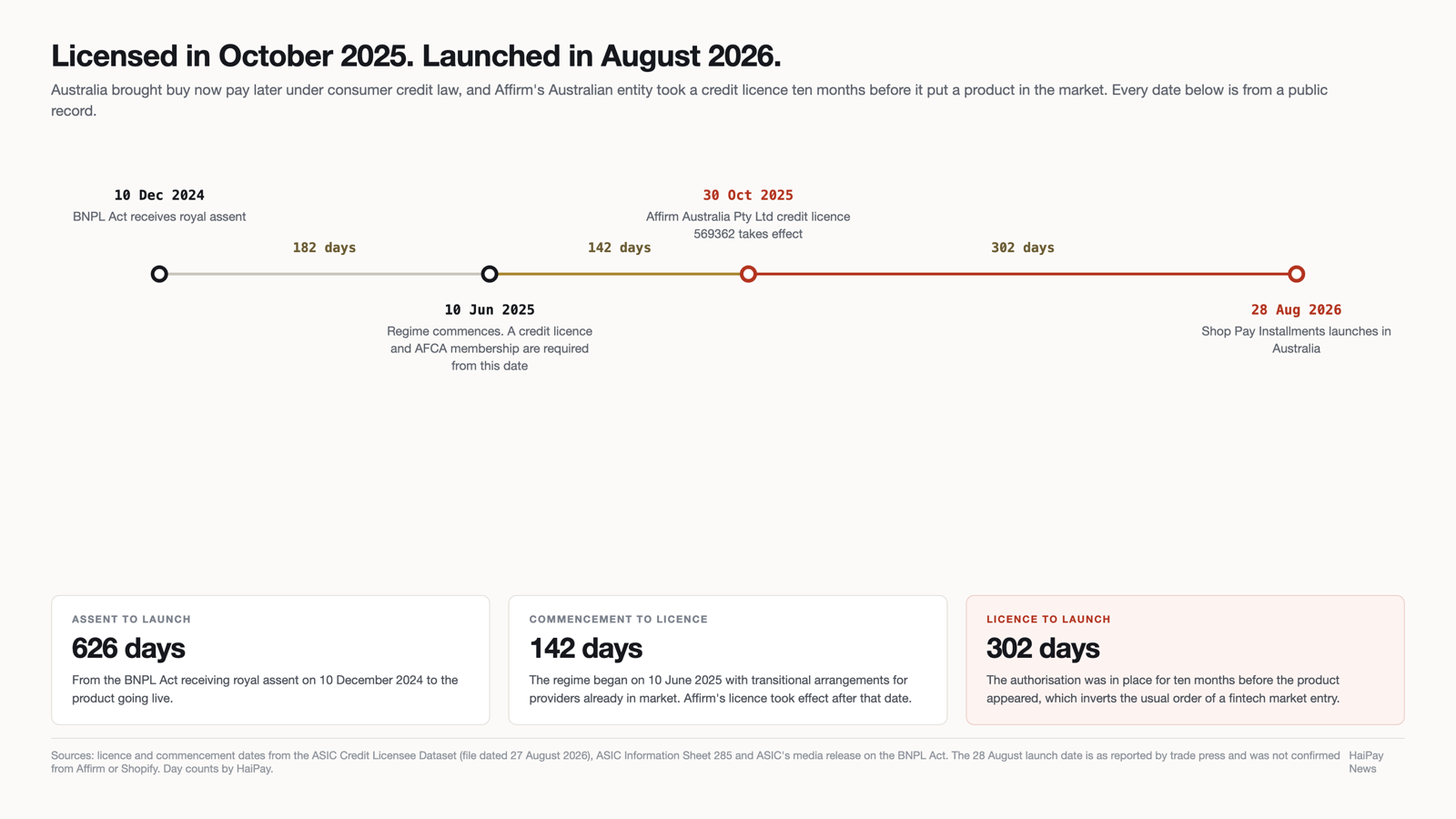
Royal assent to commencement was 182 days. Commencement to the day Affirm Australia's licence took effect was a further 142. From that licence date to the launch reported this week is 302 days. End to end, 626 days separate the Act receiving assent from the product going live.
That ordering is worth noting because it is not the usual one. The familiar pattern in payments is to launch into a market and resolve the regulatory position afterwards, occasionally under supervision. Here the authorisation predates the product by ten months, in a market that had just made the authorisation compulsory.
The register entry
ASIC publishes its credit licensee register as a dataset on data.gov.au, refreshed monthly. The current file is dated 27 August 2026 and carries 4,334 records.
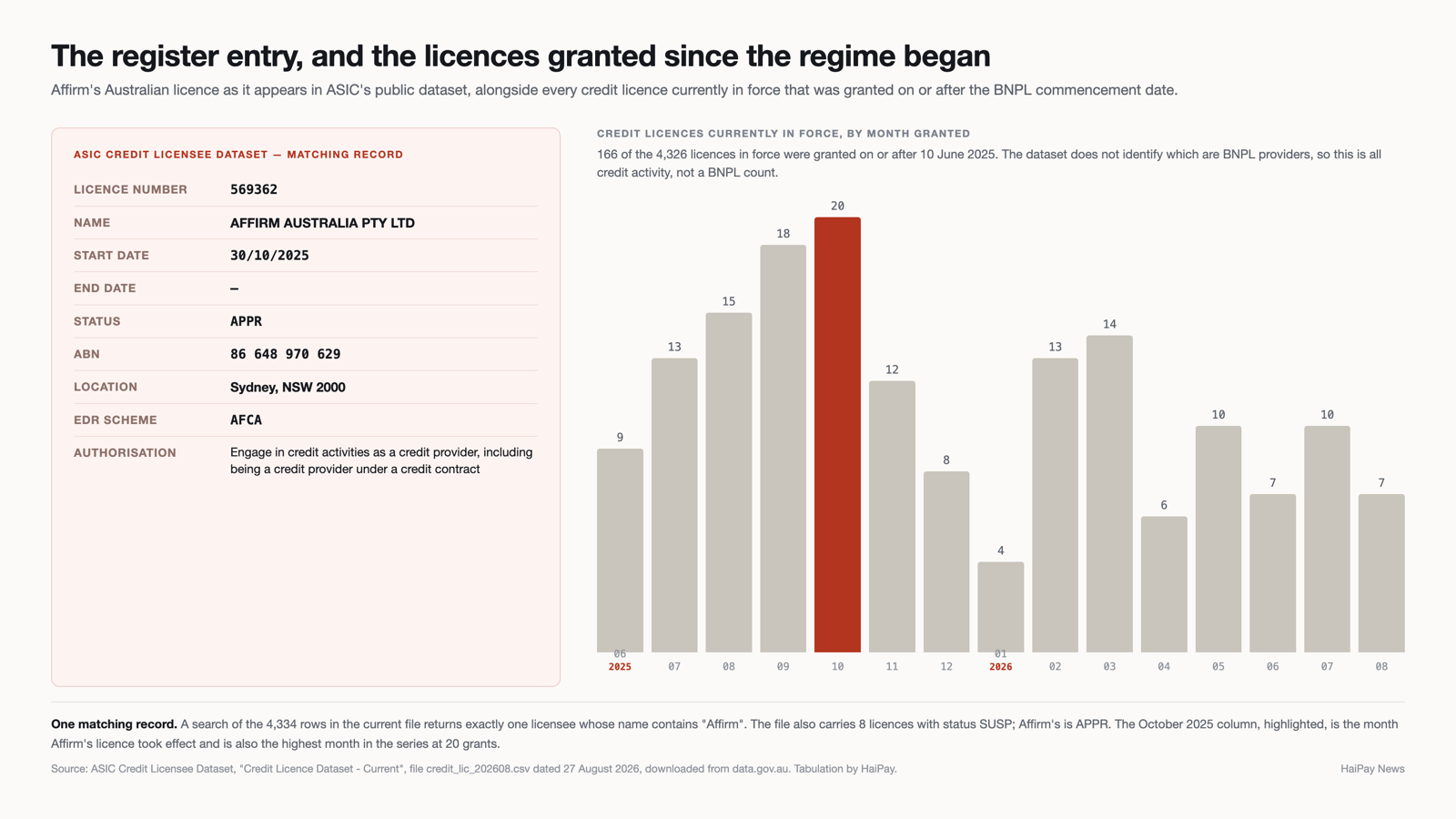
Exactly one licensee in that file has a name containing "Affirm". It is Affirm Australia Pty Ltd, licence number 569362, start date 30 October 2025, no end date, status APPR, ABN 86 648 970 629, registered in Sydney, with AFCA recorded as its external dispute resolution scheme. The authorisation permits it to engage in credit activities as a credit provider, including as the credit provider under a credit contract.
Against the wider file, 166 of the 4,326 licences currently in force were granted on or after 10 June 2025, which is 3.8 per cent of the total. The monthly pattern peaks at 20 grants in October 2025, the month Affirm's licence took effect, then settles into single figures and low teens. The dataset does not record what business a licensee is in, so those 166 cover all credit activity and cannot be read as a count of BNPL entrants.
What we could not verify
The launch itself is the weakest-sourced element here. We could not reach Affirm's investor newsroom or press pages, and we did not obtain a statement from Affirm or Shopify. The 28 August date and the description of the product as powered exclusively by Affirm come from trade press reporting, not from either company directly, and the day counts that depend on that date should be read accordingly.
We did not establish whether Affirm applied before 10 June 2025 and relied on transitional arrangements in the interim, or applied afterwards. The register records when the licence took effect, not when it was applied for. We also did not determine whether Shop Pay Installments in Australia is offered as a low cost credit contract or as an ordinary BNPL contract, which changes the compliance obligations, and neither the register nor the launch coverage says.
We did not check whether Affirm holds authorisations through a credit representative arrangement in addition to its own licence. ASIC publishes a separate credit representative dataset which we did not search.
What to watch
Whether the Australian regime becomes a template. Australia is the first major market to bring BNPL fully inside consumer credit licensing rather than regulating it through a bespoke code, and the UK and others have consultations running. A licensed entry by a large US provider is a datapoint in favour of the model being workable at scale.
And whether the fee structure puts the product inside the low cost credit contract category. That is the distinction the Act was built around, it determines how much of the responsible lending machinery applies, and it is the number that will tell you what the launch actually costs Affirm to run.
Data highlight
302 days
Days from Affirm Australia's credit licence taking effect to the reported launch of Shop Pay Installments in Australia
30 October 2025 to 28 August 2026
Read the methodology and limitations
Methodology and limitations
Licence start date taken from the ASIC Credit Licensee Dataset, resource "Credit Licence Dataset - Current", file credit_lic_202608.csv dated 27 August 2026 and downloaded from data.gov.au. The file contains 4,334 records, of which 4,326 have status APPR and 8 have status SUSP. A case-insensitive search for "Affirm" in the licensee name returns exactly one row: licence 569362, AFFIRM AUSTRALIA PTY LTD, start date 30/10/2025, no end date, status APPR, ABN 86648970629, Sydney NSW 2000, external dispute resolution scheme AFCA.
The commencement date of 10 June 2025 and the royal assent date of 10 December 2024 are from ASIC Information Sheet 285 and ASIC's media release on the Act. The launch date of 28 August 2026 is as reported by trade press; HaiPay could not reach Affirm's or Shopify's own announcement and did not confirm it with either company, so the 302-day figure inherits that uncertainty.
The count of 166 licences granted on or after 10 June 2025 is computed over rows with status APPR only and covers all credit activity types, because the dataset does not record whether a licensee provides BNPL.
Term definition
- Australian credit licence
- The authorisation required to engage in credit activities in Australia under the National Consumer Credit Protection Act 2009. Since 10 June 2025 it has been required for buy now pay later contracts, together with membership of the Australian Financial Complaints Authority.
- Low cost credit contract
- A sub-category of buy now pay later contract created by the 2024 Act, being one whose fees do not exceed the caps set in regulations. It attracts a modified set of responsible lending obligations rather than an exemption from them.
- National Credit Code
- Schedule 1 to the National Consumer Credit Protection Act 2009, which governs consumer credit contracts in Australia. The 2024 Act extended it to buy now pay later contracts, so a BNPL contract is now a credit contract under the Code.
3 sources
- Australian Securities and Investments Commission
ASIC Credit Licensee Dataset(file credit_lic_202608.csv,2026-08-27)
- Australian Securities and Investments Commission
ASIC Information Sheet 285: Buy now pay later credit contracts — Credit licensing
- Australian Securities and Investments Commission
ASIC alerts buy now pay later providers to apply for a licence under new laws
How to cite
HaiPay News, "Affirm Got Its Australian Licence 302 Days Before Launch.", https://www.haipay.net/news/affirm-australia-credit-licence-302-days, 31 August 2026