NewsAcquiring
US Contactless Card Payments Rose 28-Fold. Still Under 40%
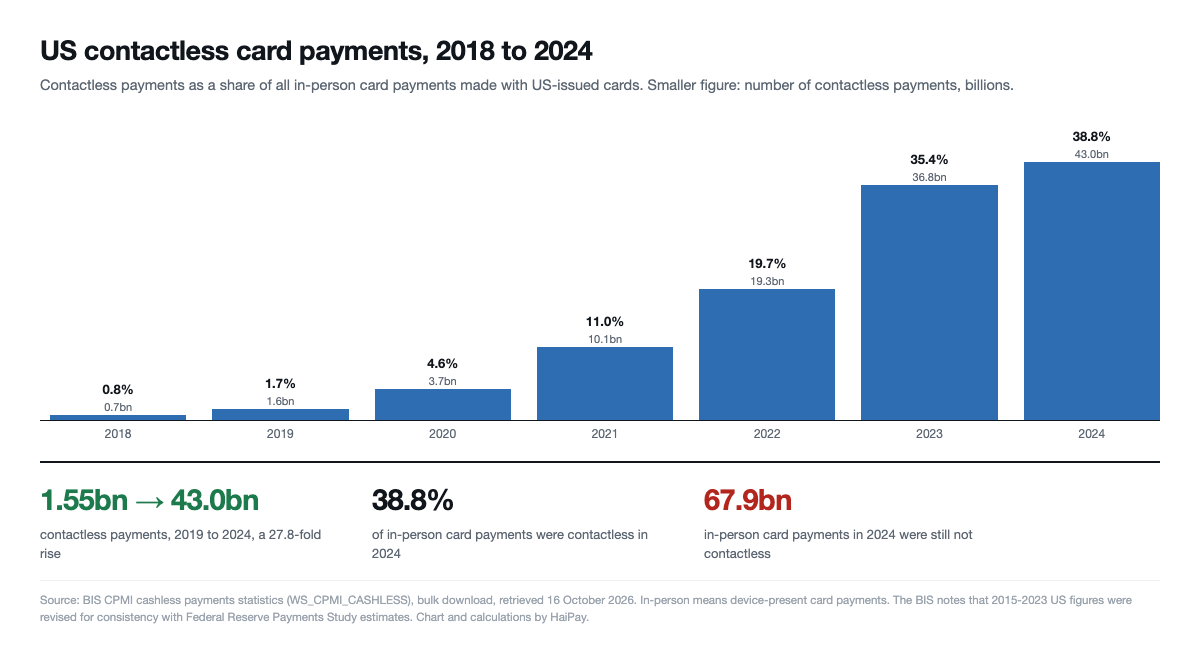
Americans made 43.0 billion contactless card payments in 2024, up from 1.55 billion in 2019, according to BIS payment statistics. Contactless is still only 38.8% of in-person card payments in the United States, ninth of the 10 economies that report the figure.
Key takeaways 6
- US contactless card payments rose from 1.55 billion in 2019 to 43.0 billion in 2024, a 27.8-fold increase, BIS data show.
- Contactless was 38.8% of US in-person card payments in 2024, up from 1.7% in 2019.
- Among 10 economies, the median contactless share was 79.6%; Spain led at 92.7% and only Mexico, at 9.8%, was below the US.
- US contactless growth slowed to 16.8% in 2024 after roughly doubling each year from 2020 to 2023.
- 67.9 billion US in-person card payments in 2024 were still made by chip or stripe rather than tap.
- Values are not used: the BIS value series for US contactless payments is internally inconsistent.
Americans made 43.0 billion contactless card payments in 2024, according to payment statistics published through the Bank for International Settlements. In 2019 they made 1.55 billion.
That is a 27.8-fold rise in five years. It still leaves contactless at 38.8% of in-person card payments in the United States, the second-lowest share among the 10 economies that report the figure.
From under 2% to almost 40%
In 2019, 1.7% of in-person payments with US-issued cards were contactless. The share reached 11.0% in 2021, 19.7% in 2022 and 35.4% in 2023.
Growth slowed in 2024. The number of contactless payments rose 16.8%, after roughly doubling in each of the three previous years, and the share edged up from 35.4% to 38.8%.
That leaves 67.9 billion in-person card payments in 2024 that were not contactless: cards inserted or swiped at the terminal.
Where the US sits
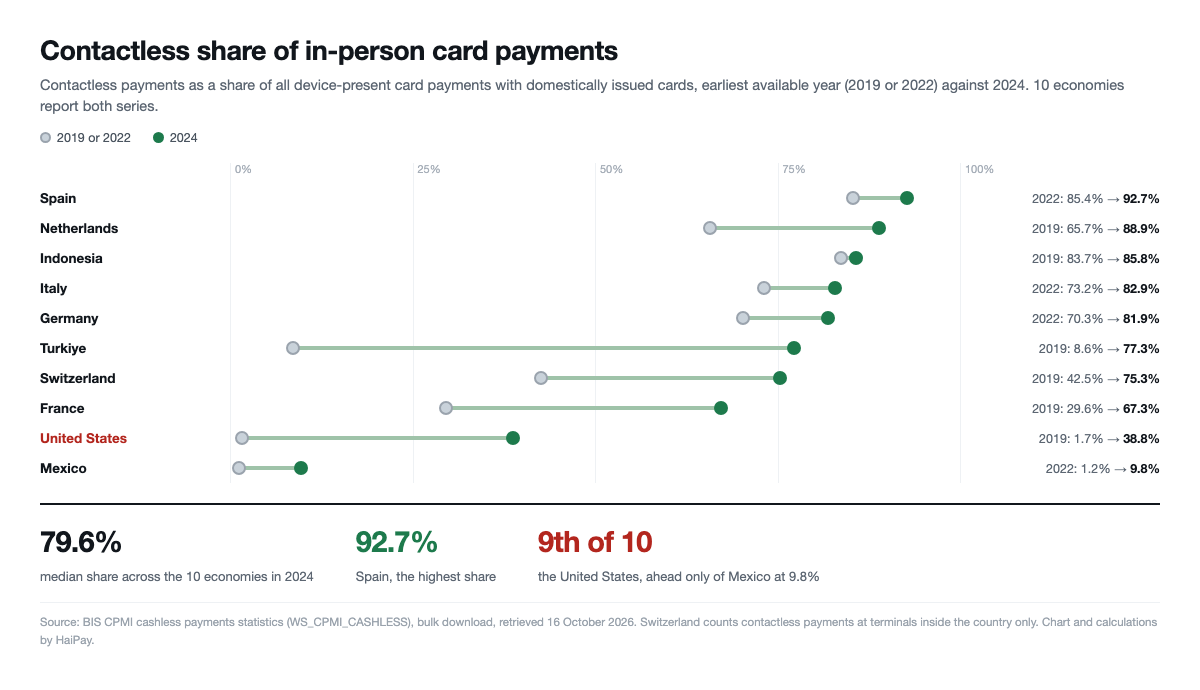
Among the 10 economies with both figures, the median contactless share in 2024 was 79.6%. Spain led at 92.7%, followed by the Netherlands at 88.9%, Italy at 82.9% and Germany at 81.9%.
France, at 67.3%, is the lowest of the European economies in the data. Only Mexico, at 9.8%, is below the United States.
The closest parallel to the US is Turkiye. Its contactless share was 8.6% in 2019, higher than the US but still low. By 2024 it was 77.3%, after a 23.8-fold rise in contactless payments, a multiple close to the US one.
Why this matters
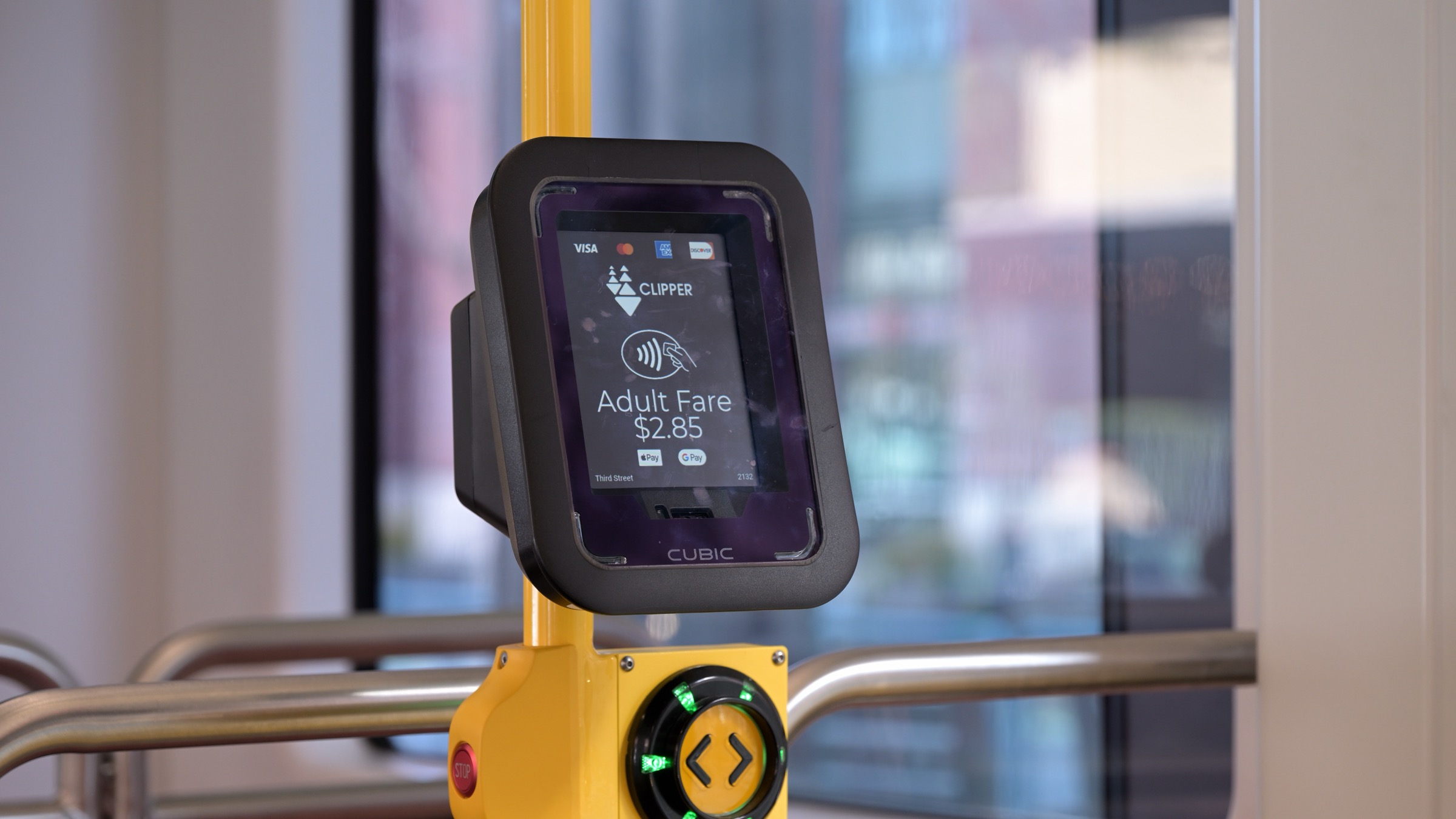
For merchants and acquirers, the US is no longer a market where contactless is optional at the counter. With 43 billion taps a year, a terminal that cannot accept them turns away a large and growing share of card payments.
At the same time, more than 60% of US in-person card payments still use the chip or the stripe. Payment providers serving US merchants have to support both for years to come, and the slowdown in 2024 suggests the remaining shift may take longer than the first.
What this is not
These are counts, not values. The BIS value figures for US contactless payments imply an average tap of about $71 against about $41 for all in-person card payments, which cannot both be right, so this article does not use them.
The data do not separate cards from phones and watches, or transit fares from shop purchases. Indonesia reports a contactless share above 80% as early as 2019, far above any other economy that year, and is shown as published.
Only 10 economies report the series, so the ranking is among those 10, not the world. HaiPay did not contact the BIS or the Federal Reserve.
What to watch
Whether the US share keeps slowing. A second year of growth below 20% would suggest the easy gains are over.
Whether Mexico follows the US path. Its share rose from 1.2% in 2022 to 9.8% in 2024.
And whether the BIS value series is revised. Until it is, US contactless spending cannot be measured from this source.
Data highlight
38.8 %
Share of in-person card payments made with US-issued cards that were contactless in 2024, up from 1.7 per cent in 2019 and ninth of 10 economies in the BIS CPMI statistics
2019 to 2024
Read the methodology and limitations
Methodology and limitations
Compiled by HaiPay on 16 October 2026 from the statistics on payments and financial market infrastructures that the Committee on Payments and Market Infrastructures publishes through the Bank for International Settlements, downloaded as the bulk file WS_CPMI_CASHLESS from data.bis.org. In-person card payments are the annual number of device-present card payments, all card functions, with cards issued in the reporting economy at terminals in any location; contactless payments are the subset reported as device-present contactless. 10 economies report both series for 2024: Spain, the Netherlands, Indonesia, Italy, Germany, Turkiye, Switzerland, France, the United States and Mexico. Switzerland counts contactless payments at terminals inside the country only. The BIS notes that the 2015 to 2023 US figures were revised for consistency with estimates from the Federal Reserve Payments Study. In the United States, contactless card payments numbered 662.2 million in 2018, 1,550.7 million in 2019, 3,680.6 million in 2020, 10,097.0 million in 2021, 19,288.2 million in 2022, 36,846.0 million in 2023 and 43,041.0 million in 2024, a 27.8-fold rise from 2019; as a share of in-person card payments they were 0.8, 1.7, 4.6, 11.0, 19.7, 35.4 and 38.8 per cent. In-person card payments with US-issued cards numbered 110,944.0 million in 2024, so 67,903.0 million were not contactless. The 2024 contactless share was 92.7 per cent in Spain, 88.9 in the Netherlands, 85.8 in Indonesia, 82.9 in Italy, 81.9 in Germany, 77.3 in Turkiye, 75.3 in Switzerland, 67.3 in France, 38.8 in the United States and 9.8 in Mexico, with a median of 79.6 per cent. Where a 2019 value exists, the share rose from 65.7 per cent in the Netherlands, 83.7 in Indonesia, 8.6 in Turkiye, 42.5 in Switzerland, 29.6 in France and 1.7 in the United States; Spain, Italy, Germany and Mexico report from 2022, at 85.4, 73.2, 70.3 and 1.2 per cent. Turkiye’s contactless payments rose 23.8-fold from 2019 to 2024, from 502 million to 11,963 million. Every share, difference and multiple is HaiPay’s arithmetic on the published counts. Values are not used: the BIS value series for US contactless payments implies an average contactless payment of about USD 71 in 2024 against about USD 41 for all in-person card payments, which is inconsistent with contactless payments being a subset, so HaiPay treats the value series as unreliable for this comparison. Two further limits apply. Indonesia’s contactless share was already 83.7 per cent in 2019, well above every other economy that year, and is reported as published without HaiPay being able to verify its definition. And the data do not separate cards tapped from phones and wearables, or transit fares from retail purchases. HaiPay did not contact the BIS or the Federal Reserve.
Data note
HaiPay calculation from the BIS CPMI bulk file WS_CPMI_CASHLESS, downloaded from data.bis.org on 16 October 2026. In-person card payments are device-present card payments with domestically issued cards; contactless payments are the device-present contactless subset. US contactless payments rose from 1,550.7 million in 2019 to 43,041.0 million in 2024, a 27.8-fold rise, and from 1.7 to 38.8 per cent of 110,944.0 million in-person card payments.
Across the 10 economies reporting both series the 2024 median share was 79.6 per cent, from 92.7 in Spain to 9.8 in Mexico; the United States ranks ninth. The BIS revised the 2015 to 2023 US figures to match Federal Reserve Payments Study estimates. Values are not used because the BIS value series for US contactless payments is internally inconsistent. The data do not separate cards from phones or transit from retail.
Data and research materials
- Contactless and in-person card payments by economy, 2019, 2022 and 2024 (BIS CPMI, HaiPay calculations) ↓CSV · 1 KB
- United States contactless card payments and share, 2018-2024 ↓CSV · 1 KB
HaiPay’s charts and the two CSV tables on this page may be reused with attribution to HaiPay and a link to this article. The underlying statistics are published by the Bank for International Settlements; reuse of the source data is governed by the BIS terms of use, not by HaiPay.
Term definition
- Contactless payment
- A card payment made by holding a card, phone or wearable near a terminal rather than inserting or swiping it. 43.0 billion were made with US-issued cards in 2024.
- In-person card payment
- A card payment where the card or device is present at the terminal, as opposed to an online or phone payment. The BIS calls these device-present payments.
- Contactless share
- Contactless payments divided by all in-person card payments. In the United States it rose from 1.7 per cent in 2019 to 38.8 per cent in 2024.
3 sources
- Bank for International Settlements
CPMI cashless payments statistics (WS_CPMI_CASHLESS), bulk download
Annual number of contactless and of all device-present card payments for each economy, 2018 to 2024. Source of every count, share and multiple in this article.
Accessed 16 October 2026 · UTC
- Bank for International Settlements
The BIS presentation of the same CPMI statistics, for readers who want to browse the tables rather than download the file.
Accessed 16 October 2026 · UTC
- Bank for International Settlements
Index page listing the BIS bulk files, including the one used here.
Accessed 16 October 2026 · UTC
How to cite
HaiPay News, "US Contactless Card Payments Rose 28-Fold. Still Under 40%", https://www.haipay.net/news/us-contactless-card-payments-39-percent, 16 October 2026