NewsAcquiring
Swift Said There Was No Contingency. Then It Moved the Date.
More than 98 per cent of payment instructions now use the ISO 20022 format. On the most recent figure Swift published, fewer than two in five carried a structured postal address. Adopting a format is a systems project; filling it with address data reaches past the bank to its customers, and that is the half that slipped.

Key takeaways 6
- Swift deferred all payments changes in Standards Release 2026 on 27 August, 79 days before the 14 November cutover.
- No replacement date was set. Swift will consult and provide an update by December at the latest, 126 days after the deferral.
- More than 98 per cent of payment instructions use the ISO 20022 format, following last year's transition from MT.
- April data showed 61.2 per cent of payments still carried unstructured Debtor addresses, against a target of zero per cent.
- Swift's May guidance had stated there was no contingency measure to process non-compliant messages.
- Securities and trade changes are decoupled to Q1 2027, with an exact date to be set by mid-September.
On 27 August Swift told its community that it will defer all payments changes in Standards Release 2026, including the requirement to move from unstructured to structured postal addresses in ISO 20022 payment messages. Progress, it said, "remains uneven with large parts of the industry across all regions still unable to meet the requirement", and several communities had formally asked for more time.
Three months earlier Swift had published a call-to-action for the same deadline. It was specific: "After 14 November 2026, unstructured addresses will be removed." It was also explicit that there was no fallback. "There is no Swift contingency measure to process non-compliant messages."
The format migrated. The data did not.
The deferral announcement opens with a success. More than 98 per cent of payment instructions are now sent in the ISO 20022 format, following last year's transition from the MT standard, which Swift says puts the industry in a strong position.
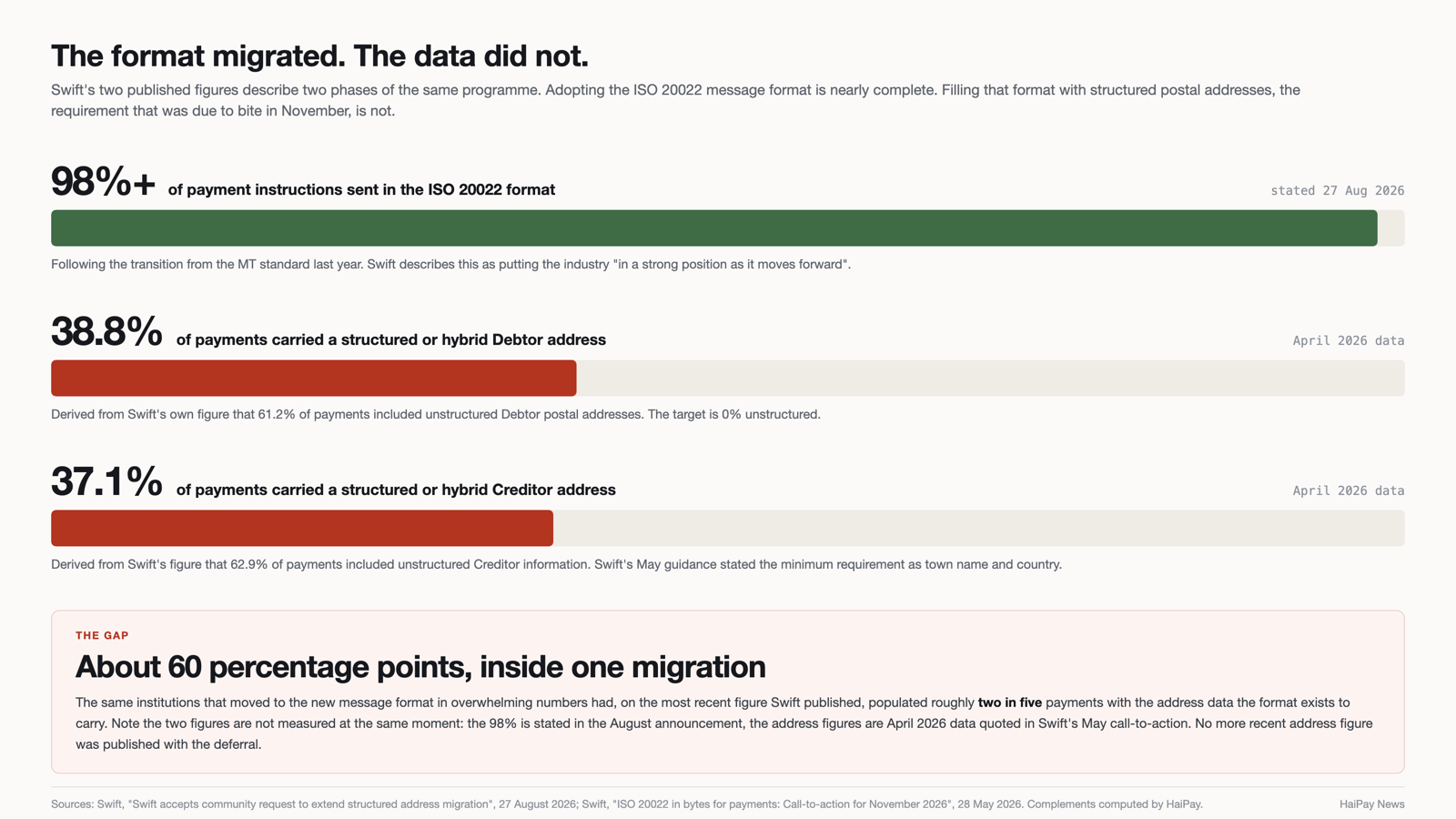
The address figures point the other way. In the May call-to-action Swift reported that April data showed 61.2 per cent of payments included unstructured Debtor postal addresses and 62.9 per cent included unstructured Creditor information. Inverted, that is 38.8 per cent and 37.1 per cent compliant, against a target of zero per cent unstructured.
The two sets of figures are not measured at the same moment. The 98 per cent is stated in the August announcement; the address percentages are April data quoted in May. Swift published no updated address figure alongside the deferral, so the most recent public number on the requirement that has just been postponed is four months old.
Taken together they describe a gap of roughly sixty percentage points inside a single migration. Adopting a message format is a systems change a bank can complete on its own. Populating that format with a structured address means obtaining the town and country of a beneficiary from a corporate customer, who has to hold it in an ERP or treasury system in the first place. The first is an IT project. The second is a data-collection problem that reaches past the bank to its clients and their records, and that is the one that has slipped.
What was deferred, and what was not
The announcement splits Standards Release 2026 into three.
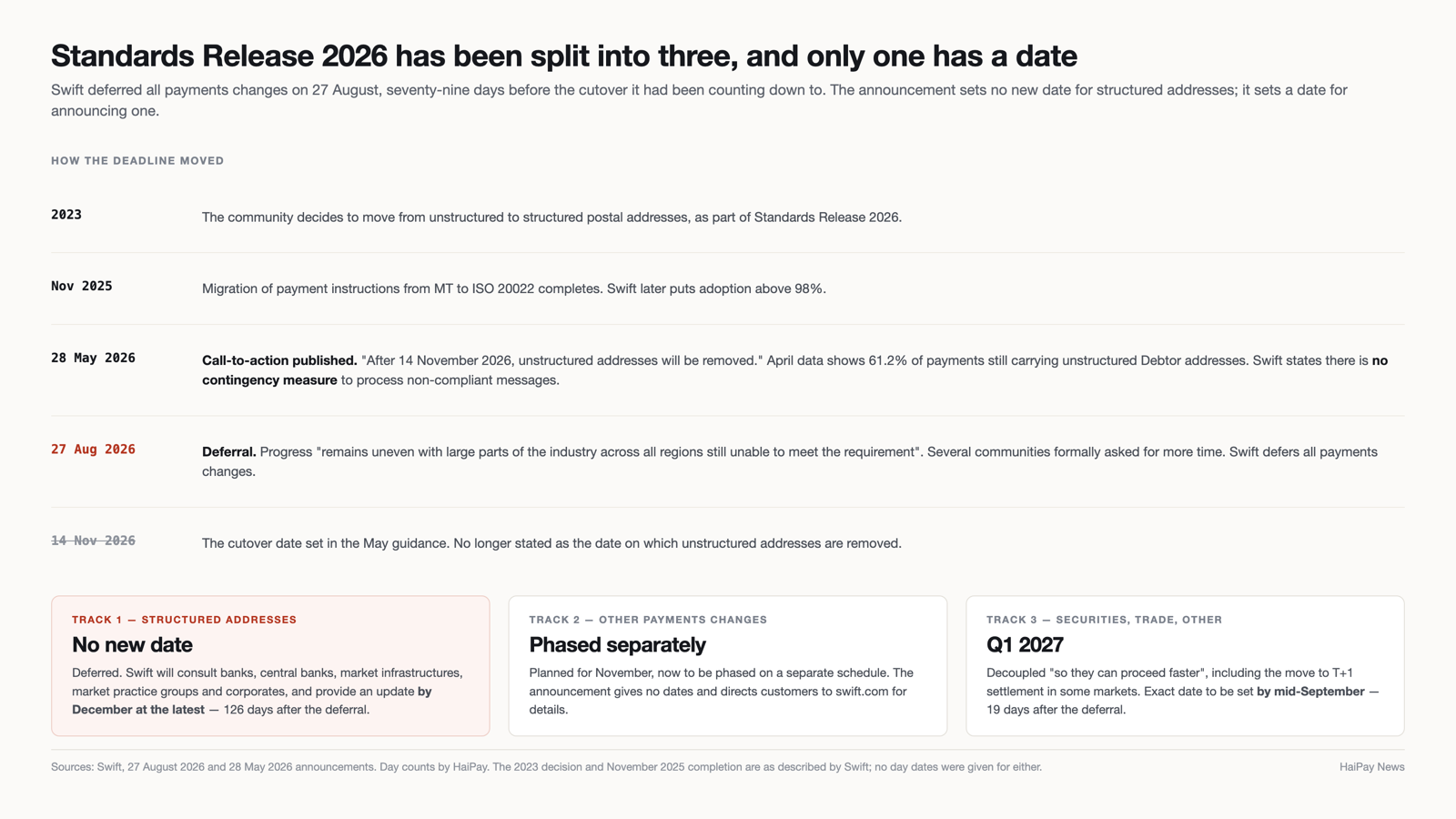
Structured addresses are deferred with no replacement date. Swift will consult banks, central banks, payment market infrastructures, market practice groups and corporates to define the timing, and will "provide an update by December, at the latest, as part of its governance cycle". That is a date for announcing a date, and it falls 126 days after the deferral.
Other payments changes planned for November "will be phased separately", with no dates given in the announcement and customers directed to swift.com for details.
Securities, trade and other changes are being decoupled "so they can proceed faster" and will go live in Q1 2027, with an exact date to be set by mid-September. Swift names the move to T+1 settlement in some markets as one of the reasons those cannot wait. Note that Q1 2027 is later than the November 2026 cutover, so "faster" here means faster than the deferred payments track rather than earlier than originally planned.
The practical position for an institution reading this is that the announcement gives no component of Standards Release 2026 a November 2026 go-live date. Whether any part of the payments package still lands in November depends on the phasing detail Swift has published elsewhere, which this announcement does not summarise.
The contingency was the date
The May guidance was unusually direct about consequences. Payments without structured or hybrid address data "may be rejected or delayed as they move through the payment chain", and institutions were told to build processes to manage rejections and repairs. Corporates on MT101 were told they must upgrade to field 59 option F. The minimum data requirement was set at town name and country.
None of that has been withdrawn. What changed is the date on which it binds. Swift's position is that institutions which have already upgraded can use structured addresses on the network today, and it "strongly encourages" market infrastructures and institutions to keep going, because domestic adoption is what enables the cross-border requirement to work.
That is a reasonable ask and also an uncomfortable one. The firms that spent to hit 14 November now carry the cost without the deadline, and the firms that did not have been proved right to wait. Any future date has to be set against that.
What we could not verify
This report is based on two Swift announcements and no other source. We did not obtain the underlying readiness data behind the 61.2 and 62.9 per cent figures, the identity of the communities that requested the extension, or the domestic payment market infrastructures that Swift says it consulted. Swift names none of them.
We could not reach swift.com by direct request while preparing this piece and read both announcements through a browser session instead. We did not review the customer-area FAQs or the Quick Guides referenced in the May guidance, which sit behind the customer login.
The 2023 decision date and the November 2025 completion are as Swift describes them; neither announcement gives a day date for either, so this piece does not compute intervals from them.
What to watch
Mid-September, for the exact Q1 2027 date on the securities track, which is the nearest commitment in the announcement and the first test of whether the new timetable holds. December, for the structured address update, which Swift has bounded as "at the latest". And the next readiness figure Swift publishes, because 61.2 per cent unstructured in April is the number any new deadline has to be justified against, and it is the one figure the deferral did not update.
Data highlight
61.2 percent
Share of payments including unstructured Debtor postal addresses on the Swift network
April 2026
Read the methodology and limitations
“Progress remains uneven with large parts of the industry across all regions still unable to meet the requirement.”
Methodology and limitations
Figure as published by Swift in "ISO 20022 in bytes for payments: Call-to-action for November 2026", 28 May 2026, which states that April's data showed 61.2 per cent of payments included unstructured Debtor postal addresses and 62.9 per cent included unstructured Creditor information, against a target of 0 per cent unstructured. HaiPay computed the complements, 38.8 per cent and 37.1 per cent, as the shares carrying structured or hybrid addresses.
The 98 per cent adoption figure for the ISO 20022 message format is stated separately in Swift's announcement of 27 August 2026 and is not measured at the same date as the address figures; the two are presented side by side in this piece with that difference stated. Swift published no updated address figure with the deferral, so April 2026 remains the most recent public reading. HaiPay did not obtain the underlying readiness data.
Term definition
- Structured postal address
- An address carried in separate named fields, such as town name and country, rather than as free text. ISO 20022 payment messages were due to require structured or hybrid addresses so that screening and automation can read the components reliably.
- Standards Release
- Swift's annual update to the message formats and rules used on its network for payments, securities, trade and other transaction types. Standards Release 2026 has been split, with payments changes deferred and securities and trade changes moved to Q1 2027.
- Hybrid address
- An address that carries some components in structured fields, typically town and country, while leaving the remainder as free text. Swift's November requirement would have accepted fully structured or hybrid addresses but not fully unstructured ones.
2 sources
How to cite
HaiPay News, "Swift Said There Was No Contingency. Then It Moved the Date.", https://www.haipay.net/news/swift-structured-address-deadline-deferred, 31 August 2026