NewsRegulation
Toast's $0 POS Plan: Six Charges the FTC Says Were Hidden
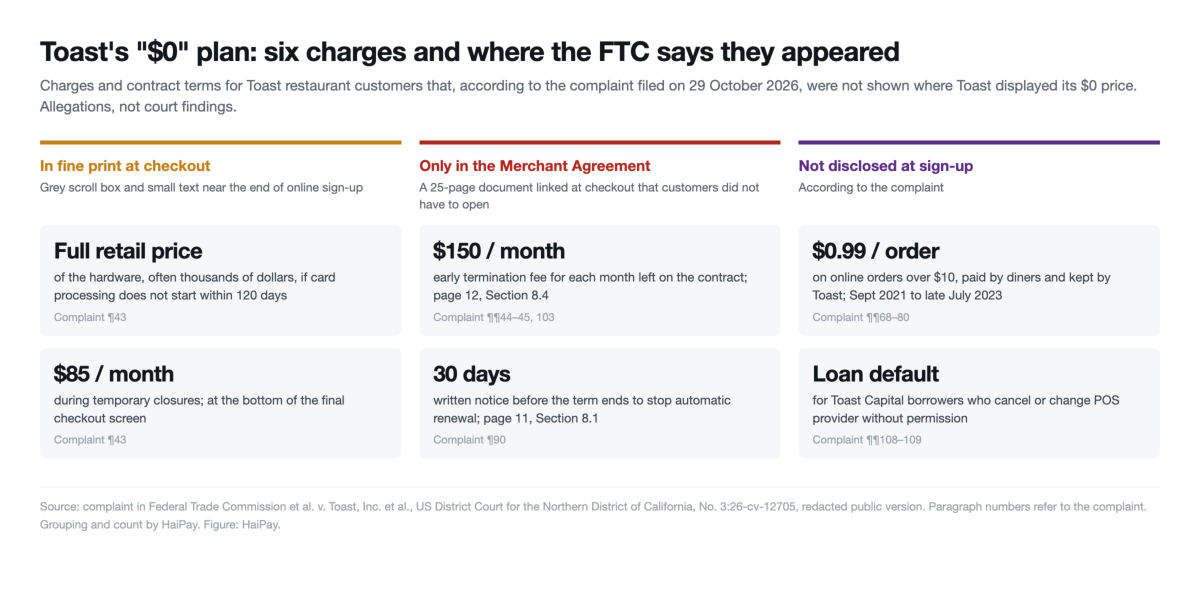
The US Federal Trade Commission and state and local enforcers say Toast's "$0" restaurant point-of-sale plan came with six charges and contract terms that did not appear beside the price. By HaiPay's reading of the 71-page complaint, two sat in checkout fine print, two only in a 25-page merchant agreement, and two were not disclosed at sign-up.

Key takeaways 6
- An FTC and state complaint says Toast's $0 POS plan carried six charges not shown beside the price.
- Two were in checkout fine print: full hardware cost if unused for 120 days, and $85 a month during closures.
- Two were only in a 25-page merchant agreement: a $150-a-month exit fee and 30 days' written notice.
- A $0.99 fee on online orders over $10 was charged to diners and kept by Toast until late July 2023.
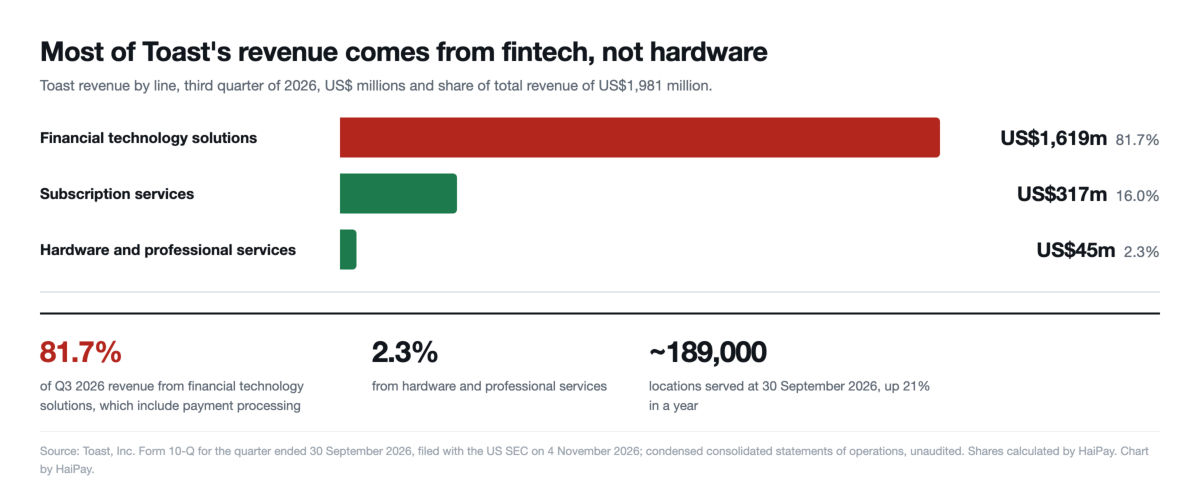
- Fintech services, including payment processing, were 81.7% of Toast's Q3 2026 revenue, by HaiPay's count.
- Toast says it strongly disagrees and will defend itself; the claims are untested in court.
Toast advertises a restaurant point-of-sale kit for "$0 to own", with software at "$0/mo". A complaint filed on 29 October by the US Federal Trade Commission, seven state attorneys general and two California local offices says Toast customers faced six charges and contract terms that did not appear where the $0 price did. HaiPay read the 71-page public version and mapped where, according to the complaint, each one was disclosed.
Two sat in fine print near the end of checkout. Two appeared only in a 25-page merchant agreement that customers did not have to open. The complaint says the other two were not disclosed at sign-up at all. The allegations have not been tested in court, and Toast says it will defend itself.
How the $0 plan was priced
On Toast's website, the Countertop Starter Kit, a terminal, a payment device and point-of-sale software, was listed at $0 under a "Pay-as-you-Go" plan selected by default, according to screenshots in the complaint. That screen said: "Card transaction fee covers most costs." Customers who switched to "Traditional" pricing saw upwards of $1,000 for the same kit and around $69 a month for software, with a lower card transaction fee.
Six charges and where they appeared
Hardware at full retail value, often thousands of dollars, if a restaurant did not start processing card payments within 120 days. This was in a grey fine-print box near the end of sign-up.
A fee of $85 a month during temporary closures, at the bottom of the final checkout screen, eight lines into a block of small text.
An early termination fee of $150 for each month left on the contract, however long the restaurant had paid the higher card rate. This was on page 12 of the merchant agreement, in Section 8.4, which has no heading.
Written notice at least 30 days before the term ends to stop automatic renewal, in the eleventh line of a 17-line paragraph on page 11.
A $0.99 fee on online orders over $10, charged to diners and kept by Toast. It began at some restaurants around September 2021, was tested in 14 markets, reached all Toast restaurants by June 2023 and was dropped in late July 2023. It was in no pricing plan or restaurant contract, and diners saw it inside a "Taxes & Fees" line.
For Toast Capital borrowers, cancelling or changing point-of-sale provider without permission is treated as a default on the loan. The complaint says this was not disclosed during the loan application.
Cancelling involves several teams
Customers could sign up online but could not cancel online. After giving written notice, they had to call customer care, then be transferred to a cancellation line that Toast calls the "churn line", open on weekdays from 9am to 5pm Eastern time, and stay on the call while filling in a deactivation form of about 15 minutes. Another team then had to process the form before the cancellation took effect. Payroll customers needed separate notice 90 days before their payroll term ended.
Among the examples the complaint cites are a $5,318.87 termination fee charged after four years, and a $17,030.74 invoice sent to a restaurant that cancelled before receiving any equipment.
Fintech, not hardware, carries the revenue
Toast's own filings show how little of its revenue comes from hardware. In the third quarter of 2026, financial technology solutions, which include payment processing and loans, brought in US$1,619 million, 81.7% of Toast's US$1,981 million revenue, by HaiPay's calculation. Subscriptions were 16.0% and hardware and professional services 2.3%. Toast served about 189,000 locations at the end of September. The complaint puts the figure at 156,000.
What Toast says
In its quarterly report filed on 4 November, Toast said it had cooperated with an FTC investigation since June 2025 and negotiated after receiving a draft complaint in June 2026, without reaching agreement. It said it "strongly disagrees" with the FTC's challenges, including whether certain of the laws apply to its type of business, and that it cannot yet estimate any possible loss.
What this does not show
These are allegations, and no court has ruled on them. The public complaint is redacted in places, including Toast's average monthly subscription spend and how much it earned from the $0.99 fee. It says at least tens of thousands of consumers complained but gives no exact count. HaiPay's count of six depends on how charges are grouped and leaves out add-on prices the complaint does not call hidden. HaiPay did not contact Toast.
What to watch
Toast's formal response in the Northern District of California.
Whether Toast changes how the $0 plan is presented on its pricing pages.
And whether the $0.99 fee is refunded, which the complaint says Toast has not done.
About HaiPay's card acquiring
HaiPay, which publishes this news section, offers card acquiring for online merchants. Its credit card page publishes card rates for US merchants contracting through its US entity, after a business and risk review, and offers either a blended rate or interchange-plus-plus pricing, which lists interchange, scheme fees and HaiPay's processing fee separately. For the blended rate, the page lists no setup or annual fees and no minimum monthly billing. Learn more about HaiPay's card acquiring.
Data highlight
6 charges and contract terms
Charges and contract terms that the FTC complaint against Toast says were not shown where Toast advertised its $0 point-of-sale plan
Complaint filed 29 October 2026
Read the methodology and limitations
Data as of 5 November 2026 · UTC
Methodology and limitations
Compiled by HaiPay on 5 November 2026 from the redacted public version of the complaint filed on 29 October 2026 in the US District Court for the Northern District of California, Federal Trade Commission et al. v. Toast, Inc. et al., case 3:26-cv-12705, as posted by the FTC, and from Toast's Form 10-Q for the third quarter of 2026. HaiPay listed each charge or contract term with a stated amount or deadline that the complaint says was not disclosed, or was disclosed only in fine print or in the Merchant Agreement, rather than where Toast displayed its $0 price, and recorded where the complaint says it appeared, with paragraph numbers. Add-on prices that the complaint does not describe as hidden, such as kiosk and kitchen display subscriptions, are excluded. The count depends on this grouping. The complaint's statements are allegations that have not been tested in court. Revenue shares are HaiPay's calculations from Toast's condensed consolidated statements of operations, which are unaudited. HaiPay did not contact Toast or the plaintiffs.
Data note
HaiPay counted the charges and contract terms with a stated amount or deadline that the complaint filed on 29 October 2026 (N.D. Cal. No. 3:26-cv-12705) says were not shown where Toast displayed its $0 price: full hardware cost if card processing does not start within 120 days; US$85 a month during temporary closures; a US$150-a-month early termination fee; 30 days' written notice to stop renewal; a US$0.99 diner fee on online orders over US$10; and loan default on changing POS provider.
Allegations, not court findings; the count depends on HaiPay's grouping.
Data and research materials
- Charges and contract terms in the FTC complaint against Toast, by where disclosed (HaiPay) ↓CSV · 4 KB
6 rows compiled by HaiPay on 5 November 2026 from the redacted public complaint in FTC et al. v. Toast, Inc. et al., US District Court for the Northern District of California, No. 3:26-cv-12705, filed 29 October 2026. Columns: charge or contract term, amount or deadline, who pays, where the complaint says it was disclosed, HaiPay's disclosure grouping, complaint paragraph numbers, source and status. All entries are allegations in the complaint, not court findings.
HaiPay's charts and the CSV table on this page may be reused with attribution to HaiPay and a link to this article. The underlying statements are allegations in a public court complaint and figures from Toast's SEC filing; the grouping, count and revenue shares are HaiPay's.
Term definition
- Point of sale (POS)
- The hardware and software a business uses to take orders and accept payments at the counter or table.
- Early termination fee
- A charge for ending a contract before its term is over, often based on the months remaining.
- ROSCA
- The Restore Online Shoppers' Confidence Act, a US law requiring clear disclosure, express consent and a simple cancellation method for subscriptions sold online.
4 sources
- Federal Trade Commission
71-page redacted public complaint filed 29 October 2026 by the FTC, the attorneys general of Colorado, Florida, Illinois, Iowa, Nebraska, Oklahoma and Utah, and the People of California through the Los Angeles County Counsel and San Francisco City Attorney. Source of the $0 Starter Kit and Pay-as-you-Go screens (paragraphs 35-39); the 120-day hardware term and US$85 monthly fee (43); the US$150-a-month early termination fee on page 12 of a 25-page Merchant Agreement (44-45, 103); the 30-day written notice on page 11 (90); the US$0.99 diner fee (68-80); the Toast Capital default term (108-109); the cancellation process (89-101); the US$5,318.87 and US$17,030.74 examples (102); the 156,000 locations figure (32).
Accessed 5 November 2026 · UTC
- Federal Trade Commission
FTC press release dated 29 October 2026: list of co-plaintiffs, court, 2-0 Commission vote, alleged violations of the FTC Act, ROSCA and state laws, and the US$0.99 fee period from September 2021 to late July 2023.
Accessed 5 November 2026 · UTC
- Federal Trade Commission
Toast, Inc. case page, FTC Legal Library
FTC case page for matter 252-3101, linking the complaint.
Accessed 5 November 2026 · UTC
- U.S. Securities and Exchange Commission
Toast, Inc. Form 10-Q for the quarter ended 30 September 2026
Filed 4 November 2026. Note 11: FTC civil investigative demand received in June 2025, draft complaint in June 2026, unsuccessful negotiations, complaint filed 29 October 2026; Toast strongly disagrees and cannot estimate a reasonably possible loss. Statements of operations: Q3 2026 revenue of US$1,981 million, of which financial technology solutions US$1,619 million, subscription services US$317 million and hardware and professional services US$45 million. About 189,000 locations at 30 September 2026.
Accessed 5 November 2026 · UTC
How to cite
HaiPay News, "Toast's $0 POS Plan: Six Charges the FTC Says Were Hidden", https://www.haipay.net/news/ftc-toast-zero-dollar-pos-plan-six-charges, 5 November 2026