NewsAcquiring
Court Voids Fed's Debit Cap; Average Fee Held at 23 Cents
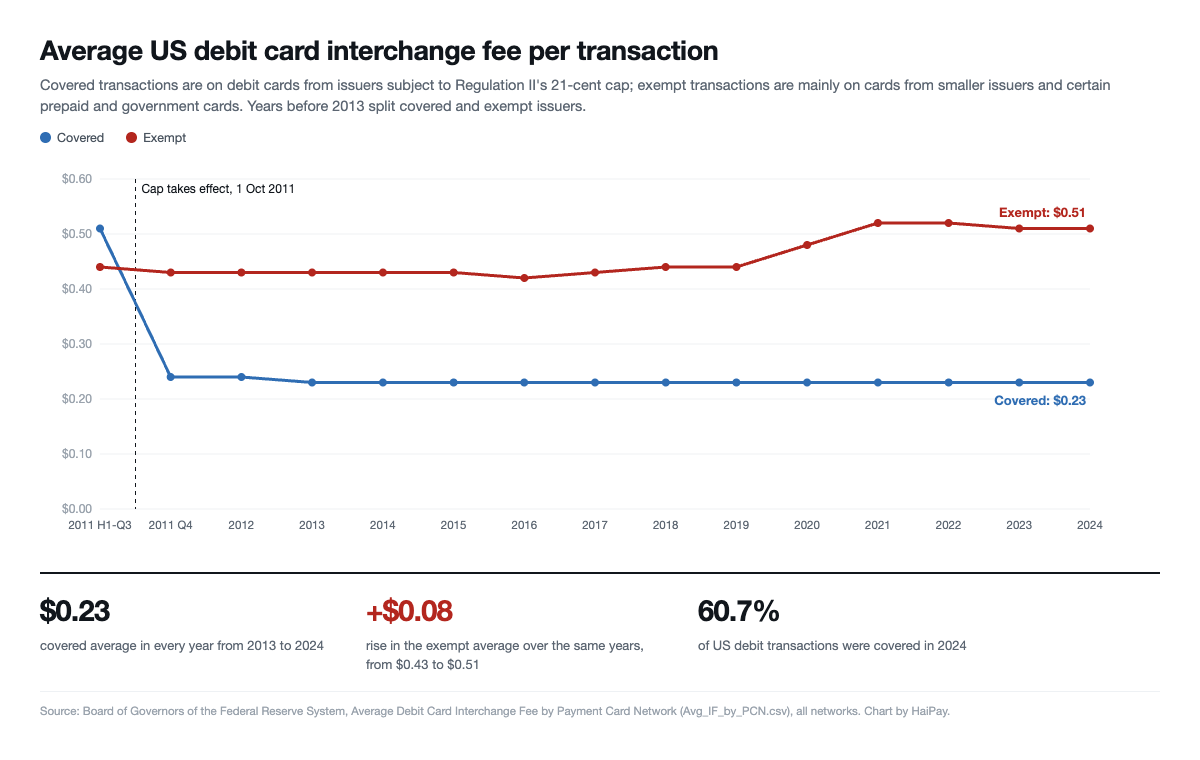
The US Court of Appeals for the Eighth Circuit on 26 October 2026 upheld the vacatur of Regulation II's 21-cent debit interchange cap, holding that the Durbin Amendment allows the Federal Reserve to consider only the marginal cost of a transaction. Fed data show the cap held the average fee on covered transactions at $0.23 in every year from 2013 to 2024.
Key takeaways 6
- The Eighth Circuit on 26 October 2026 upheld vacating the Fed's 21-cent debit interchange cap.
- The court read the Durbin Amendment's incremental cost as marginal cost, excluding fixed costs.
- Covered debit transactions averaged $0.23 in interchange in every year from 2013 to 2024.
- The exempt average rose from $0.43 to $0.51 over the same years.
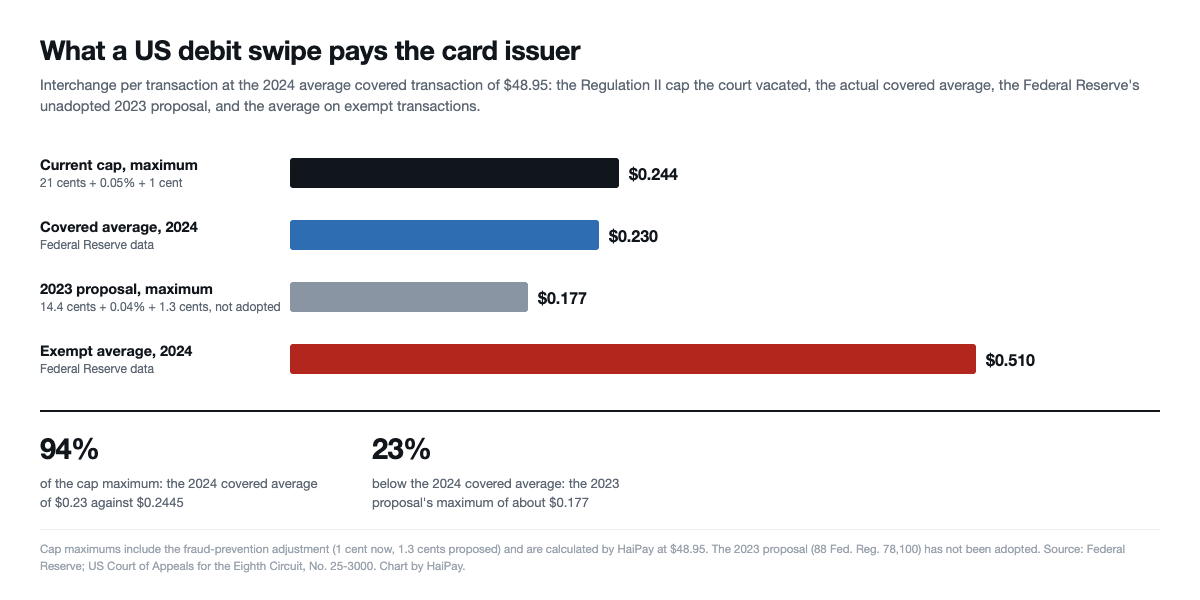
- The Fed's unadopted 2023 proposal would allow about $0.177 on a $48.95 transaction.
- The ruling takes effect only when the mandate issues, no earlier than 17 December 2026.
A federal appeals court on 26 October 2026 upheld a ruling that throws out the Federal Reserve's cap on debit card interchange fees, the 21 cents plus 0.05% of the transaction that large banks have been allowed to charge merchants' banks on each swipe since October 2011.
A three-judge panel of the US Court of Appeals for the Eighth Circuit, in an opinion by Judge David Stras, held that the Durbin Amendment lets the Fed consider only the incremental cost of a particular transaction, which the court read as marginal cost. The district court had found that Regulation II, the Fed's 2011 rule, also counted fixed costs, network processing fees, fraud-monitoring costs and fraud losses. The case, Corner Post v. Board of Governors, was brought by a North Dakota truck stop and was sent back to the Fed to set a new fee structure.
Twelve years at 23 cents
Federal Reserve data show what the cap did. On cards from issuers subject to the rule, the average interchange fee fell from $0.51 in the first nine months of 2011 to $0.24 in the last quarter. On these covered transactions it has been $0.23 in every year from 2013 to 2024. Over the same years the average on exempt transactions, on cards from smaller issuers and certain prepaid and government cards, rose from $0.43 to $0.51.
In 2024, covered transactions were 60.7% of US debit transactions. At their average value of $48.95, the cap allowed at most about $0.2445 including the one-cent fraud-prevention adjustment, so the $0.23 average was 94% of the maximum. A lower cap the Fed proposed in 2023 and never adopted, 14.4 cents plus 0.04% plus 1.3 cents, would have allowed about $0.177, 23% below the 2024 average.
What the court did and did not decide
The court did not set a number. It said the Fed may use a proxy such as average variable cost if it bears a reasonable relationship to marginal cost, but must at least sort costs into those specific to a transaction and those that are not, rather than pick a single cap. The ruling takes effect only when the court issues its mandate, seven days after the 45-day window for seeking rehearing closes or a petition is denied, so no earlier than 17 December 2026.
The opinion's caption lists 43 amicus entries supporting the Fed, including the American Bankers Association, The Clearing House and the Bank Policy Institute, and 18 supporting Corner Post, including the Retail Litigation Center, the Merchant Advisory Group and Senator Richard Durbin, whose name the amendment bears.
What this does not show
The Fed's averages cover all networks and do not show what any one merchant pays; merchants also pay acquirer and network fees on top of interchange. The 2024 data are the latest the Fed has published. A separate challenge, Linney's Pizza v. Board of Governors, has been on appeal at the Sixth Circuit since November 2025. HaiPay did not contact the parties or the Federal Reserve.
What to watch
Whether the Fed or the banking groups seek rehearing before the full Eighth Circuit, or Supreme Court review.
Whether the Fed finalises its 2023 proposal or starts again on a marginal-cost basis.
And whether the Sixth Circuit reaches the same reading of incremental cost.
About HaiPay's card acquiring
HaiPay, which publishes this news section, offers card acquiring connected to Visa, Mastercard and other major card networks, with USD settlement and additional settlement currencies in selected markets. Alongside blended pricing, it offers an Interchange++ option that bills interchange and scheme fees separately from its processing fee, with a complete fee breakdown, so merchants can see interchange as its own line. Rates on its product page apply to US merchants contracting through its US entity after a business and risk review. Learn more about HaiPay's card acquiring.
Data highlight
0.23 US$ per transaction
Average interchange fee on covered US debit card transactions, all networks, in each year from 2013 to 2024
2013 to 2024
All-networks average interchange fee per covered transaction from the Federal Reserve Board's file Avg_IF_by_PCN.csv, read by HaiPay on 27 October 2026. Covered transactions are those on debit cards from issuers subject to Regulation II, excluding exempt prepaid and government cards. The average was $0.23 in each year from 2013 to 2024 (2012: $0.24), against $0.43 to $0.51 on exempt transactions. In 2024 covered transactions were 60.7% of transactions, at an average value of $48.95.
Data as of 27 October 2026 · UTC
Methodology and limitations
Compiled by HaiPay on 27 October 2026. The ruling is the Eighth Circuit opinion in Corner Post, Inc. v. Board of Governors of the Federal Reserve System, No. 25-3000, filed 26 October 2026 and read in full from the court's website. Fee data are from the Federal Reserve Board's file Avg_IF_by_PCN.csv (Average Debit Card Interchange Fee by Payment Card Network), all-networks row, for January to September 2011 through 2024. Covered transactions are those on debit cards from issuers subject to Regulation II's interchange fee standard, excluding exempt prepaid and government-program cards; before 2013 the Board split data by covered and exempt issuer rather than transaction. The covered average was $0.23 in every year from 2013 to 2024 and $0.24 in 2012; the exempt average rose from $0.43 in 2013 to $0.51 in 2024. HaiPay calculated cap maximums at the 2024 average covered transaction of $48.95: $0.21 plus 0.05% plus the $0.01 fraud-prevention adjustment gives $0.2445; the Board's 2023 proposal of 14.4 cents plus 0.04% plus a 1.3-cent adjustment (88 Fed. Reg. 78,100, not adopted) gives about $0.177. The earliest date the mandate could issue assumes no petition for rehearing: 45 days after 26 October 2026 is 10 December, plus seven days. The amici count is the number of entries in the opinion's caption; some entries name groups of organisations or professors. HaiPay did not contact the parties or the Federal Reserve.
Data and research materials
- US debit card interchange fees, covered and exempt, 2011 to 2024 (Federal Reserve data, compiled by HaiPay) ↓CSV · 3 KB
16 rows, one per period from January to September 2011 to 2024, compiled by HaiPay on 27 October 2026 from the all-networks row of the Federal Reserve Board's Avg_IF_by_PCN.csv. For covered, exempt and all transactions: share of transaction count, average transaction value, average interchange fee per transaction and fee as a percentage of value. Rows before 2013 split covered and exempt issuers rather than transactions, as marked in split_basis.
HaiPay's charts and the CSV table on this page may be reused with attribution to HaiPay and a link to this article. The underlying data are published by the Board of Governors of the Federal Reserve System; the opinion is a public court record.
Term definition
- Interchange fee
- A fee the merchant's bank pays the cardholder's bank on each card transaction, set by the card network.
- Regulation II
- The Federal Reserve's 2011 rule implementing the Durbin Amendment, including the 21-cent debit interchange cap for large issuers.
- Covered issuer
- A debit card issuer that, with its affiliates, has $10 billion or more in assets and is subject to the Regulation II fee cap.
- Mandate
- The formal order by which an appeals court's judgment takes effect, issued after the time to seek rehearing has passed.
4 sources
- U.S. Court of Appeals for the Eighth Circuit
Opinion filed 26 October 2026 by Judge Stras for a panel of Judges Smith, Benton and Stras: affirms vacatur of the 21-cent cap, holds incremental cost means marginal cost, remands to the Board; footnotes on the unadopted 2023 proposal and on when the mandate issues; caption lists the amici.
Accessed 27 October 2026 · UTC
- Board of Governors of the Federal Reserve System
Average Debit Card Interchange Fee by Payment Card Network
Federal Reserve page on Regulation II with the 2024 table: covered transactions averaged $0.23 (0.47% of a $48.95 average transaction) and were 60.7% of transactions; exempt transactions averaged $0.51.
Accessed 27 October 2026 · UTC
- Board of Governors of the Federal Reserve System
Average debit card interchange fee by payment card network, data file (Avg_IF_by_PCN.csv)
Data file behind the page, 2009 to 2024; HaiPay read the all-networks row for each year to build the covered and exempt series.
Accessed 27 October 2026 · UTC
- Free Law Project
Linney's Pizza, LLC v. Board of Governors of the FRS, No. 25-6038 (6th Cir.), docket
Docket opened 13 November 2025 for a separate challenge to Regulation II pending at the Sixth Circuit.
Accessed 27 October 2026 · UTC
How to cite
HaiPay News, "Court Voids Fed's Debit Cap; Average Fee Held at 23 Cents", https://www.haipay.net/news/eighth-circuit-vacates-fed-debit-interchange-cap-regulation-ii, 27 October 2026