NewsAI & API Payments
The Bank-Owned Blockchain Has No California and No New York.
Set the published list against all fifty states and eleven have no bankers association named. Three of them — California, New York and Illinois — are among the largest banking markets in the country.
Key takeaways 6
- Thirty-nine state bankers associations announced BankChain Alliance on 25 August, targeting a 2027 launch.
- The published participant list carries 39 entries but names only 38 distinct associations. Oregon appears twice.
- The duplicate sits where Rhode Island would fall alphabetically, so the 39th member is an inference, not a confirmed fact.
- Eleven states have no bankers association named, including California, New York and Illinois.
- The alliance is still selecting a technology partner, so the platform the network runs on is undecided.
- Named capabilities are smart payment tools, tokenised deposits, stablecoins and automated settlement.
Thirty-nine state bankers associations announced on Tuesday 25 August that they are forming BankChain Alliance, an industry-owned, industry-designed and industry-governed network built on a common blockchain platform. The stated purpose is to let banks of any size offer smart payment tools, tokenised deposits, stablecoins and automated settlement while keeping the regulatory standards their customers expect.
The alliance is still selecting a technology partner and is targeting a 2027 launch. Kathy Kraninger, the interim chair and president and chief executive of the Florida Bankers Association, called it "an unprecedented collaboration representing thousands of banks".
Who is not in it
The more useful question for anyone assessing how national this network will be is which states are absent. Set the published participant list against all fifty and eleven states have no bankers association named.
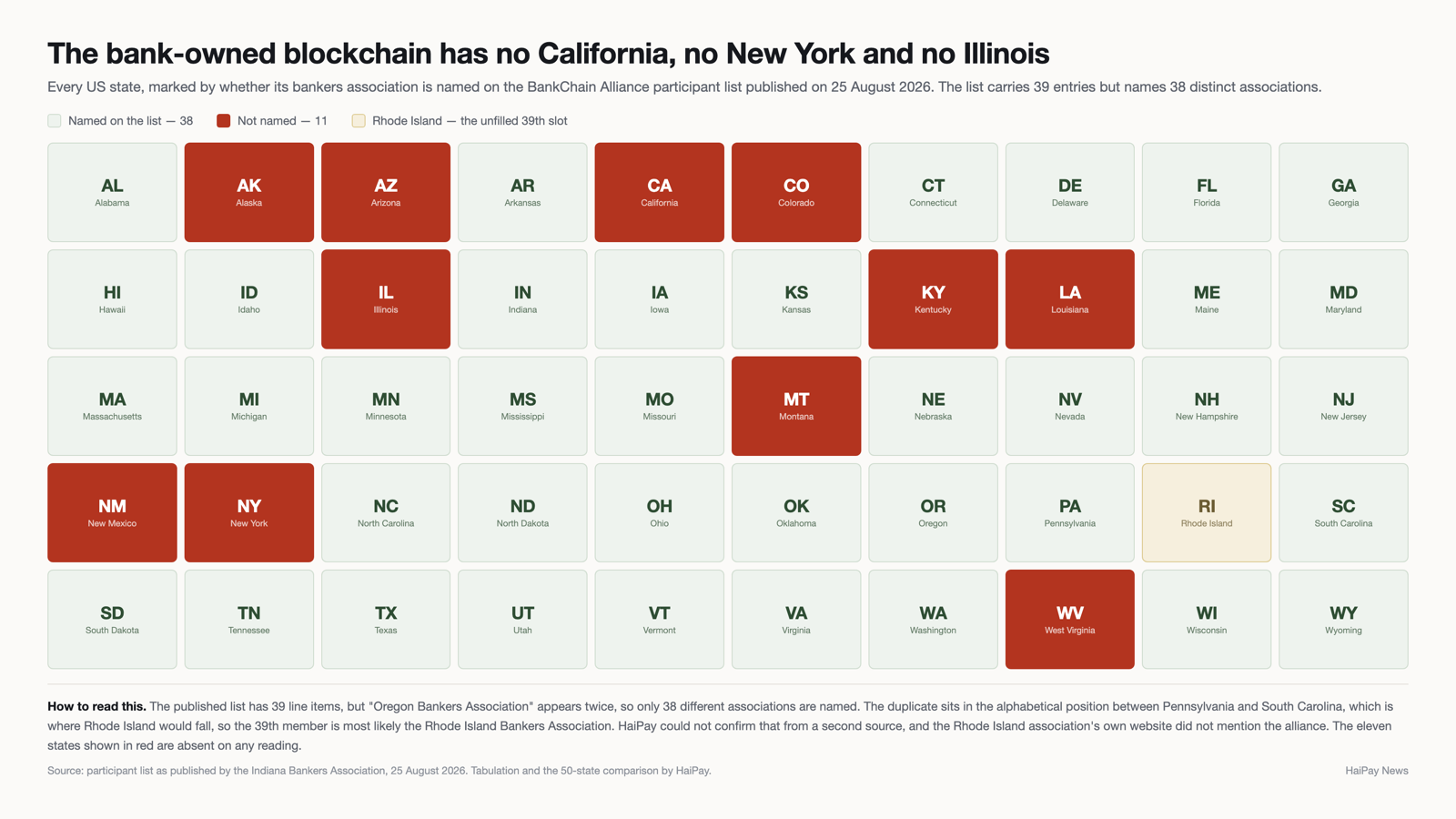
They are Alaska, Arizona, California, Colorado, Illinois, Kentucky, Louisiana, Montana, New Mexico, New York and West Virginia.Three of those matter more than the others. California, New York and Illinois are among the largest banking states in the country, and each has a long-established state bankers association: HaiPay confirmed the California Bankers Association and the Illinois Bankers Association by name from their own websites. Texas is in the alliance; the other three of the four largest state banking markets are not.Nothing in the announcement suggests those associations were excluded, and none of them has said anything publicly that we could find. An alliance that says it "invites ownership from banks across the country" may well add them. But as announced, a network describing itself as serving customers "across the country" does not include the trade bodies for the banks of California, New York or Illinois, and that is the gap any assessment of its reach has to start from.
Thirty-nine line items, thirty-eight associations
The list itself has a defect. It carries thirty-nine entries, which matches the headline number, but one association is printed twice.
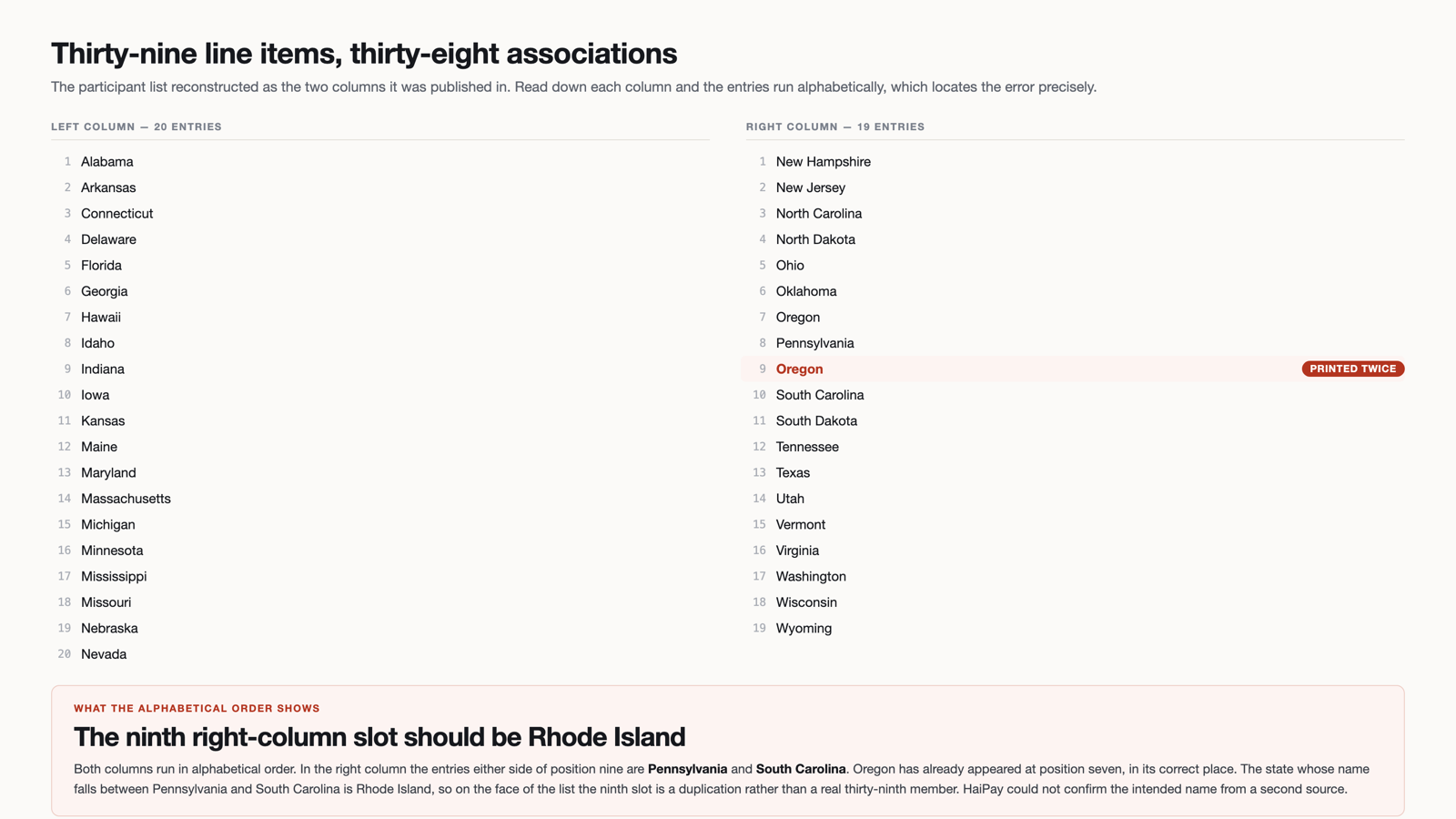
Read as the two columns it was set in, the list runs alphabetically down each. The Oregon Bankers Association appears at position seven of the right-hand column, in its correct alphabetical place, and again at position nine, between Pennsylvania and South Carolina. The state whose name falls in that gap is Rhode Island.
So the list names thirty-eight distinct associations, and the identity of the thirty-ninth is an inference rather than a fact. We could not confirm it. The Rhode Island Bankers Association's own website made no mention of BankChain Alliance when we checked, which is not evidence of absence but is not confirmation either.
This is a small error in a press release and it will presumably be corrected. It is worth recording because the number thirty-nine is doing work in the coverage of this announcement, and the published evidence for it is thirty-eight names and a duplicate.
What has been decided, and what has not
What is settled is the governance intent. The alliance describes itself as owned, designed and governed by the industry, says the network will be interoperable with other networks, and invites ownership from banks across the country. Kraninger frames it as institutions of all sizes serving "rural, urban and regional communities".
What is not settled is almost everything technical. The announcement says the alliance is "undergoing a rigorous process to select a technology partner", so the platform is undecided. The launch is described as targeted for 2027, with no month. There is no stated position on which of the listed capabilities — smart payment tools, tokenised deposits, stablecoins, automated settlement — comes first, no disclosed governance structure beyond an interim chair, and no figure for what any of it costs or who funds it.
That is a normal shape for an announcement at this stage. It also means the concrete content of the news is the coalition itself: thirty-eight named trade bodies agreeing to build something together, before knowing what they will build it on.
What we could not verify
We worked from the announcement text as published by the Indiana Bankers Association, one of the participants. We did not reach a BankChain Alliance website; bankchainalliance.org did not respond when we tried it. Two other participating associations' homepages, Massachusetts and Florida, carried no mention of the alliance at the time we looked, and we did not search their full news archives.
We did not verify the identity of the thirty-ninth association, whether any of the eleven absent states was approached, or whether any association declined. We have no information on the shortlist of technology partners, the funding model, or the legal form the alliance takes.
The phrase "thousands of banks" is the alliance's own characterisation of the membership its participants represent in aggregate. We did not attempt to count the member banks of thirty-eight associations, and no participant total is given in the announcement.
What to watch
The technology partner selection, because it is the first decision that will reveal whether this is a serious build or a positioning exercise, and because the choice determines interoperability with everything else in the market. Whether California, New York or Illinois joins, because any one of them would change the reach of the network materially. And a corrected participant list, which will settle whether the thirty-ninth member is Rhode Island or someone else entirely.
Data highlight
38 associations
Distinct state bankers associations named on the BankChain Alliance participant list
As published 25 August 2026
Read the methodology and limitations
“This is about banks of all sizes building their own future. Through an unprecedented collaboration representing thousands of banks, BankChain Alliance is developing a secure, regulated, industry-built and industry-owned network that allows institutions of all sizes to provide modern capabilities so they can continue serving customers safely and efficiently in rural, urban and regional communities across the country.”
Methodology and limitations
Counted from the participant list in the announcement as published by the Indiana Bankers Association on 25 August 2026. The list contains 39 line items. The Oregon Bankers Association appears twice, so 38 distinct associations are named. The list was set in two columns, which the extracted text interleaves; reconstructing them gives a left column of 20 entries running alphabetically from Alabama to Nevada and a right column of 19 running from New Hampshire to Wyoming, 39 positions in total.
Both columns are in alphabetical order, and the duplicate Oregon entry occupies right-column position nine, between Pennsylvania and South Carolina, which is where Rhode Island would fall. HaiPay could not confirm the intended name from a second source and does not treat Rhode Island as a member. The absent-state count of eleven is the set difference between the 50 states and the 38 named, excluding Rhode Island from both sides of the question, and holds whether or not Rhode Island is the 39th member.
Term definition
- State bankers association
- A trade body representing the banks chartered or operating in one US state. Every state has one, they are independent of each other, and they are the vehicle through which BankChain Alliance is being organised.
- Tokenised deposit
- A claim on a commercial bank deposit recorded on a distributed ledger, so it can be transferred programmatically while remaining a liability of the issuing bank. It is one of the capabilities the alliance says its network will support.
- Industry-owned network
- A shared network owned and governed by the institutions that use it rather than by an external vendor. The alliance describes its network as industry-owned, industry-designed and industry-governed, and says it invites ownership from banks across the country.
1 sources
- Indiana Bankers Association
IBA part of 39-state launch of industry-owned blockchain network
How to cite
HaiPay News, "The Bank-Owned Blockchain Has No California and No New York.", https://www.haipay.net/news/bankchain-alliance-thirty-eight-associations, 31 August 2026