Wise expands Asia-Pacific coverage for Business accounts
Wise has broadened its Wise Business account offering in Asia-Pacific, introducing additional local account details and payout options so companies can transact in local currencies without opening traditional bank accounts in each market, according to PYMNTS.com.
June 8th, 2026
Last updated: June 8
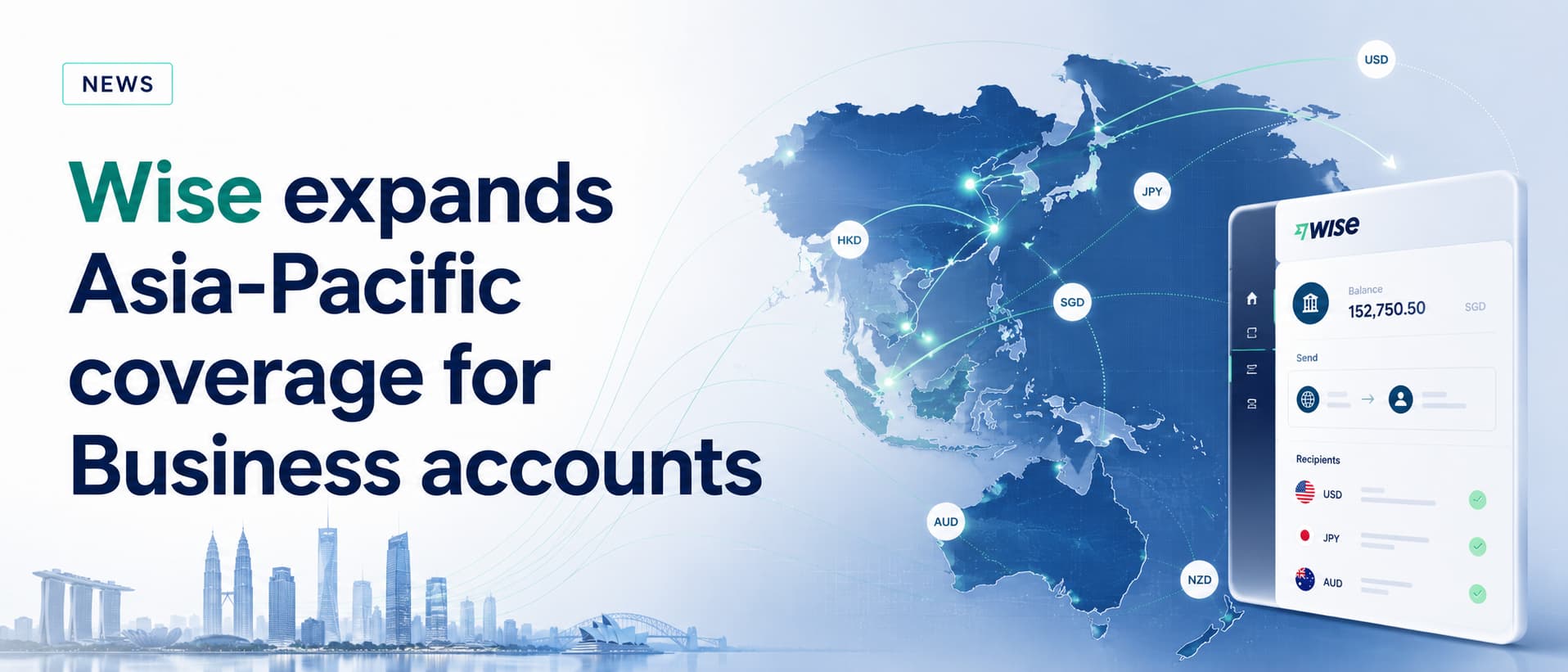
Wise is expanding the Asia-Pacific coverage of its Wise Business account, adding more local account details and payout capabilities for companies operating across borders, according to PYMNTS.com.
The move is aimed primarily at small and medium-sized enterprises (SMEs) that need to send, receive, hold, and convert funds in multiple currencies while working with customers, suppliers, employees, and partners across the region.
Expanded local account details in Asia-Pacific
PYMNTS.com reports that Wise Business customers can now access additional local account details in selected Asia-Pacific markets. These details function similarly to domestic banking credentials, allowing businesses to receive payments in local currencies as if they had a local bank account.
For companies operating across multiple jurisdictions, this can reduce the need to open and maintain separate bank accounts in each market. It also gives businesses more options for routing incoming payments and managing regional cash flows through a single digital account structure.
The expanded coverage is designed to support use cases such as invoicing customers across Asia-Pacific, paying overseas suppliers, managing remote employees and contractors, and settling platform or marketplace transactions in local markets.
Multi-currency tools for SMEs
The Wise Business account already allows companies to hold balances in multiple currencies, convert between currencies, and send payments to overseas recipients. The expanded Asia-Pacific coverage adds more local receiving capabilities to these existing features.
Business customers can use the account to receive payments through local account details, hold funds in different currencies, convert balances when needed, and make cross-border payouts from the same account.
This integrated model is positioned as an alternative to managing several domestic bank accounts, separate foreign exchange arrangements, and multiple cross-border transfer providers. For SMEs with international operations, consolidating these functions into one platform may help simplify treasury and payment workflows.
Reducing friction in cross-border payments
A central part of Wise’s strategy is to reduce the cost and complexity commonly associated with traditional cross-border payment routes. Conventional international transfers can involve correspondent banks, multiple intermediaries, opaque fees, and slower settlement times.
Wise positions its Business account around upfront pricing and transparent exchange rates. Customers are shown fees before confirming a transfer, and the applicable exchange rate is disclosed in advance.
By expanding local account endpoints and payout routes in Asia-Pacific, Wise aims to make it easier for businesses to receive and send money across the region. For smaller companies, this may reduce administrative overhead and make cross-border payment operations more predictable.
Asia-Pacific as a key growth region
The expansion comes as cross-border digital commerce continues to grow across Asia-Pacific. The region plays a major role in global supply chains, digital trade, and international services, making it an important market for payment and financial technology providers.
Many SMEs now serve customers and work with suppliers across several Asian markets, but do not have the resources to establish separate banking relationships in every jurisdiction. Wise’s expanded Business account is designed to address this gap by giving companies access to more localized account and payment capabilities through a single platform.
Use cases for globally active businesses
According to PYMNTS.com, companies use Wise Business to support several operational payment flows, including international payroll, supplier payments, client receipts, and marketplace settlements.
For example, a business may need to pay contractors in one country, receive revenue from customers in another, and hold balances in several currencies before converting them. With additional local account details in Asia-Pacific, Wise aims to make these flows easier to manage.
The ability to hold funds in different currencies may also help companies manage foreign exchange exposure. Instead of converting funds immediately upon receipt, businesses can choose when to convert based on operational needs and market conditions.
Part of a broader infrastructure strategy
PYMNTS.com frames the Asia-Pacific expansion as part of Wise’s broader effort to build infrastructure for faster and more transparent cross-border money movement. In addition to serving business and consumer customers directly, Wise also provides embedded cross-border payment capabilities to financial institutions and platforms.
More local endpoints and payout routes may therefore improve the reliability and speed of transfers not only for Wise Business customers, but also for partners that use Wise’s underlying infrastructure.
Competitive context in cross-border payments
Wise’s expansion comes at a time when payment providers are competing to offer more localized payment and account experiences across major regions. In Asia-Pacific, businesses increasingly need access to local payment methods, local receiving options, transparent pricing, and simpler reconciliation tools.
Other providers are also investing in regional payment infrastructure and local payment access. While their models differ, the broader industry trend is clear: cross-border payment competition is increasingly centered on geographic coverage, local capabilities, transparent costs, and the ability to unify complex payment flows under a single digital platform.
For globally active businesses, the question is no longer only whether a provider can move money across borders. Companies are also evaluating whether their payment partner can support local account details, multi-currency management, efficient payouts, and a smoother operational experience across multiple markets.
Although PYMNTS.com does not disclose the exact number of newly added markets or projected transaction volumes, the expansion highlights Wise’s continued focus on making cross-border business payments feel closer to domestic banking.
Source: PYMNTS.com.
How to cite
HaiPay News, "Wise expands Asia-Pacific coverage for Business accounts", https://www.haipay.net/news/wise-expands-asia-pacific-coverage-for-business-accounts, June 8th, 2026
3 sources



Discover More

BLIK Recurring Payments Now Available for ChatGPT Subscriptions
3 sources
U.S. Publishes X9.150 Standard for Interoperable QR Code Payments
4 sources
Cross-Border Checkout Data Shows Local Payment Choice Remains Critical for Global Merchants
2 sources
Payfuture Launches Shopify Integration for India Local Payments
3 sources