B2B Payment Acceptance: The Supplier's Side
Reviewed by Wesley Wang










Last updated: August 20th, 2026
Acceptance is the supplier side
Acceptance is the receiving side of B2B payments: which methods you can take, what each costs you rather than the buyer, and whether the payment arrives with enough data to close the invoice.
B2B payment acceptance is a supplier's ability to receive payments from business buyers — by card, bank transfer, or invoice-based methods — and reconcile them against invoices. It differs from consumer acceptance in approval chains, larger amounts, net payment terms, and the data (like Level 2/3) each transaction carries.
What Is B2B Payment Acceptance?
Each noun there is a supplier decision: which methods you can receive, what each costs you (not the buyer), and how fast funds land. The sleeper is a fourth decision: whether a payment carries enough data to close an invoice without human matching.
One boundary, because the language slides: "B2B payments" is the umbrella for the whole flow — procurement, invoicing, approval, settlement — and most of what's written addresses the paying side. "Acceptance" is strictly the receiving side: what a supplier stands up to get paid. This page stays in that seat.
Per Mastercard, B2B payments represent a serviceable addressable market of $80 trillion, including a $63 trillion opportunity in invoice-based payments.
Source: Mastercard, "Unlock new growth in B2B acceptance" (commercial payments page), accessed 2026-08-20.
How B2B Payment Acceptance Works
Whatever the method, an accepted payment moves through four stages on the supplier's side:
- Presentment — the buyer initiates payment against an invoice: a portal you host, a payment link on the invoice, a card charge, or a bank transfer.
- Authorization and data capture — card rails approve in seconds and carry whatever data your setup submits; on bank rails, the "authorization" is the buyer's own approval chain, which you never see.
- Settlement — funds land on the rail's timetable. This is where method choice shows up in working capital.
- Reconciliation — the payment is matched to its invoice. Consumer acceptance never thinks about this stage — the one that quietly decides whether a method is cheap or expensive for you.

The four stages every accepted B2B payment moves through on the supplier's side.
Every decision below — method mix, data tiers, surcharging, local rails — is a decision about one of these stages.
How B2B Acceptance Differs from B2C
Consumer (B2C) | B2B | |
|---|---|---|
Authorization | One cardholder, at checkout | Approval chains: requester, budget owner, finance |
Accompanying paperwork | None beyond the receipt | Purchase order (PO) and invoice that must match |
Timing | Due immediately | Net payment terms — due days after invoicing |
Typical size | Small baskets | Larger amounts in fewer transactions |
Funding sources | Personal cards and accounts | Commercial cards and business bank accounts |
Data carried | Basic transaction data | Enhanced Level 2/3 data on commercial cards |
Each row lands on the receiving side. Approval chains stretch the cycle, POs and invoices mean accounts receivable (AR) must match money to paperwork, and net terms mean you are extending credit. Larger amounts make fee differences real money: on a $50,000 invoice paid by corporate card, the data-quality spread below is several hundred dollars.
B2B Payment Methods from the Supplier's Side
Buyers pay the way their accounts payable (AP) process wants, so acceptance means running several methods at once:
Method | Supplier's cost basis | Speed to funds | Reconciliation burden |
|---|---|---|---|
ACH (Automated Clearing House) | Flat fee per transaction | Banking-day batches | Remittance often arrives separately |
Wire transfer | Flat fee per transfer | The fast manual rail for large one-offs | Minimal data; matched by hand |
Paper check | Low fees, heavy handling | Slow — mail and deposit float | The most manual method in the stack |
Corporate / purchasing cards | Percentage of volume | Authorized instantly | Requires PO and invoice matching |
Virtual card | Percentage, on card rails | Authorized like any card | Lowest — remittance travels with the payment |
ACH dominates large domestic invoices because flat pricing doesn't scale with amount; the trade-offs are batch timing and separated remittance — the invoice-matching detail arrives apart from the money. Wires buy certainty on large one-offs. Checks are cheap per item and expensive per hour of AR labor.
Corporate and purchasing cards bill as a percentage of volume and qualify for cheaper interchange (the network-set fee that is most of a card payment's cost) when the right data is submitted — next section. Virtual cards are typically single-use numbers pushed from the buyer's AP system against an invoice; remittance usually arrives with the payment. Buyers are consolidating here: per Mastercard, 74% of B2B buyers expect at least a quarter of their transactions on virtual cards by 2028.
Source: Mastercard, "Unlock new growth in B2B acceptance", accessed 2026-08-20 (virtual card expectations figure).
Payment rails also split by direction: push versus pull. Bank transfers are push — the buyer initiates, and your job is matching what arrives. Card payments are pull — you initiate the charge against an authorization, which gives you timing control but also responsibility for the data submitted. Most acceptance problems come from treating one rail with the other's workflow.

Push and pull rails demand different receiving workflows.
Underneath both sits invoice-based collection: a portal or payment link presents the invoice, the buyer chooses card or bank transfer, and the payment references the invoice automatically. The category is sometimes called EIPP — electronic invoice presentment and payment.
Level 2 and Level 3 Card Data
Level 2 and Level 3 are industry shorthand for the enhanced data a commercial card payment can carry: Level 3 means line-item detail, Level 2 a middle tier. Both sides benefit — the buyer's AP team gets machine-readable spend detail, the supplier pays lower interchange.
What most explainers skip: "Level 2/Level 3" is trade vocabulary — the shorthand does not map neatly onto the networks' own rate tables. As names for data tiers, the labels barely appear in either U.S. table — the one near-match is one Visa rate line, Commercial Level II – Fuel. Visa's data-complete program is named Commercial Product 3; Mastercard's tiers are Data Rate I, II, and III. Use those names with your processor.
These are interchange reimbursement rates, not the supplier's total processing price, and they do not guarantee a saving: eligibility depends on the card, transaction, merchant setup, program requirements, and processor support. The qualification fields live in processor documentation — your processor answers how to qualify; the network tables, why it pays.
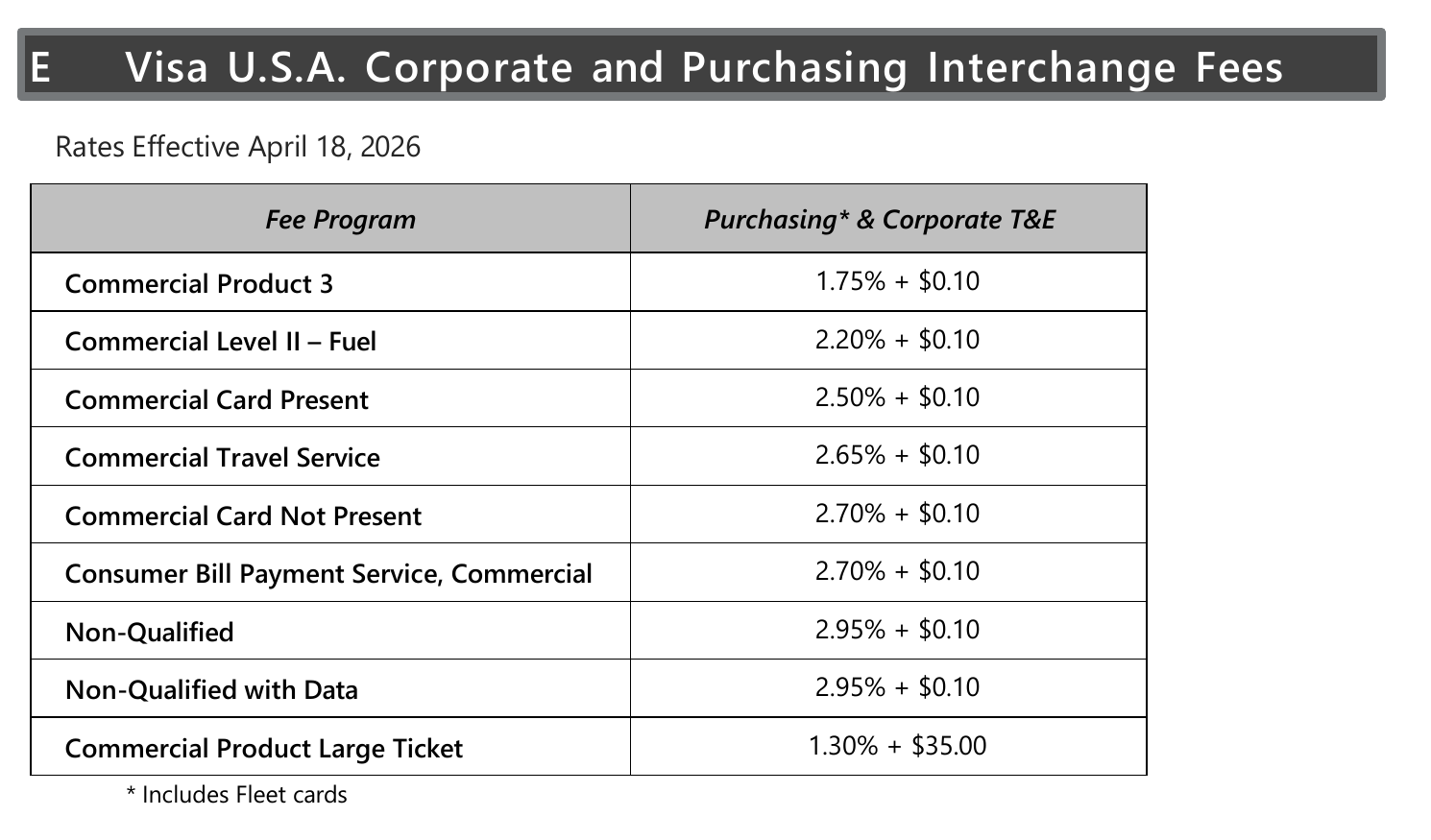
The pricing gap is why the translation matters. In Visa's U.S. Corporate and Purchasing programs table (rates effective April 18, 2026):
- Commercial Product 3 — the data-complete program — prices at 1.75% + $0.10
- Commercial Card Not Present — the same card without enhanced data — prices at 2.70% + $0.10
- The spread is 0.95 percentage points; against Non-Qualified (2.95% + $0.10) it widens to 1.20 points
Mastercard's Large Market Credit tiers price the same way (effective April 17, 2026): Data Rate I at 2.70% + $0.10, Data Rate III at 1.90% + $0.10 — a 0.80-point spread for data quality alone.
Source: Visa USA, "
" — U.S. Corporate and Purchasing programs table, rates effective April 18, 2026; accessed 2026-08-20.

Two cautions from the PDFs themselves:
- Mastercard's small-business credit table has no Data Rate III column — the enhanced-data spread mainly exists on large-market commercial cards.
- Some Mastercard tables use "Level" to name card product tiers (Business Core, Business World Elite) — a different axis from data levels entirely.
The data-quality spread per network: 0.95 points on Visa, 0.80 on Mastercard, from the networks' published April 2026 tables.
Large invoices get their own programs. Visa's Commercial Product Large Ticket prices at 1.30% + $35.00, and the straight-through processing (STP) tiers step down with size: 2.00% + $0.10 under $7,000 to 0.95% + $35 in the $50,000–$99,999 band.
Source: Visa USA, "Interchange Reimbursement Fees" (U.S. Corporate and Purchasing programs, rates effective April 18, 2026); Mastercard, "2026–2027 U.S. Region Interchange Programs and Rates" (effective April 17, 2026). Accessed 2026-08-20.
These are interchange reimbursement rates, not the supplier's total processing price. They do not guarantee a saving: eligibility depends on the card, transaction, merchant setup, program requirements, and processor support. The qualification fields live in processor documentation — your processor answers how to qualify; the network tables answer why it pays.
What It Costs to Accept B2B Payments
The cheapest way for a business to receive payments is usually ACH or another local bank transfer: flat fees don't scale with invoice size. The boundary: buyer preference, speed, and AR labor are costs too — cheap per transaction can still be expensive per hour of reconciliation.
Method | How the fee is priced |
|---|---|
ACH / wire | Flat fee, set by your bank or processor |
Check | Nominal fees; the real cost is handling labor |
Commercial and virtual cards | Percentage of volume: interchange + network assessments (the networks' own cut) + processor markup |
On card rails, interchange is the largest component and the one data quality moves; processor markup is the negotiable one. The gateway-versus-processing fee split has its own guide; interchange mechanics have theirs.
If card economics still pinch, surcharging is the other lever. In the U.S. region, both networks permit surcharges on commercial credit cards, subject to applicable law — these rules cover credit cards, not every card:
- Visa caps U.S. credit card surcharges at a flat 3.00% (rules 5.5.1.8), applied at brand level or product level — one or the other, never both; a merchant-specific cap may be lower.
- Mastercard sets its cap by formula (rules 5.12.2, U.S. Region chapter): no less than 1.8 times the sum of the average U.S. Mastercard credit interchange rate plus average network fees. Your surcharge can never exceed your own average cost of acceptance, and it must be the same on every issuer's card at whichever level — brand or product — you choose to apply it.
- Both require at least 30 days' advance written notice to your acquirer — the bank or institution that connects you to the card networks (Visa 5.5.1.5); Mastercard requires notifying Mastercard itself as well (5.12.2.4). Clear disclosure to the cardholder applies throughout.
Network rules do not override applicable law, and this is a description of the rules, not legal advice.
Source: Visa, "Core Rules and Product & Service Rules", 18 April 2026, rules 5.5.1.5–5.5.1.8; Mastercard, "Mastercard Rules", 2 June 2026, rule 5.12.2 (U.S. Region). Accessed 2026-08-20.
Cross-Border B2B Acceptance
Cross-border is where acceptance friction compounds. A buyer abroad wants the methods their finance team already uses. Route them through international wires or foreign-card acquiring and everything degrades at once: cost rises, authorizations fail more often, and remittance arrives too stripped-down to reconcile.
The structural answer is local rails: acquiring in the buyer's market and currency, over methods the buyer already trusts. HaiPay provides local receiving across 28 markets and more than 150 payment methods, with payment success rates of 85.5% or higher. Those figures are not a promise that every method is available to every merchant — the mix is market-specific.
The receiving-side payoff: fewer failed authorizations, settlement on local schemes, and payments carrying local-method remittance detail.
Explore local acquiring across 28 markets →
When Volume Changes the Rules
Onboard under a payment facilitator (payfac) instead of directly with an acquirer, and you start life as what Visa's rules call a Sponsored Merchant — the rules' term for the industry's "sub-merchant."
Visa's rules put a volume tripwire on it. Once a sponsored merchant exceeds USD 1 million in annual Visa volume, the acquirer must sign a direct merchant agreement (Visa Core Rules 5.3.1.4). The timing is an obligation, not an exemption: before any transactions for a merchant new to the facilitator, or within two years for an existing one.
Two classes of exemption exist:
- a long-tenured relationship — at least two years under the same acquirer, with regular reporting of volume, disputes, and fraud, under continued acquirer oversight
- certain merchant categories
The facilitator can continue delivering payment services, including settlement, after the direct agreement is signed.
Responsibility itself doesn't move: the acquirer remains responsible for its sponsored merchants' compliance (Visa 5.3.1.2; Mastercard's parallel rule is 7.6.5). Suppliers scaling fast should expect a direct-underwriting conversation as volume nears the threshold.
Source: Visa, "Core Rules and Product & Service Rules", 18 April 2026, rules 5.3.1.2 and 5.3.1.4; Mastercard, "Mastercard Rules", 2 June 2026, rule 7.6.5. Accessed 2026-08-20.
How Small Businesses Accept B2B Payments Fastest
For small businesses, the shortest path to B2B acceptance skips building a stack:
- Onboard under a payment facilitator. A payfac signs once with an acquirer and onboards many businesses beneath that agreement — one onboarding, not a bank's worth of underwriting. The mechanics have their own guide.
- Send invoices with payment links. A link in the invoice email lets buyers pay by card or bank transfer without a call, and the payment references the invoice number.
- Turn on virtual card acceptance. Corporate buyers' AP platforms push virtual cards whether you're ready or not; accepting them gets you paid at card speed with remittance attached.
Choosing What to Accept
The method portfolio follows three variables:
- Average ticket. Large invoices favor ACH and wire, where the fee stays flat as the amount grows. Small and recurring charges favor cards.
- Buyer type. Corporate procurement pays with commercial cards carrying Level 2/3 expectations — accept them with data-complete processing, or leave the spread on the table. Buyers abroad favor local methods.
- Internal capacity. Checks are cheap only if AR time is free, and it isn't. Price every method including its reconciliation labor.
Compare providers on the interchange programs your transactions will actually qualify for — not headline rates — plus settlement timing and how payments flow into your AR or ERP (enterprise resource planning) system. HaiPay prices card acceptance at 2.5% + $0.30 per transaction, with local receiving across 28 markets and 150+ payment methods for the cross-border part.
Merchant-of-record models, acceptance rates, and full provider evaluation have their own page: our payment acceptance guide.
Not sure which mix fits your buyer base? Contact us and we'll map it against your invoices.
Sources
- Visa USA, Interchange Reimbursement Fees — U.S. Corporate and Purchasing programs, rates effective April 18, 2026. Accessed 2026-08-20.
- Visa, Core Rules and Product & Service Rules — edition of 18 April 2026. Accessed 2026-08-20.
- Mastercard, 2026–2027 U.S. Region Interchange Programs and Rates — effective April 17, 2026. Accessed 2026-08-20.
- Mastercard, Mastercard Rules — edition of 2 June 2026. Accessed 2026-08-20.
- Mastercard, Unlock new growth in B2B acceptance — commercial payments page. Accessed 2026-08-20.
FAQ
A B2B payment is a transfer of funds from one business to another — typically a buyer settling an invoice with a supplier. B2B payment acceptance is the supplier's side of that transfer: the methods, costs, and reconciliation it takes to receive the money.
