NewsDigital Wallets
Bank Accounts: India Up 11.5 Points, the Median Country 0.7
In 2024, 78.7% of the world’s adults had an account at a bank, another financial institution or a mobile money provider, up from 73.8% in 2021. Across the 117 economies the World Bank surveyed in both rounds, the median change was 0.7 percentage points.
Key takeaways 6
- 78.7% of adults worldwide had an account in 2024, up from 73.8% in 2021, on the World Bank’s population-weighted figure.
- Across the 117 economies surveyed in both rounds, the median change was just 0.7 percentage points.
- Against a five-point threshold, 37 economies rose, 11 fell and 69 moved by less than five points either way.
- India rose from 77.5% to 89.0%, level with China; Nigeria rose 18 points and Egypt nearly 16.
- Bangladesh fell from 52.8% to 43.3%; Pakistan, at 27.3%, is the lowest of 14 large payment markets compared.
- The world gap between men and women narrowed from 4.97 to 4.22 points; women lead in 27 of 139 economies.
In 2024, 78.7% of the world’s adults had an account at a bank, another financial institution or a mobile money provider, according to the World Bank’s Global Findex survey. In 2021 it was 73.8%.
That 4.9-point rise is the headline. It is not what happened in most countries.
The typical country barely moved
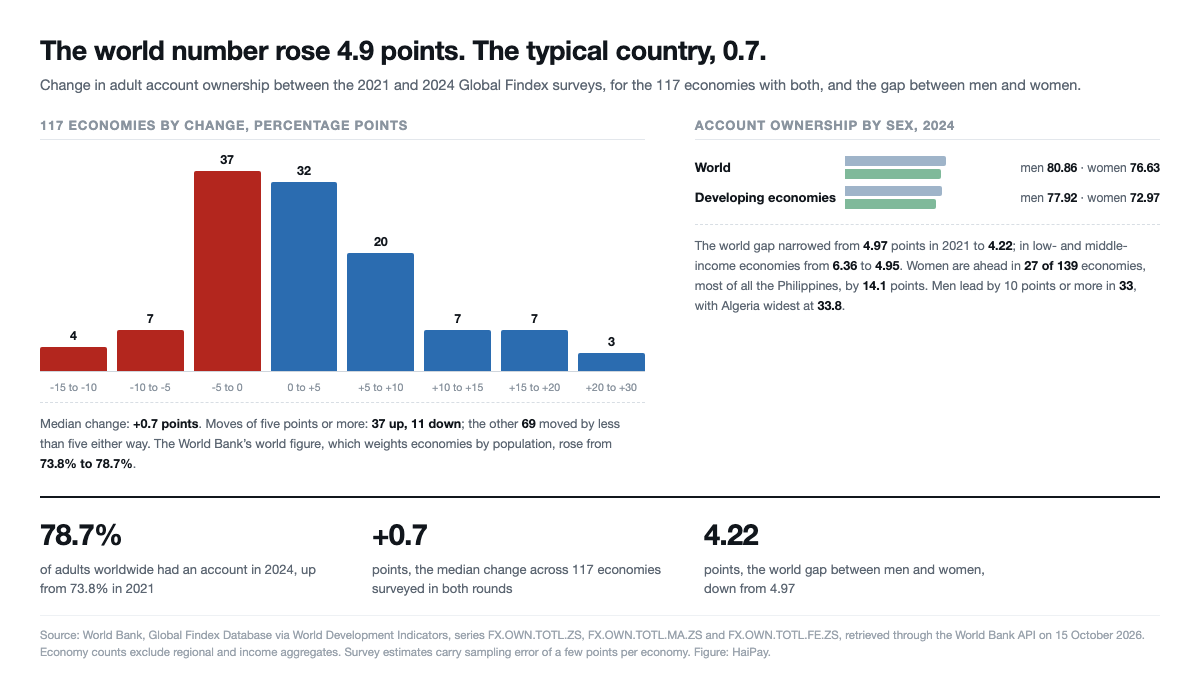
117 economies were surveyed in both 2021 and 2024. The median change between the two rounds is 0.7 percentage points.
Sixty-nine rose and forty-eight fell. But Findex figures come from surveys of about a thousand adults per country, and small changes are within the margin of error. Set the bar at five points and the picture is clearer: 37 economies rose by five or more, 11 fell by five or more, and 69 — more than half — moved by less than five points either way.
The world figure rose much more than the typical country because the World Bank weights it by population. A large move in a populous economy shifts the world number far more than the same move in a small one.
Where the big moves were
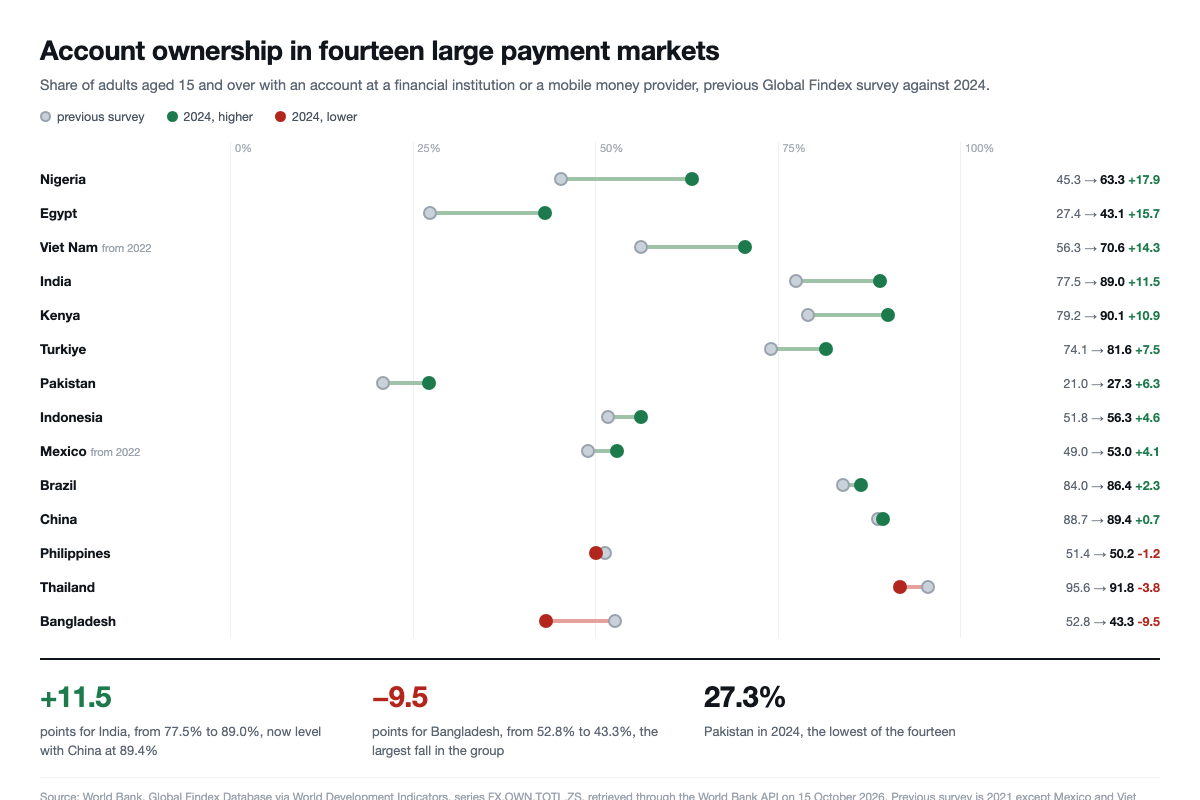
India went from 77.5% to 89.0%, an 11.5-point gain that puts it level with China at 89.4%. Kenya rose 10.9 points to 90.1%. Turkiye rose 7.5 to 81.6%.
The steepest rises in large payment markets came from lower bases: Nigeria from 45.3% to 63.3%, Egypt from 27.4% to 43.1%, and Viet Nam from 56.3% in 2022 to 70.6%. Across all 117 economies, the Kyrgyz Republic gained most, 27.2 points to 72.3%, followed by Zambia at 24.2 points and Senegal at 20.5.
Three large markets went the other way. Bangladesh fell from 52.8% to 43.3%. Thailand slipped from 95.6% to 91.8%. The Philippines was effectively flat, 51.4% to 50.2%.
And Pakistan, at 27.3%, is still the lowest of the fourteen large payment markets compared here, up from 21.0%.
The gap between men and women narrowed
Worldwide, 80.86% of men and 76.63% of women had an account in 2024, a gap of 4.22 points. In 2021 the gap was 4.97. In low- and middle-income economies it fell further, from 6.36 points to 4.95.
Women are ahead of men in 27 of the 139 economies with 2024 data. The widest lead is in the Philippines, where 57.1% of women and 43.0% of men have an account. Men lead by ten points or more in 33 economies, most of all Algeria, at 51.9% against 18.1%.
Why this matters
Account ownership is the floor under every other digital payment. A wallet, a payout or a cross-border transfer needs somewhere to land, and this survey is the only measure of that floor that covers most of the world on a consistent basis.
For payment providers the useful reading is the distribution, not the average. The world figure says growth continues. The median says that in a typical market, the share of adults who can receive a digital payment barely changed in three years — and in the markets where it did change, the moves were large enough to reshape them. Nigeria, Egypt, Viet Nam and India look materially different in 2024 from 2021. Most of the rest look the same.
What this is not
These are survey estimates, with sampling error of a few points per economy. Changes smaller than that may not be real, which is why this article reports moves against a five-point threshold as well as raw changes.
Survey timing and method can differ between rounds, and the 2021 round was fielded during the pandemic. Some of the larger falls — Italy from 97.3% to 86.0%, Poland from 95.7% to 86.1% — are in economies where near-universal account ownership is otherwise well established, and a single round-to-round drop of that size should be read with caution rather than as evidence that adults closed their accounts.
The measure records whether an adult has an account, not whether it is used. It says nothing about how often people pay or are paid digitally.
The world and developing-economy figures are the World Bank’s population-weighted aggregates, not averages computed by HaiPay. HaiPay did not contact the World Bank.
What to watch
Whether the next round confirms the large falls. If Bangladesh, Italy and Poland come back up, the 2024 drops were survey noise; if they hold, they are a story.
Whether the gains in Nigeria, Egypt and Viet Nam translate into usage. Ownership is the precondition. The next question is whether those new accounts carry payments.
And whether the median starts moving. A world figure rising on the strength of a few populous economies is a different market from one in which the typical country is gaining ground.
Data highlight
+0.7 percentage points
Median change in adult account ownership across the 117 economies surveyed by Global Findex in both 2021 and 2024, against a 4.9-point rise in the population-weighted world figure
2021 to 2024 survey rounds
Read the methodology and limitations
Methodology and limitations
Compiled by HaiPay on 15 October 2026 from the World Bank’s Global Findex Database as published in the World Development Indicators and retrieved through the World Bank API. The core series is FX.OWN.TOTL.ZS, which the World Bank defines as the percentage of respondents aged 15 and over who report having an account, alone or with someone else, at a bank or another type of financial institution, or who report personally using a mobile money service in the past 12 months. Breakdowns by sex use FX.OWN.TOTL.MA.ZS and FX.OWN.TOTL.FE.ZS.
Survey rounds in the series are 2011, 2014, 2017, 2021 and 2024, with a small number of economies surveyed in 2022 instead of 2021. Economy counts exclude the World Bank’s regional and income aggregates. 139 economies have a 2024 value and 117 have values for both 2021 and 2024; all changes between rounds use those 117 unless stated.
The world figures, 73.83 per cent in 2021 and 78.74 per cent in 2024, and the low- and middle-income figures, 69.00 and 75.45 per cent, are the World Bank’s own aggregates, which weight economies by population; they are not averages computed by HaiPay. Across the 117 economies the median change is +0.7 percentage points; 69 rose and 48 fell, but measured against a five-point threshold 37 rose by five points or more, 11 fell by five points or more and 69 moved by less than five points in either direction.
By band, 4 fell by 10 to 15 points, 7 by 5 to 10, 37 by up to 5, 32 rose by up to 5, 20 by 5 to 10, 7 by 10 to 15, 7 by 15 to 20 and 3 by 20 or more. The largest rises are the Kyrgyz Republic, 45.1 to 72.3 per cent, Zambia, 48.5 to 72.7, Senegal, 56.0 to 76.5, Panama, 45.0 to 64.1, and Nigeria, 45.3 to 63.3.
The largest falls are Bolivia, 68.9 to 56.8, Italy, 97.3 to 86.0, the Russian Federation, 89.7 to 79.3, Zimbabwe, 59.7 to 49.5, and Poland, 95.7 to 86.1.
Among large payment markets, India moved from 77.5 to 89.0 per cent, China from 88.7 to 89.4, Brazil from 84.0 to 86.4, Indonesia from 51.8 to 56.3, Kenya from 79.2 to 90.1, Turkiye from 74.1 to 81.6, Egypt from 27.4 to 43.1, Pakistan from 21.0 to 27.3, the Philippines from 51.4 to 50.2, Thailand from 95.6 to 91.8 and Bangladesh from 52.8 to 43.3; Mexico moved from 49.0 and Viet Nam from 56.3, both in 2022, to 53.0 and 70.6.
In 2024, 6 economies are at or above 99 per cent and 29 are below 50 per cent, the lowest being Niger at 14.8, Chad at 20.9, Lebanon at 23.0, Nicaragua at 23.5 and Madagascar at 24.5. By sex, the world figures are 80.86 per cent for men and 76.63 for women in 2024, a gap of 4.22 points, against 76.29 and 71.32, a gap of 4.97, in 2021; in low- and middle-income economies the gap fell from 6.36 to 4.95 points.
Women are ahead of men in 27 of the 139 economies with 2024 values, most of all the Philippines, at 57.1 per cent for women against 43.0 for men; men lead by 10 points or more in 33, most of all Algeria, at 51.9 against 18.1. Every median, count, difference and band is HaiPay’s arithmetic on the published values. Three limits apply.
Global Findex figures are estimates from nationally representative surveys of roughly a thousand adults per economy, so each carries sampling error of a few points, and changes smaller than that may not reflect real movement; this is why changes are also reported against a five-point threshold. Survey timing and method can differ between rounds, and the 2021 round was fielded during the pandemic, so a single large fall in one economy should be read with caution.
And the measure records whether an adult has an account, not whether it is used. HaiPay did not contact the World Bank.
Term definition
- Account ownership
- The Global Findex measure of the share of adults aged 15 and over with an account at a bank, another financial institution or a mobile money provider. It was 78.7 per cent worldwide in 2024.
- Global Findex
- The World Bank’s survey of how adults save, borrow, pay and manage risk, run in 2011, 2014, 2017, 2021 and 2024 with roughly a thousand respondents per economy.
- Population-weighted aggregate
- An average in which each economy counts in proportion to its population. It is why the world figure rose 4.9 points while the median economy moved 0.7.
4 sources
How to cite
HaiPay News, "Bank Accounts: India Up 11.5 Points, the Median Country 0.7", https://www.haipay.net/news/findex-2024-account-ownership-median, 15 October 2026