Adyen launches embedded finance offering for European platforms
Adyen has expanded its platform strategy in Europe with a new embedded finance offering that lets software platforms and marketplaces integrate business accounts, cards and working capital into their own interfaces. The launch targets SMEs using digital platforms and leverages Ad
June 4th, 2026
Last updated: June 4
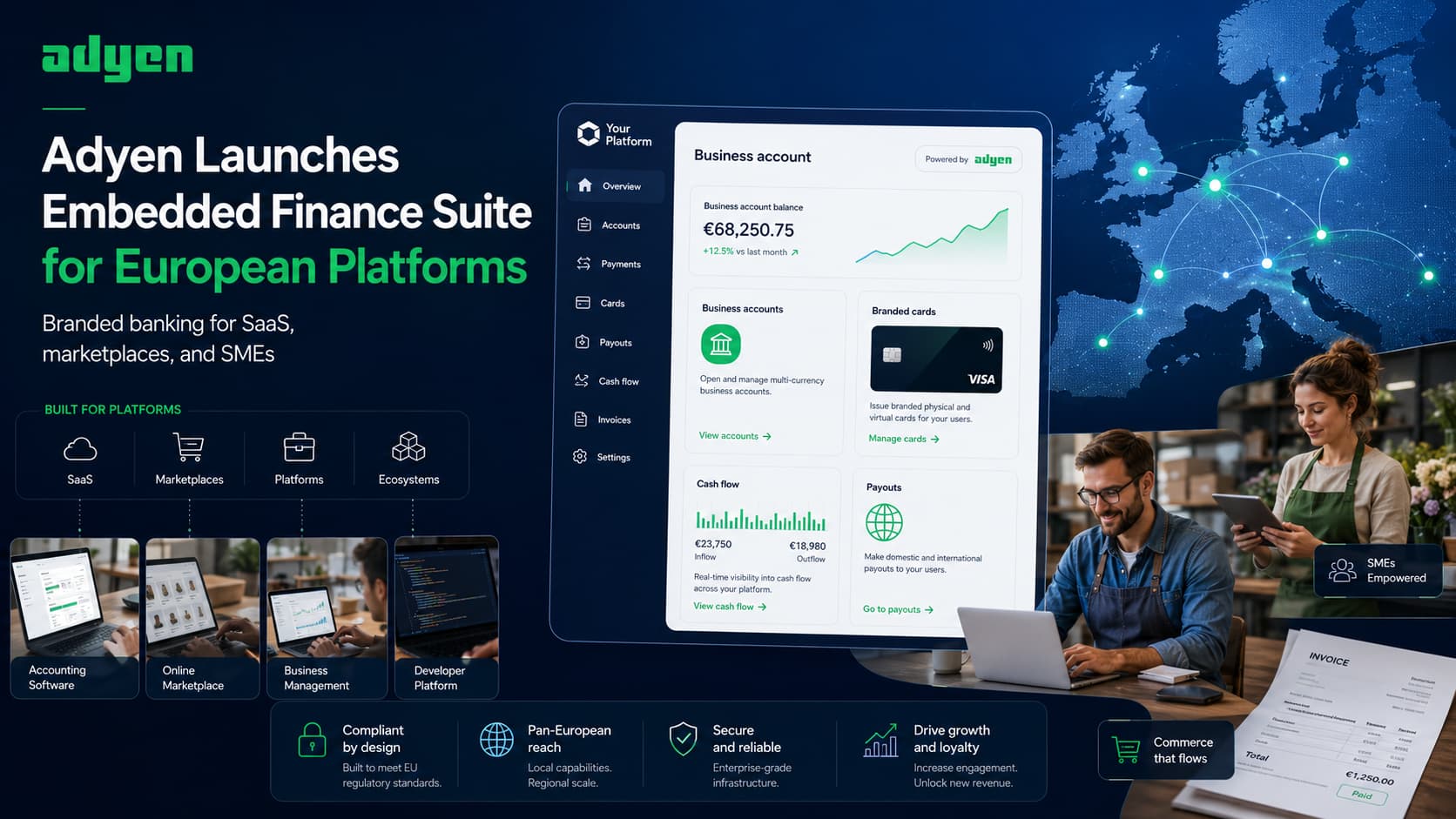
Adyen is extending its role in the European platform economy with the launch of a new embedded finance suite designed for software providers, marketplaces and other digital platforms that serve small and medium-sized businesses (SMEs), according to Finextra. The offering moves the company beyond payment processing into a broader range of financial services that can be delivered directly inside platform interfaces under the platform’s own brand.
From payments provider to financial infrastructure partner
According to Finextra, Adyen’s embedded finance proposition allows European platforms to integrate services such as business bank accounts, corporate cards and cash advances into the tools their customers already use to run day‑to‑day operations. Rather than sending users to separate banking portals, platforms can keep financial workflows inside a single environment, turning their software into a more complete financial hub for SMEs.
The move builds on Adyen’s existing embedded financial products and reflects a strategic shift toward becoming a broader financial technology partner for platforms rather than a pure payments processor. Finextra notes that the company is positioning this launch as a way for platforms to deepen customer relationships, increase retention and create new revenue streams by layering financial services onto their core software.
How the embedded finance suite works
The new suite is delivered through Adyen’s unified technology stack and is available via a single integration, according to Finextra. This means a platform can connect once to Adyen and then offer multiple financial features, instead of stitching together separate providers for accounts, cards, payouts and lending.
Within this setup, Adyen supplies the regulated infrastructure and technology, while the platform maintains the user relationship and brand presentation. Business users on a platform can:
- Open and manage business accounts within the platform interface
- Receive incoming payments into those accounts
- Store funds and manage balances
- Initiate payouts to suppliers, partners or employees
- Use cards linked to their accounts for everyday business expenses
By concentrating these functions in one connected system, Adyen aims to reduce the friction and delays that often arise when money must move between different banks, payment processors and software tools. Finextra reports that this design is intended to streamline fund flows and simplify financial management for SMEs that already rely on digital platforms to run their operations.
Regulatory footing and European focus
A key enabler of the offering is Adyen’s possession of banking and payment licences in Europe, which allows the company to operate as the regulated backbone behind the embedded services, according to Finextra. With these licences, Adyen can support account issuance, card products and capital solutions in compliance with regional requirements, while platforms avoid the burden of obtaining full banking permissions themselves.
The launch is initially focused on European platforms, aligning with Adyen’s regulatory footprint and existing customer base in the region. The embedded finance suite is aimed at:
- Software-as-a-service (SaaS) providers serving business users
- E-commerce marketplaces connecting buyers and sellers
- Other platform businesses that aggregate large numbers of SMEs and seek to offer them more integrated financial solutions
By centering the initial rollout in Europe, Adyen can leverage its local licences and infrastructure, while catering to platforms that must navigate a complex financial and regulatory environment across multiple markets.
Targeting SMEs’ demand for integrated finance
Finextra highlights that Adyen sees growing demand from SMEs to handle payments, cash management and financing inside the same tools they use for inventory, billing, customer management and other core functions. Embedding finance into these operational systems allows businesses to reduce manual steps, reconcile cash flows more easily and gain quicker access to funds and credit.
Within Adyen’s model, SMEs using a platform can treat it as their primary interface for both business management and finance. According to Finextra, the company believes this integrated approach can help platforms:
- Strengthen user loyalty by becoming more central to customers’ financial workflows
- Differentiate from competitors that offer only basic payment acceptance
- Capture additional margin from banking-like services on top of transaction processing
In turn, SMEs stand to benefit from fewer logins, less data re-entry and a more coherent view of their financial position within the software they already use daily.
Single integration to reduce complexity for platforms
A central theme in Finextra’s coverage is Adyen’s focus on reducing technical complexity for platforms. Instead of managing multiple third-party integrations for payments, accounts, cards and lending, platforms can rely on Adyen’s single technology stack. This model mirrors a broader trend in the payments and fintech sector, where providers increasingly leverage their infrastructure and licences to offer bundled, multi-product solutions.
For platforms, a single integration can lower development effort, simplify compliance coordination and streamline ongoing maintenance. It can also shorten time-to-market for new financial features, enabling platforms to respond more quickly to customer demand.
Part of a wider embedded finance and SME trend
While the secondary sources provided focus on other companies, they underline the broader momentum behind embedded and integrated financial services for European businesses.
PYMNTS.com reports that Worldline has introduced a smart routing engine to help European merchants optimize card payment costs and authorization performance by dynamically selecting the best route across different acquirers and networks. Although distinct from Adyen’s embedded finance launch, this development similarly aims to simplify the complexity of Europe’s fragmented payments landscape and improve economics for merchants.
Separately, The Paypers describes how Currencycloud has partnered with Ebury to expand cross‑border foreign exchange and collections services for European SMEs. That partnership combines Currencycloud’s embedded cross-border infrastructure with Ebury’s SME-focused platform to help businesses manage multi-currency payments and improve international cash flow.
Viewed together, these initiatives point to a wider industry shift toward platform-based financial services tailored to SMEs. Adyen’s embedded finance suite fits squarely within this pattern: it offers domestic-oriented accounts, cards and capital inside platforms, while other providers focus on optimizing transaction routing or cross-border capabilities.
Revenue potential and long-term positioning
According to Finextra, Adyen sees significant revenue potential in enabling platforms to offer banking-like services alongside payments. Embedded finance allows platforms to participate in value pools that have traditionally belonged to banks, from account balances to card spend and working capital products.
By supplying the underlying infrastructure, Adyen positions itself to benefit from this shift at scale. The company’s strategy, as described by Finextra, is to become an end‑to‑end financial technology partner that supports platforms throughout the full lifecycle of funds: from accepting payments, to holding and managing balances, to financing growth and paying out to third parties.
As demand from platform customers for more integrated financial solutions continues, Adyen’s European embedded finance launch marks a notable step in its evolution from global payments processor to a comprehensive embedded finance provider for the platform economy.
Originally reported by Finextra.
How to cite
HaiPay News, "Adyen launches embedded finance offering for European platforms", https://www.haipay.net/news/adyen-launches-embedded-finance-suite-for-european-platforms, June 4th, 2026